Who Was Swami Vivekananda?
Swami Vivekananda (1863–1902), born Narendranath Datta, was an Indian monk, philosopher, religious teacher, and one of the most influential interpreters of Vedanta in the modern era. He became one of the best-known figures associated with presenting Indian philosophical and religious ideas to audiences in the West, and his reputation today spans religious history, comparative philosophy, and modern Hindu reform movements alike.
Vivekananda was a major disciple of Sri Ramakrishna, a relationship that decisively shaped the course of his life. His intellectual and spiritual development brought together ideas drawn from Vedanta, Yoga, the Upanishadic tradition, and his own original interpretation of religion and human potential, producing a synthesis that was distinctly his own rather than a simple repetition of earlier teachings.
He became internationally famous after addressing the World's Parliament of Religions in Chicago in 1893, an event that transformed him almost overnight from a relatively unknown monk into a recognized spokesperson for Indian religious thought on the world stage. His subsequent lectures across the United States and Europe helped introduce Vedanta and Yoga to wider Western audiences, many of whom were encountering these traditions in a serious philosophical form for the first time.
Beyond his public lectures, Vivekananda also worked to translate ancient philosophical concepts into a vocabulary that educated audiences unfamiliar with Sanskrit terminology could grasp and engage with directly. This effort at "translation," in the broadest sense, made him not just a religious teacher but a genuine bridge figure between Indian and Western intellectual traditions, a role that continues to define much of his enduring legacy.
Swami Vivekananda: Quick Facts
- Birth name — Narendranath Datta
- Born — 12 January 1863
- Birthplace — Calcutta, British India
- Died — 4 July 1902
- Tradition — Vedanta and Hindu philosophical thought
- Teacher — Sri Ramakrishna
- Known for — Vedanta, Yoga, religious philosophy, spiritual thought, education, and service
- Internationally known for — His addresses at the World's Parliament of Religions in Chicago in 1893
- Major works — Raja Yoga, Karma Yoga, Jnana Yoga, and Bhakti Yoga
- Major institution associated with him — Ramakrishna Math and Ramakrishna Mission
Swami Vivekananda's Early Life and Education
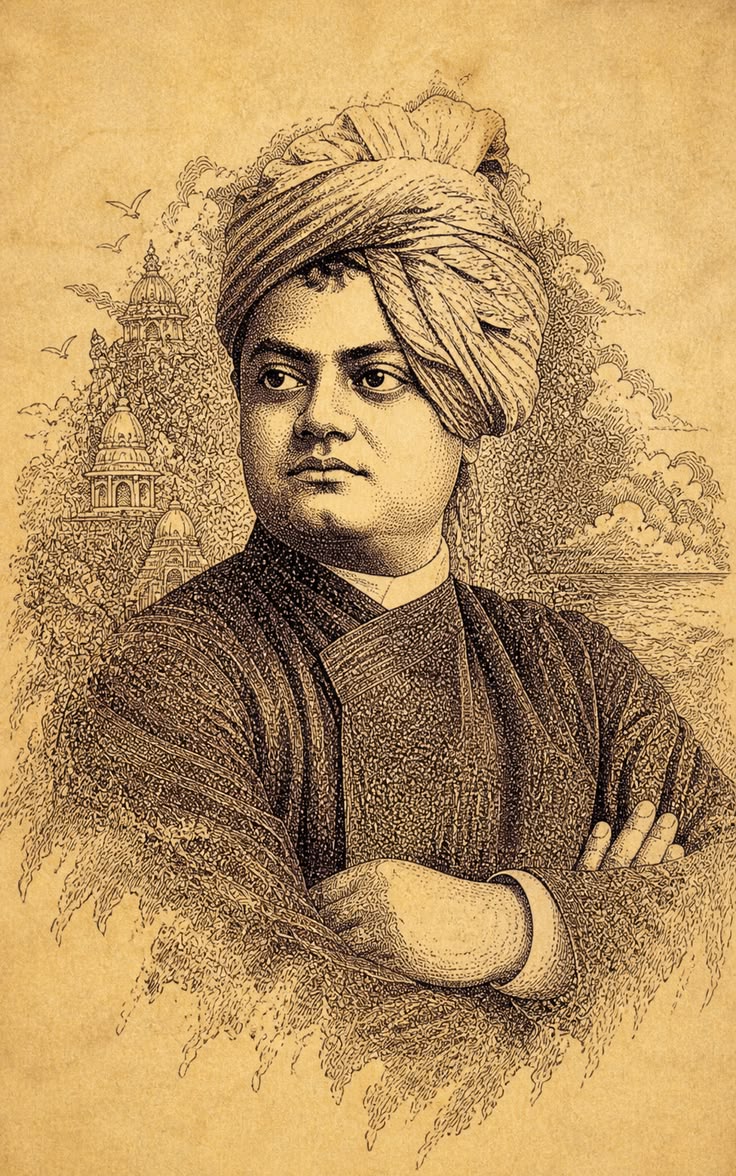
Narendranath Datta was born in Calcutta on 12 January 1863, into a family that valued education, culture, religion, and intellectual discussion, an environment that gave him early exposure to both traditional Indian learning and the modern ideas circulating in colonial Bengal. This upbringing gave him a wide-ranging curiosity that would later shape his eclectic and synthesizing approach to philosophy.
As a young man, Narendranath studied Western philosophy alongside Indian traditions and became deeply interested in fundamental questions concerning God, religion, reason, and the possibility of direct spiritual experience. He was associated for a period with the Brahmo movement, a reform-oriented religious organization that emphasized rational religion and rejected certain traditional ritual practices, reflecting his early restlessness with inherited answers to spiritual questions.
His encounter with Sri Ramakrishna became a decisive and transformative event in his intellectual and spiritual life, redirecting him away from purely rational or reformist religion and toward a tradition grounded in direct mystical experience. Under Ramakrishna's influence, Narendranath increasingly explored Vedanta, religious experience, meditation, and the possibility of realizing spiritual truth directly rather than merely accepting it on the authority of scripture or argument.
This period of searching also involved genuine doubt and testing; Narendranath is often described as having questioned Ramakrishna directly and repeatedly before accepting him as a teacher, a detail that highlights the intellectually demanding character of his spiritual formation. Far from a passive convert, he arrived at his eventual convictions only after sustained personal inquiry.
Swami Vivekananda and Sri Ramakrishna
Sri Ramakrishna was one of the most important and formative influences on Vivekananda's philosophical and spiritual development. Their relationship began when Narendranath, still searching for satisfying answers to questions about religious experience and the existence of God, sought out Ramakrishna directly, testing his claims to spiritual realization with the same critical rigor he had applied to Western philosophy.
Ramakrishna's emphasis on direct spiritual experience, rather than purely intellectual or scriptural knowledge, became particularly important to Vivekananda and shaped the experiential character of his later teaching. After Ramakrishna's death in 1886, Vivekananda and a group of his fellow disciples, facing considerable hardship, eventually formed a monastic community dedicated to preserving and continuing their teacher's spiritual legacy.
Vivekananda later developed and presented his own interpretation of Vedanta and religious universality to audiences in India and abroad, building on but also extending beyond what Ramakrishna had taught directly. His work therefore connects the intimate, experiential spiritual legacy of Ramakrishna with modern, systematized discussions of religion, philosophy, and human development, translating a guru-disciple relationship into a durable intellectual and institutional movement.
What Was Swami Vivekananda's Philosophy?
Swami Vivekananda's philosophy was strongly influenced by Vedanta, especially the Upanishadic understanding of the deeper unity underlying apparent existence. He presented Vedanta as a living philosophy capable of addressing both intense personal spiritual experience and pressing questions about human nature, rather than treating it as a purely abstract or academic system confined to scholarly debate.
A central theme in Vivekananda's thought is the idea that human beings possess a deeper spiritual nature that transcends their ordinary sense of individual, limited identity. He connected this idea closely with the Vedantic understanding of the Atman, the Self, and its ultimate relationship to Brahman, arguing that recognizing this deeper nature could radically transform how a person understands their own capabilities and worth.
Vivekananda also emphasized repeatedly that philosophy should not remain merely theoretical or confined to quiet contemplation. Spiritual ideas, in his view, ought to have direct and visible practical consequences for human life, shaping how people act, work, and relate to one another. This conviction helped shape his strong emphasis on strength, character, self-discipline, service, education, and active spiritual realization.
This practical orientation distinguished Vivekananda from many earlier interpreters of Vedanta who focused primarily on renunciation and withdrawal from worldly affairs. He instead argued that engagement with the world, when grounded in spiritual understanding, could itself become a valid and powerful form of religious practice, a position that would prove enormously influential for later reform movements in modern Hinduism.
Swami Vivekananda and Vedanta Philosophy
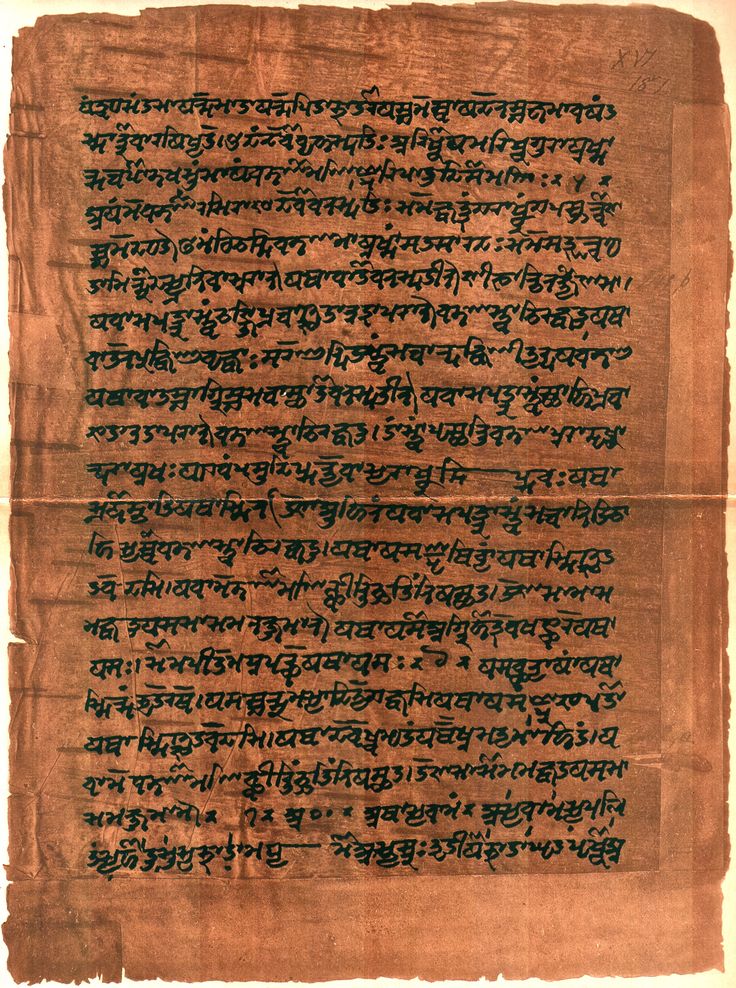
Vedanta became one of the central philosophical frameworks through which Vivekananda interpreted religion and human existence as a whole. Vedanta, as he presented it, draws heavily on the Upanishads, the Bhagavad Gita, and the Brahma Sutras, and Vivekananda treated these texts not as museum pieces but as living sources of insight relevant to modern spiritual and intellectual life.
Vivekananda frequently and forcefully emphasized the idea that the deepest nature of the human being is fundamentally spiritual rather than merely physical or psychological. He interpreted the Upanishadic conception of the Self as pointing beyond the limited identification of human beings with the body, the senses, and ordinary mental states, urging his listeners to recognize a dimension of themselves far greater than their everyday self-image.
Vivekananda's presentation of Vedanta was also deliberately intended to be practical rather than purely speculative. Rather than treating philosophy as an abstract intellectual system to be studied and debated in isolation, he actively connected Vedanta with spiritual practice, ethical action, meditation, devotion, knowledge, and service, insisting that a philosophy which changed nothing in daily life had failed at its central purpose.
This reinterpretation of Vedanta also involved a distinctive universalism: Vivekananda argued that the Vedantic vision of unity was not the exclusive property of any one religion or culture but a truth that could, in principle, be recognized and approached from many different spiritual and philosophical starting points, a claim that underpinned much of his later teaching on religious tolerance.
What Is Practical Vedanta According to Vivekananda?
One of the most distinctive and influential features of Vivekananda's thought is his emphasis on Practical Vedanta. He sought deliberately to connect abstract Vedantic ideas about the underlying unity and spiritual nature of existence with the concrete details of everyday human conduct, refusing to let philosophy remain confined to monastic seclusion or scholarly discussion alone.
In this approach, recognizing spiritual unity at the metaphysical level should directly influence how people treat one another in ordinary life, since seeing the same underlying reality in every being naturally undermines selfishness and indifference toward others. Service, compassion, self-discipline, and dedicated work can therefore become genuine expressions of spiritual understanding rather than separate, secondary activities.
Practical Vedanta helped Vivekananda forge a strong and lasting connection between philosophical ideas and pressing social and ethical concerns of his own time, including poverty, education, and social reform in India. His interpretation of spirituality was therefore never limited to meditation or private religious experience alone, but extended outward into active engagement with the conditions of ordinary human life.
This emphasis also carried institutional consequences, since Practical Vedanta provided the philosophical justification for the extensive charitable and educational work later undertaken by the organizations Vivekananda founded, ensuring that his ideas did not remain merely rhetorical but were translated into sustained, organized action across generations.
Swami Vivekananda and the Philosophy of Yoga
Yoga was another major and carefully developed component of Vivekananda's philosophical teaching, standing alongside Vedanta as one of the two great pillars of his thought. He presented Yoga as a systematic, disciplined approach to spiritual development and self-realization, grounded in classical Indian sources rather than invented anew for Western audiences.
His writings and lectures discussed several traditional approaches to spiritual practice in considerable depth, including Raja Yoga, Karma Yoga, Jnana Yoga, and Bhakti Yoga, treating each as a legitimate and complete path suited to different temperaments rather than ranking one above the others as inherently superior.
Vivekananda's presentation of Yoga was considerably broader than the modern popular association of yoga primarily with physical postures and exercise. His discussions instead emphasized meditation, sustained concentration, ethical discipline, rigorous knowledge, heartfelt devotion, and ultimate spiritual realization, presenting yoga as a comprehensive science of the mind and spirit rather than a purely physical practice.
What Are the Four Yogas in Vivekananda's Philosophy?
Raja Yoga
Raja Yoga emphasizes the disciplined training of the mind, sustained concentration, meditation, and the gradual development of higher states of consciousness through systematic practice. Vivekananda's presentation draws substantially on the classical Yoga tradition associated with Patanjali, reframing its technical vocabulary in terms accessible to a modern audience without abandoning its philosophical depth.
Karma Yoga
Karma Yoga is the path of action, and Vivekananda presented selfless work as a genuine and powerful means of spiritual development when that action is performed without attachment to personal reward or recognition. This path allowed him to argue that ordinary work in the world, far from being an obstacle to spiritual life, could itself become a form of worship.
Jnana Yoga
Jnana Yoga is the path of knowledge, and it involves sustained philosophical inquiry into the nature of the Self, ultimate reality, and the ignorance that obscures their true relationship. Vivekananda treated this path as demanding considerable intellectual rigor, well suited to those with a strongly reflective and analytical temperament.
Bhakti Yoga
Bhakti Yoga is the path of devotion, and Vivekananda explored heartfelt devotion to the divine as a genuine and complete path toward spiritual realization, equal in validity to the paths of knowledge and action. He presented this path as especially suited to emotionally oriented temperaments seeking a direct, loving relationship with the divine.
Swami Vivekananda's Chicago Speech of 1893
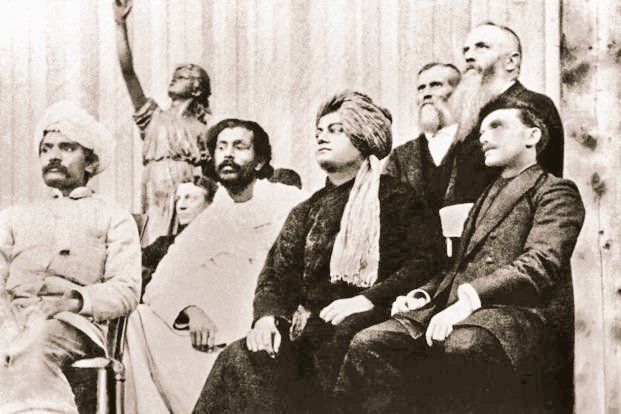
One of the single most defining events in Vivekananda's public life was his participation in the World's Parliament of Religions in Chicago in September 1893, an unprecedented gathering that brought representatives of many of the world's major religious traditions together on a single stage for the first time. The event itself was organized as part of the World's Columbian Exposition and drew delegates from Christianity, Judaism, Islam, Buddhism, and several other traditions, making Hinduism's presence there historically significant in its own right.
His opening address at the Parliament began with the now-famous greeting "Sisters and brothers of America." This simple phrase reportedly drew a lengthy standing ovation from an audience unaccustomed to being addressed with such warmth and familiarity, and the speech went on to develop themes of religious tolerance, mutual acceptance, and the distinctive contribution of Indian religious thought to global discussions of religion. Later accounts describe the audience's reaction as unusually immediate and emotional for what was, at the time, an unscripted address.
Vivekananda's appearances at the Parliament, and his subsequent lectures across the country, helped establish him almost overnight as an important and credible representative of Indian religious and philosophical thought to Western audiences, many of whom had previously encountered only distorted or dismissive accounts of Hinduism through colonial-era writing. Newspapers of the period took particular notice of him, further amplifying his reach well beyond the audience physically present at the Parliament.
The Chicago address also had lasting consequences for how Vedanta would be received in the decades that followed, since it opened doors to lecture invitations, personal introductions, and eventually the founding of Vedanta societies across the United States. In this sense, the 1893 speech functioned not merely as a single memorable moment but as the starting point of an entire subsequent chapter of Vivekananda's public life and teaching career in the West.
Vivekananda's Philosophy of Religion and Religious Unity
Vivekananda argued that the world's religious traditions could be understood as different, culturally shaped approaches to a common underlying spiritual truth rather than as mutually exclusive, competing claims to exclusive validity. His presentation of Vedanta emphasized tolerance and the genuine possibility of recognizing real value in religious paths quite different from one's own, treating this recognition as a mark of spiritual maturity rather than doctrinal compromise.
His philosophy, however, did not simply assert that all religions were identical or interchangeable, a simplification sometimes attributed to him inaccurately. Instead, he emphasized a broader spiritual unity underlying diverse traditions while still fully recognizing meaningful differences in their doctrines, practices, and historical development, resisting an easy flattening of religious diversity into sameness that would have ignored real theological distinctions.
This carefully balanced approach became one of the most recognizable and widely cited features of Vivekananda's public teaching, and it contributed substantially to his lasting reputation as an important figure in the history of interreligious dialogue, one whose ideas continue to be invoked in contemporary discussions of religious pluralism. His framing offered a model for engaging other traditions respectfully without abandoning one's own convictions.
This vision of unity in diversity was not simply an abstract theological position for Vivekananda but something he consistently modeled in his own conduct, engaging respectfully with Christian clergy, Jewish thinkers, and representatives of other Eastern traditions throughout his time in the West. His example demonstrated that genuine conviction and genuine openness to other paths were not, in his view, mutually exclusive commitments.
Vivekananda's Ideas About the Self and Human Potential
Vivekananda's understanding of human nature was closely and deliberately connected with Vedantic philosophy. He emphasized repeatedly that human beings should not be understood only as physical organisms shaped by biology or as limited personalities defined by circumstance, but as beings with a far deeper and more expansive nature that ordinary self-perception tends to obscure entirely.
The concept of the Atman, or Self, played a central role in this perspective. Vivekananda presented the deeper Self as fundamentally spiritual rather than merely physical or psychological, arguing that recognizing this true nature could fundamentally change a person's sense of their own limits and possibilities, replacing habitual self-doubt with a settled inner confidence.
This understanding led him to place considerable emphasis on human dignity, self-mastery, courage, and the genuine possibility of spiritual realization available to every individual regardless of background. His philosophy therefore placed substantial weight on developing character and actively realizing one's deeper nature, rather than treating spiritual potential as reserved for a select few set apart by birth or circumstance.
Importantly, this teaching was not intended as abstract comfort but as a call to concrete transformation, since Vivekananda repeatedly insisted that believing in one's own deeper divinity should translate directly into greater courage, greater self-respect, and a reduced tolerance for weakness or excuse-making in daily conduct. He treated this shift in self-understanding as the necessary first step toward every other form of personal and spiritual growth he taught.
Swami Vivekananda on Service, Ethics, and Humanity
Service became a major and highly visible practical expression of Vivekananda's philosophy. His understanding of underlying spiritual unity encouraged an approach to human relationships grounded in compassion and shared responsibility rather than narrow self-interest or indifference toward the suffering of others, treating every act of genuine service as an act of worship in its own right.
Vivekananda's thought closely connected spiritual development with concrete action in the world, refusing to separate inner realization from outer conduct. This connection is particularly visible in his interpretation of Karma Yoga, in which ordinary work can become a genuine spiritual discipline when it is performed without selfish attachment to its results or recognition, transforming even mundane labor into a form of practice.
His emphasis on service later became an important and lasting part of the institutional work associated with the Ramakrishna Mission, translating a philosophical principle into sustained programs of education, healthcare, and relief that continue to operate to this day, carrying his practical vision of spirituality forward into concrete social action across generations of followers.
Vivekananda often expressed this ethic memorably, framing service to the poor and suffering as service to God directly present in human form rather than as a separate, secondary charitable duty. This framing gave his followers a powerful motivational language for humanitarian work, one grounded in Vedantic metaphysics rather than in obligation or pity alone.
Swami Vivekananda's Philosophy of Education
Vivekananda regarded education as vitally important for the development of character and human potential alike. He did not view education as simply the accumulation of facts or information to be memorized and reproduced, but as a process aimed at drawing out capacities already present within the learner rather than imposing knowledge from the outside.
His educational thought emphasized the development of inner strength, confidence, discipline, character, and the practical ability to realize one's own capacities in the world, rather than treating academic achievement as an end in itself disconnected from personal growth or moral formation.
This emphasis on character formation is closely connected with his broader philosophical view that education should help individuals become capable, self-directed, and genuinely aware of their deeper potential, preparing them not merely for employment but for a fuller and more purposeful life shaped by self-knowledge.
Vivekananda was also critical of educational systems that produced knowledgeable but timid or dependent individuals, arguing that true education should instill self-reliance and initiative alongside intellectual training. This concern for practical, character-building education later influenced institutions connected with the Ramakrishna Mission, which combined academic instruction with moral and physical development.
Why Did Vivekananda Emphasize Strength and Character?
Strength is a recurring and insistent theme throughout Vivekananda's teachings. He regarded weakness, fear, and lack of confidence as serious obstacles to both personal and spiritual development, and he frequently urged his listeners, particularly young people in India, to cultivate courage and self-belief above ritual observance alone.
His emphasis on strength should be understood within his broader philosophical framework rather than in isolation. For Vivekananda, genuine spiritual realization was never intended to produce passivity, withdrawal, or indifference toward the challenges of life, a misreading of renunciation he explicitly rejected as a distortion of authentic spiritual teaching.
Instead, he closely connected spiritual awareness with courage, disciplined action, self-control, and active service to others, insisting that true spirituality should make a person more capable and engaged with the world, not less. This combination of strength and spirituality became one of his most quoted and influential teachings, often repeated in modern Indian public discourse.
He famously encouraged practical exercises of will and body alongside spiritual discipline, at times suggesting that physical courage and vigor could serve as a foundation for higher spiritual striving rather than standing opposed to it. This unusually robust, almost athletic vision of spirituality set him apart from more purely ascetic or otherworldly interpretations of renunciation common in his time.
Swami Vivekananda's Ideas About India
Vivekananda strongly and repeatedly emphasized the intellectual and spiritual traditions of India as a source of genuine contribution to world civilization. He regarded Indian philosophical traditions, especially Vedanta, as important and valuable contributions to humanity's wider search for spiritual knowledge, deserving serious engagement rather than dismissal by either Indian or Western critics.
At the same time, his thought included strong and genuine concern for the social and educational condition of Indian society during his own lifetime, a period marked by colonial rule and widespread poverty. He emphasized the urgent need for education, inner strength, social organization, and dedicated service among his fellow countrymen as preconditions for national revival.
His interpretation of Indian philosophy therefore combined profound spiritual thought with a strong, practical concern for human development and social responsibility, refusing to treat India's philosophical heritage as separate from its pressing contemporary social needs or as an excuse for passivity in the face of them.
Vivekananda also urged Indians to take pride in their own civilization without becoming complacent, calling for a renewal that combined respect for tradition with active reform of social practices he considered harmful or outdated. This dual message, honoring heritage while demanding change, became a defining feature of his appeal to Indian audiences of his time and to later generations.
Swami Vivekananda's Influence in the West
After the Chicago Parliament of Religions, Vivekananda spent several years teaching and lecturing extensively in the United States and Europe, building on the attention his Chicago address had generated. His lectures introduced many Western audiences, often for the first time, to his particular interpretation of Vedanta and Yoga presented in clear, accessible language.
His Western teaching contributed directly to the development of Vedanta societies and related institutions that continued to present Indian philosophical ideas outside India long after his own lecture tours had ended, establishing an institutional foundation that outlasted his relatively short life and continues to operate in several countries today.
His influence is therefore significant not only within modern Indian intellectual history but also within the broader history of the transmission of Indian religious and philosophical ideas to the modern West, making him a genuinely transnational figure whose impact crossed multiple continents and cultures well beyond his own lifetime.
Vivekananda's Western lectures also attracted a number of dedicated students and disciples who went on to support and extend his work, including figures who helped establish and sustain Vedanta centers long after his return to India and eventual death in 1902. This network of Western students played a meaningful role in ensuring that his teachings did not remain confined to a single lecture tour but took root as an ongoing institutional presence.
Books and Major Works of Swami Vivekananda
Vivekananda's writings and lectures were later collected in the Complete Works of Swami Vivekananda, a substantial multi-volume set that remains the primary source for studying his thought today. These volumes contain lectures, speeches, letters, essays, recorded conversations, poems, and other writings spanning the full range of his public and private intellectual activity.
Raja Yoga
Raja Yoga presents Vivekananda's detailed interpretation of Yoga, especially meditation, concentration, mental discipline, and the gradual path toward spiritual realization, drawing systematically on classical sources while addressing a modern readership.
Karma Yoga
Karma Yoga explains the philosophical significance of action and selfless work, exploring how ordinary activity can be transformed into a genuine spiritual discipline through the right inner attitude.
Jnana Yoga
Jnana Yoga explores the path of knowledge and sustained philosophical inquiry into the nature of the Self and ultimate reality, presenting a rigorous intellectual approach to spiritual realization.
Bhakti Yoga
Bhakti Yoga examines devotion as a complete and valid path of spiritual realization, exploring the emotional and relational dimensions of approaching the divine.
Chicago Addresses
His addresses at the World's Parliament of Religions in Chicago in 1893 are among his most historically significant public speeches, remembered both for their content and for the cultural moment they represented.
Swami Vivekananda and the Ramakrishna Mission
Vivekananda established the Ramakrishna Mission in 1897, naming it after his own teacher as a lasting tribute to the spiritual foundation on which his own work rested. The organization developed a distinctive model that combined disciplined spiritual life with organized, practical service to society.
Its activities have included education, healthcare, disaster relief work, and numerous other forms of social service, carried out alongside the continued teaching and practice of Vedanta, reflecting Vivekananda's conviction that spiritual life and worldly service belonged together rather than in separate spheres.
The institutional legacy of Vivekananda is therefore closely and permanently connected with his central philosophical idea that spiritual life should be expressed through practical work and genuine service to humanity, an idea the Mission continues to embody more than a century after its founding.
Swami Vivekananda's Main Philosophical Ideas
Vivekananda's thought contains several interconnected themes that together help explain his lasting importance in modern Indian philosophy and religious thought, each reinforcing and building upon the others rather than standing as isolated doctrines.
Vedanta and the Spiritual Nature of Humanity
Vivekananda emphasized the spiritual dimension of human existence and interpreted Vedanta as a philosophy centered on the deeper, more expansive Self underlying ordinary identity.
Practical Spirituality
He argued forcefully that spiritual ideas should directly influence practical life, everyday conduct, meaningful work, and relationships with others.
Yoga as a Path to Realization
Vivekananda presented different forms of Yoga as disciplined, well-defined paths toward spiritual development suited to different temperaments.
Religious Tolerance and Unity
He emphasized the genuine possibility of recognizing truth and value across different religious traditions without collapsing their meaningful differences.
Service to Humanity
Service became a central and practical expression of his understanding of underlying spiritual unity among all beings.
Education and Character
Vivekananda emphasized education as a powerful means of developing character, confidence, strength, and untapped human potential.
What Is Historically Certain About Vivekananda?
Vivekananda left behind a substantial and well-preserved body of lectures, writings, letters, and recorded recollections from those who knew him, making his intellectual legacy considerably more directly documented than that of many ancient or medieval philosophers whose ideas survive only in fragments.
Well-Documented
- Vivekananda was born as Narendranath Datta in Calcutta in 1863.
- He became a disciple of Sri Ramakrishna.
- He participated in the World's Parliament of Religions in Chicago in 1893.
- He later lectured extensively in the United States and Europe.
- His writings include works on Raja Yoga, Karma Yoga, Jnana Yoga, and Bhakti Yoga.
- He established the Ramakrishna Mission in 1897.
Important Interpretive Considerations
- Vivekananda's presentation of Vedanta should be understood as his modern interpretation of a much older philosophical tradition.
- His teachings combine philosophical, religious, ethical, and practical concerns rather than forming a narrowly academic system.
- Popular quotations attributed to Vivekananda should be checked against his actual writings or documented speeches before being treated as authentic.
Vivekananda's Famous Chicago Address
“Sisters and brothers of America.”
Why Is Swami Vivekananda Important Today?
Swami Vivekananda remains an important and widely studied figure in the history of modern Indian philosophy because he presented Vedanta and Yoga in forms capable of genuinely engaging modern audiences both in India and abroad, translating ancient concepts into a living, applicable philosophy rather than a purely historical curiosity.
His thought also connected spiritual philosophy directly with pressing questions about education, character, service, social responsibility, religious pluralism, and human potential, refusing to treat these as separate from genuine spiritual life. This integration remains one of the most cited reasons for his continuing relevance.
His influence extends well beyond any single philosophical school or religious tradition. He is studied today in connection with Vedanta, Yoga, modern Hindu reform movements, comparative religion, Indian intellectual history, and the broader global transmission of Indian philosophical ideas, ensuring his continued presence across multiple academic and spiritual disciplines.
Swami Vivekananda's Philosophy Explained Simply
In simple terms, Vivekananda believed that human beings possess a deeper spiritual nature hidden beneath their ordinary sense of self, and that genuinely recognizing this nature should transform the way people live, work, and treat one another rather than remaining a private or abstract belief.
He presented Vedanta as a philosophy of underlying spiritual unity and taught that different paths, including knowledge, devotion, meditation, and selfless action, could each contribute to spiritual realization depending on a person's own temperament and inclination, rather than insisting that everyone follow a single fixed route.
- Philosophical tradition: Vedanta and modern Indian philosophical thought.
- Central concern: The spiritual nature of humanity and realization of the Self.
- Major teaching: Spiritual philosophy should be expressed through practical life and action.
- Major paths: Jnana Yoga, Bhakti Yoga, Karma Yoga, and Raja Yoga.
- Major public event: World's Parliament of Religions, Chicago, 1893.
- Legacy: A major modern interpreter of Vedanta and Indian spiritual philosophy.
Frequently Asked Questions About Swami Vivekananda
Who was Swami Vivekananda?
Swami Vivekananda was an Indian monk, philosopher, religious teacher, and major modern interpreter of Vedanta. He was born Narendranath Datta in 1863 and became a disciple of Sri Ramakrishna.
What was Swami Vivekananda's philosophy?
Vivekananda's philosophy was strongly influenced by Vedanta and emphasized the spiritual nature of humanity, self-realization, practical spirituality, religious understanding, and service.
What did Swami Vivekananda believe?
Vivekananda believed that human beings have a deeper spiritual nature and emphasized the possibility of spiritual realization through knowledge, devotion, meditation, and selfless action.
What is Swami Vivekananda famous for?
Vivekananda is especially famous for his speeches at the World's Parliament of Religions in Chicago in 1893 and for presenting Vedanta and Yoga to wider audiences in India and the West.
What did Vivekananda say in Chicago in 1893?
Vivekananda's first address at the Parliament of Religions began with the famous greeting "Sisters and brothers of America." His speeches discussed religious tolerance, acceptance, and Indian religious thought.
What is Vivekananda's connection with Vedanta?
Vivekananda was one of the most influential modern interpreters of Vedanta. He presented Vedantic ideas concerning the Self, ultimate reality, spiritual realization, and religious universality to audiences in India and abroad.
What are the four Yogas according to Vivekananda?
Vivekananda discussed four major paths: Jnana Yoga, the path of knowledge; Bhakti Yoga, the path of devotion; Karma Yoga, the path of selfless action; and Raja Yoga, the path emphasizing mental discipline and meditation.
What is Practical Vedanta?
Practical Vedanta refers to applying Vedantic spiritual principles to everyday life. In Vivekananda's presentation, spiritual understanding should influence conduct, work, relationships, and service to others.
Who was Vivekananda's guru?
Sri Ramakrishna was Vivekananda's principal spiritual teacher and had a profound influence on his philosophical and spiritual development.
What books did Swami Vivekananda write?
Major works associated with Vivekananda include Raja Yoga, Karma Yoga, Jnana Yoga, and Bhakti Yoga. His lectures, speeches, letters, and other writings were later collected in the Complete Works of Swami Vivekananda.
Did Swami Vivekananda introduce Yoga to the West?
Vivekananda was an important early figure in presenting Yoga, particularly its philosophical and meditative dimensions, to Western audiences. It is more accurate to describe him as a major popularizer and interpreter rather than as the sole person who introduced Yoga to the West.
Why is Swami Vivekananda important in Indian philosophy?
Vivekananda is important because he developed a modern presentation of Vedanta and connected philosophical and spiritual ideas with education, character, service, religion, and human development.
Related Indian Philosophers and Thinkers
Vivekananda belongs to a broad history of Indian philosophical and spiritual thought. Explore other major thinkers associated with Vedanta, Buddhism, Jainism, Indian political thought, and modern Indian philosophy.
Philosophy Branches Connected to Swami Vivekananda
Vivekananda's thought connects with several major areas of philosophical inquiry, particularly metaphysics, philosophy of religion, ethics, and the philosophical study of consciousness and the self.
Why Swami Vivekananda Still Matters
Swami Vivekananda occupies an important place in modern Indian intellectual history because he presented Indian philosophical ideas to a rapidly changing modern world.
His interpretation of Vedanta emphasized the spiritual nature of humanity, while his teachings on Yoga, education, character, and service gave those philosophical ideas a practical dimension.
His legacy continues through his writings, the institutions associated with the Ramakrishna tradition, and the continuing study of Vedanta, Yoga, comparative religion, and modern Indian philosophy.
Explore Great Philosophers