Born out of centuries of war and political collapse, Chinese
philosophy asked a relentlessly practical question: how should people
live together, and how should a fractured world be governed?
Introduction
Classical Chinese philosophy developed during one of the most turbulent
periods in China's early history, when the weakening of Zhou authority
and centuries of warfare forced thinkers to confront urgent questions
about human nature, political order, education, morality, and the
conditions of social stability. Compared with some ancient philosophical
traditions, early Chinese thought often placed practical questions at
its center: how should a person cultivate character, how should a ruler
govern, and what kind of social order allows human beings to flourish?
Yet ancient Chinese philosophy was not concerned only with politics or
social ethics. Thinkers also investigated the nature of reality, the
relationship between language and the world, the patterns governing
change, the limits of knowledge, and humanity's place within the larger
processes of Heaven and nature. Concepts such as the
Dao, yin and yang,
qi, and the
Mandate of Heaven connected questions about individual
conduct with wider visions of the cosmos.
This page traces the development of ancient Chinese philosophy through
the competing traditions that flourished during the Spring and Autumn
and Warring States periods. It begins with the moral cultivation and
social order proposed by
Confucianism,
the natural and spontaneous way of life associated with
Daoism, and the
institutional approach to power developed by
Legalism.
The story then expands beyond these three famous traditions to include
Mohism, debates about language and logic associated with the School of
Names, cosmological theories of yin and yang and the Five Phases, and
the wider intellectual competition remembered as the
Hundred Schools of Thought. Together these traditions
created one of the great periods of philosophical innovation in world
history, producing ideas that continued to shape China and East Asia for
more than two thousand years.
Ancient Chinese philosophy therefore cannot be reduced to a single
answer to the problem of human life. Confucian thinkers emphasized
virtue, education, family relationships, and responsible government;
Daoist texts questioned excessive striving and artificial social
conventions; Legalists focused on institutions and political power;
while Mohists searched for objective standards capable of promoting the
welfare of society. Their disagreements created a sustained
philosophical conversation about how people should live together and how
a fractured world might be governed.
Timeline at a Glance
c. 1046 BCE
The Zhou dynasty begins and develops the doctrine of the Mandate of
Heaven
770 BCE
Zhou authority weakens — the Spring and Autumn period begins
551–479 BCE
Traditional dates of Confucius
c. 5th–3rd centuries BCE
Mohism, Daoism, Confucianism, and other philosophical traditions
flourish
475–221 BCE
Warring States period — the Hundred Schools of Thought reach their
greatest influence
c. 280–233 BCE
Life of Han Feizi, one of the major theorists associated with
Legalism
221 BCE
Qin unifies China and brings the Warring States period to an end
2nd century BCE
Confucian learning gains increasing importance within the Han
imperial order
🏺 China Before the Hundred Schools
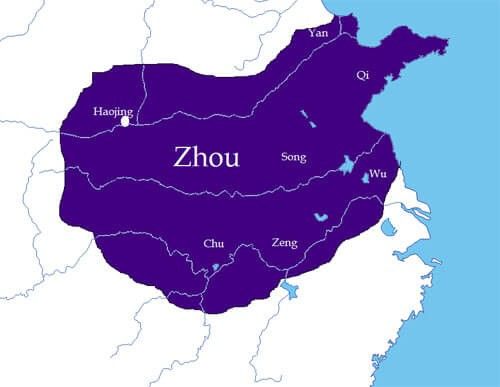
The Zhou political order linked kings, regional rulers, ritual
traditions, and the belief that legitimate government depended on
Heaven's approval.
Before the great outpouring of philosophy in the Spring and Autumn and
Warring States periods, much of northern China was governed, at least in
principle, by the Zhou dynasty, which began around the middle of the
eleventh century BCE. Zhou political culture developed around networks
of regional rulers, kinship relationships, inherited status, and ritual
obligations. The political order was never simply a centralized state in
the modern sense, but it provided an influential framework through which
later Chinese thinkers understood authority, hierarchy, and social
responsibility.
One of the Zhou dynasty's most enduring political ideas was the
Mandate of Heaven. According to this conception,
political legitimacy was not guaranteed forever by bloodline alone.
Heaven could withdraw its support from a ruler who governed disastrously
or unjustly, allowing another house to claim legitimate authority. This
idea connected political success with moral responsibility and gave
later philosophers a powerful vocabulary for discussing the duties of
rulers and the reasons dynasties rise and fall.
By the eighth century BCE, Zhou royal authority had weakened
significantly. Regional states increasingly acted independently,
competed for territory, and formed shifting alliances. The period from
roughly 770 to 476 BCE, conventionally called the
Spring and Autumn period, witnessed both political
fragmentation and major social transformation. Warfare, diplomacy,
agricultural development, and the growth of new administrative systems
created a world in which inherited customs could no longer guarantee
political stability.
The crisis intensified during the Warring States period
(traditionally dated 475–221 BCE). Rival states became larger, more
centralized, and increasingly capable of mobilizing armies, taxation,
and administration. Rulers sought advisers who could explain how to
strengthen a state, educate officials, improve agriculture, organize
society, or avoid political collapse. Philosophy became closely
connected with the practical problems of survival in an intensely
competitive political environment.
It was within this atmosphere that the extraordinary intellectual
flowering later remembered as the
Hundred Schools of Thought took place. The phrase does
not mean that there were literally one hundred perfectly separate
institutions. Rather, it describes the remarkable diversity of teachers,
texts, disputers, advisers, and intellectual traditions that proposed
competing answers to the problems of human nature, morality, language,
knowledge, government, war, and the structure of the cosmos.
1️⃣ Confucianism
Confucius and the Cultivation of Virtue
Confucius taught that lasting social order begins with the moral
cultivation of human beings, especially those entrusted with political
authority.
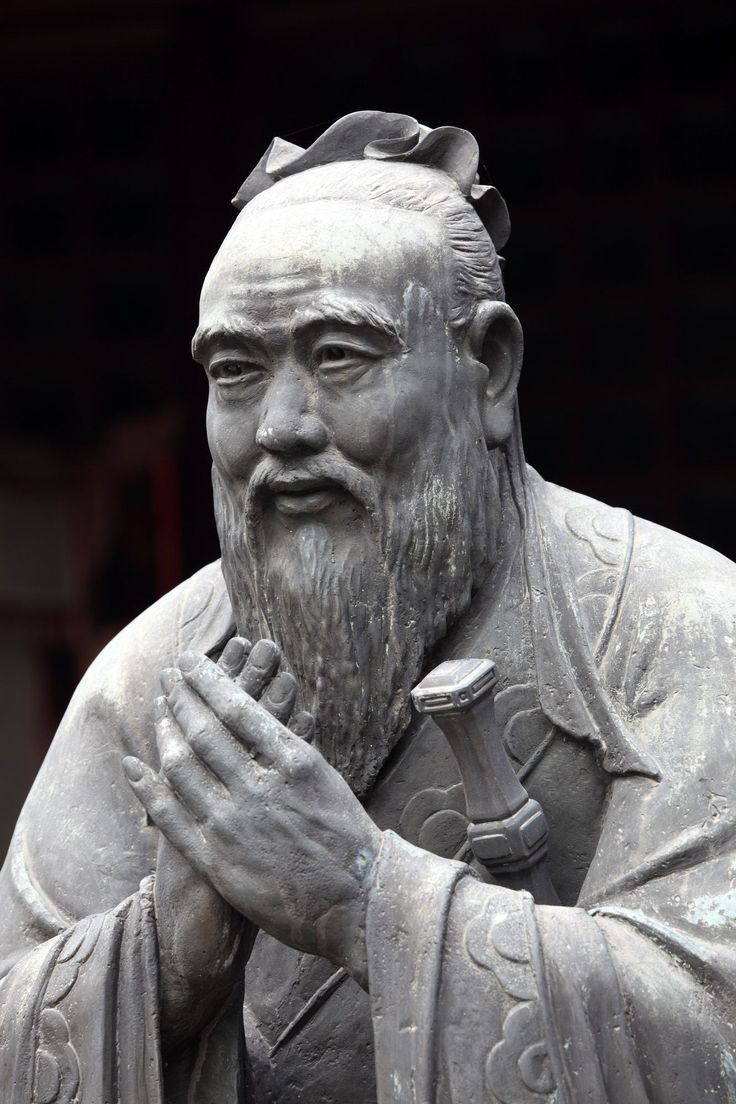
Confucius, known in Chinese as Kong Qiu or Kongzi and traditionally dated
551–479 BCE, lived during the Spring and Autumn period, when the older
Zhou political order was visibly weakening. Later tradition describes
him as having worked in government before devoting himself to teaching
and traveling among different states in search of rulers willing to
adopt his political ideas. Whether every detail of these later accounts
is historically certain, Confucius became the central figure of a
tradition that transformed Chinese ethics, education, and political
philosophy.
Confucius left no philosophical treatise that can confidently be
regarded as his own composition. His teachings are preserved primarily
in the
Analects, a collection of sayings and conversations
compiled and transmitted by later followers. The text does not present a
single systematic philosophical theory. Instead, it repeatedly returns
to practical questions about learning, character, friendship, family
duty, ritual behavior, political responsibility, and the difficult
process of becoming a genuinely cultivated human being.
At the center of Confucian ethics is ren, often
translated as benevolence, humaneness, or human-heartedness. Ren
concerns the quality of one's relationships with other people and the
capacity to respond to them with appropriate concern. For Confucius,
moral excellence was not achieved merely by obeying external rules. It
required the gradual cultivation of character, self-discipline,
judgment, empathy, and an ability to act appropriately within the
changing circumstances of human life.
Closely connected with ren is li, a term covering
ritual propriety, ceremony, etiquette, and the appropriate forms of
social conduct. Confucius did not treat ritual as empty formalism.
Proper forms of conduct could train emotions and habits, helping
individuals learn respect, restraint, gratitude, and responsibility. In
this sense, Confucian ritual was a philosophical technology of moral
education: outward practices were meant gradually to shape inward
character.
Another major Confucian concept is xiao, usually
translated as filial piety. The family served as an important setting in
which people first learned responsibility and care for others. But
Confucian ethics did not simply reduce morality to obedience within a
family hierarchy. The broader ideal was that habits of respect and
responsibility developed in close relationships could extend outward
into friendship, community, and political life, creating a society held
together by cultivated relationships rather than fear alone.
Confucius also developed the ideal of the junzi, often
translated as the exemplary person or cultivated gentleman. In older
usage, the term had associations with aristocratic status, but Confucian
thought increasingly connected human excellence with education and moral
effort rather than birth alone. The junzi is not someone who has
achieved perfection; instead, the ideal represents a continuing
discipline of learning, self-examination, and ethical improvement.
Confucian political philosophy follows directly from this emphasis on
moral cultivation. Confucius argued that rulers should govern primarily
through virtue and moral example rather than relying exclusively on
punishment. Laws may compel outward obedience, but they cannot by
themselves create a population capable of understanding why good conduct
matters. A ruler who possesses moral authority can shape the character
of the political community, making government an extension of ethical
responsibility rather than merely an instrument of coercion.
Confucius's later interpreters developed these ideas in sharply
different directions.
Mencius (c. 372–289 BCE)
argued that human beings possess natural beginnings or tendencies toward
compassion, shame, respect, and moral judgment, which must be cultivated
like seeds. His position is often summarized by saying that human nature
is good, though this does not mean that every human action is
automatically virtuous. Education and social conditions determine
whether moral capacities develop or are damaged.
Xunzi, another major Confucian thinker of the late Warring States period,
offered a strikingly different account. He argued that untrained human
desires naturally produce competition and disorder, making education,
ritual, and deliberate effort essential to moral life. The disagreement
between Mencius and Xunzi became one of the great debates in Chinese
philosophy: are human beings naturally oriented toward goodness, or does
goodness emerge through the transformation of unruly desires by culture,
education, and disciplined practice?
2️⃣ Daoism
Laozi, Zhuangzi, and the Way of Nature
The Daoist tradition questioned excessive striving and argued that
human beings often create disorder by forcing the world to conform to
rigid ambitions and artificial distinctions.
Where Confucianism sought social order through moral cultivation,
education, and ritual, the philosophical tradition commonly called
Daoism questioned whether excessive moralizing and
artificial social conventions might themselves become sources of
disorder. Early Daoist texts ask what happens when human beings attempt
to control every aspect of life through ambition, rigid categories,
political interference, and constant striving. Their answer often
emphasizes simplicity, flexibility, spontaneity, and a deeper
responsiveness to the changing patterns of the natural world.
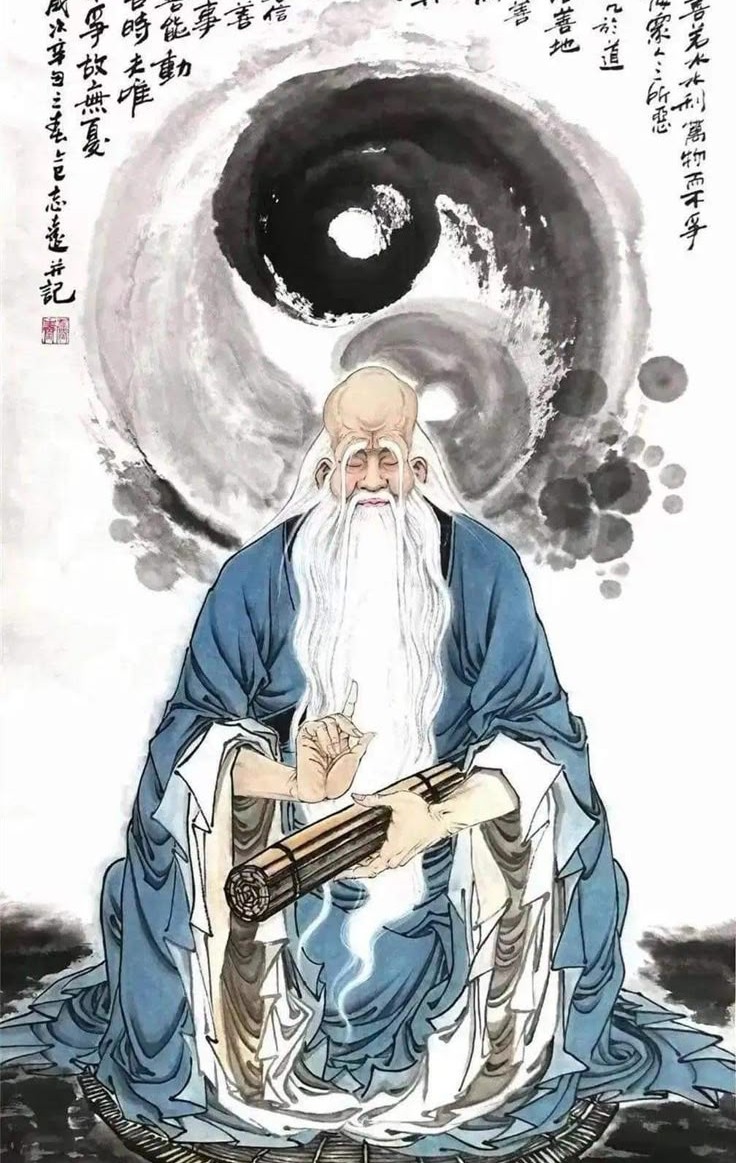
Daoism is traditionally associated with
Laozi, the semi-legendary author to whom the
Tao Te Ching or Daodejing is
attributed. Modern scholarship, however, treats the historical identity
of Laozi and the authorship of the text with considerable caution. The
Daodejing appears to have been compiled and transmitted over time rather
than being securely attributable to a single historical author. Its
importance lies not only in the identity of its supposed writer but in
the distinctive philosophical vocabulary it helped establish.
Central to Daoist philosophy is the Dao, literally the
Way. The term can refer to a path, method, pattern, or way of
proceeding, but Daoist texts use it to point toward the fundamental
processes through which reality unfolds. The Dao cannot be completely
captured by fixed language or definitions, because language divides
experience into stable categories while reality itself is constantly
changing. The famous opening of the Daodejing therefore warns that the
Dao which can be fully spoken is not identical with the ultimate Dao.
Living well requires sensitivity to the Dao rather than an attempt to
dominate every situation. This is expressed through the concept of
wu wei, often translated as non-action or effortless
action. Wu wei does not mean doing absolutely nothing. It refers instead
to action that is not forced, strained, or unnecessarily opposed to the
conditions of a situation. The Daoist image of water captures this idea:
water is yielding and apparently weak, yet it adapts to obstacles and
can, over time, reshape even the hardest surfaces.
Another important Daoist idea is ziran, often
translated as naturalness or spontaneity. Human beings frequently become
trapped by artificial ambitions and social expectations, losing the
ability to respond freely and appropriately to life as it unfolds.
Daoist thought therefore asks whether wisdom sometimes requires less
control rather than more, less accumulation rather than more, and a
willingness to recognize the limits of deliberate planning.
These ideas receive a more playful and philosophically experimental form
in the Zhuangzi, traditionally associated with Zhuang Zhou, who probably lived during
the fourth century BCE. The text uses stories, humor, paradox, imaginary
conversations, and transformations to challenge confidence in fixed
distinctions. Rather than constructing a conventional philosophical
system, the Zhuangzi repeatedly unsettles the reader's assumptions about
knowledge, identity, usefulness, success, and the difference between
apparently opposing perspectives.
One of the most famous stories concerns Zhuangzi dreaming that he was a
butterfly and waking uncertain whether he was a man who had dreamed of
being a butterfly or a butterfly dreaming that it was a man. The story
is not simply an early version of modern skepticism about whether
reality is a dream. It also illustrates a deeper Daoist concern with
transformation and the instability of rigid identities. Human
perspectives are limited, and what appears fixed from one point of view
may look entirely different from another.
Daoist political thought similarly challenged the assumption that more
government always produces more order. The Daodejing often suggests that
excessive interference, taxation, regulation, and moral preaching can
generate the very problems rulers hope to solve. The ideal ruler
therefore governs with restraint and avoids unnecessary intervention.
This does not amount to a simple modern doctrine of individual liberty,
but it provides a powerful ancient critique of political overreach and
the human desire to control complex social processes.
Daoism became one of the most influential traditions in Chinese
intellectual and religious history. Its philosophical reflections on
nature, language, spontaneity, transformation, and the limits of human
knowledge continued to interact with Confucianism and later Buddhism.
Rather than existing as an isolated alternative to other traditions,
Daoist ideas became part of the larger vocabulary through which Chinese
thinkers continued to debate what it means to live well in a changing
world.
3️⃣ Legalism
Han Feizi and the Philosophy of Strict Law
Thinkers associated with Legalism emphasized institutions,
administrative methods, law, and political power as the foundations of
a strong state.
The political philosophy conventionally known as
Legalism emerged from the practical problems of the
Warring States period, when rulers faced intense military competition
and needed increasingly effective systems of administration. The English
label can be misleading because the thinkers grouped under it did not
all advocate the same doctrine, and the Chinese tradition associated
them with fa — standards, models, or laws — rather than
with a modern constitutional conception of the rule of law.
One of the most important figures associated with this tradition was
Shang Yang, a statesman whose reforms in the state of
Qin strengthened administrative centralization, agricultural production,
and military organization. His policies attempted to weaken inherited
aristocratic privilege and tie rewards more closely to measurable
service to the state. In a world of constant warfare, such reforms gave
Qin institutions that proved increasingly effective against rival
states.
The most systematic philosophical representative of Legalist political
thought was Han Feizi (c.
280–233 BCE). Traditionally said to have studied under the Confucian
philosopher Xunzi, Han Feizi rejected the idea that a stable state could
depend primarily on the personal virtue of rulers or officials. Human
beings, he argued, are strongly motivated by advantage and fear. A
successful political system must therefore be designed with ordinary
human motivations in mind rather than relying on the unlikely hope that
everyone in power will become morally exemplary.
Legalist thought is often summarized through three major concepts:
fa, shu, and shi. Fa
refers broadly to publicly established standards and laws that allow the
state to evaluate conduct. Shu refers to administrative techniques or
methods through which a ruler manages officials and prevents ministers
from accumulating independent power. Shi refers to the strategic
authority attached to political position itself, emphasizing that
effective rule depends not only on personal talent but on control of
institutional power.
This approach represented a major challenge to Confucian political
philosophy. Where Confucius emphasized the moral example of the ruler,
Legalist thinkers asked what happens when rulers are not virtuous. Where
Confucianism placed enormous value on education and cultivated
character, Legalism focused on predictable incentives, measurable
performance, and institutional control. The fundamental political
question shifted from "How can we create virtuous rulers?" toward "How
can a state remain stable even when human beings act from ordinary
self-interest?"
Legalist political theory was therefore not simply a defense of cruelty
for its own sake. Its thinkers sought an explanation of how large states
could survive in a competitive environment without depending on personal
loyalty or moral idealism alone. Yet the system often treated harsh
punishment, collective responsibility, surveillance of officials, and
strict control as legitimate instruments of political order. This
produced an enduring tension between administrative effectiveness and
the moral costs of authoritarian power.
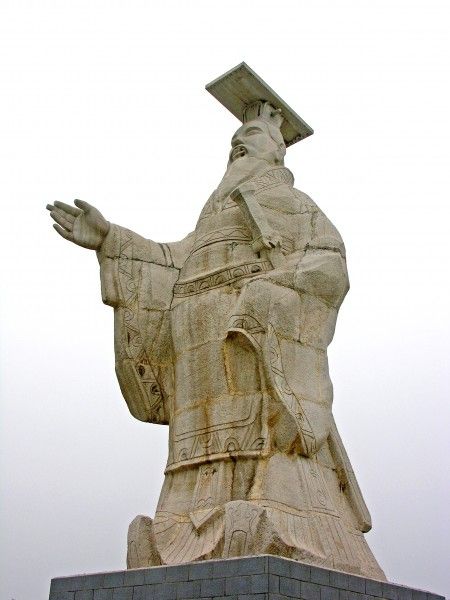
Legalist ideas found their most consequential application in the rise of
Qin. Building on earlier reforms and highly centralized administration,
Qin defeated its rivals and unified the Chinese world in 221 BCE under
the First Emperor, Qin Shi Huang. Unification brought standardized
systems of administration and created the first long-lasting model of a
centralized Chinese empire, but the Qin dynasty itself survived only
briefly before collapsing amid political crisis and rebellion.
The fall of Qin did not mean the disappearance of Legalist political
ideas. Later dynasties often publicly celebrated Confucian moral ideals
while retaining centralized bureaucracies, legal codes, taxation
systems, and administrative techniques that owed much to the political
transformations of the Warring States and Qin periods. For this reason,
Chinese political history cannot be understood simply as a victory of
Confucianism over Legalism. Moral ideals and institutional power
continued to exist together in complex and sometimes contradictory
forms.
4️⃣ Mohism
Mozi and the Search for Universal Standards
Mohism was one of the most powerful intellectual movements of the
Warring States period, yet it is often overshadowed today by
Confucianism and Daoism. The tradition is associated with
Mozi, or Mo Di, who probably flourished around the fifth century BCE.
Unlike the more aristocratic cultural orientation often associated with
early Confucianism, Mohist texts show strong concern for practical
standards, public welfare, craftsmanship, military defense, and
arguments that could be tested by their consequences.
The best-known Mohist doctrine is jian ai, often
translated as inclusive care, impartial concern, or universal love. The
Mohists argued that many forms of social disorder arise because people
care intensely for their own families, states, and interests while
neglecting or harming others. A more inclusive concern for the welfare
of all people, they believed, would reduce conflict, theft,
exploitation, and aggressive war. This doctrine became one of the great
ethical challenges to Confucian ideas about graded obligations within
family relationships.
Mohist ethics was strongly concerned with benefit and
the practical consequences of policies. A practice should not be
accepted merely because it is ancient or socially prestigious; thinkers
should ask whether it promotes human welfare and social order. For this
reason, scholars often describe Mohist ethics as an early form of
consequentialist thought. The Mohists evaluated actions partly by asking
whether they increased prosperity, population, security, and harmonious
social relationships.
Mohism also developed a powerful critique of aggressive warfare. The
Mohists condemned unprovoked military conquest because the suffering
caused by invasion could not be justified by the benefits gained by
rulers. Yet they were not simply pacifists in every circumstance. Mohist
groups became famous for expertise in defensive warfare and siege
defense, sometimes assisting smaller states threatened by more powerful
aggressors. Their opposition was directed particularly against unjust
attack rather than against all forms of defense.
Another important Mohist principle was the promotion of the worthy.
Public offices, they argued, should not be distributed simply according
to inherited status or family background. Political communities should
select capable and morally reliable individuals for positions of
responsibility. This emphasis on ability and merit responded directly to
the political transformations of the Warring States period, when
increasingly complex states required skilled administrators rather than
aristocratic privilege alone.
Mohist philosophy also made major contributions to ancient Chinese
epistemology, language, and argumentation. Mohist thinkers searched for
fa, reliable models or standards that could guide
correct judgment and action. Later Mohist writings developed discussions
of definitions, analogy, inference, geometry, mechanics, optics, and the
relationship between names and things. These texts demonstrate that
ancient Chinese philosophy included sustained reflection on reasoning
and knowledge alongside its more famous ethical and political
traditions.
The Mohists declined after the imperial unification of China, and their
movement eventually disappeared as an organized philosophical tradition.
Nevertheless, their influence was substantial. Mohist debates helped
shape later discussions of ethics, political order, argumentation,
language, and objective standards. Their challenge to inherited custom
remains one of the most philosophically radical moments of ancient
Chinese thought: tradition, they argued, is not automatically right
merely because it is tradition.
5️⃣ The School of Names and Chinese Logic
Language, Paradox, and the Problem of Names
Ancient Chinese philosophy did not ignore questions about language and
logic. During the Warring States period, a diverse group of thinkers
became associated with debates about ming, or names,
and the relationship between words, categories, and the things to which
language refers. Later Han scholars grouped some of these thinkers under
the label School of Names, though this name should not
be understood as proof that they formed a single unified philosophical
institution.
Among the figures traditionally associated with these debates were
Hui Shi and Gongsun Long. Their
surviving ideas are fragmentary and often preserved through later
sources, making precise interpretation difficult. Nevertheless, they
became famous for paradoxes and arguments that challenged ordinary
assumptions about identity, difference, movement, space, and
classification.
Gongsun Long is particularly associated with the famous proposition
"a white horse is not a horse." The argument does not
simply deny the obvious fact that a white horse belongs to the category
of horses. Instead, it investigates how different terms select different
features of an object. The name "horse" refers to a broader category,
while "white horse" includes a distinction based on color. The puzzle
forces the reader to ask whether two expressions that apply to the same
object always have exactly the same meaning.
Such debates reveal an important problem shared by many philosophical
traditions: how accurately can language represent reality? Words divide
the world into categories, but the boundaries between categories may be
more complicated than ordinary speech suggests. When does a difference
in name represent a real difference in the world, and when does language
create distinctions that mislead us?
These questions were not confined to thinkers later labeled as members
of the School of Names. Mohists developed sophisticated discussions of
names and argumentation, while Confucians debated the importance of
correctly ordering names and social roles. Daoist texts often challenged
the belief that fixed language could capture the constantly transforming
Dao. The philosophy of language was therefore part of a wider
intellectual struggle over how human beings should understand and
classify reality.
The School of Names is sometimes described as ancient Chinese logic, but
this description must be used carefully. These thinkers did not create a
system identical to Aristotelian syllogistic logic or modern symbolic
logic. Their work emerged from different intellectual problems and
textual traditions. Nevertheless, their attention to paradox, argument,
classification, and the relationship between names and things makes them
essential to any serious history of Chinese philosophy and early
theories of language.
6️⃣ Yin, Yang, and the Five Phases
Cosmology and the Patterns of Change
While some ancient Chinese philosophers focused primarily on ethics and
politics, other traditions attempted to understand the larger patterns
governing nature and historical change. The concepts of
yin and yang and the Five Phases
eventually became central elements of Chinese cosmological thought,
influencing philosophy, medicine, political theory, and interpretations
of the natural world.
Yin and yang are often misunderstood as two permanently opposed
substances. In classical Chinese thought, they are better understood as
complementary and dynamically related patterns. Yin is commonly
associated with qualities such as darkness, receptivity, coolness, and
inwardness, while yang is associated with brightness, activity, warmth,
and outward movement. Neither exists as an isolated absolute. Change
occurs through their interaction, transformation, and shifting balance.
The theory of the Five Phases, or
wuxing, described recurring patterns through the terms
wood, fire, earth, metal, and water. These were not simply the five
chemical elements in the modern scientific sense. They represented
phases or modes of transformation that could be used to interpret
natural cycles, seasons, political change, bodily processes, and
relationships between different aspects of the world.
The thinker Zou Yan, who probably lived during the
Warring States period, became associated in later tradition with
systematic cosmological speculation involving yin-yang and Five Phases
theories. Political thinkers could use such cosmology to interpret the
rise and fall of dynasties, suggesting that historical change followed
larger patterns within the natural order rather than being merely the
result of individual decisions.
This style of thought encouraged what modern scholars often call
correlative thinking: events in different domains of
reality could be understood through patterned relationships and
correspondences. Heaven, the seasons, the body, society, and political
authority were frequently interpreted as parts of an interconnected
order. A disturbance in one domain could therefore be understood as
connected with imbalance elsewhere.
Yin-yang and Five Phases cosmology became increasingly influential after
the Warring States period and played an important role in Han
intellectual synthesis. Although these theories differ greatly from
modern scientific explanations of nature, their philosophical
significance lies in the attempt to understand reality as a system of
dynamic relationships rather than as a collection of permanently
isolated objects.
7️⃣ The Hundred Schools of Thought
China's Great Age of Philosophical Debate
The phrase Hundred Schools of Thought has become the
standard name for the extraordinary intellectual diversity of the Spring
and Autumn and Warring States periods. It should not be interpreted
literally as a census of exactly one hundred formal schools. Instead, it
captures the sense that ancient China experienced a remarkable expansion
of philosophical debate, with teachers, advisers, specialists, and
wandering intellectuals offering competing answers to the problems
facing their society.
Political fragmentation helped create this intellectual competition.
Because China was divided among rival states, rulers competed not only
for territory but also for capable advisers. A thinker rejected in one
court might seek patronage elsewhere. Some intellectuals offered
strategies for military strength, while others proposed systems of moral
education, economic reform, diplomacy, ritual restoration, or withdrawal
from public political life.
This environment transformed philosophy into a form of public and
political debate. Confucians argued that disorder resulted from failures
of virtue and proper relationships. Mohists blamed partiality,
aggression, and the absence of objective standards. Daoist texts
questioned the very desire to impose excessive order through human
schemes. Legalists argued that states could not survive without powerful
institutions capable of controlling predictable human self-interest.
Other intellectual currents added further complexity. Military theorists
examined strategy and conflict; cosmological thinkers searched for
patterns linking nature and political change; specialists in language
investigated names and distinctions. The boundaries between these
traditions were often less rigid than later textbook categories suggest.
Thinkers borrowed concepts from opponents, developed ideas in reaction
to rival positions, and participated in overlapping networks of
argument.
The importance of the Hundred Schools lies not only in the number of
ideas produced but in the intensity of the disagreements. Ancient
Chinese philosophers debated whether human nature is good or selfish,
whether morality should follow family relationships or impartial
standards, whether rulers should govern through virtue or institutions,
whether language can capture reality, and whether political ambition
itself is a source of disorder.
This period therefore deserves comparison with other great ages of
philosophical innovation. The political crises of ancient China did not
prevent intellectual life; in many ways, they stimulated it. The need to
explain and respond to a rapidly changing world created a philosophical
culture in which competing visions of humanity, society, and the cosmos
could develop with extraordinary depth.
8️⃣ Qin Unification and the End of the Classical Age
When Philosophy Met Empire
The philosophical world of the Hundred Schools developed within a
divided political landscape. That landscape changed dramatically in 221
BCE when the state of Qin defeated its remaining rivals and unified the
Chinese world under Qin Shi Huang, the First Emperor.
For the first time, the long competition among the major Warring States
ended in a centralized imperial structure.
Qin's success was closely connected with the administrative and military
transformations that had developed during the preceding centuries.
Reforms associated with Shang Yang and other Qin statesmen strengthened
centralized authority, weakened competing aristocratic powers, and
organized society more directly around the needs of the state. The
political effectiveness of these institutions demonstrated why Legalist
approaches had become so attractive during an era of relentless
interstate competition.
Unification transformed the conditions under which philosophy operated.
When multiple independent states competed for advisers, intellectuals
could travel between courts and present rival political programs. A
centralized empire created a different relationship between ideas and
political power. The question was no longer simply how one state might
defeat another, but how a single ruler could administer an enormous and
diverse territory.
Later accounts famously associate the Qin regime with censorship and the
suppression of certain intellectual traditions, including stories about
the burning of books. These events must be interpreted carefully because
many surviving accounts were written under later dynasties hostile to
Qin. Nevertheless, the broader historical point is clear: imperial
centralization placed new limits on the open competition among political
philosophies that had characterized the Warring States period.
The Qin dynasty itself was remarkably short-lived, collapsing after
little more than a decade of imperial rule. Its failure demonstrated
that administrative efficiency and military strength were not sufficient
to guarantee lasting political legitimacy. The rulers who followed
inherited the institutions of centralized empire but faced the
continuing problem of explaining how political authority could become
morally legitimate as well as practically effective.
9️⃣ The Han Synthesis and the Legacy of Ancient China
From Competing Schools to a Lasting Intellectual Tradition
The Han dynasty inherited a political world transformed by Qin
unification. Rather than simply restoring the fragmented order of the
Warring States period, Han rulers developed new forms of imperial
government that combined centralized administration with changing
systems of moral and cultural legitimacy. In this environment, the
competing philosophies of the classical age were not simply preserved or
rejected as separate packages; many of their ideas were absorbed into
broader intellectual syntheses.
Confucian learning gradually gained a privileged position within the Han
political and educational order. The teachings associated with Confucius
offered a language of moral government, filial responsibility, ritual
order, and the duties of rulers. Yet imperial Confucianism was never a
simple return to the world of Confucius himself. It developed within a
centralized state whose administrative structure had been shaped by the
political innovations of the Warring States and Qin periods.
Daoist ideas also continued to influence Chinese thought. Reflections on
the Dao, natural processes, spontaneity, transformation, and the limits
of political interference remained powerful alternatives to highly
regulated visions of society. In later centuries, Daoist philosophy and
religious traditions developed in new directions while continuing to
interact with Confucian and Buddhist ideas.
Cosmological theories involving yin and yang and the Five Phases became
increasingly important in attempts to explain the relationship between
Heaven, nature, human society, and political authority. Han thinkers
often sought comprehensive frameworks capable of connecting ethics,
government, natural events, and cosmic patterns. Ancient Chinese
philosophy thus moved beyond the direct rivalry of the Warring States
schools toward increasingly ambitious attempts to understand human life
as part of an interconnected universe.
The legacy of the classical period extended far beyond China. Confucian
traditions influenced Korea, Japan, Vietnam, and other parts of East
Asia; Daoist ideas shaped philosophy, religion, literature, and art;
while Legalist approaches to institutions and state power remained
important for understanding the history of centralized government. When
Buddhism arrived from India, it entered an already sophisticated
philosophical environment and was transformed through centuries of
dialogue with Chinese concepts.
Ancient Chinese philosophy therefore did not end with the Qin or Han
dynasties. Its classical concepts became the foundation for later
debates about human nature, ethics, knowledge, political legitimacy, and
the relationship between humanity and the cosmos. Neo-Confucianism, Chan
Buddhism, later Daoist philosophy, and modern discussions of East Asian
thought all inherited questions first developed during this
extraordinary age of intellectual competition.
👤 Major Thinkers
The Hundred Schools period produced an extraordinary range of
philosophers, political advisers, teachers, and intellectual movements.
Some founded enduring traditions, while others survive only through
fragments and the writings of their opponents. Together, these thinkers
transformed questions about virtue, government, language, nature,
knowledge, and human society into one of the world's great classical
philosophical traditions.
A major reformer of the state of Qin whose administrative and legal
reforms strengthened the centralized state and helped create the
political foundations for China's eventual unification.
Hui Shi
c. 370–310 BCE
A prominent disputation thinker associated with the later category
of the School of Names, remembered for paradoxes and reflections on
language, difference, relation, and the structure of reality.
Gongsun Long
c. 320–250 BCE
Famous for philosophical paradoxes concerning names and things,
including the celebrated argument commonly translated as "a white
horse is not a horse."
❤️ Ren — humaneness or benevolence, understood in
Confucian thought as a central quality of cultivated moral character
🎎 Li — ritual propriety and socially appropriate
conduct through which moral character is cultivated and expressed
👨👩👧 Xiao — filial devotion and responsibility within
the family, treated as a foundation for wider ethical relationships
🌿 The Dao — the Way or fundamental course through
which reality unfolds and with which human life should seek harmony
🌊 Wu Wei — action without forced striving, allowing
conduct to respond effectively to circumstances rather than opposing
the natural course of things
🤝 Jian Ai — Mohist impartial or inclusive concern,
extending moral consideration beyond narrow family and social
boundaries
📜 Fa — standards or laws that structure political
and administrative life through publicly established rules and
institutions
⚖️ Merit and Ability — the idea, strongly developed
by Mohist thinkers, that capable and worthy people should be promoted
rather than positions being determined only by inherited status
🗣 Names and Reality — philosophical investigation
into how language, classification, distinction, and argument relate to
the world and to human knowledge
☯️ Yin and Yang — complementary patterns of change
used to explain natural processes, seasonal cycles, and the dynamic
balance of the cosmos
👑 The Mandate of Heaven — the principle that
political legitimacy is not absolute but depends upon a ruler's
capacity to maintain order and govern appropriately
🌍 Influence on Later Philosophy
The philosophical movements of early China did not disappear when the
Warring States period ended. Instead, their ideas entered later Chinese
civilization in different combinations and institutional forms.
Confucian traditions gradually acquired exceptional cultural and
political authority, shaping education, family ethics, literary culture,
and conceptions of responsible government. Yet Confucianism itself
continued to change as later thinkers debated the nature of the mind,
moral knowledge, ritual, and the relationship between principle and the
material world.
Daoist philosophy remained equally important as a source of reflection
on nature, spontaneity, language, transformation, and the limits of
deliberate control. The Tao Te Ching and Zhuangzi influenced Chinese
poetry, painting, religious traditions, and later philosophical
movements. When Buddhism entered China from India, Daoist vocabulary and
intellectual categories also became part of the complex process through
which Buddhist ideas were translated, interpreted, and eventually
transformed within Chinese culture.
Legalist political thought likewise left a lasting institutional legacy,
although later Chinese dynasties rarely presented themselves simply as
Legalist. The centralized state, systems of administration, techniques
for supervising officials, and concern with effective institutions
remained important long after the Qin dynasty collapsed. The contrast
between moral government and institutional control therefore became one
of the enduring tensions within Chinese political philosophy rather than
a question settled permanently in favor of a single school.
Mohism, though it eventually declined as an organized movement, made
major contributions to early Chinese philosophical argument. Mohist
thinkers developed systematic discussions of ethical standards, social
welfare, political order, language, reasoning, and practical knowledge.
Their commitment to impartial concern and their opposition to aggressive
warfare also created an important alternative to both Confucian
role-based ethics and the political realism associated with the fa
tradition.
Other traditions expanded the range of Chinese philosophy still further.
Thinkers later grouped under the School of Names investigated problems
of language, classification, and paradox, while Yin-Yang traditions
explored recurring patterns within nature and the cosmos. The familiar
label "Hundred Schools of Thought" should therefore not be understood as
a perfectly fixed list of separate institutions; it is better understood
as a broad description of an unusually creative intellectual world
containing competing teachers, texts, methods, and traditions.
Centuries later, Neo-Confucian philosophers would construct new
syntheses by responding to Buddhist and Daoist metaphysical questions
while retaining the Confucian concern with ethical cultivation and
social responsibility. The classical debates of ancient China thus
continued far beyond their original historical setting, influencing
Korea, Japan, Vietnam, and modern global discussions of virtue ethics,
political authority, education, environmental thought, and the
relationship between individual freedom and social order.
📊 Quick Facts
Time Period: c. 770 BCE – 221 BCE, with the most
intense philosophical activity occurring during the Spring and Autumn
and Warring States periods
Key Region: Ancient China, particularly the Yellow
River basin and the competing states of the central and eastern
Chinese world
Major Traditions: Confucianism, Daoism, Mohism, the
fa tradition commonly called Legalism, Yin-Yang thought, and the
thinkers later grouped as the School of Names
Central Questions: How should human beings cultivate
virtue? What creates political order? What is the proper relationship
between nature and human action? How do names and language relate to
reality?
Historical Context: The weakening of Zhou authority,
interstate warfare, political fragmentation, and intense competition
among rulers seeking effective methods of government
Successor Traditions: Han Confucianism, religious and
philosophical Daoism, Neo-Confucianism, Chan Buddhism, and the wider
philosophical traditions of East Asia
Frequently Asked Questions About Ancient Chinese Philosophy
What is Ancient Chinese philosophy?
Ancient Chinese philosophy developed through competing traditions
that explored human nature, moral cultivation, political order,
knowledge, language, the patterns of nature, and humanity's
relationship with the larger cosmos. Major traditions discussed on
this page include Confucianism, Daoism, Legalism, Mohism, the School
of Names, and cosmological traditions involving yin-yang and the
Five Phases.
When did Ancient Chinese philosophy develop?
Ancient Chinese philosophy developed especially during the Spring
and Autumn and Warring States periods. The Zhou dynasty began around
the middle of the eleventh century BCE, Zhou authority weakened by
the eighth century BCE, and the Warring States period is
traditionally dated from 475 to 221 BCE. This period saw an
extraordinary expansion of philosophical debate known as the Hundred
Schools of Thought.
What was the Hundred Schools of Thought?
The Hundred Schools of Thought refers to the extraordinary diversity
of teachers, advisers, specialists, and intellectual traditions that
debated human nature, morality, government, language, knowledge,
warfare, and the structure of the cosmos during the Spring and
Autumn and Warring States periods. The phrase does not mean that
there were literally one hundred separate formal schools.
What was the Mandate of Heaven?
The Mandate of Heaven was a Zhou conception of political legitimacy
according to which Heaven could withdraw its support from a ruler
who governed unjustly or disastrously. It connected political
authority with moral responsibility and provided later Chinese
thinkers with a framework for discussing why rulers and dynasties
could lose legitimate authority.
What did Confucius teach?
Confucius emphasized moral cultivation, education, family
responsibility, ritual propriety, ethical relationships, and
responsible government. His philosophy centered on the cultivation
of character rather than merely obeying external rules, and he
argued that rulers should govern through virtue and moral example
rather than relying exclusively on punishment.
What are ren, li, and xiao in Confucian philosophy?
Ren refers to qualities such as benevolence, humaneness, or
human-heartedness; li concerns ritual propriety, ceremony,
etiquette, and appropriate social conduct; and xiao is usually
translated as filial piety. Together, these concepts describe
important aspects of moral cultivation, relationships, social
responsibility, and ethical education in Confucian thought.
What is Daoism in Ancient Chinese philosophy?
Daoism is a philosophical tradition associated with texts such as
the Daodejing and the Zhuangzi. It questions excessive striving and
artificial social conventions and emphasizes simplicity,
flexibility, spontaneity, and responsiveness to the changing
patterns of the natural world. Important concepts include the Dao,
wu wei, and ziran.
What are the Dao and wu wei?
The Dao, or Way, refers to the fundamental processes and patterns
through which reality unfolds. Wu wei is often translated as
non-action or effortless action, but it does not mean doing
absolutely nothing. It refers to action that is not forced or
unnecessarily strained and that responds appropriately to the
conditions of a situation.
What was Legalism in Ancient China?
Legalism was a political tradition that developed in response to the
intense competition of the Warring States period. Thinkers
associated with it emphasized publicly established standards and
laws, administrative techniques, institutional power, predictable
incentives, and political control rather than depending primarily on
the personal virtue of rulers.
What did Mohism teach?
Mohism, associated with Mozi, emphasized inclusive concern for human
welfare, practical standards, merit, and opposition to aggressive
warfare. Its best-known ethical doctrine, jian ai, is commonly
translated as inclusive care, impartial concern, or universal love.
Mohist thinkers also developed important discussions of language,
argumentation, knowledge, and standards for judgment.
What was the School of Names?
The School of Names refers to a group of thinkers associated with
debates about names, categories, language, and the relationship
between words and things. Figures such as Hui Shi and Gongsun Long
became known for paradoxes and arguments concerning identity,
difference, classification, and the relationship between language
and reality.
What are yin-yang and the Five Phases in Chinese philosophy?
Yin and yang describe complementary and dynamically related patterns
rather than two permanently opposed substances. The Five Phases, or
wuxing, refer to wood, fire, earth, metal, and water as recurring
patterns or modes of transformation. These theories were used to
interpret relationships among nature, seasons, society, political
change, and other aspects of reality.
While Chinese philosophers debated how to restore order to a fractured
world, an entirely different intellectual project was unfolding to the
west — Islamic scholars were translating and transforming Greek
philosophy, and building a centuries-long argument over the relationship
between reason and revelation.