Who Was Lao Tzu?
Lao Tzu, also written as Laozi, is the traditional Chinese philosopher associated with the beginnings of philosophical Daoism. The name Laozi is commonly understood as meaning "Old Master." He occupies a central place in the history of Chinese philosophy and is traditionally associated with the text known as the Daodejing, commonly called the Tao Te Ching, one of the most influential works in the entire Chinese philosophical tradition.
The philosophy associated with Laozi centers on the Dao, often translated as "the Way." The Dao refers to the fundamental way or underlying process through which the world operates, although the Daodejing repeatedly warns that the Dao cannot be completely captured by ordinary language. Laozi's thought also emphasizes simplicity, naturalness, humility, and wu wei, often understood as action that does not forcefully struggle against the natural course of things.
According to traditional Chinese accounts, Lao Tzu lived during the sixth century BCE and was a contemporary of Confucius. However, his historical identity and precise dates remain uncertain. Modern scholarship treats the traditional biography cautiously, and many scholars question whether the Laozi described in later traditions can be identified confidently as a single historical individual who wrote the Daodejing in its present form.
What is historically more secure is the enormous importance of the text associated with his name. The Daodejing developed within the intellectual world of ancient China and became a foundational work of Daoist thought. Its ideas profoundly influenced later Chinese philosophy, religion, political thought, literature, and culture. Whether Laozi was a single historical author or a figure later associated with a developing textual tradition, his philosophical legacy remains one of the most significant in world history.
Lao Tzu: Life, Philosophy, and Quick Facts
- Name — Lao Tzu, also written Laozi or Lao-tzu
- Chinese name — 老子
- Meaning of Laozi — Commonly translated as "Old Master"
- Traditional period — Sixth century BCE
- Tradition — Classical Chinese philosophy and Daoism
- Associated text — Daodejing, also known as the Tao Te Ching
- Major philosophical concepts — Dao, de, wu wei, ziran, simplicity, and non-forcing
- Philosophical concerns — Reality, naturalness, ethics, self-cultivation, government, and human conduct
- Historical certainty — The traditional biography and authorship of the Daodejing remain subjects of scholarly debate
Lao Tzu and Ancient Chinese Philosophy
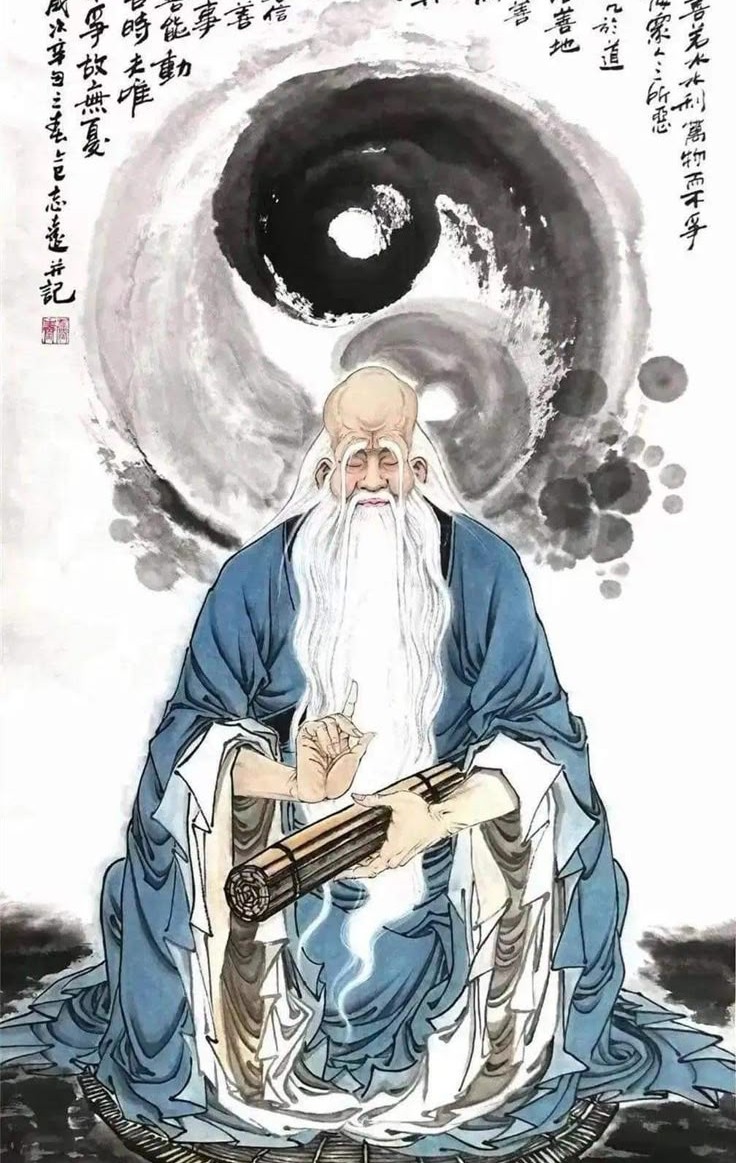
Lao Tzu, more commonly rendered in modern scholarly transliteration as Laozi, belongs to the intellectual world of ancient China, although the historical details of his life remain deeply uncertain. The tradition associated with his name developed within a broad and intellectually diverse environment in which thinkers debated morality, government, human nature, language, knowledge, social order, and the proper way to live. Confucian, Mohist, Legalist, and other philosophical currents emerged from this wider landscape of early Chinese thought.
The traditional dating of Laozi places him around the sixth century BCE and makes him an older contemporary of Confucius. Modern scholarship, however, treats this account with considerable caution. The earliest reliable evidence does not allow historians to reconstruct a secure biography of a single author called Laozi, and the text associated with his name appears to have undergone a complex process of formation and transmission before reaching a relatively stable form.
The philosophical tradition associated with Laozi developed a distinctive interest in the Dao, often translated as the "Way." Rather than treating the Dao simply as a social rule, moral doctrine, or political institution, the Daodejing presents it as something more fundamental and difficult to define. The Dao concerns the way things arise, develop, transform, and return, while also providing a perspective from which human action and political conduct can be evaluated.
Laozi's philosophy therefore challenges the assumption that human beings should attempt to control every aspect of life through force, ambition, rigid distinctions, and constant intervention. The Daodejing repeatedly values simplicity, restraint, humility, naturalness, and forms of action that do not unnecessarily oppose the circumstances in which they occur. Its philosophical importance lies partly in this attempt to rethink power and effectiveness without simply identifying either with domination.
Why Is Lao Tzu Important in Chinese Philosophy?
Lao Tzu is important because the philosophical tradition associated with his name developed a powerful alternative to more socially centered approaches to ethics and government in ancient China. Where Confucian thought placed particular emphasis on moral education, ritual, social relationships, and cultivated virtue, the Daodejing repeatedly asks whether deliberate striving and excessive intervention can themselves become sources of disorder.
The text introduced and developed concepts that became central to the history of Chinese philosophy, especially the Dao, de, ziran, and wu wei. These ideas concern not only metaphysical or cosmological questions but also practical problems of conduct, self-cultivation, leadership, and political authority. Their combination gives the Laozi tradition a philosophical range that cannot be reduced simply to quietism or withdrawal from society.
The ideas associated with Laozi also became closely connected with the philosophy of Zhuangzi. Later interpreters frequently grouped these two bodies of thought together under the broad category of Daoism, although the relationship between their texts is more complex than the idea of one thinker simply continuing the work of another. The later expression Lao-Zhuang therefore remains useful for identifying a major stream within classical Chinese philosophy.
Laozi's influence extends far beyond philosophy in a narrow academic sense. The Daodejing became one of the most important and most extensively interpreted texts in Chinese intellectual history, shaping religious traditions, political thought, literature, art, and practices of self-cultivation. Its concise and highly metaphorical language also allowed later readers to approach the text from philosophical, religious, ethical, political, and literary perspectives.
What Did Lao Tzu Believe?
The philosophy associated with Lao Tzu centers on the relationship between the Dao, human life, naturalness, virtue, and appropriate action. The Daodejing presents the Dao as something that cannot be completely captured by ordinary names or fixed concepts. Human beings nevertheless encounter its workings in the processes through which things arise, change, flourish, decline, and interact with one another.
Rather than encouraging people to impose their will upon the world at every opportunity, the text emphasizes responsiveness to the character and circumstances of things. This does not mean complete passivity or doing absolutely nothing. The better-known concept of wu wei concerns forms of action that avoid unnecessary force, coercion, and artificial striving while remaining capable of responding effectively to changing circumstances.
The Daodejing also praises qualities such as simplicity, humility, restraint, compassion, and freedom from excessive desire. These themes are connected by a broader suspicion of aggressive self-assertion and the constant pursuit of status or advantage. The sage is often portrayed as someone whose effectiveness does not depend upon public display, domination, or the continual assertion of personal will.
These ideas apply to both personal conduct and political rule. A person can become less entangled in unnecessary desire and competition, while a ruler can govern without assuming that greater control always produces greater order. Because the text contains different layers of reflection on these themes, Laozi's philosophy should not be treated as a single simple doctrine but as a sustained exploration of how human beings might act more effectively by forcing less.
What Is the Dao in Lao Tzu's Philosophy?
The Dao, often translated as the "Way," is the central concept of Lao Tzu's philosophy. In ordinary Chinese usage, the term can refer to a way, path, course, method, or manner of proceeding, but its meaning in the Daodejing is considerably broader. The Dao is presented as the fundamental way through which the world and its countless processes unfold, while remaining resistant to complete conceptual definition.
The opening of the Daodejing famously warns against identifying the Dao completely with any name or verbal formulation. This does not mean that language is useless, but it does suggest that ordinary concepts divide and classify a reality that exceeds any single description. The text therefore uses paradox, metaphor, contrast, and indirect expression rather than attempting to provide a straightforward definition of the Dao.
The Dao is also presented as deeply generative. The text associates it with the emergence and transformation of the "ten thousand things," a traditional expression referring broadly to the innumerable beings and phenomena of the world. Yet the Dao is not described as a craftsman who deliberately manufactures the universe according to a personal plan. Its generative character is instead closely connected with spontaneous processes of arising and transformation.
For this reason, the Dao should not simply be understood as a god or as a personal creator in the ordinary Western theological sense. Interpretations differ regarding its precise metaphysical status, and the concept has cosmological, ethical, political, and practical dimensions. What remains central is the idea that human beings flourish not merely by imposing their own preferences upon reality but by learning how to recognize and respond to the larger course through which things develop.
What Does Wu Wei Mean in Lao Tzu's Philosophy?

Wu wei is one of the most famous concepts associated with Lao Tzu. It is often translated as "non-action" or "non-doing," although these expressions can be misleading when interpreted as an instruction to remain completely inactive. The concept is better understood in relation to the Daodejing's criticism of forced, excessive, or improperly timed action.
In the philosophical context of the Daodejing, wu wei concerns action that avoids unnecessary forcing, coercion, and artificial interference. An action may be deliberate and effective without being aggressive or compulsive. The ideal is therefore not inactivity but a form of responsiveness in which a person does not create additional problems by attempting to dominate every situation.
Wu wei is closely connected with ziran, or naturalness. When things are allowed to develop according to their own character, intervention need not always take the form of direct control. This does not imply that every natural process is automatically good or that human beings should never alter their environment. Rather, the text repeatedly questions the assumption that more forceful intervention necessarily produces better results.
The concept is especially important in discussions of leadership. A ruler who attempts to control society through excessive regulations, punishments, demands, and interference may generate resistance and instability. By contrast, the ideal ruler acts with restraint and avoids making personal ambition the organizing principle of government. Wu wei thus connects ethical self-restraint with a distinctive reflection on political power.
Wu wei ultimately presents a different model of effectiveness. Strength does not always require aggression, and successful action does not always depend on visible exertion. Like several other themes in the Daodejing, the concept challenges ordinary oppositions between action and passivity by suggesting that the most effective response may sometimes involve knowing when not to force an outcome.
Paradox, Reversal, and Opposites in Lao Tzu's Philosophy
One of the most distinctive features of the Daodejing is its use of paradox. The text repeatedly challenges ordinary assumptions about strength, weakness, success, knowledge, and power. What appears weak may overcome what appears strong, while excessive force may ultimately produce its opposite.
Lao Tzu often describes reality as involving processes of reversal and transformation. Things that become excessively full may decline, and those who constantly seek superiority may undermine themselves. This emphasis on reversal encourages caution toward ambition, domination, and the belief that human beings can permanently control changing circumstances.
The relationship between apparent opposites is therefore an important philosophical theme. The Daodejing frequently discusses such contrasts as being and non-being, difficult and easy, high and low, strength and weakness, and fullness and emptiness. These contrasts help reveal how one condition may depend upon, define, or transform into another.
This does not mean that every opposite should simply be identified with the later philosophical system commonly described as yin and yang. Although Daoist thought developed alongside broader Chinese traditions concerned with complementary forces, the philosophy of the Daodejing should first be understood through its own language of reversal, relational contrast, transformation, and the Dao.
Who Is the Sage in Lao Tzu's Philosophy?
The Daodejing frequently presents the sage as an ideal figure who understands how to live and act without excessive self-assertion. The sage does not constantly seek personal recognition, domination, wealth, or superiority over others.
The sage is closely connected with the principle of wu wei. Rather than attempting to force every outcome, the sage responds to circumstances with restraint and sensitivity. This does not require withdrawal from all action; it describes a different manner of acting, one that avoids unnecessary interference.
Humility is especially important to this ideal. The sage is often portrayed as remaining low rather than constantly seeking the highest position, much like the recurring image of water. By refusing constant competition for status, the sage can avoid forms of conflict created by excessive ambition.
The figure of the sage also connects Lao Tzu's personal philosophy with political thought. A wise ruler should not govern merely by displaying personal power. The ideal of sage-like leadership instead emphasizes restraint, limited coercion, and the ability to allow people and circumstances to develop without unnecessary control.
Lao Tzu on Language, Names, and Knowledge
The relationship between language and reality is an important theme in Lao Tzu's philosophy. The opening of the Daodejing famously raises the problem that what can be named or described may not fully capture the ultimate Dao. Language is useful, but it may also impose fixed distinctions upon a reality that is constantly changing.
Names allow human beings to classify and communicate about the world. However, the Daodejing warns against assuming that a name is identical with the full reality of the thing it describes. A concept can make something intelligible while also limiting the way it is understood.
This philosophical concern helps explain Lao Tzu's preference for simplicity and caution toward excessive intellectual certainty. The text does not simply reject knowledge, but it repeatedly questions forms of knowing that become disconnected from practical wisdom, humility, and awareness of the limits of human control.
Lao Tzu's reflections on naming also influenced later Chinese philosophy. They raise questions that remain philosophically important: Can language fully describe reality? Do distinctions reveal the world as it is, or do they partly reflect the categories through which human beings organize experience?
What Are the Three Treasures of Lao Tzu?
One of the best-known ethical passages in the Daodejing describes three qualities often translated as the Three Treasures. These are commonly rendered as compassion, frugality or moderation, and reluctance to place oneself before others.
Compassion represents an alternative to cruelty and unnecessary aggression. It supports Lao Tzu's broader criticism of domination and excessive force. Strength, in this philosophical context, does not require constant harshness or the desire to overpower others.
Frugality expresses the importance of restraint and freedom from excess. Lao Tzu repeatedly questions the assumption that unlimited acquisition, consumption, and ambition lead automatically to a better life. Moderation can therefore be understood as both an ethical and a practical principle.
The reluctance to place oneself above others reflects the Daoist importance of humility. The person who does not constantly seek to be first avoids some of the conflicts created by competition for status and power. Together, these qualities summarize important ethical themes found throughout the Daodejing.
Lao Tzu on War, Violence, and Power
The Daodejing contains important reflections on war and the use of force. Although the text recognizes the existence of political conflict and military action, it does not celebrate violence as an ordinary source of glory or moral greatness.
Weapons and military power are generally treated with caution. Successful violence should not become a cause for pride or celebration, because war produces suffering and social disorder. This attitude is consistent with Lao Tzu's broader criticism of domination and excessive coercion.
The philosophy of wu wei also has political implications here. A ruler who constantly relies on force may create further resistance and instability. Lao Tzu therefore presents restraint as a form of political wisdom rather than simply a sign of weakness.
This does not make the Daodejing a modern pacifist political manifesto. Its historical context and philosophical language differ greatly from modern political categories. Nevertheless, its suspicion of unnecessary aggression remains one of its most important ethical and political themes.
Ancient Manuscripts of the Daodejing
Modern understanding of the Daodejing changed significantly through archaeological discoveries. Earlier readers depended mainly on later received versions and influential commentaries, but excavated manuscripts revealed that the text had a more complicated history of transmission and development.
Two important manuscripts were discovered at Mawangdui in the twentieth century. These silk manuscripts preserve versions of the Laozi that differ in important ways from later standard editions and demonstrate that the text existed in forms that were not identical to the received version.
Another major discovery was made at Guodian, where bamboo slips dating to around the late Warring States period contained passages closely related to the Laozi. These materials are earlier than the Mawangdui manuscripts and have played a major role in scholarly debates about the formation and development of the text.
These discoveries do not provide a simple final answer to the question of authorship. Instead, they show why the history of the Daodejing must be studied as a process of transmission, collection, editing, and interpretation. They are among the most important pieces of evidence in modern research on Lao Tzu and the Laozi tradition.
What Does Naturalness Mean in Lao Tzu's Philosophy?
Another important concept in the Daodejing is ziran, often translated as "naturalness" or "self-so." The expression points toward things being so of themselves rather than being entirely determined by external imposition. In the philosophical context of Laozi, naturalness concerns spontaneity and the capacity of things to develop according to their own character and circumstances.
Naturalness is closely related to the text's criticism of excessive striving. Human beings often create unnecessary complexity through ambition, rigid distinctions, uncontrolled desire, and continual attempts to manipulate circumstances. The Daodejing asks whether such efforts always improve life or whether they can produce the very disorder and dissatisfaction they are intended to eliminate.
The Daoist ideal is therefore not simply to imitate the natural world in a superficial sense. Laozi is not merely advising people to copy the behavior of animals, plants, or landscapes. Naturalness concerns a more fundamental way of acting in which one becomes less dominated by artificial striving and more attentive to the particular character of a situation.
Ziran also helps explain why the Daodejing values flexibility and simplicity. A rigid plan may fail when circumstances change, whereas a responsive person can adapt without abandoning all purpose. In this sense, naturalness does not reject human action but questions forms of action that become so controlled by ambition and fixed expectations that they lose contact with the reality they are attempting to manage.
What Is De or Virtue in Lao Tzu's Philosophy?
The second major concept in the title Daodejing is de, a term translated in different contexts as "virtue," "power," "potency," or "inner efficacy." Its meaning in the text is broader than the modern idea of moral virtue understood simply as obedience to a set of ethical rules. De concerns the particular way in which the Dao is expressed, embodied, or made effective in individual beings and human conduct.
In this sense, de can be understood as the capacity through which a thing lives out or realizes its own character in relation to the Dao. For human beings, this gives the concept an important practical dimension. A person who embodies de does not merely possess an abstract moral quality but develops a way of living characterized by responsiveness, restraint, and freedom from excessive self-assertion.
The relationship between Dao and de also prevents Laozi's philosophy from being understood as a purely speculative metaphysics. The Dao concerns the broader way through which things unfold, while de concerns how that way is expressed in particular forms of life and action. The philosophical question is therefore not only what reality ultimately is, but also how human beings can live and act without becoming alienated from its processes.
The combination of Dao and de gives the Daodejing its traditional title, commonly translated as the Classic of the Way and Virtue. No single English translation captures all the meanings carried by either term, which is one reason why interpretations of the work often retain the original Chinese vocabulary when discussing its central philosophical concepts.
Lao Tzu on Simplicity, Desire, and Humility
Lao Tzu frequently presents simplicity as an alternative to excessive desire and social ambition. The Daodejing repeatedly contrasts the uncomplicated with forms of life dominated by competition, accumulation, display, and restless striving. Simplicity is not merely an aesthetic preference but part of a philosophical criticism of the belief that greater possession and greater complexity necessarily produce a better human life.
The text is especially suspicious of excessive desire. Desire can become self-defeating when the pursuit of wealth, status, recognition, or power has no natural limit. A person may gain more while becoming increasingly dissatisfied, because each achievement creates a new object of pursuit. Restraint therefore appears not simply as denial but as a way of reducing dependence upon endless competition.
This does not mean that Laozi rejects all human activity, civilization, knowledge, or social organization. The philosophical issue is whether increasing complexity actually serves human flourishing or instead creates new forms of artificial dependence and conflict. The Daodejing repeatedly asks readers to reconsider values that are commonly treated as obvious signs of progress or success.
Humility is another recurring theme. The sage is often portrayed as someone who does not constantly seek recognition, superiority, domination, or personal glory. Like water, which benefits things while moving toward lower places, humility can appear weak while possessing considerable practical strength. The paradox is central to Laozi's philosophy: refusing constant self-assertion may make a person more adaptable and therefore more effective.
Lao Tzu's Philosophy of Government and Leadership
Lao Tzu's philosophy is not limited to personal spirituality or meditation. The Daodejing contains substantial reflections on government, leadership, war, power, and political authority. Questions about how rulers should govern form an important part of the text, although modern readers should be cautious about treating its political ideas as a direct equivalent of any modern ideology.
The text is generally skeptical of excessive government intervention. Rulers can create additional problems when they multiply restrictions, punishments, demands, and artificial forms of control without understanding the conditions of social life. This skepticism does not amount to a detailed modern theory of constitutional government; it is instead a philosophical warning about the unintended consequences of aggressive political action.
The ideal ruler is therefore often described through the principle of wu wei: governing without unnecessary coercion and avoiding constant interference for its own sake. The best leadership does not always make itself conspicuous. A ruler may create conditions in which people can carry out their lives without feeling that every aspect of society is being visibly directed by an ambitious authority.
The Daodejing also expresses caution about military aggression and the glorification of victory. Force may sometimes appear effective, but it carries consequences that can undermine the stability a ruler seeks to preserve. The text's preference for restraint therefore extends beyond domestic government to a broader criticism of pride, conquest, and the assumption that political strength is demonstrated primarily through domination.
Laozi's political philosophy has sometimes been described as political quietism, minimal government, or an early form of anti-authoritarian thought, but none of these modern labels fully captures the text. The Daodejing contains complex and sometimes tension-filled reflections on authority, order, and intervention. Its most distinctive political insight is perhaps the suggestion that power can become less effective precisely when it attempts to control too much.
Lao Tzu's Ethical Philosophy
Lao Tzu's ethical philosophy emphasizes qualities that reduce conflict and excessive self-assertion. Simplicity, humility, compassion, restraint, and non-aggression are recurring themes in the Daodejing. These qualities do not form a conventional moral code in which every situation can be solved by applying a fixed rule; instead, they describe a particular orientation toward desire, power, and human relationships.
The Daodejing does not present ethics primarily as obedience to an externally imposed system of commands. Good conduct is connected with a transformation in the way a person relates to ambition, possession, recognition, and control. Someone who is less dominated by the need to win every conflict or display superiority may become capable of acting with greater flexibility and less unnecessary aggression.
Compassion is particularly significant because Laozi's ideal of non-forcing should not be confused with indifference. The text repeatedly challenges harshness and excessive violence while valuing forms of conduct that preserve rather than dominate. Ethical strength can therefore consist in restraint and care rather than in the ability to impose one's will upon others.
In this respect, Lao Tzu's ethics is inseparable from his understanding of the Dao. To live well is not simply to obey a list of abstract principles but to develop a manner of life that is less opposed to the character and changing conditions of reality. The ethical ideal of the sage is therefore closely connected with humility: one acts effectively without assuming that the self must always stand at the center of every situation.
Why Does Lao Tzu Compare the Daoist Ideal to Water?
Water is one of the most memorable images in the Daodejing. It is repeatedly presented as an example of something that may appear weak, yielding, or unimportant while nevertheless possessing remarkable power and persistence. The image allows Laozi to challenge the common assumption that strength must always take the form of hardness, confrontation, or domination.
Water flows toward lower places rather than constantly seeking superiority. It adapts to the shape of its surroundings and can continue moving where a rigid object cannot. Over time, water can also wear away substances stronger and harder than itself without relying on a single act of violent force. These characteristics make it a powerful philosophical image for humility, flexibility, persistence, and non-forcing.
The image also illustrates the value of responsiveness. Water does not remain fixed in one shape regardless of circumstances, yet its capacity to adapt does not make it powerless. In a similar way, the Daoist sage avoids rigid self-assertion while remaining capable of responding to change. What appears to be yielding can therefore become a source of endurance and practical effectiveness.
The water metaphor should not be treated as a literal definition of the Dao. It is better understood as one of the Daodejing's philosophical images for illustrating how apparently yielding action can possess considerable power. The metaphor expresses a broader theme running through the text: opposites such as weakness and strength, lowliness and greatness, or yielding and effectiveness may not be as separate as ordinary assumptions suggest.
What Is the Tao Te Ching or Daodejing?
The Daodejing, commonly known in English through the older Wade-Giles spelling Tao Te Ching, is the text most strongly associated with Lao Tzu. The work is also traditionally called the Laozi, after its putative author. Its title is commonly translated as the Classic of the Way and Virtue, although the meanings of dao and de are richer than any single English translation can fully express.
The work is traditionally attributed to Laozi, but modern scholarship does not simply accept the image of a single historical author writing the entire text at one particular moment. Archaeological discoveries and textual analysis have revealed a complicated history of transmission. Many scholars understand the work as having developed from earlier bodies of sayings and materials that circulated before being gradually consolidated.
Important manuscript discoveries include the Guodian bamboo-slip texts, dated around 300 BCE, and the Mawangdui silk manuscripts, copied before the middle of the second century BCE. These materials differ in content and arrangement from later received versions and demonstrate that the textual history of the Laozi was not simple or uniform. Such discoveries have transformed scholarly understanding of how the text developed.
The received Daodejing is relatively short and consists of concise, often poetic passages. It discusses the Dao, de, naturalness, wu wei, desire, simplicity, leadership, conflict, transformation, and the relationship between apparent opposites. Its compressed style often leaves considerable room for interpretation, requiring readers to reconstruct connections between sayings rather than following a conventional systematic philosophical argument.
Because of this compact and metaphorical character, the Daodejing has generated many different interpretations. Philosophers, religious practitioners, political thinkers, commentators, and literary readers have approached it in different ways. The continuing debate over its meaning is therefore not merely a modern problem but part of the text's long history as one of the most influential works of Chinese intellectual and religious culture.
Did Lao Tzu Really Write the Tao Te Ching?
The traditional answer is that Lao Tzu wrote the Daodejing. According to later historical accounts, Laozi was a learned keeper of records who left the declining Zhou realm and wrote his teachings at the request of a border official before disappearing from the historical record. This story became enormously influential, but its historical reliability cannot be established with confidence.
Modern scholarship generally treats the question as considerably more complicated than a simple choice between one author and no tradition. Evidence suggests that sayings associated with Laozi circulated and were transmitted in different forms before the text reached a relatively stable form. The exact process remains debated, but the received work is widely understood as the product of a complex history rather than a securely dated manuscript written by one identifiable individual.
The Guodian and Mawangdui manuscripts are especially important for this question because they preserve materials related to the Laozi in forms that differ from the later received text. They show that the work existed within a changing textual tradition and that its arrangement was not always fixed. This evidence makes it difficult to defend an uncomplicated picture of one author composing the familiar eighty-one-chapter text exactly as it survives today.
This uncertainty does not make Lao Tzu philosophically unimportant. "Laozi" can refer both to the traditional philosopher and to the textual tradition associated with his name. Whether there was one historical author, several contributors, or a more complex process of compilation, the Daodejing became an enormously influential philosophical work whose ideas shaped Chinese thought for centuries.
Lao Tzu and Confucius: How Were Their Philosophies Different?
Lao Tzu and Confucius became two of the most influential names in the history of Chinese philosophy, but the traditions associated with them emphasize different approaches to human life and social order. The contrast should not be exaggerated into a simple opposition, since both traditions contain complex ideas about virtue, government, and human flourishing. Nevertheless, their characteristic priorities are often significantly different.
Confucian philosophy places strong emphasis on moral education, social relationships, ritual, responsibility, and the cultivation of virtuous conduct within human society. Human beings become fully developed through learning and participation in appropriately ordered relationships. The Laozi tradition, by contrast, is more suspicious of excessive reliance on deliberate cultivation, rigid distinctions, and artificial forms of social control.
The Daodejing emphasizes the Dao, naturalness, simplicity, and the reduction of unnecessary interference. Where a Confucian approach may ask how individuals should cultivate virtue within family and political relationships, the Laozi often asks whether excessive moralizing and regulation can themselves arise from, or contribute to, social disorder. The difference is therefore partly a disagreement about the role of deliberate effort in creating a good human life.
Traditional Chinese sources also tell stories of meetings between Confucius and Laozi. These accounts are historically difficult to verify and should not be treated as securely documented encounters between two identifiable individuals. They nevertheless became important for later Chinese intellectual history because they expressed an imagined encounter between different philosophical orientations: ritual cultivation and social order on one side, and naturalness and non-forcing on the other.
Lao Tzu and Zhuangzi: The Classical Daoist Tradition
Zhuangzi is another central figure in Classical Daoist philosophy. The texts associated with Laozi and Zhuangzi were later grouped together under the broad category of Daoism, and the expression Lao-Zhuang is often used to identify this major current of early Chinese thought. Their relationship, however, should not be understood as a simple teacher-and-student succession.
The two traditions share important concerns, including the Dao, naturalness, the limitations of rigid distinctions, and the problems created by excessive interference. Both also challenge forms of human confidence that assume language and conventional categories can capture reality completely. Their shared philosophical vocabulary helps explain why later readers frequently considered them together.
Zhuangzi nevertheless develops distinctive arguments and literary methods that go well beyond the characteristic concerns of the Daodejing. His philosophy explores language, perspective, knowledge, spontaneity, transformation, death, and the instability of many distinctions that human beings treat as absolute. The imaginative stories and dialogues of the Zhuangzi create a philosophical style very different from the compressed aphoristic character of the Laozi.
It is therefore more accurate to speak of a broader Lao-Zhuang tradition than to assume that Zhuangzi simply repeated Lao Tzu's philosophy. Their texts overlap in important ways while preserving different intellectual voices. Together, they became central sources for later philosophical interpretations of Daoism and continued to influence debates about nature, language, knowledge, freedom, and the proper relationship between human beings and the wider world.
Lao Tzu's Main Philosophical Ideas
Although the interpretation of the Daodejing remains debated, several concepts are central to the philosophical tradition associated with Lao Tzu. These ideas should not be treated as completely separate doctrines, because the text repeatedly connects its views about the Dao with questions of human conduct, desire, leadership, and the limits of force.
The Dao or Way
The Dao is the central concept of the Daodejing. It cannot be completely captured by fixed language and is presented as the fundamental way through which things arise, develop, transform, and interact. The concept has cosmological and metaphysical dimensions while also providing a practical perspective on how human beings should act.
Wu Wei
Wu wei refers to action that avoids unnecessary forcing and interference. It does not simply mean complete inactivity. The concept suggests that effective action may arise from responsiveness to circumstances rather than from constant exertion, coercion, or attempts to impose one's will upon every situation.
Naturalness
Ziran, commonly translated as naturalness or "self-so," expresses the importance of things developing according to their own character rather than being unnecessarily forced into artificial patterns. In human life, it encourages a form of responsiveness that is less dominated by excessive ambition, rigid expectations, and compulsive control.
Simplicity
Lao Tzu repeatedly criticizes excessive desire, ambition, complexity, and artificial social striving. Simplicity is presented as a way of reducing unnecessary conflict and dependence upon endless acquisition. The text questions whether constantly wanting more genuinely produces a better or more fulfilled life.
Humility
The Daoist sage does not constantly seek superiority, recognition, or domination. Humility is presented not simply as weakness but as a source of flexibility and strength. Like the image of water moving toward lower places, the refusal to insist upon superiority can allow a person to act effectively without becoming trapped by pride.
Compassion and Non-Aggression
The Daodejing associates the ideal life with compassion, restraint, and resistance to unnecessary violence and aggression. Laozi repeatedly questions the glorification of force and presents harshness as potentially self-defeating. Ethical strength is therefore not identified simply with the ability to defeat or dominate others.
Non-Coercive Leadership
Lao Tzu's political philosophy emphasizes governing with restraint rather than relying excessively on force, coercion, and intervention. The ideal ruler avoids turning personal ambition into a system of control and recognizes that excessive attempts to manage society can produce unintended disorder. Political effectiveness, like personal action, is therefore connected with knowing when not to force.
What Do We Actually Know About Lao Tzu?
Lao Tzu is an important example of the difficulties involved in studying ancient Chinese philosophy. His historical reputation is enormous, but direct and contemporaneous evidence concerning his life is limited. Much of the traditional biography comes from sources written long after the period in which he is supposed to have lived, and scholars therefore distinguish carefully between inherited tradition and securely established historical fact.
Traditional Accounts
- Lao Tzu is traditionally associated with the sixth century BCE and is often described as an older contemporary of Confucius.
- Sima Qian's Shiji connects Laozi with the state of Chu and identifies him with the name Li Er, also associated with Lao Dan.
- He is traditionally described as having served as a keeper of archival records or related official records at the Zhou court.
- Traditional accounts and several early Chinese texts describe encounters or possible meetings between Lao Tzu and Confucius.
- Lao Tzu is traditionally credited with the text later known as the Daodejing.
Historically Uncertain
- The exact dates, biography, and even the secure historical existence of a single individual corresponding to the traditional Lao Tzu.
- Whether the different early traditions concerning Lao Dan, Li Er, and other figures refer to one historical person.
- Whether the Daodejing was composed by one author or developed through the collection and consolidation of different materials.
- The precise stages through which the text was composed, arranged, transmitted, and eventually standardized.
- The historical accuracy of the reported meetings between Lao Tzu and Confucius.
Lao Tzu's Influence on Chinese Philosophy
Lao Tzu's influence on Chinese philosophy is enormous. The Daodejing became one of the most extensively commented-on works in Chinese intellectual history and provided a major source for later interpretations of Dao, virtue, naturalness, and self-cultivation. Its continuing influence is partly the result of its philosophical richness and partly the openness of its concise and often paradoxical language.
The ideas associated with Lao Tzu influenced discussions of metaphysics, ethics, political philosophy, self-cultivation, language, and the relationship between human beings and the wider natural world. Later thinkers repeatedly returned to the text when confronting questions about the limits of knowledge, the proper use of political power, and the possibility of living without excessive attachment to conventional success and social recognition.
Later Chinese intellectual movements interpreted Laozi in new ways. The philosophical movement commonly called Xuanxue, often translated as "Learning of the Mysterious" and sometimes called Neo-Daoism, produced influential interpretations of both the Daodejing and the Zhuangzi. Thinkers such as Wang Bi developed highly influential commentaries that shaped how later generations understood the Dao and the relationship between being and nonbeing.
Daoist thought also interacted historically with Buddhism after Buddhism entered China, contributing to a complex process of translation, interpretation, and philosophical exchange. These interactions formed part of the broader intellectual environment from which distinctive Chinese Buddhist traditions, including Chan, developed. Laozi's influence therefore cannot be confined to one philosophical school but belongs to the wider history of Chinese intellectual and religious culture.
Lao Tzu and Daoism: What Is the Connection?
Lao Tzu is traditionally regarded as a foundational figure of Daoism, also spelled Taoism. However, the history of Daoism is more complex than the idea that one individual simply founded a complete philosophical and religious system. The traditions later called Daoist developed over long periods and incorporated diverse texts, practices, institutions, cosmological ideas, and forms of self-cultivation.
Scholars often distinguish between philosophical Daoism and religious Daoism, though this distinction can become too rigid if treated as an absolute division. The philosophical tradition is particularly associated with texts such as the Daodejing and Zhuangzi, while organized Daoist religious movements developed institutions, rituals, scriptures, lineages, and practices of their own. These dimensions of Daoism nevertheless remained historically interconnected.
Organized religious Daoism emerged significantly later than the traditional period assigned to Laozi. Movements such as the Way of the Celestial Masters, which developed in the second century CE, gave Laozi an important religious and hagiographical role. In later Daoist traditions, he could be understood not merely as an ancient philosopher but as a divine or sacred figure associated with the revelation of the Dao.
Lao Tzu therefore occupies a central place in both the philosophical history and later religious traditions of Daoism. At the same time, his historical identity and exact role in the formation of these traditions remain subjects of scholarly discussion. It is most accurate to understand Laozi as a foundational symbolic and textual figure whose importance grew through centuries of philosophical interpretation and religious development.
Lao Tzu Philosophy Explained Simply
Lao Tzu's philosophy can be understood as a challenge to the belief that more force, more control, and more ambition always produce better results. The Daodejing encourages simplicity, humility, flexibility, and restraint while asking human beings to pay closer attention to the way situations actually develop rather than constantly attempting to impose their own desires upon them.
Instead of saying that people should never act, Laozi asks what happens when action becomes excessive, forced, or badly timed. The ideal of wu wei suggests that effective action can work with the character of circumstances rather than against them. A person can therefore remain active while becoming less aggressive, less compulsive, and less dependent upon constant control.
At the center of this philosophy is the Dao, the "Way" through which things arise and change. Because the Dao cannot be completely captured by fixed definitions, human wisdom requires humility about the limits of knowledge and control. Laozi's philosophy therefore combines reflection on reality itself with practical questions about desire, leadership, conflict, and the art of living.
- Central concept: The Dao, or Way.
- Important practice: Wu wei, or non-forcing action.
- Ideal quality: Naturalness, flexibility, and simplicity.
- Ethical emphasis: Humility, compassion, restraint, and resistance to unnecessary aggression.
- Political emphasis: Leadership that avoids excessive coercion and unnecessary intervention.
- Central text: The Daodejing, also known as the Tao Te Ching or Laozi.
Lao Tzu Quotes and Sayings
"A journey of a thousand miles begins beneath one's feet."
Frequently Asked Questions About Lao Tzu
Who was Lao Tzu?
Lao Tzu, also written Laozi, is the traditional Chinese philosopher associated with Daoism and the text known as the Daodejing or Tao Te Ching. His historical identity and biography remain uncertain.
What is Lao Tzu famous for?
Lao Tzu is famous for his association with Daoist philosophy, the concept of the Dao, the principle of wu wei, and the Daodejing or Tao Te Ching.
What did Lao Tzu believe?
Lao Tzu's philosophy emphasizes living in accordance with the Dao, naturalness, simplicity, humility, restraint, and action that avoids unnecessary force or interference.
What is the Dao according to Lao Tzu?
The Dao, or Way, is the central concept of the Daodejing. It is difficult to define completely and is presented as a fundamental way or process underlying the natural unfolding of things.
What does wu wei mean?
Wu wei is commonly translated as "non-action" or "non-doing." In Lao Tzu's philosophy, it is better understood as action that avoids unnecessary forcing, coercion, and interference.
What is the Tao Te Ching?
The Tao Te Ching, also called the Daodejing, is a short classical Chinese philosophical text traditionally attributed to Lao Tzu. It explores the Dao, virtue, naturalness, wu wei, leadership, desire, simplicity, and human conduct.
Did Lao Tzu really exist?
A historical figure behind the Laozi tradition may have existed, but the details of his life are uncertain. Some scholars have questioned whether the traditional Lao Tzu was a single historical individual.
Did Lao Tzu write the Tao Te Ching?
Tradition attributes the Daodejing to Lao Tzu, but modern scholarship treats the text's authorship and development as more complicated. The work appears to contain material that developed through multiple stages of textual transmission.
Was Lao Tzu a contemporary of Confucius?
Traditional Chinese accounts present Lao Tzu and Confucius as contemporaries and describe encounters between them. The historical reliability of these stories cannot be established with certainty.
What is Lao Tzu's philosophy of life?
Lao Tzu's philosophy of life emphasizes simplicity, naturalness, humility, restraint, and avoiding unnecessary struggle or interference. It encourages people to live in greater harmony with the Dao.
What did Lao Tzu say about government?
The Daodejing frequently criticizes excessive political intervention and coercion. Its ideal ruler governs with restraint and avoids unnecessary interference in people's lives.
How is Lao Tzu different from Confucius?
Confucian philosophy strongly emphasizes moral education, social relationships, ritual, and responsibility within society. Lao Tzu's philosophy emphasizes the Dao, naturalness, simplicity, and reducing unnecessary intervention and artificiality.
Related Chinese Philosophers and Thinkers
Lao Tzu belongs to the wider tradition of Chinese philosophy. Explore thinkers who developed different approaches to ethics, politics, human nature, knowledge, and the Dao.
Philosophical Traditions Connected to Lao Tzu
Lao Tzu is most closely associated with Classical Daoist philosophy, but his ideas also became part of the broader history of Chinese philosophy and later interacted with Buddhism and Confucian thought.
Why Lao Tzu Still Matters
Lao Tzu remains one of the most influential names in the history of Chinese philosophy. Although the historical details surrounding him are uncertain, the philosophical tradition associated with his name has had an extraordinary intellectual and cultural influence.
The questions explored in the Daodejing remain relevant: How should human beings respond to the natural world? When does action become excessive? Can power be exercised without domination? And can a person live well without being controlled by endless desire and ambition?
Lao Tzu's philosophy does not offer simple answers to these questions. Instead, it encourages a different way of looking at action, authority, nature, and human life—one based on the Dao, naturalness, simplicity, and the wisdom of knowing when not to force.
Explore Great Philosophers