Who Was Immanuel Kant?
Immanuel Kant (1724–1804) was a German philosopher and one of the most influential thinkers in the history of Western philosophy. His work transformed debates about knowledge, metaphysics, ethics, religion, aesthetics, and political philosophy. Kant is widely regarded as a central figure of the Enlightenment and as one of the philosophers whose work helped shape the development of modern philosophy. His mature writings attempted to establish what human reason can legitimately know, what it ought morally to do, and how human beings can exercise freedom within a rational and lawful society.
Kant's philosophical project asked fundamental questions about the powers and limits of human reason. What can we know? What ought we to do? and What may we hope? became closely connected questions within his mature philosophy. He argued that the human mind is not simply a passive receiver of information but contributes fundamental conditions that make coherent experience and objective knowledge possible. His critical philosophy therefore examined not only objects of knowledge but also the structures and principles through which human beings are capable of experiencing and thinking about those objects.
His moral philosophy was equally influential. Kant argued that morality cannot rest merely on personal desires, changing emotions, or calculations about desirable consequences. Instead, moral action must be guided by principles that rational agents can recognize as universally binding, while respecting the dignity of persons as ends in themselves. His concept of the categorical imperative became one of the most important ideas in modern ethical theory because it presents morality as a matter of rational principle, duty, autonomy, and respect for persons rather than simply the pursuit of happiness or advantageous results.
Kant's philosophy is often associated with a Copernican revolution in philosophy. By examining the contribution of human cognition to experience, he changed the terms of debate about knowledge and metaphysics. His influence extended to German idealism, phenomenology, existentialism, modern ethics, political philosophy, epistemology, and many other areas of philosophical inquiry. His critical method also encouraged later philosophers to investigate the conditions under which knowledge, judgment, morality, and experience are possible rather than assuming that philosophical questions can always be answered by speculation alone.
Kant's importance ultimately lies in the way he attempted to connect apparently competing philosophical traditions into a systematic account of human reason. He responded to rationalist metaphysics, engaged deeply with empiricism, and sought to explain how necessary knowledge could be possible while acknowledging the essential role of experience. At the same time, his ethical, aesthetic, religious, and political writings explored different dimensions of rational human agency. For this reason, Kant remains a central reference point for understanding modern philosophy and the continuing debate over knowledge, freedom, morality, and the limits of reason.
Immanuel Kant: Quick Facts
Immanuel Kant was born in 1724 and died in 1804, spending most of his life in Königsberg, East Prussia. Although he rarely travelled far from his home region, his philosophical influence eventually became international. Kant lived during the European Enlightenment, a period characterized by intense debates about reason, science, religion, political authority, and human freedom. His intellectual career moved from early scientific and metaphysical writings toward the mature critical philosophy for which he is best known.
Kant's philosophical identity is closely associated with critical philosophy and transcendental philosophy. Rather than beginning with unrestricted claims about reality, he investigated the conditions and limits under which human beings can know objects and make judgments. This approach became especially important in his epistemology and metaphysics, where he argued that experience depends upon fundamental structures of human cognition. His work therefore occupies a distinctive position between earlier rationalist and empiricist approaches.
Kant also developed one of the most influential systems of modern moral philosophy. His ethics emphasizes rational duty, moral law, autonomy, freedom, and respect for persons. The categorical imperative expresses the idea that moral principles must have a form that rational agents can will universally. Kant's ethical theory became especially important for later discussions of human dignity, rights, responsibility, autonomy, and the philosophical foundations of moral obligation.
Kant's major works include the three great Critiques: Critique of Pure Reason, Critique of Practical Reason, and Critique of Judgment. Together, these works address central questions concerning knowledge, metaphysics, morality, aesthetics, and teleological judgment. They form the core of his mature philosophical system, although his other writings on religion, politics, history, anthropology, and perpetual peace are also essential for understanding the wider scope of his thought.
Kant was influenced by major figures and traditions including Gottfried Wilhelm Leibniz, Christian Wolff, Isaac Newton, Jean-Jacques Rousseau, and David Hume. Rationalism and empiricism provided important intellectual problems for his mature philosophy, while Hume's challenge to traditional accounts of causation famously contributed to Kant's philosophical awakening. Kant did not simply adopt these influences; instead, he attempted to reconstruct the foundations of philosophy by determining what reason can establish and where its legitimate boundaries lie.
- Full name — Immanuel Kant
- Born — 22 April 1724
- Died — 12 February 1804
- Born in — Königsberg, East Prussia
- Philosophical period — Enlightenment and modern philosophy
- Philosophical movement — Critical philosophy and transcendental philosophy
- Major subjects — Epistemology, metaphysics, ethics, aesthetics, political philosophy, and philosophy of religion
- Most famous moral idea — The categorical imperative
- Major epistemological theory — Transcendental idealism
- Famous work — Critique of Pure Reason
- Other major works — Critique of Practical Reason and Critique of Judgment
- Important influences — David Hume, Gottfried Wilhelm Leibniz, Christian Wolff, Jean-Jacques Rousseau, Isaac Newton, rationalism, and empiricism
Immanuel Kant's Early Life and Historical Background
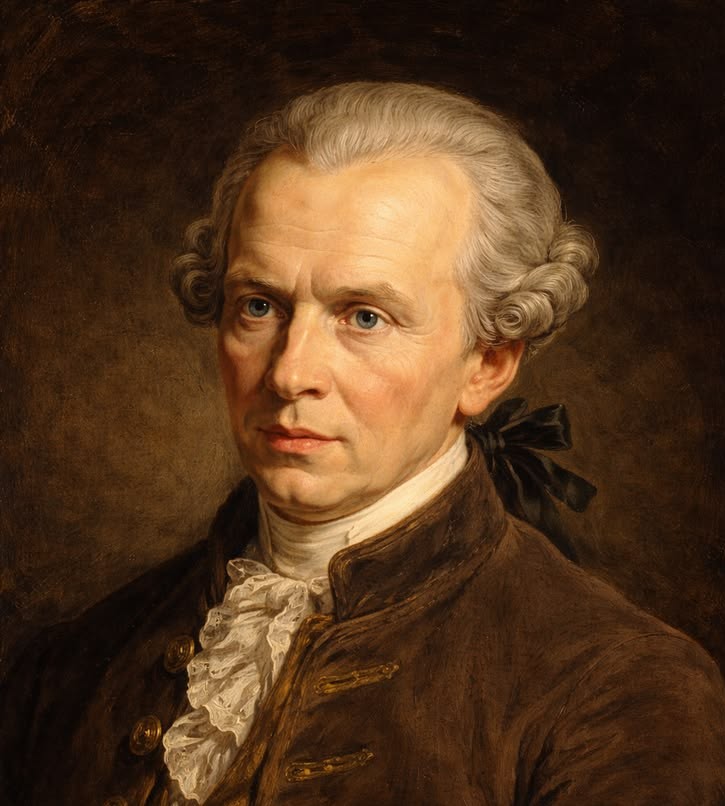
Immanuel Kant was born on 22 April 1724 in Königsberg, the capital of East Prussia. The city was an important commercial and university center, although it stood geographically far from many of the major intellectual centers of Europe. Kant spent almost his entire life in Königsberg and its surrounding region, where he studied, lectured, taught, and developed the philosophy that would transform European intellectual history. His unusual geographical stability contrasts with the extraordinary international influence eventually achieved by his writings and lectures.
Kant was born into a family of modest means. His parents were associated with Pietism, a reform movement within Lutheran Christianity that emphasized personal devotion, religious discipline, and moral seriousness. Kant attended the Pietist Collegium Fridericianum before entering the University of Königsberg, where his interests increasingly turned toward philosophy, mathematics, and natural science. His early education contributed to the seriousness with which he later approached questions of moral discipline, rational self-government, and religious belief.
At the university, Kant encountered the powerful influence of the Leibnizian-Wolffian rationalist tradition, while also becoming familiar with Newtonian science and later with British philosophy. His teacher Martin Knutzen helped introduce him to important developments in mathematics and physics. Kant's early writings consequently dealt with scientific and metaphysical questions long before the appearance of his mature critical philosophy. These early interests remained important throughout his career because he continued to regard the achievements of mathematical physics as a major philosophical problem.
Kant's academic career developed gradually. After completing his university studies, he worked for several years as a private tutor before becoming a lecturer at the University of Königsberg. He later became professor of logic and metaphysics in 1770. The period between his early publications and the appearance of the Critique of Pure Reason in 1781 was especially significant, because Kant spent years reconsidering the relationship between experience, reason, metaphysics, and scientific knowledge. This long period of intellectual development helped produce the distinctive critical method of his mature philosophy.
Kant lived during the Age of Enlightenment, when confidence in reason and scientific inquiry encouraged philosophers to question inherited authority and examine the foundations of human knowledge. His mature philosophy emerged partly from the tension between rationalism and empiricism and culminated in Critique of Pure Reason, published in 1781, after more than a decade of concentrated philosophical development. The historical Kant therefore belongs simultaneously to the Enlightenment and to the transition toward modern German philosophy, especially the tradition that followed his critical system in the nineteenth century.
Immanuel Kant and the Enlightenment
Kant was one of the most important philosophical representatives of the Enlightenment. He believed that human beings should learn to use their own understanding rather than remain intellectually dependent on tradition, authority, or the judgments of others. For Kant, enlightenment required the courage to think for oneself and to submit claims to rational criticism. Intellectual maturity therefore involved more than acquiring information; it meant developing the capacity to judge independently while accepting the discipline of reason.
In his famous 1784 essay An Answer to the Question: What Is Enlightenment?, Kant defined enlightenment as humanity's emergence from what he called self-incurred immaturity. He argued that people often allow others to think and decide for them even when they possess the capacity to exercise their own judgment. His famous motto was Sapere aude—"dare to know," or have the courage to use your own understanding. The essay presents enlightenment as a process through which individuals gradually learn to exercise rational judgment without surrendering their intellectual responsibility to external authorities.
Kant did not mean that enlightenment required rejecting every institution or social tradition. Instead, he argued that no claim to authority should place itself completely beyond rational examination. His defense of the public use of reason emphasized the importance of free intellectual discussion, criticism, and the ability of scholars and citizens to examine ideas publicly. Kant distinguished this public use of reason from certain restricted private uses connected with one's official role or occupation, allowing him to defend intellectual freedom while still acknowledging the need for social institutions to function according to established rules.
Kant's Enlightenment philosophy was therefore connected with both freedom and responsibility. Independent thinking was not simply the freedom to believe anything one wished. It required disciplined reasoning, criticism of prejudice and dogmatism, and a willingness to examine the limits of reason itself. This point is particularly important because Kant's own critical philosophy did not treat reason as an unlimited power. Instead, he believed that genuine intellectual progress requires understanding both what reason can establish and where its claims become unjustified or speculative.
Kant's understanding of enlightenment also connects with his broader conception of human autonomy. A mature human being should be capable of thinking and judging rather than merely following commands because they come from an external authority. This ideal has an important relationship to Kant's later moral philosophy, where autonomy becomes central to the idea of rational self-legislation under moral law. Consequently, Kant's Enlightenment thought is not simply a historical statement about eighteenth-century Europe; it is part of a broader philosophical account of intellectual freedom, rational agency, responsibility, and the development of humanity.
What Was Immanuel Kant's Philosophy?
Immanuel Kant's philosophy is often called critical philosophy because it investigates the powers, conditions, and limits of human reason. Kant believed that before philosophy makes ambitious claims about reality, it must first ask what makes knowledge, experience, morality, and judgment possible in the first place. His method therefore involves a systematic examination of reason itself rather than an unrestricted attempt to describe reality through abstract speculation. This critical approach became the foundation of his mature philosophical system.
One of Kant's major aims was to respond to the conflict between rationalism and empiricism. He agreed with empiricists that human knowledge begins with experience, but he rejected the idea that the mind is merely a passive receiver of sensory information. Human cognition contributes fundamental forms and concepts that help make experience intelligible. Kant consequently sought to explain how experience and a priori structures of cognition work together, allowing human beings to possess knowledge that is both connected with experience and governed by principles that are not simply copied from individual observations.
Kant therefore changed the focus of philosophical inquiry. Instead of asking only what reality is like independently of the knower, he asked what conditions must be satisfied for human beings to experience and know objects at all. This investigation into the conditions of possible experience became the foundation of his transcendental philosophy. Concepts such as space, time, the categories of the understanding, and the distinction between phenomena and noumena became central to his attempt to explain the structure of human cognition and the limits within which knowledge is possible.
Kant's system also extended far beyond epistemology. His moral philosophy examined duty, autonomy, freedom, and the dignity of rational persons; his political philosophy explored right and lawful freedom; and his aesthetics investigated beauty, the sublime, genius, and judgment. His philosophy of religion examined religious belief in relation to morality and the limits of speculative reason, while his writings on history and anthropology considered human development and social existence. Kant therefore developed a broad philosophical project concerned with several interconnected dimensions of human life.
The central feature of Kant's philosophy is the attempt to establish legitimate boundaries for reason without abandoning reason's authority. He rejected both dogmatic metaphysics that claimed knowledge beyond possible experience and forms of skepticism that threatened the possibility of reliable knowledge altogether. His critical method sought a middle position in which reason could explain the structures of experience, establish principles of morality, and guide judgment while recognizing that certain questions exceed the limits of human theoretical knowledge. This balance is a major reason Kant remains central to modern epistemology, metaphysics, ethics, and aesthetics.
Kant's Copernican Revolution in Philosophy
Kant compared his philosophical method to the revolution introduced by Nicolaus Copernicus in astronomy. Rather than assuming that human knowledge must simply conform to objects considered independently of cognition, Kant proposed that objects as objects of possible experience must conform to fundamental conditions supplied by human cognition. The analogy describes a change in philosophical perspective: instead of treating the knowing subject as merely adapting to independently given objects, Kant investigates the contribution made by the subject to the form in which objects can be experienced and known.
This does not mean that Kant believed human beings create the external world through imagination. His claim concerns the conditions under which objects can be experienced and known by us. Sensory experience is received through human sensibility, while the understanding organizes that experience according to fundamental concepts and principles. Kant therefore distinguishes between things considered independently of our mode of cognition and objects as they appear within possible human experience. This distinction is essential to understanding what his Copernican revolution actually proposes.
Kant's Copernican revolution therefore changed a central question of epistemology. Instead of asking only how the mind can copy or discover a completely independent reality, Kant asked what the mind must contribute for an ordered experience of objects, events, and natural laws to be possible. The problem becomes transcendental: what structures must already be in place for empirical knowledge to occur? By asking this question, Kant attempted to explain how mathematics and natural science could contain necessary and universal principles while still relating to objects encountered through experience.
This approach became the foundation of transcendental philosophy. For Kant, "transcendental" does not simply mean mysterious or beyond the physical world. It refers to an investigation of the a priori conditions that make possible experience and knowledge of objects. Space and time, for example, are treated as fundamental forms of human sensibility, while the categories of the understanding provide basic conceptual structures through which experienced objects can be thought. Kant's transcendental method therefore studies the framework within which experience and objective cognition are possible.
The Copernican revolution also explains why Kant's philosophy occupies a distinctive position between traditional metaphysics and modern epistemology. He did not simply deny that a reality exists independently of human cognition, but he argued that theoretical knowledge is restricted to objects as they can be given within possible experience. This limitation was intended to prevent reason from turning concepts such as God, freedom, and the soul into objects of theoretical knowledge when they cannot be experienced in the same way as empirical objects. Kant's revolution therefore both expands the importance of the knowing subject and establishes strict limits on what theoretical reason can legitimately claim.
Immanuel Kant's Theory of Knowledge and Epistemology
Kant's epistemology investigates the relationship between experience, sensibility, understanding, and reason. Kant famously argued that all our knowledge begins with experience, but he denied that all knowledge arises from experience. Human cognition contains a priori elements that help make coherent experience possible. His central concern was therefore not simply where individual pieces of information come from, but what conditions must be present for human beings to have organized, objective, and meaningful knowledge of the world.
This position allowed Kant to challenge both a simple empiricism and a traditional form of rationalism. Experience supplies the material through which objects are encountered, but the mind does not merely record disconnected sensations. Human cognition organizes experience in ways that allow us to recognize objects, events, relationships, and lawful connections. Kant's approach consequently attempts to explain how knowledge can depend upon experience while also containing elements that are not themselves derived from particular sensory observations.
Kant therefore emphasized the cooperation between sensibility and understanding. Sensibility gives us intuitions through which objects are presented, while the understanding supplies concepts through which what is given in intuition can be thought and judged. Neither faculty can by itself provide the complete structure of human cognition. Sensibility without conceptual organization would provide appearances without the kind of unified objectivity required for knowledge, while concepts without sensible content would lack objects to which they could meaningfully apply.
Kant expressed this relationship in one of his most famous claims: concepts without intuitions are empty, while intuitions without concepts are blind. Knowledge requires both sensible content and conceptual activity. Neither the senses alone nor abstract concepts alone can explain the full possibility of human knowledge. This principle captures an important feature of Kant's critical philosophy: knowledge is produced through the interaction of what is given to human sensibility and the structures through which the understanding organizes and judges that material.
Kant's theory of knowledge therefore seeks to explain how objective experience is possible without reducing cognition either to passive sensation or to pure intellectual speculation. His investigation of sensibility, understanding, reason, and a priori principles became one of the foundations of modern epistemology. By asking about the conditions that make knowledge possible, Kant shifted philosophical attention toward the structure of cognition itself and established the transcendental method as a central feature of his mature philosophy.
What Are A Priori and A Posteriori Knowledge in Kant's Philosophy?
Kant distinguished between a priori and a posteriori knowledge. A posteriori knowledge depends on experience, while a priori knowledge has a justification that does not depend on particular experiences in the same way. Kant associated genuine a priori knowledge with necessity and strict universality. This distinction became fundamental to his attempt to explain how human beings can possess knowledge that is not simply a collection of generalizations formed from repeated observations.
For example, learning that it is raining outside depends on observation and is therefore a posteriori. Kant, however, was interested in how mathematics and fundamental principles of natural science could possess a kind of necessity that seemed difficult to explain merely by observing many particular cases. A person can observe countless instances of an event occurring in a certain way, but observation alone does not straightforwardly establish the necessity that Kant believed certain forms of knowledge possess.
Kant also distinguished between analytic and synthetic judgments. In analytic judgments, the predicate is contained within the concept of the subject, whereas synthetic judgments extend knowledge by connecting concepts in a way that adds something not already contained in the original concept. This distinction allowed Kant to formulate a more precise question about the relationship between the structure of concepts, experience, and the possibility of knowledge that genuinely expands our understanding.
His central question became: How are synthetic a priori judgments possible? Kant believed that answering this question was essential for explaining mathematics and the possibility of a priori knowledge of nature. It also formed part of his larger attempt to determine whether metaphysics could become a genuine science. The problem was especially important because synthetic a priori judgments appear to extend knowledge while also possessing a necessity that cannot simply be explained as the result of repeated empirical observations.
Kant's treatment of a priori and a posteriori knowledge therefore became one of the central foundations of his critical philosophy. Instead of asking whether knowledge comes exclusively from reason or exclusively from experience, he examined how different elements of cognition contribute to knowledge. His analysis ultimately connects a priori principles with the structures of human cognition and with the conditions under which experience itself becomes possible, making the distinction essential to understanding his epistemology and philosophy of science.
Kant's Philosophy of Space and Time
Kant argued that space and time are fundamental forms through which human beings receive sensible experience. They are not, in his view, ordinary empirical concepts that we first learn by observing the world, because particular experiences already appear to us as spatially and temporally ordered. Before we can encounter particular objects as being located somewhere or events as occurring in succession, experience must already be structured through these fundamental forms of sensibility.
Kant therefore described space and time as pure forms of intuition. Space is the form through which external objects are presented to us, while time is the form of inner sense and also conditions all of our experience. These forms make it possible for sensory appearances to be ordered rather than received as an unintelligible collection of impressions. Space allows outer objects to be experienced as spatially related, while time provides the ordering through which inner states and events can be experienced as successive or simultaneous.
This theory became a central part of Kant's transcendental idealism. Kant argued that space and time characterize objects as they appear under the conditions of human sensibility. We therefore cannot simply assume that space and time describe things exactly as they exist independently of every possible human mode of experience. His argument concerns the structure through which objects can appear to beings possessing human sensibility, rather than denying that spatial and temporal experience has objective validity within the empirical world.
Kant's theory did not deny the reality of spatial and temporal experience. Instead, it distinguished between the world as it is experienced by human beings and things considered independently of the particular conditions through which humans experience them. This distinction became one of the most controversial features of his philosophy. Kant's position allowed him to explain why geometry and arithmetic could possess a special kind of necessity while maintaining that human knowledge remains connected to the conditions of possible experience.
The philosophical importance of Kant's account of space and time lies in his attempt to explain the framework within which experience itself becomes possible. Space and time are not learned after experience has already occurred; they are conditions through which sensible experience is structured. This idea became central to his transcendental argument and had a lasting influence on later debates about perception, mathematics, metaphysics, and the relationship between human cognition and the structure of experienced reality.
Kant's Categories of Understanding
Kant argued that sensory experience alone cannot explain how we have knowledge of objects. The understanding actively organizes what is given in sensibility through fundamental concepts that Kant called the categories. These categories are a priori concepts that play a necessary role in the experience of an objective and law-governed world. They are therefore not merely classifications that people invent after observing objects but are connected with the fundamental activity of human understanding.
Kant identified twelve categories, traditionally arranged under the headings of quantity, quality, relation, and modality. They include concepts such as unity, plurality, reality, causality, possibility, and necessity. These are not ordinary ideas acquired simply by comparing individual objects through repeated observation. Kant regarded them as fundamental conceptual forms through which the understanding can organize what is presented in sensible intuition into an intelligible experience of objects and events.
The categories help explain how experience can have objective unity. When we understand one event as causing another, for example, we do not experience merely a succession of disconnected sensations. The understanding brings experiences together according to principles that make it possible to recognize events as belonging to an ordered natural world. Causality is therefore not treated simply as something discovered by repeatedly observing sequences; it functions as a fundamental category through which events can be understood as objectively connected.
Kant's claim was therefore stronger than the simple idea that the mind interprets experience differently from one person to another. The categories are presented as universal conditions of human experience, making possible the kind of objective knowledge investigated by the natural sciences. They provide conceptual structures through which appearances can be judged as objects possessing relations, properties, and connections. In this sense, Kant's categories form an important part of his explanation of how a coherent world of experience is possible.
The categories also demonstrate why Kant's epistemology cannot be reduced either to pure empiricism or to unrestricted rationalism. Sensibility provides the material of intuition, but the understanding supplies conceptual structures that allow this material to become intelligible as an objective experience. Kant's theory of the categories consequently became one of the most important parts of the Critique of Pure Reason and a major influence on subsequent philosophy of mind, metaphysics, epistemology, and theories of scientific knowledge.
Phenomena and Noumena in Kant's Philosophy
One of the most famous and difficult distinctions in Immanuel Kant's philosophy concerns phenomena and noumena. Phenomena are objects as they appear within the conditions of human experience—through space, time, and the conceptual activity of the understanding. They are therefore the objects about which human beings can possess empirical knowledge, because they are available within the framework of possible experience and can be investigated through observation and scientific inquiry.
The term noumenon is connected with the idea of a thing considered independently of human sensibility. Kant also speaks of the thing-in-itself, but these terms should not be treated as entirely simple synonyms in every context. What is crucial is that Kant denies human beings theoretical knowledge of things as they may be independently of the conditions of possible experience. The distinction therefore marks an important boundary between what human cognition can legitimately know and what it can merely think as a limiting concept.
Kant therefore did not claim that the external world is imaginary or that only minds exist. His argument concerns the limits of human cognition: whatever objects may be independently of our way of experiencing them, human theoretical knowledge is restricted to objects insofar as they can be given to us in experience. The empirical world is consequently not dismissed as illusion. Rather, Kant asks us to distinguish the reality of experienced objects from claims about what things might be like independently of the conditions through which they can become objects for human cognition.
This distinction became one of the most debated features of transcendental idealism. Later philosophers, particularly within German idealism, questioned whether Kant could consistently maintain a distinction between appearances and things in themselves while also explaining the conditions under which appearances are experienced. Some later thinkers attempted to modify or overcome the distinction, while others developed new interpretations of Kant's account of the relationship between cognition, appearance, and reality.
The phenomena–noumena distinction is therefore essential for understanding Kant's theory of the limits of knowledge. Human beings can investigate the empirical world because phenomena are structured within possible experience, but theoretical reason cannot simply cross beyond those conditions and claim knowledge of things as they might be independently of human cognition. Kant's position establishes a boundary between legitimate empirical knowledge and speculative metaphysical claims, making the distinction one of the defining features of his critical philosophy.
What Is Kant's Transcendental Idealism?
Transcendental idealism is one of the central and most controversial theories of Kant's philosophy. It holds that human knowledge of objects is conditioned by the fundamental forms and structures through which human beings experience and understand the world. Kant's theory therefore does not begin by describing reality from a supposedly completely independent standpoint; it investigates the conditions under which objects can become objects of human experience and knowledge.
Kant called his philosophy "transcendental" because it investigates the conditions that make experience possible. He called it "idealism" because space and time characterize objects as they appear to human sensibility rather than describing things independently of every possible relation to human cognition. The term "transcendental" in Kant's usage therefore refers to a specific philosophical method concerned with a priori conditions of experience rather than simply referring to something supernatural or beyond the physical world.
At the same time, Kant rejected the suggestion that the empirical world is merely imaginary or unreal. He combined transcendental idealism with what he called empirical realism: objects in space and time are fully real as objects of possible human experience and can be investigated objectively through empirical science. This combination is important because Kant's idealism was not intended to deny ordinary experience, the existence of empirical objects, or the validity of scientific investigation.
Transcendental idealism therefore attempts to explain both the possibility and the limits of human knowledge. Human beings can possess objective knowledge of the world of experience, yet speculative reason cannot legitimately claim unlimited theoretical knowledge of realities that could never be encountered within possible experience. Kant's theory thus places a boundary around theoretical reason while preserving a substantial domain in which empirical knowledge remains possible and meaningful.
The theory became one of the defining features of Kant's mature philosophy and strongly influenced later debates about reality, consciousness, knowledge, and metaphysics. Its central insight is that understanding human knowledge requires examining the conditions through which objects can be experienced in the first place. Kant consequently transformed the traditional question "What is reality?" into a closely related critical question: what conditions must hold for human beings to experience and know objects as part of an ordered world?
Immanuel Kant's Critique of Pure Reason
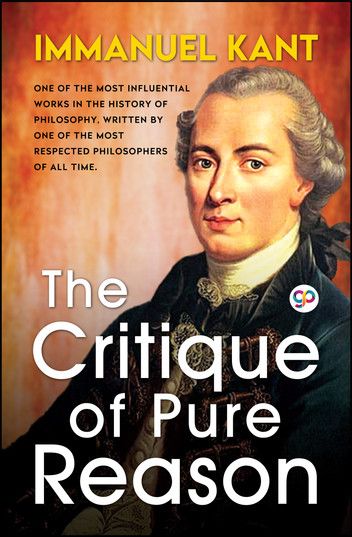
Critique of Pure Reason, first published in 1781 and substantially revised in 1787, is Kant's most famous philosophical work. The book investigates the possibility, sources, scope, and limits of a priori knowledge and asks whether metaphysics can become a genuine science. It represents the central statement of Kant's mature epistemological and metaphysical project and attempts to determine what human reason can establish independently of particular experiences.
Kant wanted to explain how mathematics and natural science could possess necessity and universality while also showing why traditional metaphysics repeatedly became involved in disputes about the soul, freedom, God, and the universe as a whole. His solution was to examine the contribution that human cognition makes to possible experience. Rather than treating scientific knowledge and metaphysical speculation as equally secure, Kant investigated the conditions under which different kinds of claims can legitimately count as knowledge.
The Critique argues that sensibility and understanding provide fundamental conditions for experience. Space and time structure sensible intuition, while the categories of the understanding make possible the experience of objects as connected within an ordered and law-governed world. These elements work together: sensible intuition provides what is given to cognition, while the understanding supplies concepts and principles through which that material can be thought as an objective experience.
Kant also examines the tendency of reason to seek ultimate explanations beyond particular experience. This tendency is natural, but speculative reason can generate transcendental illusions when it treats ideas such as the soul, the world as a complete totality, or God as objects that can be known theoretically in the same manner as empirical objects. Kant's discussion of these problems demonstrates why reason requires criticism when it attempts to extend its concepts beyond the limits of possible experience.
The importance of the book lies not only in its individual arguments but in its method. Kant attempted to transform philosophy by requiring reason to examine its own powers before extending knowledge beyond the limits of possible experience. In this sense, the Critique of Pure Reason both restricts speculative metaphysics and seeks to explain the legitimate foundations of scientific knowledge. Its influence on epistemology, metaphysics, philosophy of science, and subsequent German philosophy has made it one of the foundational works of modern philosophical thought.
Immanuel Kant's Philosophy of Metaphysics
Kant did not simply reject metaphysics. Instead, he believed that metaphysics required a critical investigation of its sources, possibilities, and limits. Philosophers had made ambitious claims about God, the soul, freedom, and the universe without first determining whether human cognition was capable of theoretical knowledge about such objects. Kant's project was therefore to investigate the conditions under which metaphysical reasoning could be legitimate rather than simply accepting or dismissing metaphysics as a whole.
Kant argued that metaphysical questions arise naturally from human reason. Human beings seek explanations that move beyond particular events toward increasingly comprehensive conditions and ultimate principles. Yet reason can exceed its legitimate theoretical use when it treats ideas that guide inquiry as though they were objects directly available for knowledge. This tendency helps explain why metaphysical reasoning repeatedly produces apparently compelling but conflicting arguments about ultimate reality.
Kant's critical philosophy therefore attempted to establish a new foundation for metaphysics. Rather than beginning with speculative descriptions of ultimate reality, philosophy should first investigate the a priori conditions under which objects can be experienced and known by human beings. This transcendental investigation allows Kant to distinguish questions that belong legitimately to empirical and transcendental inquiry from questions that cannot be answered through theoretical knowledge.
This approach transformed later metaphysical debates. Kant showed that questions about reality cannot be entirely separated from questions about the capacities through which human beings experience, think, and judge. His philosophy thus made the limits of cognition themselves a central problem of metaphysics. The result was not the elimination of metaphysical questions but a major transformation in the way those questions could be formulated and defended philosophically.
Kant's conception of metaphysics therefore occupies a difficult position between dogmatism and skepticism. He rejected attempts to claim theoretical knowledge where the conditions of possible experience do not permit it, but he also recognized that reason naturally raises questions about freedom, God, the soul, and the ultimate unity of knowledge. His critical philosophy seeks to discipline these questions by distinguishing legitimate knowledge from speculative overreach, while leaving room for their practical and regulative significance.
The Limits of Human Reason in Kant's Philosophy
Kant believed that recognizing the limits of reason was one of philosophy's most important tasks. Human reason is capable of extraordinary achievements, particularly in organizing knowledge and seeking systematic explanations, but it cannot automatically provide theoretical knowledge about every question that human beings are able to ask. The ability to formulate a question does not by itself guarantee that human cognition possesses the means necessary to answer it as an object of theoretical knowledge.
Questions about the ultimate beginning of the universe, the nature of the soul, human freedom, or the existence of God can lead reason beyond the conditions under which objects can be given in possible experience. Kant argued that speculative reason becomes confused when it treats such questions as though they concerned ordinary objects available for theoretical investigation. The problem is not that reason should stop asking such questions, but that it must recognize the difference between thinking an idea and possessing knowledge of an object corresponding to that idea.
Kant's famous antinomies illustrate this problem. When reason attempts to understand the world as a complete totality beyond all possible experience, it can produce apparently compelling arguments for opposite conclusions. The resulting conflict reveals a problem in the way reason has extended its concepts beyond their legitimate application. Kant uses these conflicts to demonstrate why philosophical reason requires a critical examination of the conditions within which its concepts can legitimately be used.
Limiting theoretical reason did not mean that Kant considered metaphysical or religious questions meaningless. Instead, he distinguished between what can be theoretically known and what may have practical or regulative importance. This distinction became essential to his later philosophy of freedom, morality, religion, and the highest good. Questions that cannot be settled as objects of theoretical knowledge can still have an important role in practical reasoning and in the organization of human thought.
Kant's critical limitation of reason is therefore not simply a skeptical doctrine saying that human beings know very little. It is an attempt to establish a precise boundary between legitimate knowledge and unjustified speculation. By examining where concepts can and cannot legitimately be applied, Kant sought to protect scientific and empirical knowledge while preventing metaphysics from claiming more than theoretical reason can establish. This balance became one of the defining characteristics of his critical philosophy.
Immanuel Kant's Ethics and Moral Philosophy
Kant's moral philosophy is one of the most influential ethical systems in the history of philosophy. Kant argued that morality cannot be grounded merely in changing emotions, personal preferences, social customs, or calculations about the consequences that happen to result from an action. Moral principles must instead possess a rational authority that does not depend entirely upon what an individual happens to desire or what consequences they happen to expect.
For Kant, the distinctive moral worth of an action depends on its maxim, or principle of action, and on whether the agent acts from duty. This does not mean that feelings such as sympathy are worthless. Rather, Kant distinguishes an action performed because it happens to satisfy an inclination from an action performed out of respect for moral law. The distinction is important because Kant's ethics evaluates the principle and motivation underlying an action rather than judging moral worth solely from its external result.
Kant believed that morality must have a universal and rational character. A moral principle cannot merely express what one particular person wants under particular circumstances. Rational agents must be able to ask whether the principle guiding an action can be consistently willed as a law for everyone. This requirement gives Kant's ethics a strongly universal dimension and explains why his moral theory is commonly associated with deontological ethics, in which duty and principle have a central role.
His ethical philosophy therefore emphasizes duty, autonomy, universal law, freedom, and respect for persons. Kant's claim that humanity must always be treated as an end and never merely as a means remains influential in contemporary debates about rights, professional ethics, political responsibility, and human dignity. The moral status of persons is not dependent simply upon their usefulness, social position, wealth, intelligence, or contribution to a particular collective goal.
Kant's ethics ultimately presents morality as an expression of rational agency. Human beings are capable of reflecting on the principles that guide their actions and of holding themselves responsible for whether those principles can be justified. This connection between morality, reason, freedom, and autonomy explains why Kant remains central to modern ethical theory and why his work continues to influence debates about universal moral principles, dignity, responsibility, rights, and the obligations individuals have toward one another.
Kant's Concept of the Good Will
Kant begins the Groundwork of the Metaphysics of Morals with the idea of the good will. He argues that qualities commonly considered valuable, such as intelligence, courage, power, wealth, or even happiness, can become harmful when they are directed by a morally corrupt will. Their value therefore depends partly on how they are used and on the principles governing the person who possesses them.
A good will, by contrast, is good because of the way it wills. Its moral value does not depend simply on whether circumstances allow an action to achieve its intended result. A person can act from a morally worthy principle even when external obstacles prevent success. Kant therefore separates the moral worth of the will from the contingent success or failure of the consequences that follow from an action.
Kant's emphasis on the good will therefore distinguishes moral worth from the mere production of desirable consequences. The fundamental question is not only what happened? but also from what principle did the person act? A will acting from duty expresses respect for the moral law rather than allowing self-interest alone to determine action. This emphasis on the principle of willing is central to understanding Kant's conception of moral agency.
The good will is closely connected with Kant's broader concept of duty. To act from duty is to act because one recognizes a moral requirement as binding, rather than simply because the action happens to coincide with one's desires or inclinations. Kant's argument does not require that moral agents lack feelings; instead, it distinguishes the source of moral worth from feelings that may or may not accompany morally correct conduct.
Kant's account of the good will provides the starting point for his wider moral philosophy. The good will is a rational will capable of acting according to principles that can be justified as moral law. This connects the good will with duty, autonomy, freedom, and the categorical imperative. Kant's central insight is that moral worth belongs fundamentally to the rational character of willing rather than to external success, social recognition, or the possession of talents and advantages.
What Is Kant's Categorical Imperative?
The categorical imperative is the central principle of Kant's moral philosophy. Kant distinguishes categorical imperatives from hypothetical imperatives, which tell a person what they ought to do if they wish to achieve a particular goal. Hypothetical requirements therefore depend upon an antecedent desire or purpose, while categorical moral requirements are presented as binding independently of whatever particular ends a person happens to pursue.
A hypothetical imperative might say that if someone wants to become a skilled musician, they should practice regularly. The requirement depends on the person's chosen purpose. A categorical imperative, by contrast, expresses an unconditional moral requirement that does not depend on any particular desire or personal objective. Its authority therefore comes from the rational character of moral law rather than from the practical usefulness of an action for achieving a desired outcome.
Kant believed that moral reasoning requires us to examine the maxim behind an action—the principle according to which we intend to act. Rather than asking only whether an action will produce desirable results, Kant asks whether the underlying principle can be rationally justified as universally binding. The moral agent must therefore reflect on the principle of action and consider whether it could be consistently adopted as a law for rational agents in general.
The categorical imperative is therefore not simply a list of ordinary moral rules. Kant developed several formulations that express closely related aspects of moral law, including universality, respect for humanity, autonomy, and the idea of a community of rational beings who recognize themselves as subject to universal moral principles. These formulations help clarify different dimensions of the same fundamental demand that morality be grounded in rationally universal principles.
Kant's categorical imperative is important because it makes moral obligation independent of calculations about personal advantage or predicted consequences. Its purpose is not to provide a mechanical formula for every possible moral decision but to establish a standard for evaluating the principles on which actions are based. Through this idea, Kant connects morality with rationality, autonomy, freedom, duty, and the equal moral status of persons, creating one of the most influential forms of deontological ethics in modern philosophy.
The Main Formulations of Kant's Categorical Imperative
1. The Formula of Universal Law
One of Kant's best-known formulations asks individuals to act only according to a maxim through which they can at the same time will that it become a universal law. A person must therefore examine the principle behind an action and ask whether it could coherently be adopted as a principle for rational agents generally. The formulation shifts attention away from the immediate attractiveness of an action toward the rational structure of the principle on which the action is based.
The universal-law formulation requires moral agents to test their maxims rather than simply asking whether a particular action benefits them. If a person adopts a maxim that could not coherently function as a universal law, Kant's moral framework treats this as evidence of a problem in the principle of action. The test is therefore concerned with the rational consistency and universalizability of the maxim.
This formulation illustrates why Kant's ethics is strongly concerned with principles rather than isolated acts. The same outward action may occur under different motives and maxims, and Kant's ethical analysis therefore asks what principle the agent is actually following. The universal-law test provides a way of examining whether that principle can be regarded as suitable for rational agents generally rather than merely as an exception permitted for oneself.
The idea of universal law also connects Kant's ethics with his broader conception of rational autonomy. Moral agents are not simply obeying a rule imposed upon them from outside; they are rationally evaluating the principles that can govern their own conduct. The moral law is therefore connected with the capacity of reason to recognize principles as universally binding rather than treating morality as a collection of arbitrary commands.
The Formula of Universal Law consequently provides one of the clearest expressions of Kant's attempt to ground morality in rational universality. It asks whether the principle guiding an action can be consistently willed as a universal law and thereby connects moral judgment with duty, rational consistency, autonomy, and responsibility. It remains one of the most widely discussed aspects of Kant's ethical theory.
2. Humanity as an End in Itself
Kant also argues that humanity, whether in one's own person or in the person of another, must always be treated as an end in itself and never merely as a means. Individuals may cooperate and benefit from one another, but rational persons possess a dignity that prevents them from being treated simply as instruments for someone else's purposes. This formulation places the moral status of rational persons at the center of Kant's ethical theory.
Treating someone as an end does not mean that people can never serve one another's purposes. Ordinary social cooperation constantly involves people helping one another to achieve particular goals. Kant's concern is with treating another person merely as a means, especially when their rational agency is ignored, manipulated, or deliberately subordinated to another person's private objective.
The concept of humanity in this formulation refers to the rational capacities associated with moral agency. Human beings are capable of understanding principles, making choices, setting ends, and taking responsibility for their conduct. Because of this rational capacity, persons cannot legitimately be assigned the same moral status as objects whose value depends entirely upon how useful they are to someone else.
Kant's language of an end in itself therefore provides a philosophical foundation for the idea that persons possess intrinsic moral worth. Their dignity does not arise merely from social recognition, economic usefulness, political power, or personal achievement. Instead, rational agency itself has a distinctive moral status that imposes limits on how individuals may legitimately treat one another.
This formulation has had a profound influence on later discussions of human dignity, rights, consent, exploitation, and moral responsibility. Although contemporary theories of human rights should not be reduced entirely to Kant's philosophy, the principle that persons must not be treated merely as instruments remains one of Kant's most enduring contributions to modern ethical and political thought.
3. The Kingdom of Ends
Another formulation presents the ideal of a kingdom of ends, a systematic moral community in which rational beings understand themselves as both subject to and participants in universal lawgiving. The idea emphasizes autonomy, reciprocal respect, and the possibility of a rational moral order. Each member is understood not simply as an object governed by rules but as a rational agent capable of participating in the principles that govern moral community.
The kingdom of ends is closely connected with Kant's idea that rational beings must regard one another as ends in themselves. A moral community is therefore not simply a collection of individuals pursuing private interests. It is an ideal order in which each person recognizes the moral standing of every other rational agent and acts according to principles that could be accepted as universal laws.
The concept also combines the ideas of autonomy and universal moral legislation. Rational agents are both subject to moral law and, through their rational autonomy, participants in the lawgiving authority of that moral order. This does not mean that individuals invent personal moral rules whenever they wish. Rather, moral legislation is constrained by principles that can be justified as universal and consistent with the equal status of rational beings.
Kant's kingdom of ends therefore represents an ideal of moral reciprocity. Each rational person must respect others as beings with their own ends rather than treating them simply as instruments. At the same time, each person remains responsible for acting according to principles that could belong to a universal moral order. The concept thus links individual moral agency with the possibility of a community founded on shared rational principles.
Together, the three formulations show that Kant's ethics is concerned with several interconnected dimensions of moral life: universal law, respect for humanity, autonomy, and rational community. They should not be understood as three unrelated rules but as different expressions of Kant's account of the moral law. His ethical theory ultimately asks rational agents to govern themselves according to principles that can be universally justified while respecting every person as an end in themselves.
Together, these formulations show that Kant's ethics is concerned with more than mechanically obeying isolated rules. His moral philosophy investigates whether rational agents can act according to principles they can justify universally while recognizing the intrinsic worth and autonomy of every person. The formulations therefore provide a bridge between Kant's concepts of duty, freedom, dignity, autonomy, and moral responsibility.
Kant's Philosophy of Duty
The concept of duty plays a central role in Kant's ethics. An action has distinctive moral worth when a person performs it because they recognize that it is morally required, rather than merely because the action happens to agree with a desire, interest, or expected advantage. Duty therefore expresses the authority of moral law over the will and helps distinguish moral action from conduct motivated exclusively by personal inclination.
For example, a person may help another because they expect praise, wish to protect their reputation, or simply enjoy helping. Kant does not necessarily claim that such motives are morally bad. His point is that an action's agreement with duty is not identical with acting from duty. The distinction becomes important when we ask what gives an action its specifically moral worth rather than merely asking whether the outward behavior happens to produce a good or socially desirable result.
This distinction becomes especially important when inclination and moral principle conflict. Kant asks whether a person can remain committed to what is right even when doing so brings no personal benefit and may require sacrifice. Respect for moral law, rather than the expectation of reward, gives duty its distinctive place in his ethics. The morally significant question is whether the person acts because they recognize an obligation as binding.
Kant's conception of duty is therefore closely connected with his account of autonomy. To act from duty is not simply to obey another person's command without reflection. Moral duty arises from a rational recognition of principles that can be understood as universally binding. The agent is therefore responsible for acting according to moral law while also exercising rational judgment about the principles governing conduct.
Kant's philosophy of duty has often been criticized as overly strict or excessively formal. Nevertheless, its emphasis on principle remains influential because it raises a fundamental question: can morality be reduced to personal preference or desirable outcomes, or does it require obligations that remain binding even when self-interest points in another direction? Kant's answer places moral responsibility in the rational capacity to recognize and act from principles of universal moral law.
Immanuel Kant's Philosophy of Freedom
Freedom is essential to Kant's moral philosophy. Moral obligation appears to require that human beings be capable of acting according to principles rather than being understood only as passive effects of natural causes, instincts, desires, and external circumstances. If human beings were incapable of choosing according to rational principles, the concepts of moral responsibility, obligation, and duty would become difficult to understand.
Kant distinguishes between different standpoints from which human beings can be considered. As beings who appear within nature, humans are subject to causal laws. Yet as rational agents engaged in moral deliberation, they must also understand themselves as capable of initiating action according to principles that reason recognizes as binding. This distinction forms part of Kant's attempt to reconcile the causal order described by natural science with the practical standpoint required by morality.
Freedom therefore does not simply mean doing whatever one desires. Kant connects genuine freedom with autonomy—the capacity of rational agents to govern their wills according to laws that reason gives to itself rather than being ruled entirely by impulse, desire, or external authority. A person dominated entirely by changing inclinations may act according to desire, but Kant does not regard such action as the fullest expression of rational moral freedom.
Kant's conception of freedom is consequently closely connected with moral law. To be free is not merely to have many possible choices; it is to possess the capacity to act according to rational principles rather than being determined solely by inclination. This connection between freedom and moral self-legislation became one of the defining features of Kant's account of autonomy and helped shape later philosophical discussions of agency and responsibility.
Kant's attempt to connect freedom with morality became one of the most important developments in modern philosophy. It also generated a lasting problem: how can human freedom be understood alongside the causal laws through which science explains the natural world? Kant's critical philosophy addresses this tension by distinguishing the standpoint from which human beings are understood as natural objects from the practical standpoint in which they must regard themselves as free and morally responsible agents.
Kant's Concept of Autonomy
Autonomy literally refers to self-legislation and is one of the central concepts of Kant's moral philosophy. A morally autonomous person does not merely obey commands because an external authority demands obedience. Instead, the rational will recognizes itself as bound by moral principles that it can understand through practical reason. Autonomy is therefore closely connected with the capacity to act according to principles rather than being governed entirely by external forces or changing desires.
Kant contrasts autonomy with heteronomy. A heteronomous will is determined by something external to rational moral self-legislation, such as the pursuit of pleasure, fear of punishment, the desire for reward, or dependence on contingent personal inclinations. Such motives may influence ordinary behavior, but Kant argues that they cannot by themselves provide the ultimate foundation of moral obligation.
Kant's autonomy should not be confused with the modern idea that every individual is morally free to invent whatever values they personally prefer. Autonomy concerns the capacity of rational agents to bind themselves to universal moral law rather than allowing arbitrary desire to determine what counts as right. The autonomous will is therefore not lawless; it is governed by principles that reason can recognize as universally valid.
Autonomy is also closely connected with Kant's conception of dignity. Rational persons are not merely passive recipients of moral rules imposed from outside. They are capable of understanding moral principles and acting according to them. This capacity for rational self-legislation helps explain why Kant treats persons as ends in themselves and why moral respect requires recognizing their status as autonomous agents rather than reducing them to instruments.
This concept has had a major influence on modern ideas of dignity, responsibility, consent, and political freedom. Although contemporary uses of the word "autonomy" are often broader than Kant's original theory, his account remains a major source for philosophical debates about self-governance and respect for persons. Kant's autonomy ultimately connects freedom, rationality, morality, and universal law into a unified account of what it means for a person to govern their conduct through reason.
Critique of Practical Reason
Critique of Practical Reason, published in 1788, develops Kant's philosophy of morality and practical reason. While the Critique of Pure Reason investigates the conditions and limits of theoretical knowledge, the second Critique examines reason in its capacity to guide action. It therefore shifts attention from the question of what can be known theoretically to the question of how rational agents understand and govern their conduct.
Kant argues that practical reason concerns what rational agents ought to do. Moral consciousness reveals that we experience ourselves as subject to obligations and as responsible for our actions. This practical standpoint is closely connected with freedom, because moral law addresses agents as capable of acting for reasons rather than merely following natural impulses. Practical reason therefore plays a distinctive role in Kant's account of moral agency.
The work also explores the relationship between morality, freedom, happiness, and the highest good. Kant argues that morality cannot be reduced to the pursuit of happiness, even though happiness remains an unavoidable human concern and practical reason seeks a systematic relation between virtue and well-being. The highest good involves a connection between moral virtue and appropriate happiness, although Kant does not treat happiness as the fundamental basis of moral obligation.
The Critique of Practical Reason also develops Kant's conception of the moral law as something that reason recognizes as authoritative. Moral obligation is not derived simply from external commands or calculations about consequences. Instead, practical reason presents the moral law as binding on rational agents and thereby connects morality with autonomy, freedom, and responsibility. This account forms an important continuation of the ethical arguments Kant developed in the Groundwork.
The Critique of Practical Reason therefore expands Kant's critical philosophy beyond theoretical knowledge. It investigates how moral law gives practical reason a distinctive role and prepares the ground for Kant's discussion of freedom, God, immortality, and the practical postulates of reason. The work demonstrates how Kant's critical method applies not only to the limits of knowledge but also to the structure of rational action and the demands of moral life.
Immanuel Kant's Philosophy of Religion
Kant's philosophy of religion is closely connected with his distinction between theoretical and practical reason. He argued that traditional metaphysical arguments could not provide theoretical knowledge of God in the same way that empirical science provides knowledge of objects within possible experience. His critical philosophy therefore places important limits on what can be demonstrated through speculative reasoning about religious objects.
In the Critique of Pure Reason, Kant critically examined traditional arguments for God's existence, including the ontological, cosmological, and physico-theological arguments. His critique did not mean that religious ideas were necessarily without significance; it challenged the claim that speculative metaphysics could establish theological truths as objects of theoretical knowledge. Kant's criticism was directed at the attempt to turn such ideas into objects of theoretical cognition beyond the limits of possible experience.
Kant nevertheless argued that God, freedom, and immortality have an important connection with practical reason. They are not theoretical objects that can simply be demonstrated through speculative proof, but practical reason gives them a distinctive role in relation to morality and the pursuit of the highest good. This distinction allows Kant to preserve an important role for religious ideas while maintaining the limits established by his critical account of theoretical knowledge.
Kant later developed his views more extensively in Religion within the Boundaries of Mere Reason. His philosophy of religion therefore attempts to preserve the moral seriousness of religious questions while sharply distinguishing faith and practical commitment from claims of unrestricted theoretical knowledge. Religion becomes closely related to morality because questions about human moral responsibility, evil, virtue, and the highest good cannot be reduced simply to empirical descriptions of the natural world.
Kant's philosophy of religion is consequently neither a straightforward defense of traditional theology nor a simple rejection of religion. Instead, it places religious thought within the limits established by critical reason while emphasizing the importance of morality and practical rationality. His approach became highly influential in later philosophy of religion because it raised enduring questions about the relationship between rational proof, faith, morality, freedom, and the boundaries of human knowledge.
Immanuel Kant's Political Philosophy
Kant's political philosophy is grounded in ideas of freedom, right, and law. He argued that a just civil condition should make it possible for the external freedom of each person to coexist with the freedom of everyone else according to universal laws. Political philosophy therefore concerns the legal conditions under which individuals can live together without one person's arbitrary freedom destroying the equal freedom of another.
Kant therefore did not identify political freedom with the absence of all legal constraint. A lawful political order can protect freedom when its laws prevent individuals from arbitrarily interfering with the equal freedom and rights of others. The problem of politics is thus closely connected with establishing a rightful condition rather than leaving individuals in a state governed solely by private power. Law can restrict certain forms of conduct precisely in order to make a system of reciprocal freedom possible.
Kant defended the importance of a civil state governed by public laws rather than arbitrary authority. His political writings also address republican government, citizenship, property, coercion, international relations, and the conditions under which political communities might move toward a more peaceful legal order. Political institutions are therefore evaluated in relation to the principles of right and the possibility of lawful freedom rather than solely according to efficiency or material prosperity.
Kant's political philosophy also connects with his broader conception of autonomy and human dignity. Individuals should not be treated as instruments of arbitrary political power, and a rightful political order must recognize citizens as beings capable of exercising freedom under publicly established laws. His political thought consequently links individual rights with a broader conception of a lawful civil condition in which freedom is compatible with the freedom of others.
His political philosophy influenced later liberal and republican thought, although the precise interpretation of Kant's political theory remains debated. His ideas continue to be important in discussions of rights, constitutional government, international law, global justice, and the relationship between individual freedom and public authority. Kant's political project is especially significant because it connects the philosophical ideals of freedom and reason with concrete questions about law, institutions, citizenship, and international relations.
Kant's Idea of Perpetual Peace
In Perpetual Peace, published in 1795, Kant examined the conditions under which political communities might move toward a lasting peace. He argued that peace should not be understood merely as a temporary pause between wars or as an agreement dependent entirely on the interests of powerful states. A stable peace requires political and legal conditions capable of transforming the relationships that repeatedly make war possible.
Kant proposed that republican constitutional government, a lawful relationship among states, and a form of cosmopolitan right could help create conditions more favorable to peace. His argument did not call for a single world state but for a federation or association of free states capable of establishing more stable legal relationships. The political structure of individual states therefore becomes relevant to the possibility of peaceful relations beyond their borders.
His political theory connected peace with law and freedom. Kant believed that international relations should gradually move away from a condition in which states deal with one another primarily through force and toward an order governed by principles that could be publicly recognized and justified. International peace would therefore require more than diplomatic convenience; it would require a movement toward lawful relations among political communities.
Kant also connected his theory of peace with the idea that individuals and states should not be governed solely by arbitrary power. Just as a civil condition establishes laws through which individuals can coexist, international relations require principles capable of constraining destructive conflict among states. His conception of cosmopolitan right adds another dimension by considering the relationship between individuals and the broader international community.
Although Kant did not believe that peace would emerge automatically, his philosophical project attempted to show that reason and law could provide principles for reducing the conditions that repeatedly produce war. Perpetual Peace later became an important work in discussions of international law, cosmopolitanism, global justice, and international political institutions. Its continuing influence comes from Kant's attempt to connect peace with constitutional government, lawful international relations, and principles of universal justice.
Immanuel Kant's Philosophy of Aesthetics
Kant's philosophy of art and beauty is developed most fully in the Critique of Judgment. He investigates how human beings make aesthetic judgments and why judgments about beauty, although based on a person's experience of pleasure, seem to involve a claim that others ought to be able to share that judgment. His analysis therefore examines the unusual relationship between subjective feeling and the apparent universality of aesthetic judgment.
According to Kant, an aesthetic judgment about beauty is not simply a factual statement about an object's physical properties. Nor is it merely a report that an object happens to satisfy someone's private preference. A judgment of beauty involves a distinctive kind of reflective pleasure connected with the way our cognitive faculties relate to the object. The judgment is therefore subjective in its basis while nevertheless presenting itself as having a claim beyond an individual's private liking.
Kant famously describes aesthetic appreciation as involving disinterested pleasure. This does not mean that the experience is cold or without enjoyment. Rather, it means that the pleasure involved is not based primarily on practical usefulness, possession, moral advantage, or the satisfaction of an ordinary desire. A beautiful object can be appreciated for the pleasure of contemplating it without the judgment depending on a practical purpose or personal interest in possessing the object.
Kant also argues that beauty is experienced as displaying a kind of purposiveness without a purpose. An object may appear meaningfully ordered or suited to our faculties of judgment without being appreciated simply as an instrument designed to achieve a practical goal. This idea helps explain why aesthetic experience can involve a feeling that an object's form is appropriate to our cognitive faculties even when we cannot identify a specific practical purpose that explains its beauty.
Kant's aesthetics became enormously influential in later philosophy of art. His ideas about beauty, judgment, artistic genius, imagination, universality, and the sublime continue to shape debates about the nature and value of artistic and aesthetic experience. His theory is particularly significant because it treats aesthetic judgment as a distinctive philosophical problem rather than reducing beauty either to objective physical properties or to completely arbitrary individual preference.
Kant's Philosophy of the Sublime
Kant distinguishes beauty from the sublime. Beauty is associated with a feeling of harmonious pleasure, whereas the sublime arises when human beings encounter something that appears overwhelming because of its immense magnitude or apparent power. The sublime therefore involves a more complex experience in which the mind confronts something that exceeds ordinary sensory comprehension or appears to threaten its physical security.
Kant distinguishes between the mathematically sublime and the dynamically sublime. The mathematically sublime concerns experiences of overwhelming magnitude, while the dynamically sublime concerns the apparent power of nature, such as violent storms or immense natural forces. These two forms involve different ways in which the imagination encounters something that appears to exceed its ordinary capacity to represent or comprehend.
In such experiences, the imagination may struggle to grasp what is presented as a unified whole. Yet Kant argues that this very failure reveals something important about human reason, which can form ideas that exceed the limits of ordinary sensory representation. The experience therefore becomes philosophically significant because it reveals a tension between the limitations of imagination and the greater reach of reason.
The sublime therefore produces a complex experience involving both discomfort and elevation. Human beings may feel physically small before the vastness or power of nature while simultaneously recognizing their capacity, as rational beings, to think beyond what the senses can completely comprehend. The feeling is therefore not simply fear or admiration; it involves a recognition of the distinction between sensible limitation and rational capacity.
Kant's theory of the sublime influenced later discussions of nature, art, emotional experience, imagination, and the limits of representation. It became particularly important for Romantic thinkers and for later philosophical reflections on experiences of overwhelming scale and power. His account remains significant because it treats the sublime as an experience through which human beings become aware not only of the limitations of their sensory imagination but also of the distinctive capacities associated with rational thought.
Critique of Judgment
Critique of Judgment, published in 1790, is the third major work in Kant's critical philosophy. It investigates aesthetic judgment, beauty, the sublime, artistic genius, and teleological judgment concerning the apparent purposiveness found in nature. The work is especially important because it examines judgment as a distinctive capacity that operates in areas where universal rules cannot simply be mechanically applied to particular cases.
The book occupies an important position between Kant's theoretical and practical philosophy. Kant examines the faculty of judgment and explores how human beings can reflect upon nature in ways that seem to connect understanding with reason, natural necessity with freedom, and particular experiences with more general principles. The work therefore contributes to Kant's larger attempt to understand how different domains of human cognition and rational activity can belong to a coherent philosophical system.
In the first major part of the work, Kant develops his account of aesthetic judgment. He investigates why judgments of beauty are subjective because they involve feeling, yet nevertheless make a claim to a kind of universal communicability that goes beyond mere personal preference. His analysis of beauty introduces the concepts of disinterested pleasure and purposiveness without purpose, which became central to modern philosophical aesthetics.
Kant's discussion of artistic genius became particularly influential. He describes genius as a natural productive capacity through which art creates original and exemplary works that cannot simply be produced by mechanically applying established rules. Genius is therefore connected with originality and artistic creativity, while artistic judgment remains important in evaluating how such creativity becomes embodied in works that can serve as examples for others.
The later part of the work considers teleological judgment and the way human beings understand organized natural beings. The Critique of Judgment therefore demonstrates the extraordinary range of Kant's philosophy, extending his critical method beyond epistemology and ethics to art, nature, imagination, and reflective judgment. Its importance lies in its attempt to explain how judgment operates when human beings encounter particular objects and phenomena that cannot simply be understood through the mechanical application of predetermined concepts.
Immanuel Kant and David Hume
David Hume was one of the most important influences on Kant's philosophical development. Hume's skeptical examination of causation and human knowledge challenged the assumption that reason could easily establish necessary truths about the structure of reality merely by examining experience. Kant's engagement with Hume therefore became an important part of his attempt to understand how knowledge could possess necessity and universality.
Hume questioned whether experience could justify the belief that one event must necessarily cause another. Human beings observe repeated sequences of events, but Hume argued that necessary connection itself is not simply perceived through the senses. This problem created a serious challenge for traditional accounts of causality and scientific knowledge. If experience gives us repeated sequences but not necessity itself, then philosophers must explain how people can legitimately understand causal relationships as necessary.
Kant famously wrote that Hume interrupted his "dogmatic slumber." Hume's challenge forced Kant to reconsider how concepts such as causality could possess necessity and universal validity if human knowledge begins with experience. The encounter with Hume therefore contributed to the transformation of Kant's philosophical project from earlier metaphysical investigations toward the critical examination of the conditions of possible knowledge.
Kant did not simply accept Hume's skepticism. Instead, he attempted to answer it by arguing that causality is one of the fundamental concepts through which the human understanding organizes possible experience. Causality is therefore not derived merely by observing repeated events. Kant's argument seeks to show that certain conceptual structures are necessary conditions for experiencing events as part of an objectively ordered natural world.
The philosophical relationship between Kant and Hume became central to the development of modern epistemology. Kant attempted to preserve the possibility of objective scientific knowledge while accepting the force of Hume's challenge to traditional metaphysical certainty. The resulting critical philosophy represents an attempt to explain how necessary principles can apply to experience without claiming that human beings possess unrestricted knowledge of reality beyond possible experience.
Kant Between Rationalism and Empiricism
Kant developed his philosophy partly as a response to the conflict between rationalism and empiricism. Rationalist philosophers such as Descartes and Leibniz emphasized the power of reason, while empiricists such as Locke and Hume emphasized sensory experience as the starting point of human knowledge. Kant regarded the conflict between these traditions as one of the central intellectual problems that a critical philosophy needed to address.
Kant believed that both traditions contained important insights. He agreed with empiricism that human knowledge begins with experience, but he rejected the idea that the human mind is simply a passive receiver of sensory information. Experience provides the material of cognition, but human beings also possess forms and concepts through which that material can become an ordered and intelligible experience of objects.
At the same time, Kant rejected the belief that reason alone could simply discover the complete structure of ultimate reality without examining the conditions and limits of human cognition. Pure speculation, he argued, could easily move beyond what human beings are capable of knowing. Rational thought therefore requires critical examination of the concepts it employs and of the objects to which those concepts can legitimately be applied.
Kant's famous position can therefore be understood as an attempt to explain how experience provides the material of knowledge while the mind provides the structures through which that material becomes intelligible. His philosophy did not merely compromise between rationalism and empiricism but transformed the terms of the debate. The question became how experience and a priori cognition cooperate in making objective knowledge possible.
Kant's critical synthesis became one of the defining features of modern epistemology. Rather than choosing between reason and experience as exclusive sources of knowledge, he examined the different roles played by sensibility, understanding, and reason. This approach allowed him to defend the importance of empirical knowledge while also explaining why certain fundamental principles of cognition cannot simply be reduced to repeated observations.
Kant's Influence on German Idealism
Kant's philosophy became a crucial starting point for the development of German idealism. Philosophers such as Johann Gottlieb Fichte, Friedrich Schelling, and G. W. F. Hegel developed their own philosophical systems partly through attempts to extend, revise, or criticize Kant's critical philosophy. Kant's work therefore became a major intellectual turning point in late eighteenth- and early nineteenth-century German philosophy.
Kant's distinction between phenomena and things-in-themselves was particularly controversial. Later German idealists questioned whether philosophy could maintain such a distinction while also providing a systematic account of consciousness, reason, and the conditions of knowledge. The problem encouraged later thinkers to reconsider the relationship between the knowing subject, reality, and the structures through which philosophical knowledge is possible.
Fichte placed greater emphasis on the activity of the self, while Schelling and Hegel developed broader accounts of nature, spirit, and historical development. These philosophers did not simply repeat Kant's ideas; they often regarded their own systems as attempts to overcome problems they believed remained unresolved in his philosophy. Their disagreements demonstrate how Kant's critical philosophy became not merely a doctrine to be accepted but a philosophical problem that later thinkers sought to reinterpret.
Despite their disagreements, later idealists inherited Kant's conviction that philosophy must examine the relationship between consciousness, reason, freedom, and reality. Kant is therefore more accurately understood as a foundational influence on German idealism than simply as a member of the later movement himself. His questions about knowledge, freedom, subjectivity, and reason helped establish the intellectual framework within which subsequent German idealist systems developed.
Kant's influence on German idealism was therefore both direct and transformative. Later philosophers frequently disagreed with his distinction between phenomena and things-in-themselves, his account of subjectivity, and the limits he placed on metaphysical knowledge, yet they continued to engage with the problems his philosophy had made central. His critical project consequently served as one of the major foundations from which nineteenth-century German philosophy developed.
Major Works of Immanuel Kant
Immanuel Kant produced a large body of philosophical writing covering epistemology, metaphysics, ethics, aesthetics, religion, politics, history, and anthropology. His mature philosophy is particularly associated with a sequence of major works that investigate different capacities of human reason. These writings should be read together because Kant's critical project develops across several interconnected investigations rather than being contained entirely within a single book.
The three Critiques occupy a central position in Kant's mature philosophical system. The Critique of Pure Reason examines theoretical knowledge and the limits of metaphysics, the Critique of Practical Reason develops his account of moral reasoning, and the Critique of Judgment investigates aesthetic and teleological judgment. Together, these works demonstrate the breadth of Kant's attempt to examine reason's different capacities.
Kant's ethical writings are equally important for understanding his moral philosophy. The Groundwork of the Metaphysics of Morals introduces and develops central ideas concerning the good will, duty, autonomy, moral law, and the categorical imperative. His later writings on religion and politics extend these philosophical concerns into questions about moral community, historical development, lawful freedom, and the possibility of lasting peace.
Several of Kant's shorter works are particularly useful because they present aspects of his philosophy in a more focused form. His Prolegomena to Any Future Metaphysics addresses problems arising from the Critique of Pure Reason, while What Is Enlightenment? explores intellectual maturity and the public use of reason. Perpetual Peace applies philosophical reasoning to international politics, law, and the possibility of a peaceful political order.
Taken together, Kant's major works reveal a philosophical project concerned with the powers and limits of reason across different areas of human life. His writings on knowledge, morality, aesthetics, religion, and politics are not isolated contributions but parts of a wider investigation into human rationality, freedom, judgment, and responsibility. This interconnected character is one reason Kant's works remain central to the study of modern philosophy.
- Critique of Pure Reason — Kant's major work on knowledge, metaphysics, space, time, categories, transcendental idealism, and the limits of theoretical reason.
- Prolegomena to Any Future Metaphysics — A shorter and more accessible presentation of several central problems developed in Kant's critical philosophy.
- Groundwork of the Metaphysics of Morals — A foundational work explaining the good will, duty, autonomy, and the categorical imperative.
- Critique of Practical Reason — Kant's major examination of morality, freedom, practical reason, the moral law, and the highest good.
- Critique of Judgment — A major work on aesthetics, beauty, the sublime, artistic genius, purposiveness, and teleological judgment.
- What Is Enlightenment? — Kant's famous essay concerning intellectual independence, maturity, and the public use of reason.
- Perpetual Peace — An influential philosophical work on politics, international law, republican government, and the conditions for lasting peace.
Immanuel Kant's Main Philosophical Ideas
1. The Mind Helps Structure Experience
Kant argues that human beings do not simply receive a finished world through the senses. Experience becomes intelligible through fundamental forms such as space and time and through concepts and categories that allow the mind to understand objects and events as part of a coherent world. The knowing subject therefore contributes essential structures to the organization of experience rather than functioning merely as a passive container for sensory information.
Space and time are especially important in Kant's account because they are treated as fundamental forms of sensible intuition. They provide the framework within which objects can appear externally and events can be experienced temporally. Human beings do not first encounter a completely unstructured collection of sensations and then add space and time afterward; rather, sensible experience is already presented within these forms.
The understanding contributes another level of organization through the categories. Concepts such as causality, unity, plurality, and necessity help human beings think objects and events as belonging to an ordered world. Sensory data alone would not provide the complete conceptual structure required for objective knowledge. The understanding therefore actively participates in turning what is given in intuition into something that can be judged and known.
Kant's famous statement that concepts without intuitions are empty, while intuitions without concepts are blind summarizes this cooperation. Sensibility supplies what is given, while understanding supplies conceptual structures through which that material can be thought. Knowledge is therefore neither pure sensation nor pure conceptual speculation but arises through the interaction of these distinct capacities.
This account became one of the foundations of Kant's transcendental philosophy. By examining how cognition contributes to the structure of experience, Kant transformed the traditional philosophical question about knowledge. Instead of asking only how the mind copies an independently structured world, he asked what conditions must exist for human beings to experience objects as coherent and knowable in the first place. This shift became central to modern epistemology.
2. Human Knowledge Has Limits
Kant argues that human beings can possess knowledge of objects within possible experience, but theoretical reason cannot automatically provide complete knowledge of realities considered entirely beyond the conditions under which human experience is possible. The existence of a question does not guarantee that the human mind possesses the appropriate cognitive conditions for answering it theoretically. This distinction is central to Kant's attempt to establish legitimate boundaries for philosophical reason.
The distinction between phenomena and noumena is particularly important here. Human beings can know phenomena, meaning objects as they appear within the conditions of possible experience. By contrast, things considered independently of those conditions cannot simply become objects of theoretical knowledge. Kant's argument therefore places a boundary between empirical knowledge and speculative claims about reality beyond possible experience.
Kant's discussion of the antinomies illustrates the dangers of extending reason beyond its legitimate limits. When reason attempts to understand the universe as an absolutely complete totality, it can generate apparently convincing arguments for opposing conclusions. Kant uses these conflicts to show that reason can become entangled in contradictions when concepts are applied outside the domain in which they have legitimate theoretical use.
Limiting theoretical knowledge does not mean that Kant believed human beings should abandon philosophical questions about God, freedom, the soul, or ultimate reality. Instead, he distinguished theoretical knowledge from other legitimate uses of reason. Some ideas can have practical, moral, or regulative significance even when they cannot be established as objects of empirical or theoretical knowledge.
Kant's theory of limits is therefore not simple skepticism. His goal was to protect legitimate knowledge while preventing reason from making unjustified claims beyond its proper domain. This critical approach became one of the defining features of modern philosophy and continues to influence debates about metaphysics, epistemology, science, religion, and the scope of human reason.
3. Morality Is Based on Universal Principles
Kant argues that moral actions should be guided by principles that rational agents could consistently will as universal laws rather than merely by personal advantage, temporary desires, or the consequences that happen to result. Morality therefore requires more than asking whether an action produces a desirable outcome. It requires examining the principle, or maxim, on which the agent intends to act.
This emphasis on universality is expressed most clearly through the categorical imperative. Kant distinguishes a categorical moral requirement from a hypothetical instruction that depends upon a particular goal. Moral principles are binding independently of whatever personal desires or objectives an individual happens to possess. Their authority comes from the rational structure of moral law rather than from their usefulness for achieving a chosen end.
Kant's universalism does not mean that every moral situation can be solved by mechanically applying a short list of rules. Instead, the moral agent must examine the maxim behind an action and consider whether it could function as a universal law. This makes moral reflection a process of rational self-examination in which individuals assess whether the principles guiding their conduct can be justified consistently.
Universal moral principles are also connected with Kant's conception of autonomy. Rational agents are capable of recognizing moral law and governing their actions according to it. Moral obligation is therefore not simply external obedience. The rational will participates in the recognition of principles that can bind every rational agent, making morality closely connected with freedom and self-legislation.
Kant's theory remains influential because it provides a strong alternative to ethical systems that judge actions entirely by their consequences or by individual preferences. His emphasis on universal principles, duty, autonomy, and rational justification continues to shape modern deontological ethics and debates about moral responsibility, human rights, justice, professional conduct, and the foundations of moral obligation.
4. Human Beings Have Intrinsic Dignity
Kant's ethical philosophy argues that rational persons should be treated as ends in themselves and never merely as instruments for achieving someone else's purposes. This principle became one of the foundations of modern discussions of dignity and respect for persons. Human beings possess moral significance that cannot simply be reduced to their usefulness, economic value, social status, or ability to satisfy the purposes of another individual or institution.
Kant's idea does not prohibit all forms of cooperation in which people help one another achieve goals. In ordinary social life, individuals constantly rely upon one another for services, knowledge, assistance, and cooperation. The moral problem arises when a person is treated merely as a means, particularly when their own rational agency and capacity to determine their ends are ignored or deliberately manipulated.
The concept of an end in itself therefore recognizes a distinctive status belonging to rational persons. Human beings can form intentions, understand principles, pursue ends, and reflect on whether their conduct is morally justified. Kant connects this rational capacity with dignity, meaning that the moral worth of a person cannot be reduced to an external price or instrumental value.
This principle also explains why deception, coercion, exploitation, and manipulation raise serious moral problems within Kant's framework. Such actions can interfere with another person's capacity to make rational choices for themselves. Respecting persons therefore involves recognizing their agency and treating them as participants in a moral community rather than merely as objects through which another person's private goals can be achieved.
Kant's account of human dignity has had a lasting influence on modern moral and political philosophy. Contemporary theories of rights and human dignity cannot simply be identified with Kant's own system, but the idea that persons possess intrinsic worth and must not be reduced to instruments remains one of his most important philosophical contributions. It continues to influence debates concerning autonomy, consent, rights, justice, medicine, law, and political ethics.
5. Freedom Requires Autonomy
Kant understands genuine freedom as more than simply following one's impulses. Freedom involves autonomy: the capacity of rational agents to govern themselves according to principles that they recognize as morally binding. A person who acts solely according to changing desires may be choosing freely in an ordinary sense, but Kant's moral philosophy asks whether such conduct represents genuine rational self-government.
Autonomy is therefore connected with self-legislation. The autonomous rational will does not simply receive moral rules from an external authority and obey them passively. Instead, rational agents recognize themselves as subject to universal moral law through their own rational capacity. Autonomy consequently combines freedom with obligation rather than treating freedom as unrestricted choice.
Kant contrasts autonomy with heteronomy, in which the will is determined by something other than rational moral self-legislation. Pleasure, fear, reward, social pressure, or personal advantage can influence human behavior, but Kant argues that such factors cannot provide the ultimate foundation of moral obligation. Genuine moral freedom requires acting according to principles that reason can recognize as universally binding.
This connection between freedom and moral law creates an important feature of Kant's ethical theory. Moral responsibility requires that human beings be capable of acting according to reasons, while moral autonomy requires that they be capable of governing themselves through rational principles. Freedom is therefore not opposed to moral law; rather, rational obedience to universally valid moral principles is part of what Kant means by genuine autonomy.
Kant's conception of autonomous freedom became highly influential in later philosophy. It contributed to philosophical discussions of agency, responsibility, dignity, consent, self-government, and moral independence. Although later thinkers have interpreted autonomy in many different ways, Kant's central connection between freedom, rational self-legislation, and universal moral law remains one of the most important themes in modern ethical theory.
6. Reason Must Criticize Itself
Kant's critical philosophy argues that reason must examine its own powers, conditions, and limits. Before making unlimited claims about ultimate reality, philosophy must ask what human cognition is actually capable of knowing. This self-critical approach distinguishes Kant's mature philosophy from forms of dogmatic metaphysics that begin with assumptions about reality without first determining whether human reason has the appropriate grounds for making such claims.
The Critique of Pure Reason is the clearest expression of this project. Kant investigates sensibility, understanding, reason, a priori knowledge, and the conditions of possible experience. Instead of treating reason as an unlimited instrument capable of answering every metaphysical question, he examines the legitimate domain in which its concepts and principles can provide knowledge.
This critical method is particularly important because Kant believes that reason naturally seeks completeness. Human beings want to move from particular explanations toward ultimate principles and comprehensive accounts of reality. Yet this natural tendency can lead reason beyond possible experience, producing contradictions and speculative illusions when ideas are treated as though they were objects that can be theoretically known.
Criticism of reason therefore does not mean rejecting rational thought. Kant's objective is almost the opposite: by understanding reason's limits, philosophy can establish a more secure basis for the knowledge that reason can legitimately provide. Scientific inquiry, mathematics, empirical knowledge, and moral reasoning can be distinguished from speculative claims that exceed their proper conditions of justification.
The principle that reason must examine itself became one of Kant's most enduring contributions to modern philosophy. His critical method encouraged later philosophers to investigate the conditions under which knowledge, judgment, morality, and experience are possible. Kant's legacy therefore lies not only in particular doctrines but also in a philosophical attitude: reason should be powerful enough to question inherited assumptions, including assumptions about its own powers, while disciplined enough to recognize the boundaries of legitimate knowledge.
Immanuel Kant's Influence on Philosophy
Kant's influence on later philosophy is extraordinarily extensive. His ideas shaped German idealism, phenomenology, existentialism, moral and political philosophy, and important developments within both continental and analytic philosophical traditions. His critical investigation of knowledge, reason, morality, judgment, and freedom created a set of problems that became central to philosophical debate throughout the nineteenth and twentieth centuries.
Philosophers including Hegel, Schopenhauer, Kierkegaard, Nietzsche, Husserl, Heidegger, and many others developed their ideas partly in response to Kant's critical philosophy. Even thinkers who strongly rejected Kant often had to engage with the philosophical problems he placed at the center of modern thought. His influence was therefore not limited to philosophers who accepted his conclusions; disagreement with Kant frequently became an important route through which later philosophical systems developed.
Kant's moral philosophy remains particularly important in contemporary ethics. His emphasis on autonomy, dignity, universal principles, and respect for persons continues to influence discussions about rights, justice, medicine, law, political responsibility, and moral obligation. Deontological approaches to ethics continue to engage with his central claim that moral reasoning cannot be reduced entirely to calculations about consequences or personal advantage.
His epistemology also remains central to philosophy. Questions about the relationship between the mind and reality, the structure of experience, objectivity, and the limits of knowledge continue to develop problems that Kant placed at the center of philosophical inquiry. His account of a priori cognition, categories, space and time, and transcendental idealism has generated extensive discussion across epistemology, metaphysics, philosophy of science, and philosophy of mind.
Kant's importance lies partly in the breadth of his influence. His philosophy created problems that later thinkers could not easily ignore, ensuring that debates about knowledge, freedom, morality, and reality continued to develop in dialogue with his critical project. More than two centuries after his death, Kant remains a foundational figure in the history of modern philosophy because his work reshaped the questions philosophers ask about reason and established a lasting framework for investigating its powers, achievements, and limits.
Immanuel Kant's Philosophy Explained Simply
- How do humans know the world? Human knowledge begins with experience, but the mind actively organizes experience through fundamental structures such as space, time, and categories of understanding.
- What is transcendental idealism? Human beings know objects as they appear under the conditions of human experience rather than possessing unlimited theoretical knowledge of things exactly as they may exist independently of those conditions.
- What is the categorical imperative? It is Kant's central moral principle, which asks people to examine whether the principle behind their action could be rationally willed as a universal law.
- What makes an action moral? An action has distinctive moral worth when it is performed from duty and respect for moral law rather than merely from self-interest or the desire to obtain a particular result.
- What does Kant mean by freedom? Freedom is not simply doing whatever one wants. It involves autonomy—the capacity to act according to rational principles rather than being controlled entirely by impulses or external pressures.
- Why is Kant important? Kant transformed modern philosophy by redefining debates about knowledge, morality, freedom, metaphysics, aesthetics, and the relationship between the human mind and reality.
Why Is Immanuel Kant Important in the History of Philosophy?
Immanuel Kant is important because he transformed several major areas of philosophy at the same time. His work changed how philosophers approached epistemology, metaphysics, ethics, political philosophy, aesthetics, and the philosophy of religion.
His critical philosophy demonstrated that questions about reality cannot be separated completely from questions about the human capacity to know reality. By investigating the conditions of possible experience, Kant created a new framework for understanding both the possibility and the limits of human knowledge.
In ethics, Kant developed one of the most influential theories of moral obligation, autonomy, and human dignity. His categorical imperative and his principle that persons should be treated as ends in themselves remain central to modern moral and political thought.
Kant also provided a new way of understanding philosophy itself. His method required reason to investigate its own powers before making unrestricted claims about reality, creating a critical approach that profoundly influenced generations of later thinkers.
Kant's importance is therefore both historical and philosophical. Modern philosophy after Kant developed in continual dialogue with his ideas, whether by extending, revising, or rejecting them. For this reason, he remains one of the most essential thinkers for understanding the development of Western philosophy.
Frequently Asked Questions About Immanuel Kant
Who was Immanuel Kant?
Immanuel Kant was a German philosopher who lived from 1724 to 1804. He was one of the most important thinkers of the Enlightenment and transformed modern philosophy through his work on knowledge, metaphysics, ethics, freedom, aesthetics, and reason.
What is Immanuel Kant famous for?
Kant is famous for developing transcendental idealism, writing Critique of Pure Reason, and creating one of the most influential moral theories in philosophy through the concept of the categorical imperative.
What was Immanuel Kant's philosophy?
Kant's philosophy investigates the powers and limits of human reason. He argued that the mind actively structures experience and that moral action should be guided by universal principles grounded in rational autonomy and respect for persons.
What is transcendental idealism?
Transcendental idealism is Kant's theory that human beings experience and know objects through fundamental conditions of cognition such as space, time, and the categories of understanding. Human knowledge is therefore limited to objects as they appear within possible experience.
What is the categorical imperative?
The categorical imperative is Kant's central moral principle. It requires people to examine whether the principles behind their actions could be rationally universalized and emphasizes treating rational persons as ends in themselves rather than merely as means.
What did Kant believe about morality?
Kant believed that morality should be based on duty and rational moral principles rather than simply on emotions, personal preferences, or desirable consequences. A morally worthy action is performed from respect for moral law.
What is Kant's theory of knowledge?
Kant argued that knowledge begins with experience but is not derived entirely from experience. The human mind contributes fundamental forms and concepts that organize sensory information into coherent experience and make objective knowledge possible.
What are phenomena and noumena?
Phenomena are objects as they appear within human experience. Noumena, or things-in-themselves, refer to reality considered independently of the conditions through which human beings experience and understand the world.
What is Kant's most famous book?
Kant's most famous book is Critique of Pure Reason. It investigates how human knowledge is possible and examines the limits of theoretical reason, metaphysics, space, time, and the categories of understanding.
What are Kant's three Critiques?
Kant's three major Critiques are Critique of Pure Reason, Critique of Practical Reason, and Critique of Judgment. Together they examine knowledge, morality, freedom, aesthetics, and human judgment.
What did Kant mean by autonomy?
Kant used autonomy to describe the capacity of rational beings to govern themselves according to moral principles recognized through reason. Autonomy is therefore closely connected with freedom and moral responsibility.
How did David Hume influence Kant?
David Hume's skepticism about causation and knowledge strongly influenced Kant. Kant attempted to answer Hume's challenge by arguing that concepts such as causality are fundamental structures through which the human mind organizes possible experience.
Was Immanuel Kant an Enlightenment philosopher?
Yes. Kant was one of the most important philosophers of the Enlightenment. He defended the critical and responsible use of reason and encouraged individuals to develop intellectual independence rather than relying blindly on authority.
Why is Kant important today?
Kant remains important because his ideas continue to influence modern ethics, political philosophy, epistemology, philosophy of mind, human rights, aesthetics, and debates concerning freedom, autonomy, and the limits of human knowledge.
Related Enlightenment and Modern Philosophers
Explore other major thinkers connected with Enlightenment philosophy, rationalism, empiricism, German idealism, modern ethics, and the development of modern Western philosophy.
Related Areas of Philosophy
Kant's philosophy connects epistemology, metaphysics, ethics, aesthetics, political philosophy, philosophy of religion, philosophy of mind, Enlightenment thought, and the broader development of modern philosophy.
Why Immanuel Kant Still Matters
Immanuel Kant remains one of the most important philosophers because his work fundamentally changed how human beings think about knowledge, morality, freedom, and reason. His critical philosophy demonstrated that understanding reality requires examining the conditions through which human beings experience and understand the world.
Kant's moral philosophy also remains deeply influential. His emphasis on autonomy, duty, universal principles, and the intrinsic dignity of persons continues to shape ethical and political discussions in the modern world.
Understanding Kant is essential for understanding the development of German idealism, modern epistemology, contemporary ethics, philosophy of mind, aesthetics, and much of the history of philosophy after the Enlightenment.
Explore Great Philosophers