Who Was John Locke?
John Locke (1632–1704) was an English philosopher, physician, political thinker, and one of the most influential figures of early modern philosophy. He played a central role in the development of empiricism, epistemology, political philosophy, religious toleration, and Enlightenment thought. His writings examined how human beings acquire knowledge, what the limits of understanding are, why political authority is legitimate, and what rights individuals possess. Locke's work is especially important because he connected these questions rather than treating knowledge, morality, and politics as completely separate philosophical subjects.
Locke's philosophy is especially significant because it connected questions about human knowledge with broader questions about freedom and political authority. In An Essay Concerning Human Understanding, he investigated the origin, scope, and limits of human understanding and rejected the claim that human beings possess innate ideas or principles. Instead, he argued that experience plays a fundamental role in the formation of human ideas and knowledge. At the same time, Locke emphasized that the mind actively compares, combines, and abstracts from the ideas supplied through experience.
In his political writings, especially the Two Treatises of Government, Locke developed an influential account of natural rights, political consent, property, and limited government. He argued that legitimate political authority must serve the purposes for which government is established and remains accountable to those it governs. When government violates its fundamental trust, Locke maintained that the people may possess a right to resist or replace it. His political philosophy therefore challenged theories of absolute monarchy and helped establish a vocabulary of constitutional liberty and limited political power.
Locke also made important contributions to debates about religion and education. In A Letter Concerning Toleration, he argued for religious toleration and drew an important distinction between the proper concerns of civil government and religious institutions, though his own theory of toleration had significant historical limitations. His Some Thoughts Concerning Education also became an influential work in the history of educational theory. These writings demonstrate that Locke's interests extended beyond epistemology into practical questions about character, education, religious disagreement, and the organization of civil society.
John Locke therefore became one of the defining thinkers of modern philosophy. His theory of experience profoundly influenced later empiricists, while his ideas about natural rights, consent, property, and constitutional government became central to the development of liberal political thought. His influence continues through Enlightenment philosophy, political theory, education, and modern debates about individual liberty and government. Locke's importance lies not in one doctrine alone, but in the way his work joined critical inquiry about knowledge with arguments for individual agency and limits on political authority.
John Locke: Quick Facts
John Locke was born on 29 August 1632 and died on 28 October 1704, living during a period of major political, religious, scientific, and intellectual transformation in England and Europe. He is generally classified as an early modern philosopher and is particularly associated with empiricism and liberal political philosophy. His career also involved medicine, natural philosophy, education, religious controversy, and practical political affairs, giving his philosophical writings a breadth that extends well beyond epistemology.
Locke's philosophical reputation rests especially on An Essay Concerning Human Understanding, where he examines the origin, extent, certainty, and limits of human knowledge. His political reputation rests largely on the Two Treatises of Government, which develops arguments concerning natural freedom, equality, consent, property, political authority, and resistance. Other writings, including A Letter Concerning Toleration and Some Thoughts Concerning Education, show that Locke's concerns included religion, education, moral development, and practical social life.
A central feature of Locke's epistemology is his rejection of substantial innate ideas. He argues that experience supplies the mind with ideas through sensation and reflection. The expression tabula rasa, or blank slate, is commonly used to summarize this position, although Locke's actual account is more precise than the popular metaphor. He also emphasizes that the understanding actively combines, compares, and abstracts from the ideas acquired through experience.
Locke's political thought is closely associated with natural rights, political consent, limited government, property, and a right of resistance against serious abuses of political trust. His account begins from the natural freedom and equality of persons rather than from the assumption that rulers possess unlimited inherited authority. Government is justified by the purposes it serves, particularly the protection of rights and the public good, and political power therefore remains subject to moral and institutional limitations.
The following facts provide a compact reference to Locke's life, intellectual traditions, principal subjects, major works, and central concepts. They should be read together with the longer discussions of empiricism, personal identity, political philosophy, natural rights, and the state of nature. Taken together, these subjects demonstrate why Locke occupies such an important position in the transition from seventeenth-century philosophy to the intellectual culture of the Enlightenment.
- Full name — John Locke
- Born — 29 August 1632
- Died — 28 October 1704
- Nationality — English
- Period — Early modern philosophy
- Philosophical traditions — Empiricism, liberal political philosophy, and early Enlightenment thought
- Major philosophical subjects — Epistemology, philosophy of mind, metaphysics, political philosophy, religion, education, and ethics
- Major philosophical work — An Essay Concerning Human Understanding
- Major political work — Two Treatises of Government
- Important religious work — A Letter Concerning Toleration
- Important educational work — Some Thoughts Concerning Education
- Major epistemological idea — The rejection of innate ideas and the foundational role of experience
- Famous concept — Tabula rasa, commonly associated with Locke's account of the mind at the beginning of life
- Political concepts — Natural rights, consent, social contract, property, limited government, and the right of resistance
John Locke's Early Life and Education
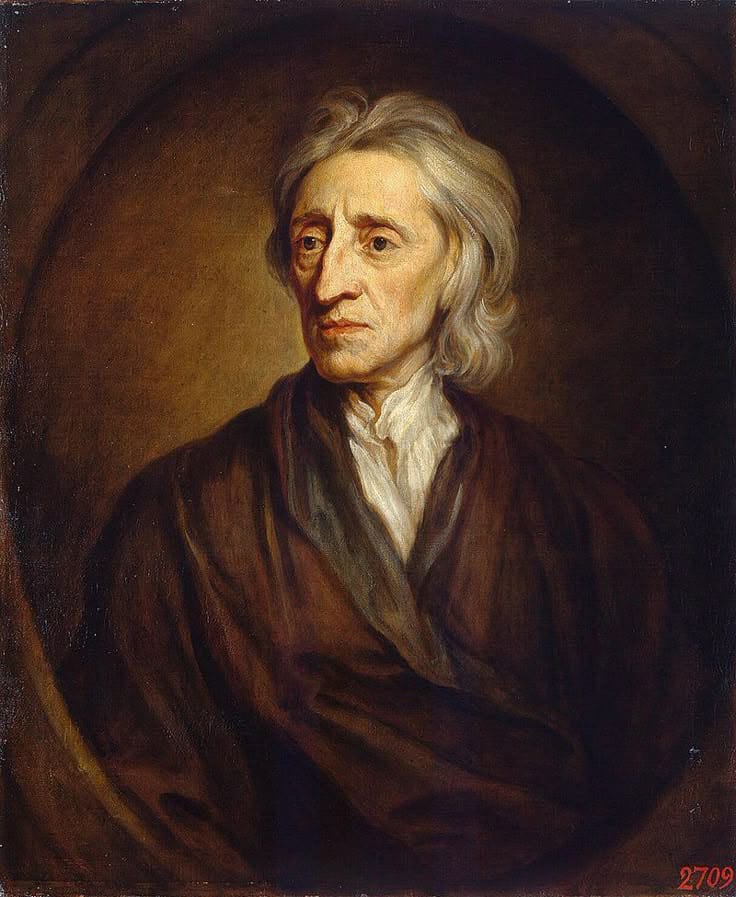
John Locke was born in 1632 in Wrington, Somerset, England, during a century marked by intense political and religious conflict. Disputes between monarchy and Parliament, together with conflicts among religious groups, eventually contributed to the English Civil War. These events formed an important part of the historical world in which Locke grew up and later developed his political ideas. His father, also named John Locke, was a lawyer and was connected with the parliamentary side during the political conflicts of the period, giving the younger Locke an early connection with questions of authority and government.
Locke received his early education at Westminster School before entering Christ Church, Oxford, in 1652. Although the traditional scholastic curriculum did not fully satisfy his intellectual interests, Oxford introduced him to important debates in philosophy and natural inquiry. He increasingly developed interests in medicine, chemistry, natural philosophy, and the emerging experimental sciences. His education thus exposed him both to inherited philosophical traditions and to newer approaches that placed greater emphasis on observation, evidence, and practical investigation.
Locke's intellectual development was closely connected with the scientific culture of seventeenth-century England. He became acquainted with figures including Robert Boyle and participated in an intellectual environment that increasingly valued observation, experiment, and careful inquiry. His medical interests also encouraged attention to empirical evidence and the complexity of natural processes. These experiences helped cultivate his characteristic concern with evidence and with examining what human beings can actually establish rather than assuming that traditional philosophical claims are automatically certain.
In 1666, Locke met Anthony Ashley Cooper, later the first Earl of Shaftesbury, and their relationship brought him deeply into political and public affairs. Locke served within Shaftesbury's household in several important capacities and gained direct experience of government and political conflict. His association with Shaftesbury eventually contributed to his exile in the Netherlands from 1683 to 1689. These experiences exposed Locke directly to questions concerning political legitimacy, religious conflict, constitutional government, and the dangers of arbitrary political power.
Locke's early life therefore combined philosophical study with medicine, scientific inquiry, and practical political experience. These different influences helped shape a thinker concerned not only with abstract questions about knowledge, but also with religion, government, liberty, education, and the practical conditions of human society. His later philosophy reflects this combination of theoretical and practical interests: he wanted to clarify the powers of human understanding while also asking how free and reasonable people could live together under legitimate political institutions.
John Locke and the Scientific Revolution
John Locke lived during the Scientific Revolution, a period in which European approaches to nature and knowledge underwent major transformation. Thinkers increasingly challenged inherited assumptions and placed greater emphasis on observation, experiment, mathematical reasoning, and systematic investigation. Locke's philosophy developed within this broader intellectual transformation. Rather than treating philosophical knowledge as detached from scientific inquiry, he became interested in how evidence, experience, and disciplined investigation could improve human understanding.
The work of figures such as Galileo, Robert Boyle, and Isaac Newton formed part of the scientific environment surrounding Locke. He was especially familiar with experimental and medical inquiry, although his own philosophical method was not simply an attempt to copy the procedures of physics. Instead, Locke sought to investigate the powers and limits of the human understanding itself. His philosophical project can therefore be understood as a critical examination of the intellectual instrument through which human beings make judgments about the natural, moral, and political world.
This project gave his philosophy an important methodological character. Before making ambitious claims about reality, Locke believed that philosophers should examine what human beings are actually capable of knowing. His An Essay Concerning Human Understanding therefore investigates the origin, extent, and certainty of human knowledge. This approach encouraged philosophers to ask whether a particular question falls within the reach of human understanding before constructing elaborate theories about subjects that may exceed available evidence.
Locke's empiricism did not mean that every philosophical question could be settled through simple sensory observation. He distinguished different degrees of certainty and carefully examined the relationship between knowledge, probability, belief, reason, and faith. His concern with intellectual limits consequently became one of the defining features of modern empiricism. Experience provides important evidence, but rational judgment is still required to determine what conclusions can properly be drawn from that evidence.
The scientific context is therefore essential for understanding Locke's method. He belonged to a period increasingly dissatisfied with unsupported speculation, yet he did not simply turn philosophy into experimental science. Instead, he investigated the conditions under which human beings form ideas, judgments, and knowledge. This emphasis on method, evidence, and intellectual restraint helped establish an important bridge between early modern philosophy and the later Enlightenment culture of critical inquiry and systematic examination.
John Locke and Empiricism
John Locke's empiricism is one of the central features of his philosophy. Empiricism is the broad philosophical position that gives experience a fundamental role in the origin of human ideas and knowledge. Locke rejected the claim that the human understanding begins life already furnished with a substantial collection of innate ideas or universally known principles. His argument was not that human beings possess no mental capacities, but that the intellectual content upon which those capacities operate is acquired through experience.
According to Locke, the materials of thought arise through experience. He identifies two principal sources: sensation, which concerns ideas received through interaction with the external world, and reflection, which concerns the mind's awareness of its own operations. From these sources, the understanding acquires the ideas upon which its later intellectual activity depends. The mind can then combine, compare, distinguish, and abstract from these materials, allowing relatively simple experiential contents to become more complex forms of thought and conceptual understanding.
Locke's empiricism was directed partly against theories of innate ideas. He questioned whether supposedly universal principles were genuinely present in every human mind before experience. His argument examines children and people who lack particular forms of education in order to challenge the claim that certain ideas are consciously possessed from birth. He also argues that supposed universal agreement cannot by itself demonstrate innateness, because agreement may arise from shared experience, learning, or common features of human development rather than from ideas implanted in the mind at birth.
The result was a major transformation in modern epistemology. Locke asked not only what reality is, but also how human beings acquire ideas and what can legitimately be known from them. His approach became central to the English empiricist tradition later associated with George Berkeley and David Hume. Later empiricists did not simply repeat Locke's conclusions; they developed, criticized, and sometimes radicalized his analysis of ideas, perception, causation, and knowledge. Locke therefore became a starting point for an extended philosophical debate about experience and reason.
Locke's empiricism is best understood as an account of the sources and limits of human cognition rather than as the claim that reason is irrelevant. Experience supplies the materials of thought, while the understanding performs operations upon those materials. This combination explains why Locke could be both an empiricist and a philosopher deeply concerned with rational standards of knowledge. His emphasis on evidence, probability, and intellectual restraint became one of the most enduring features of his philosophical legacy.
What Was John Locke's Philosophy?
John Locke's philosophy can be understood as a broad investigation of human understanding, experience, political authority, individual liberty, religion, and education. His writings address interconnected problems rather than presenting every subject as part of a single rigid philosophical system. Locke made important contributions to epistemology, metaphysics, philosophy of mind, and political theory. Across these fields, a recurring concern is the attempt to determine what human beings can reasonably claim, what grounds their claims, and what institutions can legitimately demand of them.
In epistemology, Locke investigated how ideas originate and how the mind forms increasingly complex thoughts from them. He also examined the limits of certainty and argued that human beings must distinguish genuine knowledge from probability and mere unsupported belief. This concern with the powers and limits of understanding runs throughout much of his philosophical work. Instead of beginning with an elaborate theory of reality, Locke often begins by asking what the human mind can represent, compare, demonstrate, or reasonably believe.
In political philosophy, Locke defended natural freedom and equality and explained legitimate government in relation to consent and the protection of rights. Political authority, on his account, cannot be justified merely by inherited power or absolute monarchy. Government must instead serve purposes connected with the public good and the protection of those subject to its authority. This framework makes political legitimacy dependent upon the moral status of individuals rather than upon the unrestricted will of a ruler.
Locke also addressed religion, education, and moral conduct. His writings on toleration distinguish the purposes of civil government from the proper concerns of religious belief, while his educational work emphasizes the formation of habits, judgment, and character. These subjects show that his philosophy was not limited to a theory of knowledge. He was interested in the conditions that allow people to reason responsibly and to participate in a society where disagreement does not automatically become a justification for coercion.
Locke's philosophy therefore stands at an important point between seventeenth-century intellectual debates and the development of the Enlightenment. His emphasis on experience, rational inquiry, toleration, limited authority, and individual rights made his work deeply influential in later philosophy and political thought. Although later thinkers challenged important parts of his system, Locke helped establish a durable model of philosophy in which questions about knowledge, freedom, responsibility, and government could be investigated through critical examination of human experience.
What Is John Locke's Theory of Knowledge?
John Locke's theory of knowledge is developed most fully in An Essay Concerning Human Understanding. Locke asks where human ideas originate, how the understanding operates upon them, and what kinds of certainty human beings can achieve. His project is fundamentally epistemological: he seeks to determine the origin, extent, certainty, and limits of human knowledge. This makes his philosophy an inquiry not merely into what people know, but into the conditions under which a claim deserves to be called knowledge at all.
Locke distinguishes between the ideas supplied through experience and the operations performed by the understanding. Experience provides the materials of thought through sensation and reflection, while the mind can combine, compare, distinguish, and abstract from the ideas it has acquired. Complex forms of thought can therefore develop without assuming that they were present innately from the beginning. The activity of the understanding is crucial because experience supplies materials, but intellectual operations determine how those materials are organized into increasingly complex concepts.
Locke defines knowledge in terms of the perception of agreement or disagreement between ideas. He distinguishes different kinds and degrees of knowledge and does not claim that human beings can achieve certainty about everything they investigate. This makes the limits of understanding as important to his philosophy as its powers. Intuitive and demonstrative knowledge have different forms of certainty, while sensitive knowledge concerns the existence of particular external things perceived through the senses and therefore has a different epistemic character.
An important consequence of Locke's epistemology is intellectual modesty. Human beings often must rely on probability rather than certainty, particularly when dealing with matters beyond direct demonstration. Locke therefore argues that rational people should proportion their assent to the evidence available to them. This principle provides a standard for responsible belief: uncertainty should not automatically be treated as complete ignorance, but neither should probability be exaggerated into absolute certainty merely because a conclusion feels plausible or familiar.
Locke's theory of knowledge thus combines empiricism with a detailed analysis of epistemic limits. Experience supplies the ideas from which human inquiry begins, the understanding works upon those ideas, and knowledge arises when relations between ideas are perceived with the appropriate degree of certainty. Where certainty is unavailable, judgment must operate through probability. This layered account helped establish epistemology as a central field of modern philosophy and encouraged later thinkers to examine knowledge in terms of evidence, justification, rational judgment, and cognitive limitation.
What Did John Locke Mean by Tabula Rasa?
The expression tabula rasa, meaning "blank slate," is strongly associated with John Locke's theory of the mind. Locke's own discussion is more precise than the popular slogan often suggests. He asks what the understanding contains at the beginning of life and argues against the doctrine that substantial ideas or principles are innately present in the mind. His target is therefore the doctrine of innate intellectual content, not the claim that human beings enter life without any natural capacities, tendencies, or faculties.
Locke argues that experience supplies the mind with its basic materials. These materials arise through two sources that he calls sensation and reflection. Sensation provides ideas through experience of the external world, while reflection concerns the mind's awareness of operations such as thinking, doubting, willing, believing, and reasoning. Reflection is therefore an internal source of ideas, but it is still connected with experience because the mind becomes aware of its own operations through having and examining those operations.
The blank-slate metaphor does not mean that Locke regarded the human mind as permanently passive or without natural powers. Once ideas are acquired, the understanding actively compares, combines, and abstracts from them. Locke's position is therefore better understood as a rejection of innate conceptual content than as a denial of natural human capacities. This distinction matters because his theory gives the mind substantial intellectual activity even while denying that it begins with a ready-made inventory of ideas or principles.
This distinction is important because Locke's philosophy is sometimes simplified into the claim that experience alone mechanically creates every aspect of thought. His actual theory gives experience a foundational role while also recognizing the active operations of the understanding. The development of knowledge requires both acquired materials and the mind's capacity to work upon them. This is why Locke's account can explain conceptual complexity without treating the mind as a completely passive container into which sensations are simply placed.
Locke's discussion of the mind at the beginning of life became highly influential because it challenged traditional accounts of innate principles and emphasized the importance of education and experience. At the same time, it should not be interpreted as a modern scientific theory of child development. Locke was making a philosophical argument about the origin of ideas and the justification of knowledge. The lasting significance of tabula rasa lies in this epistemological challenge to the assumption that knowledge is already intellectually present before experience.
John Locke's Simple and Complex Ideas
A major part of Locke's epistemology is his distinction between simple ideas and complex ideas. Simple ideas are the basic materials of thought received through experience. They include ideas associated with sensation and reflection, such as colors, sounds, extension, motion, pleasure, pain, thinking, and willing. Locke treats these as relatively basic contents that the understanding receives rather than freely invents. They provide the materials from which more elaborate concepts can subsequently be constructed.
Locke argues that the mind is largely passive in receiving simple ideas: it cannot simply create them at will from nothing. Once these ideas are available, however, the understanding becomes active. It can combine ideas, compare them with one another, and abstract common features in order to form increasingly complex concepts. This distinction between reception and mental operation allows Locke to explain how sophisticated thinking can arise while maintaining that the original materials of thought come through experience.
Locke classifies complex ideas into important categories, including modes, substances, and relations. A mode is a complex idea that does not represent something capable of existing independently, while ideas of substances concern supposed combinations of qualities. Relations arise when the mind considers ideas in comparison with others. These categories demonstrate how Locke's theory moves beyond the simple claim that experience supplies isolated sensations and instead provides an account of how the understanding constructs organized conceptual structures from experiential materials.
This distinction helped Locke explain how human thought can become extraordinarily sophisticated without requiring innate knowledge. Scientific concepts, moral ideas, ordinary classifications, and many forms of reasoning involve intellectual operations upon acquired ideas. His analysis became one of the central foundations of early modern epistemology. It also influenced later debates about abstraction, concepts, language, classification, and the relationship between what the mind experiences and the conceptual structures through which people describe and understand the world.
Locke's account of simple and complex ideas is therefore a theory of the materials and operations of human thought. Experience provides relatively basic ideas, while the understanding combines, compares, and abstracts them into more elaborate concepts. This framework allowed Locke to explain intellectual development without appealing to a pre-existing stock of innate ideas. It also provided later philosophers with a detailed vocabulary for analyzing how perception, thought, language, classification, and knowledge might be connected.
John Locke on Primary and Secondary Qualities
John Locke's distinction between primary and secondary qualities is an important part of his philosophy of perception. Primary qualities are features that Locke regards as inseparable from bodies themselves, including solidity, extension, figure, motion or rest, and number. His claim is that these qualities belong to bodies independently of whether a particular observer is perceiving them. They are therefore treated differently from sensory qualities whose appearance can vary according to the observer or circumstances.
Secondary qualities are powers in bodies to produce particular sensory ideas in observers. Colors, sounds, tastes, and smells are common examples. Locke does not deny that these experiences are real as ideas in the mind; rather, he distinguishes the experienced sensation from the physical constitution and powers of the object that produce it. The distinction therefore concerns how qualities exist and how they function as causes of experience, rather than simply dividing qualities into "real" and "unreal" categories.
Locke's distinction is connected with the mechanical philosophy of his period. He believed that the minute physical structure and motion of bodies could produce different sensory effects in observers. The ideas of primary qualities were thought to resemble features of bodies more closely than ideas of secondary qualities do. This account attempted to connect ordinary sensory experience with a developing scientific picture in which physical structures and motions underlie the observable effects that bodies have upon human senses.
This distinction became enormously influential because it raised deeper questions about the relationship between the external world and conscious experience. Later philosophers asked whether any experienced quality can be straightforwardly understood as resembling reality exactly as it exists independently of perception. The distinction also encouraged reflection on whether perception reveals objects directly or whether the mind encounters ideas produced by interaction with external bodies. These problems became central to later philosophy of perception.
Locke's primary-secondary quality distinction therefore illustrates a broader feature of his philosophy: the difference between what exists in bodies and what is experienced by perceivers. It does not simply divide qualities into real and unreal. Instead, it distinguishes properties attributed to bodies from the powers those bodies possess to produce particular ideas in observers. This analysis helped shape later discussions of perception, representation, physical reality, scientific description, and the relationship between external objects and conscious experience.
John Locke on Perception and Experience
Perception plays a central role in Locke's empiricism because experience supplies the understanding with its basic materials. Through sensation, human beings acquire ideas associated with the external world, while reflection provides ideas of the mind's own operations. Experience therefore stands at the beginning of Locke's account of the acquisition of ideas. His theory asks not only what people perceive, but also how those perceptual ideas become available for later comparison, abstraction, judgment, and reasoning.
Locke nevertheless recognizes that perception is not identical with knowledge. Receiving an idea through sensation is one thing; comparing ideas, examining their relations, and determining what can be known from them are further intellectual activities. His empiricism therefore does not imply that everything perceived is automatically known with certainty. Perception supplies important evidence, but the understanding must still assess what follows from that evidence and what degree of confidence is justified by the available experience.
His analysis also raises questions about the relationship between ideas and external objects. Human beings directly experience their ideas, while philosophical inquiry must consider what those ideas reveal about the bodies and causes outside the mind. This problem became increasingly important for later debates about perception and the external world. Locke's distinction between ideas and their external causes contributed to a major early modern problem: explaining how subjective experience can provide knowledge of an objective world.
Locke's theory of experience consequently connects epistemology with philosophy of mind. By investigating how ideas enter consciousness and how the understanding works upon them, he helped establish questions about perception and mental representation as central problems of modern philosophy. His account also shows why empiricism is not simply a theory about the senses. It is a theory about how sensory and reflective experience becomes the material of thought and how that material can support different forms of judgment.
Perception in Locke's philosophy therefore has both an experiential and an epistemological role. It supplies ideas, but it does not by itself settle every question about reality or certainty. The mind must organize and compare what experience provides, while philosophical reflection must distinguish immediate ideas from conclusions drawn from them. This layered account influenced later debates about realism, representation, consciousness, and the reliability of the senses, making Locke an important figure in the modern philosophy of perception.
John Locke's Philosophy of Personal Identity
John Locke's theory of personal identity is one of his most influential contributions to philosophy of mind. Locke distinguishes the identity of a person from the identity of a human organism or an immaterial substance. For him, the concept of a person is closely connected with consciousness and with the ability to appropriate thoughts and actions as one's own. This distinction allows Locke to ask what makes a person the same person over time without assuming that bodily or spiritual substance alone provides the answer.
Locke defines a person as a thinking, intelligent being capable of reason and reflection and able to consider itself as itself at different times and places. Personal identity extends as far as consciousness extends. His account therefore shifts attention away from the mere persistence of a body or soul toward questions about conscious continuity. The important issue is whether present consciousness can extend to past experiences and actions in a way that makes them attributable to the same person.
Locke's famous thought experiments explore unusual cases in which consciousness appears to be transferred or separated from ordinary bodily continuity. These examples are intended to test what actually makes someone the same person over time. They remain among the most discussed thought experiments in the history of personal identity. By separating personhood from the simple identity of a body or substance, Locke created a framework in which psychological continuity becomes central to philosophical questions about who someone is.
His account profoundly influenced later discussions of consciousness, memory, personal identity, and responsibility. Although Locke's theory is often described simply as a memory theory, this description can be misleading because his central concept is consciousness and its continuity, not memory understood as an isolated psychological mechanism. Memory matters because it can provide evidence of consciousness extending to past experiences, while Locke's deeper concern is the continuity through which a person appropriates experiences and actions.
The theory also has a direct connection with moral and legal responsibility. If responsibility concerns actions that belong to a person, then questions about personal identity become relevant to praise, blame, punishment, and accountability. Locke's analysis therefore links philosophy of mind with ethics and jurisprudence. Its lasting importance comes from the fact that it treats personal identity as a philosophical problem about consciousness and attribution rather than simply assuming that the persistence of a body or soul automatically determines personal sameness.
John Locke on Consciousness and the Self
Locke connects personal identity with consciousness. His analysis asks what it means for a present consciousness to appropriate past thoughts and actions as belonging to the same person. Consciousness therefore becomes central to the way a person understands themselves as persisting through time. Rather than identifying the self solely with a physical body or an immaterial substance, Locke investigates the psychological relation through which a person can regard past experiences and actions as their own.
Locke's discussion is important because he separates questions about personal identity from questions about the identity of an underlying substance. A human being can be considered as a living organism, while a soul can be considered as a possible immaterial substance. Neither question, however, automatically answers what makes a person the same person across time. Locke's distinction allows personhood to be examined through consciousness without requiring a final metaphysical theory about the nature or persistence of substance.
Consciousness provides the central framework for Locke's answer. Wherever consciousness can extend to a past thought or action, that action can be regarded as belonging to the same person in the relevant sense. This connection between consciousness and identity made Locke's account radically influential within the philosophy of mind. It also explains why his theory became a major point of reference for later debates about memory, psychological continuity, self-awareness, and the conditions under which experiences can properly be attributed to an individual.
The theory also has implications for moral responsibility. Questions about praise, blame, punishment, and accountability are connected with whether an action can properly be attributed to the same person. Locke's discussion therefore brings together philosophy of mind, ethics, and theories of personal responsibility. His account suggests that moral practices depend in part upon a concept of personhood that can connect present consciousness with past actions, rather than merely identifying a person with a continuously existing physical organism.
Locke's treatment of consciousness helped move modern philosophy toward a more explicitly psychological analysis of the self. It does not simply say that the self is a mysterious inner substance; it asks what relation makes experiences and actions belong to one person. This approach became influential precisely because it reframed an apparently metaphysical problem in terms of consciousness, attribution, and continuity. Later philosophers have challenged Locke's criterion in different ways, but his questions remain foundational to discussions of personal identity.
What Was John Locke's Political Philosophy?
John Locke's political philosophy is one of the most important foundations of modern liberal political thought. Locke argued that human beings are naturally free and equal and rejected the claim that political authority could be justified simply through hereditary status or the supposed natural right of absolute monarchs. Political institutions therefore require justification in terms of the rights and interests of the people who are subject to them, rather than being treated as automatically legitimate because of tradition or inheritance.
In the Two Treatises of Government, Locke describes a hypothetical state of nature in which individuals are free and equal under a law of nature. The state of nature is not simply a condition of unrestricted violence; people remain subject to moral obligations and possess rights that others ought to respect. Locke's argument begins from this pre-political condition in order to explain how political authority can arise without assuming that government is the original source of all rights.
Political society arises because the state of nature contains important practical inconveniences. Individuals may disagree about the law of nature and act as judges in their own cases, while enforcement can be uncertain and partial. Political institutions provide a common authority capable of establishing known laws and resolving disputes. The purpose of political society is therefore not to abolish natural freedom completely, but to create a public framework in which rights can be more securely protected through settled rules and impartial adjudication.
Locke therefore understands government as a form of trust. Political power exists to serve the public good and to protect people's lives, liberties, and estates. When rulers systematically violate the purposes for which government was established, the people may legitimately resist and establish a new political authority. This doctrine of resistance is an important consequence of Locke's theory of consent: rulers do not possess unlimited authority, because political power remains morally conditional upon the purposes for which it was entrusted.
Locke's political philosophy became especially influential because it linked individual rights with institutional limits on government. Consent, natural freedom, property, known laws, impartial judgment, and resistance to serious abuses form parts of a broader account of legitimate political order. Although Locke's historical context and exclusions place limits on how his arguments should be interpreted, his work provided a powerful foundation for later liberal and constitutional theories of government, citizenship, political legitimacy, and individual liberty.
What Were John Locke's Natural Rights?
John Locke's theory of natural rights is one of the most influential elements of his political philosophy. Locke argues that certain rights and moral claims do not simply depend upon the laws created by a particular government. Human beings are naturally free and equal, and legitimate political institutions must respect this moral status. Political authority is therefore not the creator of all moral rights; rather, one of its principal purposes is to secure rights that people possess independently of the particular government under which they happen to live.
Locke's political writings are especially associated with life, liberty, and property. These interests are connected with his broader account of natural law and the purposes for which political society is formed. Political authority exists to protect rights and the public good rather than to grant rulers unlimited power over those they govern. In Locke's framework, freedom does not mean the absence of all moral constraints; people remain bound by natural law and are required to respect the equal rights and preservation of others.
Locke's concept of property has a particularly important place in his political theory. He argues that individuals can acquire private property through labor, although his account includes important conditions and limitations concerning appropriation. Property is therefore not merely an economic subject but part of his broader theory of rights, independence, and political authority. His discussion of labor and ownership became highly influential, while also generating later debates about the limits of appropriation, inequality, resources, and the moral basis of private ownership.
The language of natural rights became enormously influential in later political philosophy. Locke helped provide a powerful vocabulary for discussing limited government, constitutional liberty, political consent, and resistance to arbitrary authority. His ideas became especially important within later Enlightenment and liberal political traditions. At the same time, historical interpretation must recognize that Locke's own political framework did not automatically extend equal political standing to every person in the modern sense, making the development of later rights traditions more complex than a simple repetition of his arguments.
Locke's natural-rights theory is best understood as part of a larger account of legitimate political authority. Because individuals possess a moral status prior to government, government must justify its coercive powers by reference to a public purpose. Consent gives political institutions authority, while natural law places moral limits on what that authority may do. This combination of individual rights and limited government became one of Locke's most enduring contributions to modern political philosophy and later theories of constitutional liberty.
John Locke's State of Nature
The state of nature is a central concept in Locke's political philosophy. It describes a condition in which people live without a common political authority established to judge disputes. Locke does not portray this condition simply as complete chaos. Human beings remain subject to natural law and possess duties toward one another, including duties concerning preservation and non-harm. The state of nature therefore has moral structure even though it lacks a settled public institution capable of enforcing that structure consistently and impartially.
The difficulty is that the state of nature lacks an established and impartial authority capable of consistently interpreting and enforcing the law. Individuals may become judges in their own cases, allowing self-interest, partiality, and excessive retaliation to create conflict. These practical inconveniences provide an important reason for establishing a common political authority. Locke's argument is consequently different from a theory in which government is necessary simply because people are naturally incapable of moral behavior or cooperation.
Locke's state of nature is important because it explains why government can be necessary without assuming that government creates all rights. Natural rights and obligations exist independently of particular political institutions. Government is established to secure these rights more effectively and to provide known laws and impartial means for resolving disputes. The move from the state of nature into political society is therefore a transformation in the way rights are publicly protected rather than a transformation from complete moral freedom into a condition of absolute obedience.
Political society also depends upon consent in Locke's account. Individuals agree to join a political community and to submit disputes to common rules and authorities because doing so provides greater security than relying on private judgment and individual enforcement. This consent gives the resulting government legitimate political power, but that power remains limited by the purposes for which society was formed. A government that systematically acts against those purposes can undermine the trust on which its authority depends and thereby weaken its own legitimacy.
Locke's state of nature consequently performs an important argumentative function in his political philosophy. It establishes the natural freedom and equality of individuals, explains the practical reasons for creating government, and provides a standard for judging political institutions. Government is legitimate when it improves the security of rights through common laws and impartial institutions. If it becomes a source of arbitrary domination instead, Locke's theory supplies a basis for resistance because political authority has departed from the trust that originally justified its exercise.
John Locke on Government, Consent, and Liberty
For Locke, legitimate government rests ultimately upon the consent of the governed. Political authority is not simply a natural possession of kings or ruling families. Governments are created for particular purposes, including the protection of rights and the pursuit of the public good. Political power must therefore be justified rather than merely inherited. This principle represents a major challenge to theories of absolute monarchy that treated political authority as naturally concentrated in a ruler.
Locke rejects the idea that rulers may exercise unlimited authority according to arbitrary personal will. Government should operate through established laws that are directed toward the good of the community. Legislative authority has a central place in his political theory, but legislators themselves remain subject to important limits on the use of the power entrusted to them. They cannot legitimately use political authority simply for their private advantage or arbitrarily destroy the rights of the people.
This connection between consent, liberty, law, and limited government became one of Locke's most enduring political contributions. His theory helped provide a philosophical vocabulary for explaining why political power should be accountable and exercised according to known principles rather than the arbitrary will of individual rulers. Liberty therefore does not mean the absence of all law; for Locke, lawful government can protect freedom by preventing arbitrary interference and securing predictable rights.
Locke also emphasizes that political power is fiduciary, meaning that it is entrusted for particular purposes. The legislative and executive powers are therefore not simply possessions belonging to those who hold office. Political institutions are justified by the ends they are meant to serve. When officials cease to act for the public good and instead use authority for private or destructive purposes, they undermine the trust on which their legitimacy depends.
Locke's account of government consequently combines individual liberty with institutional responsibility. A legitimate government must have sufficient authority to make and enforce laws, but that authority must remain bounded by natural law, public purposes, and the rights of individuals. His theory became an important foundation for later arguments about constitutional government, although later liberal and democratic systems developed beyond Locke's seventeenth-century political framework.
John Locke's Theory of Property
Property is another major concept in Locke's political philosophy. Locke begins with the idea that the earth and its resources were originally given to humanity in common. He then asks how an individual can legitimately acquire a private claim over particular resources without requiring the explicit consent of every other person who shares the world. His answer connects private appropriation with human labor, use, preservation, and the moral requirements imposed by natural law.
His famous labor argument connects property with human activity. When an individual applies labor to something available in common, Locke argues that this can establish a private claim under particular conditions. His discussion also includes important limits, especially the prohibition against waste and the requirement that others not be deprived of opportunities for preservation. Property therefore does not initially appear as an unlimited permission to accumulate everything that a person can physically obtain.
Locke's later discussion of money complicates the theory because durable money makes greater accumulation possible without the immediate problem of spoilage. People can exchange perishable goods for something that does not decay in the same way, allowing wealth to be accumulated on a much larger scale. Scholars continue to debate how Locke's argument should be understood, particularly regarding inequality, consent, and the transition from natural limits to monetary accumulation.
Property is also closely connected with political legitimacy. The protection of what Locke broadly calls people's lives, liberties, and estates is one of the central purposes of political society. His account therefore connects questions of labor and ownership with natural rights, political authority, and individual independence. Government is not supposed to create arbitrary ownership simply through the will of rulers; rather, political society is established partly to provide more secure protection for people's legitimate possessions and rights.
Locke's theory of property has consequently become both influential and controversial. It contributed to later arguments about private property, labor, economic freedom, and limited government, while modern scholarship also examines its relationship to inequality, colonial expansion, and historical systems of exclusion. Understanding Locke therefore requires distinguishing his philosophical argument about property from later economic doctrines that were developed in different historical circumstances.
Did John Locke Believe in a Right to Revolution?
Yes. One of the most important features of John Locke's political philosophy is his defense of a right of resistance when government fundamentally violates the trust for which political power was established. Rulers do not possess an unconditional right to govern. Political authority remains justified only while it serves legitimate public purposes. When rulers systematically attack those purposes, their claim to obedience can be undermined.
Locke's argument does not mean that citizens should rebel against every unpopular policy or ordinary political disagreement. His concern is with serious and persistent abuses of political power, particularly attempts to govern arbitrarily, disregard established law, or destroy the rights government was established to protect. Political resistance therefore requires a much more serious justification than dissatisfaction with an isolated decision or temporary political conflict.
Locke argues that a government which fundamentally breaches its trust may effectively dissolve the political relationship that gave it authority. The people then recover the authority to establish a new government capable of protecting the public good and their rights. This doctrine became one of Locke's most influential contributions to theories of limited government and political resistance. It also demonstrates why government, for Locke, must be understood as an entrusted institution rather than an absolute personal possession.
The right of resistance follows from Locke's broader account of political legitimacy. If government exists to preserve the community and protect its rights, a government that deliberately destroys those purposes cannot simply appeal to the authority it is abusing. Locke therefore places political authority within a moral framework that existed before any particular government. Political rulers remain accountable to the principles that originally justified their authority.
Locke's doctrine later became important to constitutional and revolutionary arguments, although it should not be interpreted as a simple instruction that rebellion is always justified. His concern is the preservation of legitimate political society rather than permanent instability. The people resist when government has seriously broken its trust, and the purpose of resistance is to restore political authority under conditions in which rights and public purposes can again be protected.
John Locke and Religious Toleration
Religious toleration was another major concern in Locke's political thought. In A Letter Concerning Toleration, Locke argues that civil government should not use force simply to make people adopt particular religious beliefs. Civil government and religious communities have different purposes and should not possess unlimited authority over one another. Government's proper concern is civil interests rather than the salvation of individual souls.
Locke developed his argument in response to a Europe marked by religious conflict, persecution, and struggles over religious conformity. He questioned whether coercion could genuinely produce sincere belief or salvation. If genuine belief depends upon conviction and conscience, political force cannot simply manufacture authentic religious faith. A person may be forced to perform an outward religious action, but outward conformity does not necessarily produce inward conviction.
Locke also treats religious communities as voluntary associations rather than institutions entitled to exercise coercive political power. His argument became an important contribution to the development of ideas about religious liberty and the limits of state authority in matters of conscience. The distinction between civil authority and religious persuasion became particularly important in later debates about freedom of religion and the relationship between church and state.
Locke's toleration was nevertheless not universal in the modern sense. His writings contained important exclusions, including controversial arguments concerning atheists and, in particular historical contexts, Catholics. Modern scholarship therefore examines both the importance of his defense of toleration and the significant limitations of its original scope. His argument should consequently be understood within the religious and political conflicts of seventeenth-century Europe rather than projected backward as an exact statement of modern religious liberty.
Despite these limitations, Locke's argument had lasting significance because it challenged the assumption that political stability requires complete religious uniformity. He emphasized the limits of coercion and the importance of conscience in genuine belief. His work helped make religious toleration a central subject of early modern political philosophy and contributed to later arguments for freedom of religion, even though later thinkers expanded the principle beyond the boundaries Locke himself accepted.
John Locke's Philosophy of Education
John Locke's philosophy of education is closely related to his broader understanding of human development and experience. In Some Thoughts Concerning Education, he emphasizes the formation of habits, judgment, self-discipline, and practical reason rather than treating education as the simple accumulation of information or the memorization of texts. Education should shape the habits and character through which a young person learns to direct their own conduct.
Locke's educational thought reflects his attention to the influence of experience and environment upon human development. Education should cultivate health, character, self-command, and the capacity for sound judgment. Intellectual instruction matters, but it forms only one part of the broader development of a capable and responsible person. Physical health, emotional discipline, habits, and practical experience all have a place within his educational philosophy.
His educational philosophy also has political significance. Individuals capable of reasoning, judging evidence, controlling their impulses, and understanding their responsibilities are better prepared for independent action within society. Locke consequently treated education as a central part of human formation rather than a purely academic exercise. The goal was not simply to produce people who could repeat information, but individuals capable of exercising judgment and governing their own behavior.
Locke also places considerable importance on habit. Repeated actions can gradually shape character, meaning that education should encourage desirable habits rather than relying exclusively on commands or punishment. He emphasizes the development of self-control because a person who can regulate desires and impulses is better able to exercise reason. Education therefore involves the gradual formation of practical independence and moral discipline.
Some Thoughts Concerning Education became an influential work in the history of educational theory. Published in 1693 and revised later, it extended Locke's philosophical concern with experience into the practical formation of children. His educational ideas contributed to later debates about childhood, discipline, character, reason, health, and individualized learning, even though modern educational theory has developed far beyond his seventeenth-century assumptions.
Major Works of John Locke
John Locke wrote across philosophy, politics, religion, economics, and education. Several of his works became foundational texts in early modern philosophy and political thought. Together, they reveal the breadth of his intellectual interests, from the nature of human understanding to government, toleration, money, education, and Christian belief. His published writings cannot therefore be reduced to epistemology or political theory alone.
His philosophical masterpiece is An Essay Concerning Human Understanding, which investigates ideas, knowledge, language, and the limits of human understanding. His Two Treatises of Government develops his account of natural rights, property, political authority, and resistance, while his writings on toleration and education extend his concerns into religion and human development. These works collectively established Locke as a major figure of early modern European intellectual history.
A Letter Concerning Toleration examines the relationship between religious belief and civil authority, while Some Thoughts Concerning Education applies Locke's concern with experience and human formation to childhood education. The Reasonableness of Christianity turns toward theology and the relationship between reason, faith, and Christian belief. Locke also wrote on economic and monetary questions, demonstrating that his intellectual interests extended well beyond the subjects for which he is most famous today.
The publication dates of Locke's major works sometimes require care because several texts were printed anonymously, pseudonymously, or under dates that do not correspond exactly to their first appearance. The Essay was published in December 1689 but carried the date 1690, while the Two Treatises were published anonymously around 1689/1690. A Letter Concerning Toleration appeared in Latin in 1689, and Some Thoughts Concerning Education was published in 1693.
Taken together, Locke's major works show a philosopher concerned with the limits of human knowledge and the conditions necessary for responsible human life. His epistemology, political philosophy, religious writings, and educational theory are distinct fields, but they share a recurring concern with human judgment, experience, freedom, responsibility, and the proper limits of authority.
- An Essay Concerning Human Understanding — Locke's major work on ideas, experience, knowledge, perception, personal identity, language, and the limits of human understanding.
- Two Treatises of Government — Locke's major political work on natural rights, the state of nature, property, consent, government, and resistance.
- A Letter Concerning Toleration — A defense of religious toleration and limits on coercive government authority in matters of religion.
- Some Thoughts Concerning Education — Locke's influential work on education, character, discipline, reason, health, and the formation of young people.
- The Reasonableness of Christianity — A theological work exploring Christianity, reason, faith, and religious belief.
- Some Considerations of the Consequences of the Lowering of Interest and Raising the Value of Money — A work reflecting Locke's interests in economics, money, trade, and public policy.
John Locke's An Essay Concerning Human Understanding
An Essay Concerning Human Understanding is John Locke's most important philosophical work and one of the foundational texts of modern empiricism. The book investigates where human ideas originate, how the understanding operates upon them, what knowledge consists of, and what limits should be placed upon human claims to certainty. Rather than beginning with an elaborate theory of reality, Locke investigates the powers and limits of the human understanding itself.
The Essay is organized into four books. Locke first challenges the doctrine of innate ideas, then examines the origin and kinds of ideas, investigates language and its relationship to thought, and finally analyzes knowledge, probability, judgment, and belief. The work therefore moves from the materials of thought toward a broader examination of what the human mind can legitimately know and where uncertainty must remain.
Locke's account of ideas distinguishes between simple ideas received through sensation and reflection and complex ideas constructed through the mind's operations. This distinction allows him to explain how a relatively limited set of experiential materials can become the basis for much more complicated forms of thought. The understanding is therefore not merely a passive container but an active power capable of comparing, combining, and abstracting from its ideas.
The Essay also examines language because Locke believes that words are closely connected with the communication of ideas. Ambiguous or poorly understood language can produce disputes that appear philosophical while actually arising from confusion about the meanings of terms. His discussion of language therefore forms an important part of his larger attempt to establish clearer boundaries for human knowledge and philosophical inquiry.
The importance of the Essay extends beyond its individual arguments. Locke's attempt to investigate understanding before making unrestricted metaphysical claims helped redefine central problems of modern epistemology. His analysis profoundly influenced later debates about experience, perception, personal identity, language, and the possibility and limits of human knowledge. The work became a major reference point for subsequent empiricist philosophy.
John Locke's Two Treatises of Government
Two Treatises of Government is John Locke's most important political work. It challenges arguments for absolute monarchy and develops a theory of legitimate government based on natural freedom, equality, consent, natural rights, and political trust. The work eventually became one of the defining texts of modern political philosophy and a major source for later arguments about limited government and constitutional authority.
The First Treatise attacks the political arguments of Sir Robert Filmer, particularly the claim that legitimate political authority could be traced through a divinely sanctioned patriarchal line. The Second Treatise then develops Locke's own account of the state of nature, natural law, property, consent, political society, government, and resistance. The two parts therefore have different immediate purposes but work together to challenge absolute patriarchal monarchy.
The historical context of the work is more complex than the older claim that Locke wrote it simply to justify the Glorious Revolution. Modern scholarship generally connects much of its composition with the political conflicts of the Exclusion Crisis and Locke's association with the opposition around Anthony Ashley Cooper, later the Earl of Shaftesbury. The work was published anonymously after the Revolution of 1688, making its historical context an important subject of scholarly debate.
The Second Treatise is particularly important because it explains political authority through natural freedom and consent rather than inherited sovereignty. Individuals possess rights and duties before entering civil society, and political institutions are created to provide more secure protection for those rights. Government therefore exists as a trust and can lose its legitimacy when rulers fundamentally violate the purposes for which political power was established.
The work later became an important intellectual resource for debates about constitutional government and political liberty. Locke did not single-handedly create modern democracy, and his ideas developed within wider traditions of natural law, constitutionalism, and political thought. Nevertheless, the Two Treatises became one of the most influential works in the history of liberal political philosophy and helped establish concepts that later thinkers adapted in very different political contexts.
John Locke's Main Philosophical Ideas
1. Knowledge Begins with Experience
Locke argues that experience supplies the understanding with its basic materials. Through sensation and reflection, human beings acquire ideas that the mind can later compare, combine, and examine. Experience is therefore fundamental to his account of the origin of human ideas and the development of knowledge. His argument challenges theories that assume the human mind possesses a substantial stock of ideas or principles before experience contributes anything to understanding.
Sensation provides ideas associated with external objects and the effects they have upon our senses, while reflection provides ideas arising from the mind's awareness of its own operations. These two sources allow Locke to explain how increasingly sophisticated forms of thought can develop from relatively basic materials. Experience is therefore not restricted to external observation alone; the mind's own activities also become objects of awareness and reflection.
Locke's empiricism does not mean that every belief is automatically true simply because it comes from experience. Experience supplies materials for thought, but the understanding must examine, compare, and judge them. Knowledge therefore requires intellectual activity as well as experiential input. This distinction is important because Locke's philosophy is often simplified into the claim that the mind merely records sensations, whereas his actual account gives the understanding substantial organizing powers.
The emphasis on experience also encourages Locke to investigate the limits of certainty. Human beings do not encounter reality in an entirely transparent way, and the ideas available to the mind do not automatically provide complete knowledge of the underlying nature of things. Locke's epistemology therefore combines empiricism with intellectual modesty: experience is indispensable, but human knowledge remains limited.
This principle became one of the foundations of modern empiricism. Later philosophers developed, criticized, or rejected different parts of Locke's account, but the problem he formulated remained central: how do experience and the operations of the mind contribute to human knowledge? Locke's answer established experience as a central philosophical category without reducing reasoning itself to passive sensation.
2. The Rejection of Innate Ideas
Locke rejects the claim that substantial ideas and principles are naturally present in every human mind from birth. His criticism of innate ideas became one of the defining arguments of modern empiricism and helped shift philosophical attention toward experience and the development of the human understanding. He asks how an idea can genuinely count as innate if people do not possess conscious awareness of it and if different people and cultures do not display universal agreement about it.
Locke's argument is directed particularly against claims that important principles of knowledge or morality are universally implanted in the mind. He examines supposed examples of universal agreement and argues that they do not successfully demonstrate innateness. Children and people who have not received particular forms of education or reflection may not possess the supposedly universal principles in question. This weakens the argument that such principles must have been present from birth.
The rejection of innate ideas does not mean that Locke thinks human beings are born without capacities. His position is better understood as a rejection of substantial innate conceptual content rather than a denial of natural human faculties. Human beings possess capacities for sensation, reflection, comparison, reasoning, and learning. What they do not automatically possess is a complete stock of developed ideas waiting to be uncovered.
This distinction is important for understanding the famous association between Locke and the idea of the tabula rasa. The phrase is a useful shorthand, but Locke's actual argument is more detailed than the image of an entirely featureless mind. His concern is with the origin of ideas and the rejection of innate principles, while recognizing that human beings possess natural capacities that make learning and reasoning possible.
Locke's criticism of innateness had consequences beyond epistemology. It encouraged greater attention to education, development, environment, and experience. If many human beliefs are acquired rather than simply implanted from birth, then the conditions under which people learn become philosophically important. His argument consequently connects his theory of knowledge with his later work on education and human development.
3. The Mind Organizes Ideas
Although experience provides the basic materials of thought, the mind actively compares, combines, distinguishes, and abstracts from ideas. Locke therefore does not portray human understanding as merely passive. Knowledge develops through the interaction between acquired ideas and the intellectual operations performed upon them. The mind can combine simple ideas into complex ideas and can compare ideas to discover relationships between them.
Locke distinguishes simple ideas from complex ideas partly to explain this process. Simple ideas are received as basic materials of understanding, while complex ideas are formed through operations of the mind. These operations include combining ideas into larger constructions, comparing them, and abstracting from particular instances to form general concepts. Human understanding therefore contributes significantly to the organization of experiential materials.
Abstraction is especially important because it helps explain how human beings develop general concepts from particular experiences. We encounter individual objects and events, but language and thought allow us to classify them under general terms. Locke's account of abstraction therefore connects epistemology with his philosophy of language and helps explain how human beings can reason about categories that extend beyond individual experiences.
This active role of the mind prevents Locke's empiricism from being reduced to a simplistic picture of passive sensation. The mind receives materials, but it also performs operations upon them. Comparison, combination, abstraction, and reflection allow experience to become increasingly structured. The resulting knowledge remains limited, but it is not merely a collection of isolated sensations.
Locke's account consequently occupies an important position between competing descriptions of the mind as either completely passive or entirely independent of experience. Experience supplies the materials, while the understanding works upon those materials. This interaction became an important part of later philosophical debates about perception, concepts, language, and the relationship between sensory experience and rational activity.
4. Natural Rights
Locke argues that human beings possess fundamental rights independently of the decisions of particular governments. His political philosophy is especially associated with life, liberty, and property. Legitimate government exists partly to secure these rights and may not treat them simply as privileges granted by rulers. Rights therefore provide a moral standard by which political institutions themselves can be judged.
Locke connects natural rights with the natural equality of human beings. In the state of nature, no individual is naturally born with an unlimited political authority over another person. People remain subject to natural law, which places moral restrictions upon how they may treat one another. This provides the foundation for Locke's rejection of hereditary political superiority as an automatic source of legitimate government.
Natural rights are not unlimited permissions to do anything a person wants. Locke's state of nature is governed by moral duties as well as rights. People are required to preserve themselves and, where possible, preserve others, provided that doing so does not conflict with their own preservation. The rights of individuals therefore exist within a broader moral framework rather than outside all obligations.
Government is created partly because natural rights are difficult to secure reliably without common political institutions. Established laws, impartial judges, and legitimate enforcement can reduce the uncertainty associated with individuals enforcing natural law on their own behalf. Political society therefore does not create rights from nothing; it provides institutional protection for rights that Locke believes already exist.
Locke's theory of natural rights became enormously influential in later political philosophy. It contributed to arguments about constitutional limits, political liberty, and legitimate resistance. Later theories of human rights differ substantially from Locke's seventeenth-century account, but the idea that political authority must respect fundamental rights became one of the most enduring elements of his philosophical legacy.
5. Government Requires Consent
Political authority must ultimately be connected with the consent of those who form the political community. Government is an entrusted form of authority rather than the unlimited personal possession of rulers. Political institutions are justified by the public purposes they serve and remain subject to important limits. Consent therefore provides a foundation for legitimate authority while preventing rulers from claiming unlimited power simply because they occupy political office.
Locke recognizes that a political community must be capable of making collective decisions. Once individuals form a community, majority rule becomes necessary because unanimous agreement cannot be required for every ordinary political decision. Yet majority rule itself does not erase the moral limits that apply to political society. The community remains bound by the purposes and principles that justify its authority.
Consent also distinguishes legitimate political authority from arbitrary domination. A ruler cannot simply declare that obedience is owed because of birth, conquest, or personal superiority. Political authority requires a justification connected with the community's preservation and common good. This became one of Locke's most important challenges to theories of absolute monarchy and hereditary political power.
Locke's account does not imply that every individual must explicitly sign a contract before any government can be legitimate. His discussion includes forms of express and tacit consent, and the precise meaning of tacit consent has generated extensive philosophical debate. What remains central is that legitimate political membership cannot simply be reduced to the permanent right of rulers to command.
Consent, rights, and limited government therefore form an interconnected structure in Locke's political philosophy. Consent establishes political authority, natural rights constrain what that authority may legitimately do, and government exists to secure the purposes for which political society was created. This framework became highly influential in later constitutional theories even when later thinkers developed very different accounts of democracy and representation.
6. The Right to Resist Tyranny
When government fundamentally violates its trust and attempts to rule arbitrarily, Locke argues that the people may possess a right to resist and establish a new political authority. This doctrine is directed at serious abuses of power rather than ordinary disagreement with every decision made by a government. Resistance becomes justified when rulers substantially destroy the purposes for which political authority was entrusted to them.
Locke's argument follows directly from his conception of government as a trust. If political rulers are entrusted with power to preserve the community, they cannot legitimately use that same power to destroy the community's rights. A government that attempts to make itself arbitrary or absolute therefore undermines the basis of its own authority. Political obedience is conditional upon the continued fulfillment of legitimate governmental purposes.
The right of resistance does not mean that political stability is unimportant. Locke recognizes the dangers associated with disorder and rebellion. His argument is instead concerned with situations in which governmental abuse has become sufficiently serious that preserving the existing regime would itself threaten the purposes of political society. Resistance is therefore presented as a response to fundamental political betrayal rather than routine dissatisfaction.
Locke's theory also places responsibility upon the people to judge whether government has genuinely broken its trust. This introduces an important difficulty: political actors may disagree about what counts as tyranny or serious abuse. Nevertheless, Locke maintains that rulers cannot be the sole judges of their own legitimacy when their actions directly threaten the rights and preservation of the people they govern.
The doctrine became one of the most influential parts of Locke's political philosophy. It helped establish a philosophical basis for resistance to arbitrary government and influenced later arguments concerning constitutional limits and revolutionary authority. Locke's importance here lies not in advocating constant revolution, but in insisting that political authority ultimately remains accountable to the people and to the moral purposes for which government exists.
7. Religious Toleration
Locke argues that civil government should not use coercive force simply to impose religious belief. Questions of genuine conviction and salvation cannot be settled merely through political power. His defense of toleration became highly influential, although its original scope contained important historical exclusions. Locke's central argument begins with the distinction between the purposes of civil government and the purposes of religious communities.
Government is concerned primarily with civil interests such as the preservation of life, liberty, health, and possessions, whereas religious belief concerns matters of conscience and salvation. Because sincere belief cannot simply be produced by external force, Locke argues that political coercion is poorly suited to achieving genuine religious conviction. Individuals may be forced to perform outward actions, but such actions do not necessarily produce inward belief.
Religious communities, in Locke's account, are voluntary associations whose members join because they share religious purposes. Their authority differs from the coercive authority of the state. A church may teach, persuade, discipline its members, or exclude those who reject its principles, but it should not possess unlimited civil power over people who do not belong to it. This distinction became important to later theories of religious liberty.
Locke's argument nevertheless contains significant limitations. His toleration was not fully universal, and his writings include exclusions that modern readers may regard as inconsistent with an unrestricted principle of religious equality. These limitations must be considered when evaluating his historical contribution. Locke's importance lies partly in the development of a powerful argument for limiting coercion, even though his own application of that principle remained historically constrained.
Religious toleration therefore forms an important part of Locke's broader philosophy of limited authority. Just as political rulers cannot legitimately exercise unlimited power over property and liberty, they cannot automatically claim authority over the inner convictions of individuals. His arguments helped move early modern political philosophy toward more systematic consideration of freedom of conscience and the proper boundaries of civil government.
John Locke and Enlightenment Philosophy
John Locke is one of the most important thinkers associated with the intellectual development of the Enlightenment. Although he belonged primarily to the seventeenth century, his works became enormously influential during the eighteenth. His emphasis on experience, reason, individual judgment, toleration, and limited political authority resonated with major Enlightenment concerns. His influence extended across philosophy, political theory, education, religion, and debates about human knowledge.
Locke's epistemology encouraged philosophers to examine the foundations and limits of human knowledge rather than simply accept inherited authority. His political philosophy similarly challenged inherited claims to absolute power. In both areas, Locke emphasized justification: beliefs should be proportioned to evidence, while political authority should be justified by legitimate purposes. This shared concern with intellectual and political justification helped make his work particularly important to later Enlightenment thinkers.
Locke's emphasis on experience also contributed to a broader intellectual movement toward examining the natural and social world through observation, inquiry, and criticism. He did not reject reason; instead, he investigated how reasoning operates upon ideas acquired through experience. This approach helped establish an important model for later philosophical discussions about evidence, probability, education, and the limits of certainty.
His political ideas similarly became part of wider debates about government, rights, constitutionalism, and religious liberty. Enlightenment thinkers did not simply reproduce Locke's ideas, and some disagreed with important parts of his philosophy. Nevertheless, concepts such as natural rights, consent, limited authority, toleration, and the importance of independent judgment became central themes within later eighteenth-century political thought.
Locke therefore became an important bridge between early modern philosophy and later Enlightenment thought. His influence extended into debates about education, religion, constitutional government, natural rights, liberalism, and human understanding. Later thinkers did not simply repeat Locke, but many developed their own arguments in dialogue with philosophical problems that his works helped define.
John Locke and the American Revolution
John Locke's political philosophy became an important part of eighteenth-century Anglo-American political thought. His arguments about natural rights, consent, legitimate government, and resistance to arbitrary power provided concepts that could be used to criticize political authority and defend claims to representative government and political liberty. His works circulated within an intellectual environment in which political writers debated the rights of subjects and the limits of governmental power.
Locke's writings were known and discussed within the intellectual world of Britain and North America. His political authority was particularly significant in parts of the revolutionary era, although the precise extent of his direct influence on individual founders remains debated. His ideas operated alongside other traditions of natural law, republicanism, English constitutional thought, classical political theory, and colonial political experience.
Locke's language of natural rights was especially compatible with arguments against arbitrary political power. If individuals possess rights that exist before government, then government must justify its authority by explaining how it protects rather than destroys those rights. This framework offered revolutionary writers a philosophical vocabulary for discussing liberty, consent, representation, and resistance to political authority.
Locke should therefore not be treated as the sole philosophical source of the American Revolution or the United States Constitution. The intellectual world of the eighteenth century drew upon many competing traditions and authors. Republican writers, English constitutional traditions, natural-law thinkers, religious arguments, and colonial political experience all contributed to revolutionary political thought.
Nevertheless, Locke remains one of the most important philosophers associated with the development of the language of rights, consent, limited government, and resistance. His influence is best understood as one major strand within a much broader intellectual history. The American political tradition adapted these ideas in ways that went beyond Locke and sometimes differed significantly from his original seventeenth-century arguments.
John Locke and the Development of Liberalism
John Locke is frequently described as an important founder or forerunner of modern liberalism. His political philosophy places strong emphasis on natural freedom, individual rights, consent, limited government, private property, and protection against arbitrary political power. These ideas became highly influential within later liberal traditions and helped establish a philosophical vocabulary for discussing individual liberty and legitimate political authority.
Locke's political philosophy is not simply a doctrine of unrestricted individual choice. It also contains a strong account of natural law, moral duties, equality, preservation, and political responsibility. Individual freedom exists within a moral framework that recognizes the equal status and rights of other people. A person cannot simply claim absolute freedom to harm others because liberty itself is constrained by natural law.
Limited government is central to this framework. Political authority is legitimate because it serves identifiable purposes, particularly the preservation of rights and the security of the community. When government becomes arbitrary, destroys rights, or uses entrusted power for purposes unrelated to the public good, its legitimacy becomes questionable. This conception of government as a limited trust became particularly important for later liberal constitutionalism.
Locke's emphasis on property also influenced later liberal economic and political thought, although later theories of property often differ significantly from his own. His account connects labor, appropriation, preservation, consent, and political protection in ways that generated extensive later debate. Liberalism therefore inherited several important concepts from Locke without simply reproducing his complete philosophical system.
Later forms of liberalism developed in directions that sometimes differ substantially from Locke's original arguments and historical context. Nevertheless, his combination of natural rights, political consent, limited government, and individual liberty became one of the most important foundations for later liberal political theory. His influence is best understood historically: Locke contributed several concepts that later thinkers transformed in response to new political and social conditions.
John Locke and Thomas Hobbes: What Is the Difference?
John Locke and Thomas Hobbes were both major early modern political philosophers who used the idea of a state of nature to investigate the origins and legitimacy of political authority. Both challenged the assumption that government could be justified merely by inherited tradition, but they reached significantly different conclusions about human conflict, natural law, political obligation, and the appropriate extent of government power.
Hobbes famously describes the state of nature as a condition of profound insecurity in which there is no common power capable of maintaining peace. Locke's state of nature is different: although it lacks a common political authority, it remains governed by natural law and contains morally significant rights and duties. Locke therefore does not describe pre-political life as an entirely lawless condition in which no moral obligations exist.
Their differences are especially important regarding sovereignty and political resistance. Hobbes gives the sovereign extremely extensive authority as a means of securing peace, while Locke understands government as a limited trust. Locke therefore allows resistance when government fundamentally violates the purposes for which it was established. Political authority remains conditional rather than becoming an unlimited possession of the sovereign.
The philosophers also differ in their understanding of natural rights and political obligation. Hobbes begins from a powerful concern with security and the avoidance of violent conflict, while Locke places greater emphasis upon natural law, preservation, property, and the moral equality of individuals. These differences lead them toward contrasting accounts of why people should accept political authority and what happens when rulers fail.
Comparing Locke and Hobbes helps reveal two competing approaches to modern political philosophy. Both use a theoretical account of pre-political life to explain government, but they disagree profoundly about the extent of political authority and the conditions under which subjects may resist it. Their comparison remains valuable because it demonstrates how different assumptions about human nature, security, rights, and obligation can produce very different theories of legitimate government.
John Locke and René Descartes: Empiricism vs Rationalism
John Locke and René Descartes represent two major approaches within early modern epistemology. Descartes is strongly associated with rationalism and the search for secure foundations of knowledge through methodological doubt and reason. Locke, by contrast, gives experience a foundational role in explaining how the human understanding acquires its ideas. Their differences became part of a much broader debate about reason, experience, certainty, and the origin of knowledge.
The contrast should not be exaggerated into a simple opposition between reason and experience. Locke himself gives reason an important role in comparing ideas, forming judgments, recognizing relations, and evaluating evidence. His disagreement concerns the origin of ideas, the rejection of innate principles, and the limits of human knowledge. He does not claim that reasoning becomes unnecessary once experience has supplied ideas.
Descartes, by contrast, searches for certainty through methodological doubt and emphasizes the role of reason in establishing secure foundations for knowledge. His philosophy includes arguments concerning innate ideas and rational principles that differ substantially from Locke's empiricist account. The disagreement between them therefore concerns not simply which source is more important, but also what kinds of certainty human beings can achieve and how philosophical inquiry should proceed.
Locke's account of experience also includes reflection, meaning that the mind can become aware of its own operations. His theory therefore cannot be reduced to external sensation alone. Similarly, Descartes does not ignore experience entirely. The real philosophical difference concerns the foundations and limits of knowledge, especially the role of innate ideas, rational certainty, sensory experience, and the operations of the understanding.
Comparing Locke with Descartes therefore helps explain central debates in modern philosophy. Their differing approaches raised enduring questions about innate ideas, experience, reason, certainty, perception, the mind, and the foundations of knowledge. These problems continued to shape European philosophy throughout the eighteenth century and helped establish the intellectual context in which later empiricists and rationalists developed their own theories.
John Locke's Influence and Legacy
John Locke's influence extends across several major areas of philosophy. In epistemology, he became one of the foundational figures of modern empiricism. His analysis of ideas, perception, knowledge, personal identity, language, and the limits of understanding influenced later philosophers and helped establish problems that remain important within contemporary philosophy. His Essay became an especially important reference point for eighteenth-century debates about knowledge and human understanding.
His political legacy is equally significant. Concepts such as natural rights, political consent, limited government, property, religious toleration, and the right of resistance became central to later political debates. Locke's philosophy formed part of the intellectual background from which later liberal and constitutional traditions developed. His political writings provided concepts that later thinkers adapted to changing ideas about citizenship, representation, and constitutional government.
Locke's legacy is nevertheless complex and contested. Modern scholarship examines tensions within his writings and historical context concerning property, colonialism, religion, slavery, political equality, and the wider institutions of the seventeenth-century Atlantic world. These questions make his historical legacy more complicated than a simple story of the triumph of liberty. They require historians and philosophers to examine both the emancipatory possibilities and historical limitations of his thought.
Locke also influenced education and religious thought. His emphasis on experience, habit, judgment, and self-discipline contributed to later educational discussions, while his writings on toleration helped establish important arguments about conscience and the limits of coercive authority. His work consequently influenced several different intellectual traditions rather than producing a single unified school of thought.
Studying Locke today therefore requires both historical understanding and philosophical criticism. His arguments about experience, rights, government, education, and toleration remain extraordinarily influential, while the limitations and contradictions associated with his historical context continue to generate serious scholarly debate. His enduring importance lies partly in the continuing power of the philosophical questions his writings raise rather than in universal acceptance of every conclusion he reached.
John Locke's Philosophy Explained Simply
John Locke can be understood as a philosopher who asked two major questions: How do human beings acquire knowledge? and Why is political government legitimate? His answers connect experience, reason, individual liberty, natural rights, and political consent. He argues that experience provides the basic materials of thought, while the mind actively works with those materials to develop increasingly complex ideas and judgments.
In politics, Locke begins from the idea that human beings are naturally free and equal rather than naturally subject to absolute political rulers. Governments are created because people need common laws, impartial judgment, and reliable protection for their rights. Political authority is therefore legitimate only when it serves the purposes for which political society was established. Government is a trust rather than an unlimited personal possession.
Locke's political philosophy also explains why consent matters. People form political communities in order to secure their rights more effectively, and government receives authority through that political association. Majority rule becomes necessary for collective decision-making, but majority power is not unlimited. Political institutions remain constrained by natural law, rights, and the public purposes of government.
His philosophy of religion similarly emphasizes limits on coercive power. Locke argues that sincere religious belief cannot simply be manufactured by political force. His defense of toleration became highly influential, although his own position contained important historical exclusions. Education also mattered to him because experience, habit, discipline, and judgment shape the development of capable human beings.
Locke is therefore important because his philosophy connects questions about knowledge with questions about human freedom and political authority. He asks how people acquire ideas, how they should evaluate evidence, what governments may legitimately do, and when political authority loses its justification. His answers helped shape modern empiricism, Enlightenment philosophy, liberal political thought, religious toleration, and theories of natural rights.
- Where does knowledge come from? Locke argues that experience provides the basic materials of human thought.
- Are ideas innate? Locke rejects the claim that substantial ideas and principles are naturally implanted in the human mind.
- What is tabula rasa? It is the famous idea associated with Locke's rejection of innate conceptual content and his emphasis on experience.
- What rights do people have? Locke's political philosophy emphasizes natural rights connected with life, liberty, and property.
- Why do governments exist? Governments exist to protect rights, establish impartial laws, and promote the common good.
- What makes government legitimate? Political legitimacy is connected with the consent and trust of the governed.
- Can people resist government? Locke argues that serious violations of political trust can justify resistance and the replacement of government.
- Why is Locke important? He helped shape modern empiricism, Enlightenment philosophy, liberal political thought, religious toleration, and theories of natural rights.
Why Is John Locke Important in the History of Philosophy?
John Locke is important because he helped transform the central questions of early modern philosophy. Instead of assuming that the human mind could simply possess unlimited knowledge of reality, Locke investigated the origins, powers, and limits of human understanding. His work made epistemological questions about experience, ideas, perception, certainty, and knowledge central to modern philosophy. The Essay became one of the most important early modern attempts to determine what human beings can legitimately claim to know.
Locke's empiricism also changed how philosophers approached the relationship between experience and thought. He argued that sensation and reflection provide the materials of ideas while the understanding actively compares, combines, and abstracts from them. This allowed him to develop a detailed account of knowledge without treating the mind as either completely passive or completely independent of experience. His approach became a major foundation for later empiricist philosophy.
Locke was equally important in political philosophy. His arguments for natural rights, political consent, limited government, religious toleration, and resistance to tyranny challenged theories of unlimited political authority. His writings became important sources for later Enlightenment debates about freedom, constitutional government, and the relationship between individuals and political institutions. His influence on later political thought was substantial, although it operated alongside many other intellectual traditions.
Locke's importance also extends to education and religious philosophy. His writings on education emphasized experience, habit, character, health, discipline, and practical judgment, while his work on toleration examined the proper limits of civil authority over religious belief. These writings demonstrate that Locke's philosophy was broader than the two areas for which he is most famous. He was concerned generally with how human beings acquire knowledge, develop judgment, organize society, and exercise legitimate authority.
His importance therefore cannot be reduced to a single idea such as tabula rasa or natural rights. Locke's larger contribution was a sustained attempt to understand human beings as rational agents whose knowledge has limits and whose political institutions require justification. That combination helped make him one of the defining philosophers of the modern period. His arguments remain influential precisely because questions about knowledge, freedom, rights, government, education, and toleration continue to be debated in contemporary philosophy.
Frequently Asked Questions About John Locke
Who was John Locke?
John Locke was a seventeenth-century English philosopher whose work influenced empiricism, epistemology, political philosophy, religious toleration, education, and Enlightenment thought. He lived from 1632 to 1704 and wrote some of the most influential philosophical and political works of the early modern period.
What was John Locke famous for?
John Locke is famous for his theory of empiricism, rejection of innate ideas, concept of tabula rasa, theory of knowledge, natural rights, social contract theory, political consent, religious toleration, and major works such as An Essay Concerning Human Understanding and Two Treatises of Government.
What is John Locke's philosophy?
John Locke's philosophy focuses on human knowledge, experience, perception, personal identity, political liberty, natural rights, government, religion, and education. He is particularly associated with empiricism and liberal political philosophy.
Was John Locke an empiricist?
Yes. John Locke is one of the foundational figures of modern empiricism. He argued that experience provides the basic materials of human thought and rejected the theory that substantial innate ideas are already present in the human mind.
What did John Locke mean by tabula rasa?
Tabula rasa refers to the idea commonly associated with Locke that the human understanding does not begin life already filled with substantial innate ideas. Experience supplies the mind with its basic materials through sensation and reflection.
What is John Locke's theory of knowledge?
Locke's theory of knowledge investigates the origin, certainty, and limits of human understanding. He argues that ideas originate in experience and that the mind works upon those ideas through comparison, combination, abstraction, and other intellectual operations.
What are John Locke's natural rights?
Locke's political philosophy emphasizes natural rights associated with life, liberty, and property. These rights are not simply gifts from government; legitimate political institutions exist partly to protect them.
What was John Locke's social contract?
Locke's social contract theory explains political society through the consent of individuals who are naturally free and equal. Government is established to protect rights and promote the common good, making political authority conditional rather than absolute.
What did John Locke believe about government?
Locke believed that legitimate government should be limited by law and should protect the rights and interests of the political community. Government derives its legitimacy from the consent and trust of the governed rather than from an unlimited hereditary right of rulers.
Did John Locke believe in the right to revolution?
Locke defended a right of resistance when rulers seriously violate the trust placed in government and attack the rights and purposes for which political society was established. His argument became an important part of modern theories of political resistance.
What did John Locke say about property?
Locke developed a theory in which private property can arise through the application of individual labor to resources held in common, subject to conditions and limitations. Property also became an important part of his account of why government exists.
What did John Locke believe about religious toleration?
Locke argued that civil government should not use coercion simply to impose religious belief. His Letter Concerning Toleration became an influential contribution to the history of religious liberty and toleration.
What is John Locke's most famous book?
Locke's most famous philosophical book is An Essay Concerning Human Understanding. His most famous political work is Two Treatises of Government.
What is An Essay Concerning Human Understanding about?
An Essay Concerning Human Understanding investigates the origin and limits of human ideas and knowledge. It discusses innate ideas, sensation, reflection, simple and complex ideas, perception, language, knowledge, probability, and the limits of human understanding.
What is Two Treatises of Government about?
Two Treatises of Government is John Locke's major work of political philosophy. It addresses natural law, natural rights, the state of nature, property, consent, political government, and the right of resistance against illegitimate authority.
How did John Locke influence the Enlightenment?
Locke influenced Enlightenment philosophy through his emphasis on experience, rational inquiry, individual judgment, religious toleration, natural rights, political consent, and limited government. His writings became important intellectual resources for later eighteenth-century debates.
How did John Locke influence liberalism?
Locke contributed to liberal political thought through his defense of natural rights, individual liberty, government by consent, property, religious toleration, and resistance to arbitrary political power.
How is John Locke different from Thomas Hobbes?
Both Locke and Hobbes used the state of nature and social-contract arguments, but Locke placed greater emphasis on natural rights, political consent, limited government, and the right of resistance. Hobbes defended a much more powerful sovereign authority.
How is John Locke different from René Descartes?
Descartes is strongly associated with rationalism and the search for secure knowledge through reason and methodological doubt, whereas Locke is associated with empiricism and emphasizes experience as the source of the basic materials of human thought.
Why is John Locke important today?
Locke remains important because his ideas continue to influence debates about knowledge, personal identity, liberty, natural rights, political consent, constitutional government, religious toleration, education, and the relationship between individuals and the state.
Related Modern and Enlightenment Philosophers
Explore other major thinkers connected with early modern philosophy, empiricism, rationalism, Enlightenment philosophy, political thought, and modern theories of knowledge.
Related Areas of Philosophy
John Locke's philosophy connects modern epistemology with empiricism, philosophy of mind, political philosophy, ethics, religious philosophy, education, natural rights, liberalism, and Enlightenment thought.
Why John Locke Still Matters
John Locke occupies a foundational position in the history of modern philosophy. His investigation of experience, ideas, perception, knowledge, and personal identity helped establish problems that remain central to epistemology and philosophy of mind. His empiricism also became a major influence on later philosophers who continued to debate the relationship between experience and reason.
Locke's political philosophy was equally transformative. His arguments about natural rights, liberty, property, consent, religious toleration, limited government, and political resistance provided an influential framework for thinking about legitimate political authority. These ideas became especially important during the Enlightenment and contributed to the intellectual history of modern liberal political thought.
Studying John Locke therefore means studying more than the famous phrase "tabula rasa." Locke was a philosopher of knowledge, liberty, government, religion, education, and human nature whose work helped connect early modern philosophy with the intellectual developments of the Enlightenment. His arguments continue to shape philosophical and political debates about what human beings can know, what rights they possess, and what governments are justified in doing.
Explore Great Philosophers
What Was John Locke's Social Contract Theory?
John Locke's social contract theory explains legitimate political society through the consent of free and equal individuals. People do not naturally owe absolute obedience to a monarch merely because of birth, inheritance, or claims of divine authority. Political society becomes legitimate when individuals consent to form a community capable of pursuing common political purposes. Locke therefore begins political philosophy from the moral independence and equality of persons rather than from the assumed superiority of rulers.
Locke's theory does not treat the social contract as an unlimited surrender of individual freedom to rulers. People enter political society partly because it can better secure their lives, liberties, and estates than the uncertain enforcement of natural law in the state of nature. Political society provides established laws, impartial judges, and legitimate institutions for resolving disputes. Government is therefore created as an instrument for protecting rights rather than as an institution with unlimited authority over those who created it.
Consent is consequently fundamental to Locke's account of political legitimacy. Once a political community has been formed, majority rule becomes necessary because a collective body must be capable of acting as a political community. Yet majority authority is not unlimited. The community remains bound by the purposes for which political society was established, including the preservation of rights and the common good. Consent therefore creates political authority while simultaneously placing moral limits upon its exercise.
Locke also distinguishes between entering political society and the ordinary operation of government. Individuals consent to become members of a political community, while particular governmental institutions exercise authority on behalf of that community. This distinction prevents rulers from treating political power as their personal possession. Government is a form of entrusted authority whose legitimacy depends upon its continued service to the purposes of political society.
Locke's social contract theory consequently connects several of his major ideas: natural equality, natural rights, consent, majority rule, limited government, and political trust. The theory is not simply an explanation of how governments historically originated. It is also a standard for judging whether political authority is legitimate. A government that seriously abandons the purposes for which political authority was entrusted can lose its claim to obedience.