Who Was Saint Augustine?
Saint Augustine, also known as Augustine of Hippo, was a Christian philosopher, theologian, and bishop who lived from 354 to 430 CE. He is remembered as one of the most influential thinkers in the entire history of Western philosophy, whose writings shaped Christian theology, political philosophy, and the philosophy of mind for well over a thousand years after his own death, and whose influence remains deeply felt across both religious and secular intellectual traditions to the present day.
Augustine is especially associated with a philosophy that fuses rigorous Greek philosophical method, particularly the influence of Neoplatonism, with the theological content of Christian scripture, producing a synthesis capable of addressing questions of time, evil, selfhood, and society with unusual depth. Rather than treating philosophy and theology as separate or competing projects, Augustine consistently approached philosophical reflection as inseparable from the sincere pursuit of God, using careful reasoning to explore and defend the truths he had come to accept through faith.
Born in Roman North Africa and educated in the rhetorical tradition of the late Roman world, Augustine passed through a dramatic personal and intellectual journey, moving through Manichaean dualism and philosophical skepticism before his eventual conversion to Christianity, an experience he recorded in unprecedented psychological detail in his celebrated spiritual autobiography, the Confessions, one of the earliest and most influential works of introspective writing in the Western tradition.
Because Augustine's surviving body of work is extraordinarily large, spanning theological treatise, philosophical dialogue, scriptural commentary, and sustained political reflection, historians of philosophy continue to study different facets of his thought from many distinct angles. His importance nonetheless remains foundational, since his ideas concerning time, sin, grace, and the two cities shaped the subsequent development of medieval philosophy, Reformation theology, and even certain currents of modern secular political thought.
Saint Augustine: Quick Facts
- Name — Augustine of Hippo (Aurelius Augustinus)
- Period — 354–430 CE
- Born in — Thagaste, Numidia (present-day Souk Ahras, Algeria)
- Died in — Hippo Regius, Numidia (present-day Annaba, Algeria)
- Associated with — Christian philosophy and Neoplatonism
- Known for — Confessions, City of God, and his theory of time
- Major works — Confessions, City of God, and On the Free Choice of the Will
- Role — Bishop of Hippo from 396 CE until his death
- Key controversy — The Pelagian controversy over free will and grace
- Historical importance — One of the most influential philosophers and theologians in Western history
Augustine and Late Antique Christianity
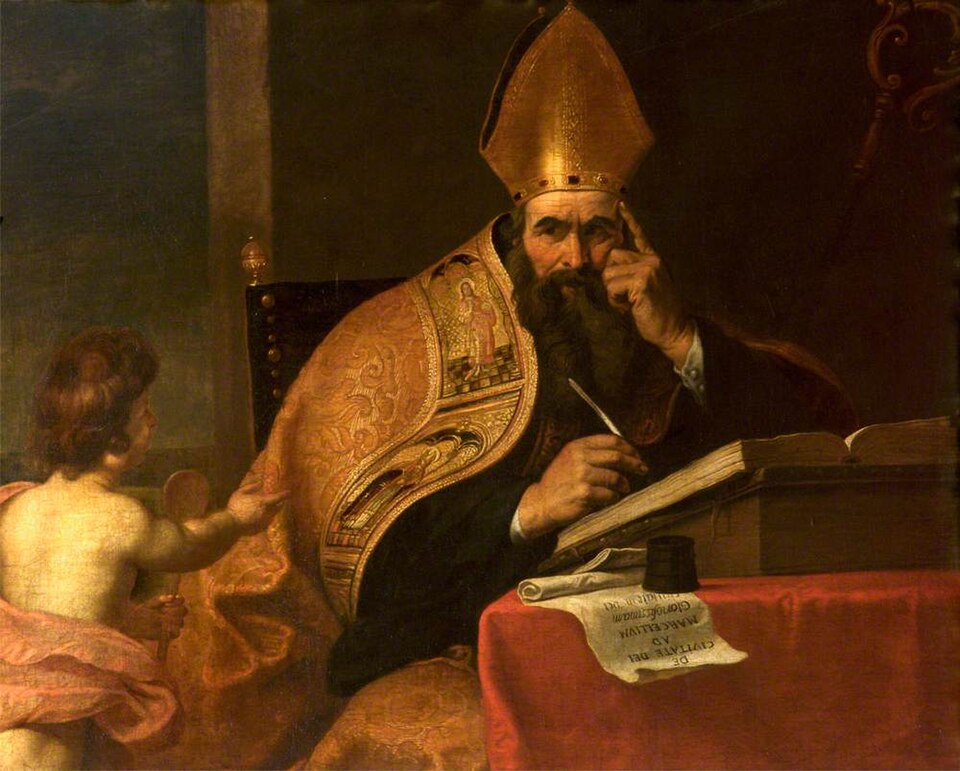
Augustine's life and philosophical career unfolded during one of the most turbulent periods in the history of the Roman world. The Western Roman Empire experienced sustained political instability, military pressure, and profound social transformation, culminating famously in the sack of Rome by Visigothic forces in 410 CE. This event shocked much of the Mediterranean world and prompted urgent questions about the fate of Rome, the meaning of history, and the future of civilization.
The political crisis of the late Roman world also raised difficult questions about the relationship between Christian faith and earthly political power. Some critics argued that Rome's decline resulted from its abandonment of traditional religious practices in favor of Christianity. Augustine responded to such accusations by developing a broader philosophy of history in which no earthly empire, however powerful, could be identified with humanity's ultimate spiritual destiny.
This same period saw Christianity undergo a dramatic transformation in status, moving from a formerly persecuted religion to an increasingly central institution within Roman public life. This transformation generated intense debates concerning doctrine, church authority, religious unity, and the relationship between Christian belief and inherited traditions of Greek and Roman philosophy. Augustine would become one of the most influential participants in these debates.
Augustine's intellectual formation also took place within a rich and contested philosophical environment. His thought was shaped by his engagement with Neoplatonism, the dualist religion of Manichaeism, and currents of philosophical skepticism, all of which he examined seriously before developing his mature Christian philosophy. His eventual synthesis transformed elements of classical philosophy while placing them within a distinctly Christian understanding of God and reality.
Augustine's Early Life and the Confessions
Augustine was born in 354 CE in the North African town of Thagaste, in the Roman province of Numidia. His father, Patricius, was not initially a Christian, while his mother, Monica, was a deeply committed Christian whose influence became central to Augustine's later understanding of his own life. In the Confessions, Augustine repeatedly presents Monica's prayers, persistence, and emotional devotion as important elements in his eventual conversion.
As a young man, Augustine pursued an education designed to prepare him for a successful career in rhetoric and public life. He studied and taught in important urban centers, eventually working in Carthage, Rome, and Milan. His own later account describes these years as marked by powerful ambition, intellectual restlessness, sensual desire, and a continuing search for philosophical truth and a more satisfying understanding of the meaning and purpose of human existence.
Augustine also lived for many years with a woman whose name he does not provide in the Confessions, and with whom he had a son named Adeodatus. His reflections on this period are shaped by the moral perspective of his later Christian life, leading him to examine his earlier desires and ambitions with considerable self-criticism. These personal experiences became part of his larger philosophical inquiry into desire, memory, identity, responsibility, and the human search for happiness.
During this period, Augustine was drawn for nearly a decade to Manichaeism, a dualist religious movement that explained the existence of evil through a cosmic struggle between opposing principles of light and darkness. He eventually became dissatisfied with its intellectual explanations and turned toward skepticism and later Neoplatonic philosophy. These successive intellectual changes prepared the way for his eventual reconsideration of Christianity.
Augustine's Conversion to Christianity
Augustine's conversion to Christianity is recorded in one of the most celebrated passages of the Confessions. In 386 CE, while living in Milan and experiencing intense inner conflict, Augustine withdrew into a garden where he reflected upon his inability to make a decisive change in his life. According to his account, he then heard what seemed to be a child's voice repeatedly saying, "take up and read," an event that he interpreted as a command directing him toward the scriptures.
Augustine opened a copy of the Christian scriptures and encountered a passage from Paul's Letter to the Romans that he understood as directly addressing his personal struggle. He describes this moment as producing an immediate transformation in which his uncertainty and inner conflict gave way to a new sense of conviction. The dramatic account became central to the literary and spiritual structure of the Confessions, though Augustine's conversion was also the result of a much longer intellectual, philosophical, and personal development.
This conversion experience was preceded by Augustine's sustained engagement with Neoplatonic philosophy, particularly ideas associated with Plotinus that he encountered through Latin translations and interpretations. Neoplatonism helped him reconsider earlier assumptions about reality, especially his difficulty in understanding how a nonmaterial and spiritual God could exist. It also helped him develop a new philosophical approach to the problem of evil.
Following his conversion, Augustine was baptized by Ambrose, Bishop of Milan, in 387 CE. He later returned to North Africa, where he adopted a more ascetic way of life and helped establish a religious community. Over the following decades, he began the extraordinary program of philosophical, theological, pastoral, and polemical writing that would establish him as one of the most authoritative thinkers in the history of Western Christianity and one of late antiquity's greatest philosophers.
Augustine's Career as Bishop of Hippo
In 391 CE, Augustine was ordained as a priest in the North African coastal city of Hippo Regius. His ordination marked a major transformation in his life, moving him from philosophical and monastic reflection into the demanding world of pastoral leadership. He was soon consecrated as a bishop and eventually became the leading bishop of Hippo, a position involving preaching, administration, correspondence, theological controversy, and responsibility for his local Christian community.
Augustine's work as bishop did not prevent him from becoming one of the most prolific writers of late antiquity. He produced sermons, letters, biblical commentaries, philosophical dialogues, theological treatises, and major works addressed to both intellectual opponents and ordinary members of the church. His surviving writings reveal a thinker deeply involved in practical religious and political problems while also pursuing broad questions concerning truth, knowledge, freedom, evil, time, and human nature.
As bishop, Augustine engaged directly in several of the most important theological controversies of his era. He wrote extensively against Manichaeism, participated in conflicts surrounding the Donatist schism within North African Christianity, and later developed his most influential arguments during the controversy surrounding Pelagius. Through these debates, Augustine progressively refined his mature positions on sin, grace, the human will, the church, and salvation.
Augustine died in 430 CE while the city of Hippo itself was under siege by Vandal forces. His death occurred during the continuing political transformation and fragmentation of the Western Roman world that had shaped much of his mature thought. The historical circumstances of his final years gave particular resonance to his reflections on the instability of earthly political power and the distinction between temporary human kingdoms and the enduring spiritual destiny of humanity.
What Did Augustine Believe?
Augustine's philosophy rests on the conviction that genuine truth and lasting happiness can ultimately be found only in God. This conviction is expressed in the famous opening of the Confessions, where Augustine describes the human heart as restless until it finds its rest in the divine. For Augustine, human beings continually seek happiness, truth, beauty, and permanence, but finite worldly things cannot finally satisfy desires directed toward an infinite and unchanging source of being.
Central to Augustine's mature thought is his understanding of the human condition as profoundly affected by original sin. Human beings possess reason and will, yet their desires have become disordered and divided. Augustine therefore argued that people often recognize what is genuinely good while still finding themselves drawn toward lesser goods in destructive ways. Divine grace consequently became essential within his mature philosophy of moral transformation and salvation.
Augustine also developed influential philosophical positions on the nature of time, memory, evil, knowledge, and personal identity. He frequently began with introspective examination of his own experience and then moved toward broader metaphysical and theological questions. This method gives much of his writing an unusually personal and psychologically penetrating character. For Augustine, the examination of the inner self could become a path toward understanding the deeper structure of reality.
Scholars continue to examine the relationship between Augustine's Neoplatonic inheritance and his specifically Christian theological commitments. His philosophy transformed important ideas inherited from the ancient philosophical tradition while refusing to treat philosophy as independent of questions about God, revelation, and salvation. The result was one of history's most consequential syntheses of philosophical argument, religious belief, introspection, and systematic reflection on human existence.
The Confessions: Augustine's Spiritual Autobiography
The Confessions, composed around 397 to 400 CE, presents an extended and deeply personal account of Augustine's spiritual and intellectual journey. Written largely in the form of a sustained prayer addressed directly to God, the work traces Augustine's life from childhood through his education, ambition, philosophical searching, and eventual conversion. Yet it is not simply a chronological autobiography, since Augustine continually interprets the events of his life through philosophical reflection.
Augustine examines his earlier experiences with remarkable intensity, using personal memory as a starting point for broader questions about desire, responsibility, happiness, and the nature of the self. Famous episodes, including his account of stealing pears as a boy, become opportunities for philosophical reflection on why human beings sometimes choose actions that they themselves recognize as wrong. His personal history therefore becomes part of a much wider investigation into the structure of human motivation.
Beyond its autobiographical narrative, the Confessions incorporates extended philosophical discussion of memory, time, evil, creation, and the nature of God. Augustine moves fluidly between personal introspection and abstract argument, demonstrating his belief that the examination of inner experience can reveal important truths about the human condition. This combination of autobiography, philosophy, theology, and literary artistry makes the work unusually difficult to classify within a single genre.
The Confessions is widely regarded as one of the earliest and most influential examples of sustained psychological self-examination within Western literature. It established a powerful model of introspective spiritual autobiography and influenced countless later writers, philosophers, and religious thinkers. The work continues to be read both as a major philosophical text and as a landmark literary exploration of memory, identity, conversion, self-knowledge, and the restless search for meaning.
City of God: Augustine's Political Theology
City of God is one of Augustine's largest and most ambitious works, composed over many years following the shocking Visigothic sack of Rome in 410 CE. The event produced a major crisis of confidence within the Roman world, and some pagan critics argued that Rome had declined because it had abandoned its traditional gods in favor of Christianity. Augustine wrote partly in response to these accusations, challenging the assumption that political success proves religious truth.
The work develops Augustine's influential distinction between the earthly city and the city of God. These should not simply be understood as two ordinary political states or geographical locations. Instead, they represent two communities ultimately defined by different fundamental loves and orientations: one directed primarily toward self and temporal power, and the other directed toward God. Throughout history, Augustine argues, these communities remain deeply intermingled.
Augustine's philosophy of history rejects the idea that the destiny of humanity can be identified with the rise and fall of a single empire. Rome was historically important, but it was neither eternal nor the ultimate measure of human moral or spiritual achievement. By separating the Christian understanding of salvation from the political fortunes of Rome, Augustine provided a powerful framework for thinking about the limits of earthly authority and the instability of all human political institutions.
City of God carries enormous philosophical significance beyond its immediate historical occasion. It contains a philosophy of history, a critique of Roman religious traditions, reflections on justice and political authority, and an influential account of the relationship between temporal government and spiritual allegiance. Its arguments shaped medieval political philosophy for centuries and remain important for debates concerning religion, politics, history, justice, and the limits of political power.
Augustine on Original Sin
Augustine's doctrine of original sin holds that the disobedience of Adam and Eve described in the biblical account of the Fall had consequences extending beyond a single isolated act of wrongdoing. Human nature itself became wounded and disordered, leaving subsequent human beings within a condition marked by mortality, disordered desire, and moral weakness. Augustine therefore understood the human problem as deeper than the accumulation of individual bad decisions.
This doctrine carried major implications for Augustine's understanding of freedom and moral responsibility. Human beings continue to possess a will and remain responsible for their actions, yet the will is not perfectly healthy or naturally directed toward the highest good. Augustine believed that people can become divided against themselves, recognizing one course of action as better while nevertheless choosing something else because desire, habit, pride, or other impulses exert powerful influence.
Augustine's account of original sin therefore became closely connected with his doctrine of grace. If the human will is fundamentally weakened and disordered, then moral transformation cannot be explained simply as the product of unaided human effort. Divine grace becomes necessary for healing and redirecting the human person toward genuine good. This emphasis distinguished Augustine sharply from thinkers who placed greater confidence in humanity's independent moral capacities.
The doctrine of original sin became one of the most historically influential and theologically consequential elements of the Christian tradition. It shaped later debates concerning baptism, salvation, responsibility, grace, and the nature of human freedom for centuries. At the same time, it has remained one of Augustine's most debated positions, raising difficult philosophical questions about inherited responsibility, human nature, moral agency, and the relationship between freedom and divine assistance.
Augustine on Free Will and Grace
Augustine's philosophy of free will developed over the course of his long intellectual career. In his earlier work, On the Free Choice of the Will, he strongly emphasized human responsibility for moral evil. Evil, he argued, does not originate from a defect in God or from an independent evil substance opposing God. Instead, moral evil arises when rational creatures misuse their freedom by turning away from higher goods toward lower and disordered desires.
This early emphasis was particularly important in Augustine's argument against Manichaean dualism. The Manichaean worldview explained evil through an opposition between cosmic principles of good and evil, whereas Augustine sought to preserve the goodness of creation and human moral responsibility. If evil were an independently existing substance created by a separate principle, Augustine believed, human responsibility would be difficult to explain in the same way.
In his later writings, especially during the Pelagian controversy, Augustine placed increasing emphasis on the necessity of divine grace. The fallen human will, weakened by sin, could not consistently heal or save itself through effort alone. Augustine therefore argued that God's grace must initiate and support the transformation of the human person, allowing the will to become genuinely capable of loving and choosing the highest good.
The relationship between free will and grace remains one of the most extensively studied and philosophically contested aspects of Augustine's thought. His writings attempt to preserve both divine grace and genuine human responsibility, but the exact relationship between these ideas remains difficult to define. The problem generated centuries of later theological and philosophical debate concerning moral agency, predestination, responsibility, and whether human freedom can coexist coherently with divine causation.
Augustine vs. Pelagius: The Pelagian Controversy
The controversy associated with Pelagius became one of the most important theological conflicts of Augustine's later life. Pelagius emphasized human moral responsibility and opposed the idea that people should excuse wrongdoing by claiming that their nature made obedience impossible. Augustine believed, however, that Pelagian ideas underestimated the depth of humanity's fallen condition and failed to give sufficient importance to the necessity of divine grace.
The dispute centered on fundamental questions about human freedom, sin, grace, and moral ability. Could human beings obey God's commands through their own natural powers, or did they require a special divine transformation in order to will and accomplish genuine good? Augustine increasingly defended the second position, arguing that the human will remains genuinely active but is incapable of healing itself without God's freely given and unearned assistance.
Augustine responded through a sustained and increasingly systematic body of anti-Pelagian writing. These works developed his mature views concerning original sin, grace, divine assistance, and the relationship between human willing and salvation. His arguments became highly influential in Western Christianity, and Pelagian positions were condemned in important ecclesiastical decisions during and after the controversy, although scholarly debate continues concerning the precise beliefs of all involved.
The Pelagian controversy remains historically significant because it forced Augustine to articulate his mature philosophy with unusual precision. Questions first sharpened during this dispute continued to influence later Christian debates, including controversies associated with medieval theology and the Protestant Reformation. More broadly, the conflict remains philosophically important because it concerns a permanent question: how much of moral transformation can human beings achieve through their own independent efforts?
Augustine's Theory of Time
Augustine's celebrated discussion of time in Book Eleven of the Confessions begins with his famous recognition of a philosophical puzzle. He observes that people ordinarily believe they know perfectly well what time is, yet become deeply perplexed when asked to define it precisely. This apparently simple problem opens one of the richest philosophical investigations of time in the ancient world and reveals Augustine's characteristic movement from ordinary experience toward profound metaphysical questions.
Augustine asks how the past and future can be said to exist. The past no longer exists in the ordinary sense because it has already passed, while the future does not yet exist because it has not arrived. Even the present appears difficult to grasp because it constantly passes into the past. These observations lead Augustine to question whether time can be understood simply as a collection of independently existing past, present, and future moments extending outside human consciousness.
His solution is often described as a theory of the threefold present. There is a present of things past through memory, a present of things currently experienced through attention, and a present of things future through expectation. All three modes are encountered within the activity of the mind. Augustine therefore connects temporal experience with the structure of consciousness and asks how the human mind can retain what has disappeared while anticipating what has not yet arrived.
Augustine's reflections on time have remained enormously influential because they combine metaphysical questions with an analysis of lived human experience. His discussion does not simply offer a scientific measurement of temporal succession but investigates what it means for human beings to experience duration, change, memory, and expectation. Philosophers of time, phenomenologists, theologians, and philosophers of mind continue to study his arguments as an important early analysis of temporal consciousness.
Augustine on Evil: The Privation Theory
Augustine's mature account of the problem of evil rejects the idea that evil exists as a positive substance or as an independent force competing with God. Instead, he argues that evil is a privation, meaning a lack, corruption, or absence of some good that ought properly to be present. Augustine often explains this idea through comparisons such as blindness, which is not itself a separate substance but the absence of the sight that normally belongs to a healthy human being.
This theory allowed Augustine to preserve the fundamental Christian conviction that creation, because it originates from God, is good in its nature. Created things differ in degree of perfection, and some are naturally more limited or changeable than others, but limitation itself is not identical with moral evil. Evil appears when a good nature becomes damaged, disordered, or deprived of the proper perfection appropriate to it. Thus, Augustine does not explain evil by introducing a second evil substance into the structure of reality.
Augustine developed this position partly through his rejection of Manichaeism, the dualist religion to which he had belonged for many years. Manichaean teaching described reality as a cosmic struggle between opposing principles of light and darkness, treating evil as something with an independent metaphysical existence. Augustine eventually came to regard this explanation as incompatible with the idea of an all-powerful and perfectly good creator, and his privation theory became one of his most important alternatives to Manichaean dualism.
Augustine also connects evil with the misuse and disordering of created goods, particularly the human will. The capacities of desire, freedom, intelligence, and love are themselves good, but they can be directed toward inappropriate objects or placed in the wrong order. Moral evil therefore does not require the creation of some positive evil thing; it arises when the will turns away from higher goods and becomes attached to lower goods in a disordered manner. This theory remains one of the most influential responses to the problem of evil.
Augustine and Neoplatonism
Augustine's philosophical vocabulary and intellectual development were profoundly shaped by Neoplatonism, particularly by ideas associated with Plotinus and the later Platonic tradition. During the period preceding his conversion to Christianity, Augustine encountered Latin translations and adaptations of Neoplatonic works that gave him new philosophical resources for thinking about God, the soul, spiritual reality, and the nature of evil. This encounter became a decisive stage in his movement away from Manichaean dualism.
Neoplatonic philosophy helped Augustine overcome his earlier tendency to imagine reality primarily in material terms. It offered a way of understanding different levels of being and of conceiving a transcendent reality that was not itself a physical object extended in space. This was particularly important for Augustine's understanding of God, whom he increasingly came to conceive as immaterial, unchanging, and superior to the changing world of physical objects rather than as a being occupying a particular physical location.
Neoplatonism also contributed to Augustine's mature account of evil. The Platonic tradition provided philosophical language for explaining evil as a deficiency or privation rather than as an independent substance, an approach that supported Augustine's rejection of the Manichaean struggle between two equally fundamental cosmic powers. Nevertheless, Augustine did not simply become a Neoplatonist. He adapted philosophical concepts to a Christian framework centered on creation, divine providence, grace, and the historical significance of Christ.
Augustine therefore represents one of the most important examples of the creative encounter between ancient Greek philosophy and Christian theology. He regarded philosophical reasoning as valuable for helping the mind understand reality, but he did not consider reason alone sufficient for the highest religious truth. His transformation of Neoplatonic concepts into a distinctly Christian philosophical framework influenced medieval thinkers for centuries and established a major model for later attempts to reconcile classical philosophy with religious revelation.
Augustine on the Trinity
Augustine's extensive treatise On the Trinity represents one of the most ambitious philosophical and theological attempts in the Christian tradition to understand the doctrine that God exists as Father, Son, and Holy Spirit while remaining one undivided divine reality. Augustine sought to defend the unity of God without denying the genuine distinctions expressed by Christian trinitarian doctrine, making the problem both a theological and a philosophical question about unity, relation, identity, and personhood.
A central feature of Augustine's approach is his search for analogies within the human mind. Because human beings are understood within Christianity as created in the image of God, Augustine explores whether the structure of human consciousness might provide a limited way of thinking about trinitarian unity. Among his best-known examples is the relationship between memory, understanding, and will, which are distinguishable aspects of a single unified mind rather than three completely separate minds or substances.
Augustine does not claim that such psychological analogies completely explain the Trinity. The divine nature, in his view, exceeds the capacity of finite human understanding, and every analogy remains limited. Nevertheless, the attempt is philosophically significant because it turns theological reflection toward questions concerning consciousness, self-knowledge, memory, love, and the unity of the person. Augustine's analysis therefore connects his doctrine of God directly with his broader investigations into the structure of the human mind.
On the Trinity exercised enormous influence over the later development of Western Christian theology, particularly in the Latin tradition. At the same time, its importance extends beyond formal doctrine because Augustine uses the problem of the Trinity to explore fundamental philosophical questions about how unity can contain distinction without collapsing into complete separation. His work remains a major example of the way metaphysical and psychological reasoning could be brought into conversation with theological questions concerning the ultimate nature of reality.
Augustine's Just War Theory
Augustine played an important role in developing the early Christian foundations of what later became known as just war theory. Earlier Christian attitudes toward military conflict included strong traditions of pacifism and suspicion toward participation in imperial warfare. Augustine, however, faced a political world in which Christian communities existed within states responsible for defending populations and maintaining public order. He therefore considered whether the use of force could ever be morally justified without abandoning the Christian commitment to peace.
Augustine argued that war should never be treated as inherently good or desirable. Peace, rather than conflict, remained the proper goal of political life. Nevertheless, he believed that force could sometimes be used to resist serious injustice, defend against aggression, or restore a violated peace. The moral question therefore depended not simply upon whether violence occurred but upon the reasons for which political authorities used force and the intentions guiding those responsible for directing military action.
Proper intention was especially important in Augustine's moral framework. Even when force was used for a defensible cause, it could become morally corrupted by hatred, cruelty, vengeance, ambition, or the desire for domination. Augustine therefore insisted that political actors should not celebrate war for its own sake. The ultimate purpose of justified force should be the restoration of peace and a more just political order, reflecting his broader belief that even necessary coercion must be judged within a moral framework.
Augustine did not produce a single formal list of just war criteria in the later scholastic form commonly associated with the tradition. His reflections were developed across different works, letters, and theological arguments and were subsequently organized more systematically by medieval thinkers, especially Thomas Aquinas. Nevertheless, Augustine's emphasis on legitimate authority, just purpose, moral intention, and peace as the ultimate end became foundational for later Western discussions of military ethics and continues to influence debates about war and political responsibility.
Augustine on Predestination
Augustine's later writings, particularly those shaped by the Pelagian controversy, increasingly emphasized the priority and necessity of divine grace in human salvation. Within this theological framework, his doctrine of predestination holds that salvation ultimately depends upon God's gracious action rather than upon any prior human achievement capable of earning divine favor. Augustine therefore rejected the idea that human beings could take the first decisive step toward salvation entirely through their own unaided moral effort.
This position emerged from Augustine's broader understanding of original sin and the weakened condition of the human will. Because human beings are unable, according to his mature theology, to restore themselves completely through their own powers, grace must precede and transform the movement of the will toward genuine good. Augustine understood this grace as a gift rather than a reward for prior merit, and his emphasis on divine initiative became one of the defining characteristics of his later theological thought.
Augustine's doctrine created difficult philosophical questions about the relationship between divine sovereignty and human responsibility. If salvation depends fundamentally upon God's grace and choice, how should human moral decisions be understood? Augustine continued to insist that human actions remain meaningful and that individuals are responsible for their sins, but critics have long argued that a substantial tension remains between this responsibility and a strong doctrine of predestination. The precise interpretation of Augustine's position consequently remains a subject of scholarly debate.
The historical influence of Augustine's teaching on predestination was immense. Medieval theologians continued to debate his views, while later Reformers, including Martin Luther and John Calvin, drew deeply upon Augustinian discussions of grace, the will, and salvation. Their interpretations were not identical to Augustine's own thought, but they helped carry Augustinian problems into the center of Reformation theology. For this reason, Augustine remains indispensable to the historical study of later debates concerning freedom, grace, divine foreknowledge, and the ultimate possibility of human salvation.
Augustine on Memory and Self-Knowledge
Augustine's extended philosophical treatment of memory, especially in the Confessions, explores memory as far more than a simple storehouse containing images of past events. He describes it as a vast and mysterious inner capacity through which human beings retain experiences, knowledge, emotions, learned abilities, and countless impressions gathered throughout life. Memory therefore becomes central to Augustine's attempt to understand what it means for a person to possess a continuous inner life and a recognizable sense of self.
Augustine is particularly interested in the remarkable fact that the mind can search within itself for something that it already possesses without immediately being conscious of it. A person may remember a place, recognize a familiar melody, recover a forgotten experience, or recall knowledge that was not previously present to immediate awareness. These experiences led Augustine to treat memory as a complex philosophical problem concerning the relationship between consciousness, knowledge, personal identity, and the hidden depths of the human mind.
His investigation of memory forms an essential part of a broader project of self-knowledge. Augustine repeatedly turns inward, examining his own desires, experiences, thoughts, and recollections in order to understand the human condition. For him, introspection is not merely a private psychological exercise but a philosophical and spiritual method. By confronting the instability and complexity of the self, Augustine seeks to understand both the limits of human knowledge and the deeper relationship between the human mind and the God toward whom he believes the mind is ultimately directed.
Augustine's reflections on memory and inner experience have remained influential because they anticipate later philosophical interest in consciousness and subjective experience. Modern philosophers may not accept his theological conclusions, but his careful attention to the structure of inner life continues to attract scholars working in the philosophy of mind, phenomenology, psychology, and theories of personal identity. His writing demonstrates that questions about memory are inseparable from larger questions about who we are and how human beings experience themselves across the changing events of time.
Augustine on Love: Caritas vs. Cupiditas
Augustine's ethical philosophy gives a central place to love, because he believes that human beings are defined not only by what they know but also by what they desire and value. His moral thought therefore distinguishes between caritas, often understood as rightly ordered or charitable love, and cupiditas, a disordered form of attachment directed toward created and finite goods as though they could provide ultimate fulfillment. The difference concerns not simply whether a person loves, but whether that love is directed and ordered properly.
For Augustine, created things such as friendship, beauty, wealth, reputation, physical pleasure, and political power can all possess genuine value. The problem arises when human beings treat temporary and changing goods as though they were absolute and permanent sources of happiness. Because finite things can be lost, altered, or destroyed, a life founded entirely upon them becomes vulnerable to disappointment and instability. Augustine therefore argues that lasting happiness requires the proper ordering of human desire toward a good that does not change or disappear.
Caritas represents love ordered toward God and expressed through a proper relationship with other human beings and created things. This does not necessarily require rejecting the world or refusing ordinary human attachments. Instead, Augustine seeks to explain how different objects of love should occupy different places within a moral hierarchy. Human beings become morally disordered when lower goods are treated as higher than they are or when love for the self, power, or pleasure overwhelms concern for truth, justice, and the ultimate good.
This theory gives Augustine's moral philosophy a distinctive understanding of virtue and vice. Virtue is not merely obedience to a collection of external rules but involves the transformation and ordering of the person's deepest desires. Vice, similarly, is often understood as a disorder within love rather than as the existence of an entirely separate evil force. Augustine's ethical influence has therefore extended into later discussions of character, desire, happiness, and moral psychology, particularly among thinkers interested in the relationship between what people love and the kind of persons they ultimately become.
The Two Cities: City of God vs. City of Man
Augustine's influential distinction between the city of God and the earthly city provides the central organizing framework of his major work City of God. These two cities should not be understood simply as two geographical places, two particular governments, or two clearly separated political institutions. Instead, Augustine uses them to describe two different orientations of human love and loyalty, each representing a fundamentally different way of ordering one's life and ultimate commitments.
The earthly city is associated with self-love, the pursuit of worldly power, domination, status, and temporal glory. Augustine does not mean that every person living within an ordinary political state belongs in a simple or obvious sense to this city, nor does he deny that earthly political institutions can provide important forms of peace and order. His argument is instead concerned with the deepest orientation of the human will. Political communities become morally distorted when power and self-interest are treated as the highest purposes of collective life.
The city of God, by contrast, is defined by love directed ultimately toward God and by a conception of human life oriented toward eternal rather than merely temporal fulfillment. Its citizens remain present within ordinary historical societies and participate in the practical conditions of earthly life, including political institutions and social relationships. Augustine therefore does not present the city of God as a simple political program for constructing a perfect earthly state. Its full realization belongs to a horizon that transcends the ordinary achievements and failures of human political history.
Augustine insists that the two cities remain intermingled throughout history, making it impossible to identify any existing empire, nation, or religious institution completely and permanently with the city of God. This distinction became enormously influential in medieval and later political thought because it placed limits on the spiritual significance that could be assigned to earthly political power. Augustine's framework continues to raise important questions about political loyalty, religious commitment, the meaning of history, and whether any human political order can genuinely represent ultimate justice or perfection.
Augustine's Influence on Christian Theology
Augustine's theological and philosophical writings exercised an extraordinary influence over the development of Western Christianity. His reflections on original sin, grace, free will, predestination, the Trinity, and the nature of the Church became essential points of reference for generations of theologians. Even thinkers who strongly disagreed with particular Augustinian doctrines were often required to define their own positions in relation to problems that Augustine had articulated with exceptional force and philosophical sophistication.
During the medieval period, Augustine remained one of the most authoritative intellectual figures within Latin Christianity. Monastic writers, theologians, and philosophers repeatedly studied his works, while later scholastic thinkers developed new philosophical methods for addressing questions that Augustine had already explored. Thomas Aquinas, despite relying more heavily upon Aristotle than Augustine had, cited and engaged Augustine extensively. The continued authority of Augustine demonstrates how deeply his ideas had become embedded within the intellectual foundations of medieval Christian thought.
Augustine's influence became equally important during the Protestant Reformation. Martin Luther, himself an Augustinian friar, drew heavily upon Augustine's emphasis on divine grace and the limitations of the fallen human will. John Calvin likewise engaged deeply with Augustinian discussions of grace and predestination, although later Protestant theological systems should not simply be identified with Augustine's own views. His writings nevertheless provided a major historical vocabulary for debates about salvation, freedom, divine action, and human moral responsibility.
Augustine's influence also extends beyond the divisions between Roman Catholic and Protestant traditions. His writings continue to be read by theologians and philosophers across different Christian communities, while his intellectual importance has also attracted scholars outside Christianity. The extraordinary breadth of his legacy reflects his ability to connect theological doctrine with fundamental philosophical questions about the human mind, moral responsibility, history, love, and the nature of ultimate reality. Few figures have exercised such a sustained influence across so many centuries of Western intellectual history.
Augustine and Manichaeism
Augustine's nearly decade-long involvement with Manichaeism during his younger years played a major role in shaping the direction of his later philosophical development. Founded by Mani in the third century, Manichaeism presented a strongly dualistic account of reality in which the forces of light and darkness were engaged in a profound cosmic conflict. For the young Augustine, this framework initially appeared attractive because it offered a clear explanation for the presence of evil and seemed capable of addressing difficult questions that troubled him about human nature and the structure of the universe.
One of the most important features of Manichaean thought for Augustine was its attempt to explain evil through a cosmic opposition between fundamentally different principles. This helped him make sense of the apparent power of suffering and moral wrongdoing, but it also created serious philosophical difficulties. If evil possessed an independent metaphysical existence, questions arose concerning the ultimate unity of reality and the power of God. Augustine gradually became dissatisfied with explanations offered by Manichaean teachers and began searching for a philosophical account that could explain evil without treating it as an eternal substance.
Augustine's encounter with Neoplatonic philosophy was important in this intellectual transition. Neoplatonic ideas helped him understand how reality could contain degrees of perfection and how evil might be explained as a deficiency rather than as a positive thing. This philosophical development eventually contributed to his rejection of Manichaeism and his movement toward Christianity. His later doctrine of evil as privation can therefore be understood in part as a response to problems that had occupied him throughout his earlier Manichaean period.
After his conversion, Augustine wrote extensively against Manichaean doctrine. His criticism was shaped by unusually close personal familiarity because he had once accepted the movement's teachings and participated in its intellectual world. This experience gave his later polemical writings a detailed understanding of the philosophical problems he sought to reject. Augustine's relationship with Manichaeism is consequently essential for understanding his mature philosophy, since several of his most important ideas about evil, freedom, matter, and the goodness of creation developed partly through his sustained intellectual struggle against the dualism he had once embraced.
Augustine Compared with Plato
Augustine's philosophy stands in a deep historical relationship with the broader Platonic tradition, although his direct philosophical engagement was shaped especially by Neoplatonic thinkers such as Plotinus. Like Plato, Augustine believed that the changing world encountered through the senses cannot by itself provide the highest form of knowledge or the ultimate foundation of truth. Both thinkers therefore directed philosophical attention toward a higher and more stable reality that could be approached through reason, intellectual reflection, and the transformation of the human soul.
Plato's philosophy distinguished the changing world of sensible things from the intelligible realm associated with eternal and unchanging Forms. Augustine adapted many elements of this intellectual orientation but placed them within an explicitly Christian framework. Rather than locating ultimate truth in an independent realm of Forms, Augustine understood truth, goodness, and being in relation to the eternal God. Divine reality was not merely an abstract metaphysical principle but the reality of a personal creator who freely creates and sustains the world.
Their views of the human soul also reveal both similarity and difference. Plato and Augustine shared the conviction that human beings should not allow themselves to become completely absorbed in material and temporary desires. Both emphasized the importance of intellectual and moral transformation. Augustine, however, connected the condition of the soul with specifically Christian ideas about creation, sin, grace, and salvation. For him, philosophical contemplation alone could not fully overcome the moral and spiritual disorder of the human will without the assistance of divine grace.
Augustine's transformation of Platonic philosophy into a Christian intellectual framework became one of his most historically significant achievements. He demonstrated how concepts inherited from Greek philosophy could be reinterpreted without simply abandoning Christian theological commitments. This synthesis influenced medieval philosophy for centuries and helped establish the Platonic and Neoplatonic tradition as a major intellectual resource within Western Christianity. At the same time, Augustine's differences from Plato reveal that his philosophy was not merely borrowed Platonism but a distinctive and creative reworking of ancient philosophical ideas.
Augustine Compared with Thomas Aquinas
Augustine and Thomas Aquinas are two of the most influential thinkers in the history of Western Christian philosophy, yet their philosophical styles and principal intellectual sources differ considerably. Augustine wrote during late antiquity and was deeply shaped by Platonic and Neoplatonic traditions, whereas Aquinas worked in the medieval scholastic world and drew extensively upon the philosophy of Aristotle. Their differences therefore reflect not only personal intellectual choices but also the changing philosophical environment between late antiquity and the high Middle Ages.
Augustine's writing frequently proceeds through personal reflection, dialogue, prayer, biblical interpretation, and responses to specific theological controversies. His philosophical investigations often begin with questions about his own consciousness, memory, desire, and experience. Aquinas, by contrast, developed a more formally systematic scholastic method in which philosophical questions were organized through objections, contrary positions, carefully constructed arguments, and replies. This difference in style gives Aquinas's major works a more structured and impersonal appearance than much of Augustine's introspective writing.
Their approaches to the relationship between faith and reason also contain important differences, although both considered philosophical reasoning valuable. Aquinas developed an extensive account of how natural reason could investigate many truths about the world and even establish certain conclusions about God independently of revelation. Augustine likewise valued reason, but his thought often places greater emphasis on the limitations of the fallen human mind and the need for divine assistance in reaching the highest truth. His intellectual method is therefore closely connected with themes of illumination, grace, and the transformation of the will.
Despite these differences, Aquinas held Augustine in exceptionally high regard and cited him extensively throughout his theological and philosophical writings. Augustine's ideas about God, evil, the human will, love, grace, and the nature of the soul remained deeply embedded within the intellectual tradition that Aquinas inherited. Their relationship illustrates an important continuity within medieval philosophy: Aquinas introduced powerful Aristotelian methods and concepts, but he did so within a Christian intellectual world already profoundly shaped by the philosophical and theological legacy of Augustine.
Common Misconceptions About Augustine
One common misconception presents Augustine as an opponent of philosophy who abandoned reason in favor of unquestioning religious faith. This interpretation overlooks the extraordinary amount of philosophical argument found throughout his writings. Augustine repeatedly investigated questions concerning truth, skepticism, knowledge, memory, time, freedom, evil, and the nature of the mind. Although he believed that human reason has limits and requires illumination or guidance from God, he did not regard philosophical reasoning as useless or incompatible with serious religious inquiry.
Another misconception reduces Augustine's views about the body and sexuality to a simple belief that physical existence itself is evil. Augustine explicitly rejected the Manichaean doctrine that matter was the product of an independent evil principle and maintained that creation is fundamentally good because it originates from God. His moral concerns focused instead on disordered desire and the effects of sin upon the human will. His views remain controversial and have been criticized extensively, but they cannot accurately be reduced to a straightforward rejection of embodiment or all physical pleasure.
A further misunderstanding assumes that Augustine's philosophical views remained completely unchanged throughout his long intellectual career. In reality, his thought developed significantly in response to new philosophical problems and theological controversies. His later emphasis on grace and the weakened condition of the human will became stronger during the Pelagian controversy than in much of his earlier writing. Augustine himself recognized the importance of intellectual development and revisited earlier positions in his later Retractationes, demonstrating a willingness to reconsider and qualify arguments he had previously defended.
Augustine is also sometimes treated as a thinker whose ideas can be summarized through a few isolated doctrines such as original sin or predestination. This approach obscures the remarkable breadth of his intellectual work, which includes philosophy of time, theories of memory, political philosophy, ethics, theories of love, and profound reflections on consciousness and personal identity. Understanding Augustine requires attention to the development and diversity of his writings rather than reducing his philosophy to a single doctrine or treating every interpretation of his work as equally representative of his complex intellectual career.
Augustine's Legacy in Western Philosophy
Augustine's philosophical legacy extends across an unusually wide range of subsequent Western intellectual history, shaping not only medieval Christian philosophy and theology but also later developments in the philosophy of time, the philosophy of mind, ethics, political thought, and theories of human freedom. His writings became major reference points for generations of philosophers and theologians, and his distinctive synthesis of Christian doctrine with Platonic and Neoplatonic philosophy helped establish the intellectual foundations of Western Christianity for many centuries.
During the medieval period, Augustine remained one of the most influential authorities in the Latin intellectual tradition. His ideas about the human will, divine illumination, evil, grace, love, and the relationship between faith and reason continued to generate new philosophical questions. Thinkers did not simply repeat Augustine's conclusions; they interpreted, criticized, modified, and developed his ideas in response to changing philosophical circumstances. His legacy therefore became a continuing intellectual tradition that helped shape the development of medieval philosophy rather than merely preserving the thought of a single late antique author.
Augustine's introspective method in the Confessions has also attracted sustained attention from philosophers interested in consciousness, selfhood, memory, and subjective experience. His reflections on the nature of time, particularly his analysis of the relationship between memory, present awareness, and expectation, remain among the most frequently discussed philosophical treatments of temporal experience from the ancient world. Modern phenomenologists and philosophers of mind have repeatedly returned to these questions, recognizing the unusual depth with which Augustine examined the inner structure of human consciousness.
His political and ethical thought likewise continues to influence discussions of justice, peace, political authority, war, desire, and the limits of earthly institutions. Even scholars working outside an explicitly Christian theological framework continue to engage with his theories of evil, freedom, memory, time, and personal identity. This continuing relevance demonstrates that Augustine's achievement cannot be understood as merely theological. Across more than sixteen centuries, his writings have remained a major source of philosophical questions about what human beings are, how they know themselves, and how they should understand their place within reality and history.
Saint Augustine: Main Philosophical Ideas
Because Augustine's philosophical output spans autobiography, extended political theology, and sustained theological controversy, his central ideas are often summarized under a small number of key themes drawn from across his extensive body of surviving work.
Restless Until Rest in God
Augustine holds that genuine and lasting human happiness can only be found in God, with every finite created good remaining ultimately insufficient on its own.
Original Sin and the Need for Grace
Human nature, corrupted by the fall of Adam, requires divine grace to overcome its disordered will and choose genuine good consistently.
Time as Present Experience
Augustine argues that past and future exist only as present memory and present expectation within the structure of the conscious mind.
Evil as Privation
Evil is not a positive substance but an absence of the good that should properly be present in a given created thing.
The Two Cities
Human society contains an earthly city oriented toward self-love and a city of God oriented toward love of the divine, intermingled throughout history.
What Do We Actually Know About Augustine's Philosophy?
Because Augustine's own autobiographical writing, letters, and extensive theological corpus survive in considerable detail, his biography and intellectual development are unusually well documented for a figure of late antiquity, though scholars continue to debate the interpretation of specific philosophical and theological positions rather than the basic outline of his life.
Relatively Well-Attested
- Augustine was born in Thagaste in 354 CE and died at Hippo in 430 CE.
- He converted to Christianity in Milan in 386 CE and was baptized the following year.
- He served as Bishop of Hippo from 396 CE until his death.
- He authored Confessions, City of God, and On the Trinity, among many other works.
- He wrote extensively against Manichaeism, Donatism, and Pelagianism.
Areas of Ongoing Scholarly Debate
- How consistently Augustine's early and later positions on free will and grace should be reconciled.
- How closely his theory of time anticipates later phenomenological treatments of temporal experience.
- The precise boundary between philosophical argument and theological authority within his mature system.
Why Is Saint Augustine Important in Philosophy?
Augustine is important because he produced one of the most influential and enduring syntheses of Greek philosophy and Christian theology ever written, shaping the subsequent course of Western philosophy, political thought, and Christian doctrine for well over a thousand years after his own death.
His philosophical legacy raises a fundamental question that remains central to metaphysics and philosophy of religion: Can genuine human freedom be coherently reconciled with dependence on divine grace, and what does the answer to this question ultimately reveal about the deeper nature of human will itself?
Augustine's importance therefore does not depend on resolving every scholarly debate about the interpretation of his complex and evolving thought. His significance comes from his role in establishing an enduring model for integrating rigorous philosophical reasoning with sincere religious conviction, a legacy that continues to shape Western philosophy and theology today.
Saint Augustine Explained Simply
Saint Augustine of Hippo was a Christian philosopher and theologian whose Confessions and City of God shaped Western thought for over a thousand years, developing influential ideas about time, sin, grace, and the proper relationship between earthly and spiritual life.
Instead of treating philosophy and religious faith as separate or competing pursuits, Augustine's work fuses careful reasoning with Christian conviction, exploring questions of time, evil, memory, and society through both rigorous philosophical argument and deeply personal spiritual reflection.
- Philosopher: Saint Augustine of Hippo
- Period: 354–430 CE
- Tradition: Christian philosophy and Neoplatonism
- Major works: Confessions and City of God
- Central concern: The relationship between the human soul and God
- Key debate: With Pelagius, over free will and grace
A Principle Central to Augustine's Philosophy
“Our heart is restless until it rests in you.”
Frequently Asked Questions About Saint Augustine
Who was Saint Augustine?
Saint Augustine of Hippo was a Christian philosopher and theologian of late antiquity whose works Confessions and City of God profoundly shaped Western philosophy, developing influential theories of time, original sin, and free will.
What is Augustine's theory of time?
Augustine argued that time has no independent existence apart from the created universe and the human mind, describing the past and future as existing only as present memory and present expectation within the mind experiencing them.
What is Augustine's privation theory of evil?
Augustine argued that evil is not a positive substance created by God but rather a privation, or absence, of the good that should properly be present in a thing, a position he developed partly in reaction against Manichaean dualism.
What is the Confessions about?
Confessions is Augustine's spiritual autobiography, tracing his journey from a youth marked by ambition and sensual indulgence through his years with Manichaeism to his eventual conversion to Christianity.
What is City of God about?
City of God is Augustine's major political-theological work, written after the sack of Rome in 410 CE, distinguishing between the earthly city oriented toward self-love and the city of God oriented toward love of the divine.
What is original sin in Augustine's philosophy?
Original sin, for Augustine, is the corruption of human nature inherited from Adam's disobedience, leaving human will disordered and unable to consistently choose good without divine grace.
What was the Pelagian controversy?
The Pelagian controversy was a theological dispute between Augustine and the monk Pelagius over whether human beings could achieve salvation through free will alone or required divine grace, a debate Augustine's position ultimately won.
What is Augustine's just war theory?
Augustine argued that war could be morally justified only when waged for a genuinely just cause and with the underlying intention of restoring peace, laying groundwork for the later formal tradition of just war theory.
How did Neoplatonism influence Augustine?
Neoplatonic philosophy, particularly the work of Plotinus, helped Augustine conceive of purely spiritual, non-material reality, providing philosophical resources he found essential for overcoming earlier obstacles to Christian belief.
Why is Augustine important today?
Augustine remains important because his reflections on time, evil, grace, and political community continue to shape Western philosophy, theology, and political thought well beyond explicitly religious contexts.
Related Thinkers
Saint Augustine belongs to the wider tradition of Christian and classical philosophy. Explore thinkers who shaped and responded to many of the same questions about God, the soul, and human society.
Philosophy Branches Connected to Augustine
Augustine's philosophical legacy is particularly important for metaphysics, where philosophers investigate the nature of time and evil, and for political philosophy, which examines the relationship between temporal and spiritual authority.
Why Saint Augustine Still Matters
Augustine did not simply inherit and repeat the philosophical and theological traditions available to him; he fused them into a genuinely original synthesis capable of addressing questions of time, evil, selfhood, and society with a depth that few later thinkers have matched, producing a body of work that shaped over a thousand years of Western thought.
Yet the questions associated with Augustine remain fundamental to philosophy: What is the true nature of time? Can human freedom coexist with divine grace? How should temporal political life relate to a deeper spiritual allegiance? What does it mean for the human heart to find genuine and lasting rest?
The philosophy he developed across decades of introspective writing, theological controversy, and sustained reflection transformed these questions into one of the richest and most enduring bodies of thought in the history of Western philosophy. His emphasis on time, grace, evil, and the two cities made Saint Augustine one of the most significant and lastingly influential philosophers in human history.
Explore Great Philosophers