Who Was Al-Farabi?
Al-Farabi (Abū Naṣr Muḥammad ibn Muḥammad al-Fārābī, c. 870–950/951 CE) was one of the most important philosophers of the medieval Islamic world. His writings addressed a remarkably wide range of subjects, including logic, metaphysics, psychology, ethics, political philosophy, the philosophy of religion, mathematics, and music. He became especially influential for his attempt to present philosophy as a coherent system concerned with both the nature of reality and the achievement of human perfection.
Al-Farabi lived during a period in which the Arabic-speaking intellectual world had inherited and developed a large body of Greek philosophical and scientific learning. His thought shows a deep engagement with Aristotle and Plato, as well as with the late antique philosophical traditions through which much Greek philosophy had reached the Islamic world. Rather than merely repeating these earlier thinkers, he developed original theories about intellect, knowledge, human happiness, religion, and political life.
He became known in later philosophical tradition as the "Second Teacher", with Aristotle regarded as the "First Teacher." This title reflects the exceptional importance of his work on logic and his role in explaining and organizing the Aristotelian philosophical tradition for later thinkers. His Enumeration of the Sciences was particularly important as an attempt to classify the major fields of human knowledge.
One of Al-Farabi's best-known political ideas appears in his conception of the Virtuous City (al-Madīnah al-Fāḍilah). For him, the highest purpose of a well-ordered political community was not simply wealth, security, or power, but the achievement of genuine human happiness and perfection. A virtuous society therefore required cooperation, education, and forms of leadership capable of guiding people toward their highest intellectual and moral ends.
Al-Farabi's importance extends beyond political philosophy. He produced major writings on the nature of the intellect and human knowledge and also wrote the Great Book of Music, one of the most significant medieval works on music theory in the Islamic world. His philosophical synthesis strongly influenced later Islamic thinkers, particularly Avicenna, and helped establish a lasting tradition of philosophical inquiry within the medieval Islamic world.
Al-Farabi: Quick Facts
- Full name — Abū Naṣr Muḥammad ibn Muḥammad al-Fārābī
- Born — c. 870 CE
- Died — c. 950–951 CE
- Known as — Al-Farabi, Alfarabius, and the "Second Master"
- Philosophical tradition — Arabic and Islamic philosophy
- Major influences — Plato, Aristotle, and Neoplatonic philosophy
- Major subjects — Logic, metaphysics, epistemology, psychology, ethics, political philosophy, religion, and music
- Best-known political concept — The Virtuous City
- Important philosophical concept — The Active Intellect
- Major work — The Opinions of the People of the Virtuous City
- Other major work — Enumeration of the Sciences
Al-Farabi's Life and Historical Background
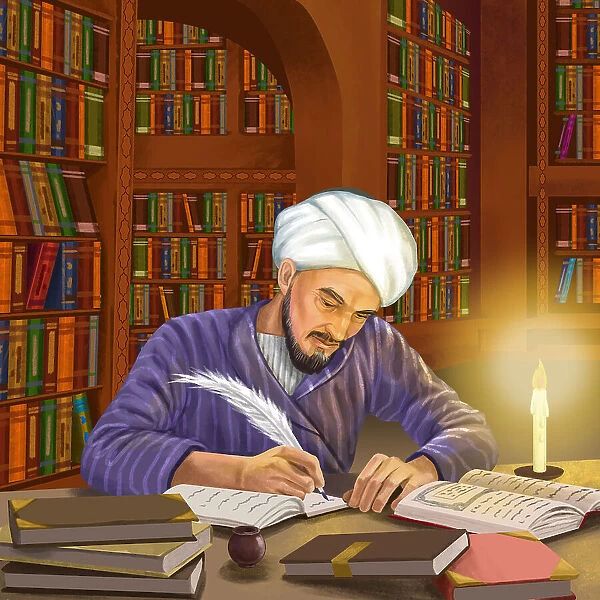
Reliable information about Al-Farabi's early life is limited. He was probably born around 870 CE in or near Farab in Central Asia and later moved toward the major intellectual centers of the Islamic world. His formative years therefore unfolded within a broad cultural environment in which Persian, Arabic, Greek, and other intellectual traditions interacted. Although later biographical accounts provide additional details, many of those stories cannot be established with complete certainty.
He spent important periods of his intellectual life in Baghdad, where he studied philosophy and logic, and later lived in Syria, including Damascus. Baghdad was then one of the most important centers of scholarship in the Islamic world, supporting extensive work in philosophy, mathematics, medicine, astronomy, grammar, and logic. Al-Farabi's intellectual development was closely connected with this wider scholarly environment and with the continuing study of philosophical works inherited from ancient Greek traditions.
Unlike many later biographical stories about philosophers, the details of Al-Farabi's life should be treated cautiously. Modern scholarship emphasizes that relatively little information about his biography can be established with confidence. Accounts concerning his education, teachers, travels, languages, occupations, and personal circumstances sometimes contain legendary or conflicting elements. This makes his philosophical writings especially important for understanding his intellectual career rather than relying entirely on later biographies.
Al-Farabi's historical importance is closely connected with the intellectual movement through which Greek philosophy was studied, translated, interpreted, and developed in the medieval Islamic world. He engaged deeply with Aristotle's logic and philosophy while also examining Plato, mathematics, political philosophy, metaphysics, music, and the organization of the sciences. His work consequently belongs to a period in which philosophers were not merely preserving earlier ideas but were actively reorganizing and extending them within new intellectual and cultural contexts.
Al-Farabi is generally associated with the final years of his life in Syria, and he died in Damascus around 950 or 951 CE. Despite the limited biographical evidence, his later reputation became exceptionally influential. He was remembered as a major authority on logic and philosophy and was traditionally given the title of the "Second Master" after Aristotle. His writings helped establish a systematic philosophical vocabulary and framework that influenced later thinkers, including Avicenna and other philosophers of the medieval Islamic and Jewish intellectual traditions.
Why Is Al-Farabi Called the Second Master?
Al-Farabi is traditionally known as the "Second Master", while Aristotle is regarded as the "First Master." The title reflects Al-Farabi's extraordinary reputation as a philosopher and especially as a scholar of logic. It expresses the exceptionally high status medieval intellectual traditions attributed to his work in organizing, explaining, and developing philosophical knowledge.
His extensive engagement with Aristotle helped make him one of the most influential interpreters of Aristotelian philosophy in the medieval Islamic world. Al-Farabi studied and commented on major areas of Aristotelian thought, particularly logic and metaphysics, while also engaging with Plato and other philosophical traditions. His writings helped make Greek philosophical ideas more systematic and accessible within the intellectual environment of the Islamic world.
The title should not be interpreted as meaning that Al-Farabi simply copied Aristotle. His writings develop original approaches to logic, metaphysics, intellect, political philosophy, religion, and music. He was particularly interested in how different branches of knowledge relate to one another and how philosophy can provide an ordered account of reality, human knowledge, and the organization of society.
Al-Farabi's importance as the "Second Master" is also connected with his attempt to clarify the structure of philosophical knowledge. His works on logic examine reasoning, demonstration, definition, and the forms through which knowledge can be organized. For Al-Farabi, logic was not merely an isolated technical discipline; it served as an instrument that could help distinguish sound reasoning from error and provide a foundation for disciplined intellectual inquiry.
The title therefore reflects both Al-Farabi's relationship with the earlier Greek philosophical tradition and his own contribution to its development. By interpreting Aristotle while also engaging with Plato, political philosophy, metaphysics, ethics, and the sciences, Al-Farabi helped shape the philosophical tradition that later influenced thinkers such as Avicenna and other philosophers of the medieval Islamic world. His reputation as the "Second Master" consequently represents his historical role as a major interpreter, organizer, and creative developer of philosophy rather than merely a follower of Aristotle.
Al-Farabi and Greek Philosophy
Greek philosophy provided one of the most important intellectual foundations for Al-Farabi's philosophical work. He was deeply engaged with the legacy of Aristotle, while also drawing upon Plato and the late antique traditions through which Greek philosophy had been transmitted to the Arabic-speaking intellectual world.
Al-Farabi's understanding of Aristotle was shaped not only by the original Aristotelian tradition but also by the Neoplatonic and Alexandrian commentators who had organized and interpreted Greek philosophy in late antiquity. This intellectual background helps explain why Aristotelian logic, Platonic political thought, and Neoplatonic metaphysical ideas could appear together in his work.
Al-Farabi was particularly concerned with the apparent relationship between Plato and Aristotle. A work traditionally attributed to him, The Harmonization of the Two Opinions of the Two Sages, attempts to show that important disagreements between Plato and Aristotle can be reconciled within a broader philosophical unity. The authenticity of this work, however, remains a subject of scholarly debate.
The attempt to harmonize Greek philosophical traditions was also complicated by the transmission of texts into Arabic. Some writings circulating in the Islamic world under Aristotle's name were actually derived from later Neoplatonic thinkers, especially Plotinus. As a result, the boundaries between Aristotelian and Neoplatonic ideas were sometimes understood differently from the way modern scholarship distinguishes them.
His political philosophy likewise shows a significant engagement with Greek thought, particularly the Platonic concern with the just and well-ordered city. Al-Farabi developed these ideas within his own philosophical framework, connecting political order with ethics, knowledge, human happiness, and the intellectual development of the community.
Al-Farabi therefore did not simply reproduce Greek philosophy. His achievement lay in interpreting, organizing, and developing this inheritance within the intellectual world of the medieval Islamic civilization. Through this work, he became an important figure in the transmission of Greek philosophy and in the formation of the later Islamic philosophical tradition.
Al-Farabi's Philosophy of Logic
Logic was one of Al-Farabi's most important philosophical interests. He regarded it as an instrumental science that provides the mind with rules for correct reasoning and helps protect human thought from error, confusion, and invalid inference.
Al-Farabi wrote extensively on the logical tradition associated with Aristotle's Organon. His writings include commentaries, summaries, and independent treatises dealing with concepts, propositions, definitions, syllogisms, demonstration, and the different forms through which human beings reason and argue.
For Al-Farabi, the highest form of logical reasoning was demonstration, because demonstration aims at genuine knowledge and certainty rather than mere persuasion or opinion. In this respect, logic was not simply a technical discipline but an essential instrument for philosophy and the systematic pursuit of truth.
One of the most distinctive features of his thought is his analysis of the relationship between logic and language. Al-Farabi compared logic to grammar: grammar provides rules governing the expressions of a particular language, whereas logic provides more universal rules governing the concepts and intelligible meanings with which the human mind reasons.
His conception of logic was also broader than the modern tendency to identify logic only with formal deduction. Following the late antique interpretation of Aristotle's logical corpus, Al-Farabi examined demonstrative, dialectical, rhetorical, sophistical, and poetic forms of reasoning and considered the different purposes they serve in intellectual and social life.
Al-Farabi's work made a major contribution to the development of the Arabic logical tradition and helped establish logic as a central part of philosophical education in the medieval Islamic world. His influence can be seen in later thinkers, including Avicenna, and his discussions of logic and language remained important for subsequent Islamic and medieval philosophical traditions.
Al-Farabi's Enumeration of the Sciences
Enumeration of the Sciences (Iḥṣāʾ al-ʿUlūm) is one of Al-Farabi's most important works for understanding his classification of human knowledge. Rather than presenting philosophy as a collection of unrelated subjects, the work attempts to show how the major intellectual disciplines can be distinguished, organized, and understood in relation to one another.
Al-Farabi's classification includes language, logic, mathematics, natural science, metaphysics, political science, jurisprudence, and theology. Mathematics itself encompasses several disciplines, while his treatment of the sciences also considers the methods, objects, and purposes that distinguish one form of inquiry from another.
The work demonstrates how broadly Al-Farabi understood philosophy and intellectual education. Logic serves as an instrument for disciplined reasoning, while the theoretical sciences investigate different levels of reality and the practical sciences concern human action and political life. Knowledge therefore possesses an intelligible order rather than being merely an accumulation of isolated information.
The Enumeration also had an important historical influence because classifications of knowledge helped shape educational and philosophical traditions beyond Al-Farabi's immediate intellectual environment. Parts of the work became known in medieval Europe through Latin translation, contributing to wider discussions about the organization and hierarchy of the sciences.
What Was Al-Farabi's Philosophy of Metaphysics?
Al-Farabi's metaphysics investigates existence, causation, the structure of reality, and the relationship between the First Existent and the beings that depend upon it. His metaphysical writings also examine fundamental philosophical distinctions, including the difference between things existing outside the mind and the concepts through which the mind understands them.
At the highest level of his cosmological framework stands the First Existent, the ultimate principle upon which all other beings depend. From this first principle proceeds an ordered hierarchy of intellectual and celestial realities, providing Al-Farabi with a philosophical account of the relationship between ultimate reality and the changing world of human experience.
His cosmological system is often described in terms of emanation. The First Existent is understood as the ultimate source from which the ordered universe proceeds, while the successive intellects are connected with the celestial order. This framework combines questions about causation, cosmology, and the hierarchy of being.
Al-Farabi's metaphysics cannot, however, be reduced simply to Neoplatonism. His writings also contain strongly Aristotelian treatments of being, categories, causation, and the objects of metaphysical inquiry. Modern scholarship therefore emphasizes the complexity of the philosophical traditions that were brought together within his broader system.
Metaphysics is also closely connected with the rest of Al-Farabi's philosophy. His account of the First Existent and the cosmic hierarchy provides the background for his theories of intellect and human knowledge, while his political philosophy ultimately connects human perfection with an understanding of the place of human beings within the larger order of reality.
Al-Farabi's Philosophy of God and the First Existent
In Al-Farabi's metaphysics, the First Existent occupies the highest position in the hierarchy of reality. The First is absolutely prior to everything else and does not depend upon another cause for its existence. Other beings ultimately depend upon the First in a way that distinguishes the ultimate principle from the caused and dependent realities below it.
Al-Farabi's philosophical discussion of the First Existent is not simply a repetition of religious theology. He seeks to investigate the ultimate principle of reality through metaphysical analysis, asking what kind of being can stand at the highest level of the causal and intelligible order of the universe.
From the First Existent proceeds an ordered hierarchy of intellectual and celestial realities. Through this cosmological framework, Al-Farabi explains how the multiplicity of the universe can be related to a single ultimate principle without treating the world as independent of its highest source.
His philosophical account of God therefore forms an important connection between metaphysics, cosmology, and philosophy of religion. The First Existent provides the ultimate foundation of his account of the universe, while the hierarchy proceeding from it helps explain the structure within which human intellectual life takes place.
Al-Farabi's Theory of Intellect
The theory of intellect is one of the most important parts of Al-Farabi's philosophy. He investigates how human beings move from the capacity for knowledge toward actual intellectual understanding, making the development of the intellect central to his accounts of psychology, epistemology, human perfection, and happiness.
In his Epistle on the Intellect, Al-Farabi discusses different meanings and forms of intellect. His philosophical account includes the potential intellect, actual intellect, acquired intellect, and the Active Intellect, although these distinctions must be understood within his wider attempt to explain how intelligible knowledge becomes actual in the human mind.
The potential intellect represents the human capacity to receive and understand intelligible forms. Through intellectual activity, this capacity becomes actualized. The development of knowledge is therefore not merely the passive collection of information but a transformation of the rational powers that belong to human beings.
The acquired intellect represents a more advanced stage of intellectual development and is associated with the human being's approach toward greater perfection. Al-Farabi consequently understands intellectual achievement as a graded process in which the rational soul moves from potentiality toward increasingly complete forms of understanding.
The Active Intellect plays a crucial role in his epistemology and psychology. It is connected with the principles through which human beings can attain intelligible knowledge and develop their rational capacities, linking the structure of the cosmos with the highest possibilities of human intellectual life.
What Is the Active Intellect in Al-Farabi's Philosophy?
The Active Intellect is an immaterial intellect that occupies a crucial position in Al-Farabi's philosophical psychology and cosmology. It belongs to the hierarchy of separate intellects associated with his account of the celestial order and also has a decisive relationship to human intellectual development.
The Active Intellect plays a role in making intelligible knowledge possible for human beings. In Al-Farabi's account, the human intellect does not begin with complete intellectual knowledge already realized; it must develop from potentiality toward actuality through the acquisition and understanding of intelligible principles.
The Active Intellect is also connected with the sublunary world and with the processes through which human beings attain the principles of understanding. This gives it a distinctive mediating role between the higher cosmological hierarchy and the intellectual capacities of embodied human beings.
The Active Intellect is therefore important not only to Al-Farabi's philosophy of mind but also to his account of human perfection and happiness. The highest development of the human intellect depends upon a process through which rational capacities are increasingly actualized and brought toward their proper fulfillment.
Al-Farabi's Epistemology and Theory of Knowledge
Al-Farabi's epistemology examines how human beings acquire knowledge and how intellectual capacities develop from potentiality into actuality. His account connects sensation, imagination, rational understanding, and the different methods through which human beings arrive at varying degrees of certainty.
Human beings initially possess rational capacities that must be developed through intellectual activity, education, experience, and the acquisition of knowledge. Sensory experience provides an important starting point, but human understanding becomes distinctively intellectual when the mind is able to grasp intelligible meanings and universal principles.
Al-Farabi also distinguishes between different forms of reasoning. Demonstration occupies the highest position because it aims at secure and properly established knowledge, while dialectical, rhetorical, and other forms of argument perform different functions within education, inquiry, and communication.
The perfection of the intellect is closely connected with the highest human goal. For Al-Farabi, genuine happiness depends upon the development and perfection of the rational faculty. Knowledge is therefore not merely useful for practical survival but part of the fulfillment of human nature itself.
What Did Al-Farabi Mean by Happiness?
Happiness (saʿāda) is one of the central concepts in Al-Farabi's philosophy. He does not understand happiness simply as pleasure, wealth, status, or physical comfort. These may be desired as subordinate goods, but they do not by themselves constitute the highest fulfillment available to human beings.
Genuine happiness is connected with human perfection, especially the perfection of the rational and intellectual capacities. A human being must develop knowledge and virtue in order to approach the highest form of happiness, because the proper end of human life involves the fulfillment of specifically human capacities.
This perfection is both intellectual and practical. Knowledge alone does not make a human life complete if the individual's choices and actions remain disordered. Al-Farabi therefore connects intellectual understanding with virtue, education, habituation, and the proper direction of human action.
This explains why Al-Farabi's ethics and political philosophy are closely connected. Society should be organized in a way that helps human beings pursue genuine happiness rather than merely satisfying bodily needs or acquiring wealth and power. Political life has a higher purpose because communities can assist human beings in pursuing forms of perfection difficult to achieve in isolation.
What Was Al-Farabi's Political Philosophy?
Al-Farabi's political philosophy asks what kind of society can enable human beings to achieve their highest perfection and genuine happiness. Political inquiry is therefore inseparable from his understanding of human nature and from the question of what constitutes the proper end of human life.
He does not regard political organization as merely a system for providing food, security, economic activity, and physical survival. A properly ordered society should also guide its citizens toward intellectual and moral development and establish forms of cooperation directed toward genuinely human ends.
Human beings require association because individuals depend upon one another for the conditions of life and for the development of their capacities. The political community is therefore not simply an accidental gathering of people but an organized form of cooperation capable of directing collective life toward different possible ends.
His political thought therefore connects politics, ethics, psychology, metaphysics, education, and philosophy. The nature of a political order depends ultimately upon what it understands to be human perfection, because different communities pursue different conceptions of what is genuinely good.
The central model of his political philosophy is the virtuous regime, whose guiding purpose is the realization of human excellence. This makes Al-Farabi's political philosophy fundamentally teleological: political institutions are evaluated not merely by their power or stability but by the ends toward which they direct communal life.
What Is Al-Farabi's Virtuous City?
The Virtuous City (al-Madīna al-Fāḍila) is Al-Farabi's most famous political concept. It describes a community in which people cooperate to achieve genuine happiness and human perfection. Its members are united not simply by geographical proximity or economic exchange but by participation in a common understanding of the highest human end.
In an excellent city, political institutions and social relationships should be directed toward the proper human end rather than merely toward material survival. The different activities within the community ideally cooperate as parts of a larger whole, with each contributing to the conditions necessary for collective flourishing.
Al-Farabi frequently explains political order through analogies with the natural and living order of the universe. Just as the parts of a living organism perform different functions within an organized whole, the members and institutions of a political community possess different roles within a coordinated social order.
Al-Farabi's ideal city is therefore both a political and philosophical model. Its organization reflects his understanding of human nature, the hierarchy of knowledge, virtue, and the structure of reality. Political order is connected with a broader philosophical account of what human beings are and what they are ultimately capable of becoming.
Al-Farabi's Philosopher-King and Ideal Ruler
The ruler of the Virtuous City must possess exceptional intellectual and moral qualities. Al-Farabi's ideal ruler combines philosophical knowledge with the ability to guide a community toward its proper end. Leadership therefore requires more than political power, inherited status, military strength, or the ability to command obedience.
This idea has clear connections with Plato's philosopher-king, but Al-Farabi develops the concept within his own philosophical framework and within the intellectual world of medieval Islamic civilization. The ideal leader must unite theoretical understanding with practical judgment and the capacity to establish an appropriate political order.
The ideal ruler must understand reality, human nature, happiness, and the proper organization of society. Where necessary, the ruler must also be able to communicate philosophical truths through forms of teaching and representation accessible to citizens who do not engage in philosophical demonstration themselves.
For this reason, political leadership in Al-Farabi's philosophy is closely related to education. The ruler must not only possess knowledge but also understand how different members of a community can be guided toward appropriate intellectual and ethical goals through laws, institutions, instruction, and persuasive representation.
Al-Farabi's Classification of Deficient Cities
Al-Farabi does not only describe the Virtuous City. He also examines forms of society that fail to direct citizens toward genuine happiness. These alternative political orders reveal the importance of purpose in his philosophy, because communities can possess organization and power while still pursuing ends that he regards as fundamentally inadequate.
Some societies are organized primarily around wealth, pleasure, honor, domination, or physical survival. Such communities may satisfy immediate needs and may even appear successful according to ordinary standards, but they remain deficient from the standpoint of genuine human perfection.
Al-Farabi's classifications also distinguish between communities whose members lack knowledge of true happiness and those in which people knowingly pursue distorted or inferior ends. His political analysis is therefore concerned not only with institutions but with the beliefs, values, and conceptions of the good that shape collective life.
His analysis demonstrates that Al-Farabi evaluates political systems according to their ultimate purpose: whether they genuinely help human beings attain knowledge, virtue, and happiness. A community cannot be judged solely by wealth, military strength, territorial size, or political stability if its fundamental orientation directs human beings away from their highest possible end.
Al-Farabi on Philosophy and Religion
The relationship between philosophy and religion is one of the most distinctive aspects of Al-Farabi's political thought. He attempts to explain how a community can be guided toward important truths even though not every individual possesses the same level of philosophical education or demonstrative understanding.
Al-Farabi understands religion as a system of beliefs, practices, and rules that guides a community toward its intended goals. Religious teaching can communicate important truths through images, symbols, narratives, and persuasive forms appropriate to the intellectual capacities and practical needs of a wider population.
Philosophy, by contrast, seeks demonstrative knowledge through intellectual reasoning. Al-Farabi therefore distinguishes philosophical knowledge from the symbolic and persuasive modes through which religion can guide a broader population, while still treating both as capable of having important roles within the organization of human life.
This distinction should not be reduced to the simple claim that philosophy and religion always teach unrelated truths. A major question in Al-Farabi's political philosophy concerns how universal truths may be represented differently according to the capacities of different audiences and the practical requirements of political communities.
His treatment of religion consequently connects epistemology, imagination, rhetoric, political authority, and education. The relationship between philosophical demonstration and religious representation became one of the most influential and controversial themes in later Islamic, Jewish, and medieval philosophical thought.
Al-Farabi's Philosophy of Prophecy
Al-Farabi's theory of prophecy is closely connected with his philosophy of imagination, intellect, and political leadership. He attempts to explain prophecy within a philosophical account of the human faculties and their relationship to the higher intelligible order described in his cosmology.
The prophet possesses an exceptionally developed imaginative capacity through which intelligible truths can be represented in forms that ordinary people can understand. Imagination therefore performs a mediating function: what may be grasped intellectually by a philosopher can be communicated symbolically through images and representations.
This philosophical treatment of prophecy does not make imagination insignificant or merely deceptive. On the contrary, imagination is essential for translating meanings into forms capable of influencing human action, educating communities, and communicating matters that many people cannot approach through philosophical demonstration alone.
This allows Al-Farabi to connect prophecy with political leadership. The ideal ruler must be capable of guiding citizens toward the appropriate intellectual and ethical goals of the community. In his highest political model, exceptional intellectual understanding and exceptional imaginative and practical capacities are therefore closely connected.
Al-Farabi's Ethics and Moral Philosophy
Although ethics is not as extensive a part of his surviving corpus as political philosophy or logic, virtue and moral development remain essential to Al-Farabi's account of human perfection. Ethical questions are closely connected with his larger investigation of happiness and the proper ends of individual and communal life.
Human beings must cultivate appropriate habits and intellectual capacities. Moral virtues help organize the individual toward the proper human end rather than toward merely temporary pleasures or external goods. Virtuous action therefore involves the disciplined formation of character as well as the development of practical understanding.
Al-Farabi does not treat moral life as completely independent from knowledge. Human beings must understand, at least in an appropriate manner, the ends toward which they act. The development of intellectual capacities and the cultivation of moral habits consequently belong to a broader process of becoming more fully perfected.
This ethical dimension is essential to the Virtuous City: a good political community must cultivate citizens who are capable of pursuing genuine happiness. Education, law, leadership, and social institutions therefore possess an ethical function because political life can either encourage or obstruct the formation of virtuous character and rational understanding.
Al-Farabi's Philosophy of Mind and Psychology
Al-Farabi's philosophy of mind examines the faculties of the human soul, including sensation, imagination, memory, and intellect. His psychological theory attempts to explain how different powers cooperate in human life and how the mind moves from immediate sensory contact with the world toward abstract intellectual knowledge.
Sensation provides awareness of particular objects, while the internal faculties retain, combine, and transform sensory materials. Imagination is especially important because it can preserve sensible forms even when the objects themselves are absent and can combine these forms in ways that extend beyond immediate perception.
His account of the human soul is important because it explains how people move from sensory experience toward abstract intellectual knowledge. The rational faculty is not simply another sense; it makes possible the understanding of intelligible meanings and universal principles that cannot be reduced to particular sensory impressions.
Imagination also plays a major role in his account of dreams, prophecy, political leadership, and the communication of philosophical truths through symbolic representations. This makes psychology central to several apparently different areas of his philosophy, including epistemology, religion, politics, and the theory of prophecy.
Al-Farabi's Cosmology and Hierarchy of Being
Al-Farabi presents a hierarchical account of the universe in which the First Existent stands at the highest level of reality. His cosmology seeks to explain how an ordered universe can proceed from an ultimate first principle while containing multiple levels of intellectual, celestial, and material existence.
From the First Existent there proceeds an ordered series of intellectual and celestial principles. His cosmological system contains multiple separate intellects associated with the celestial order, culminating in the Active Intellect, which occupies a particularly important position in relation to the sublunary world and human beings.
The celestial hierarchy in Al-Farabi's philosophy reflects the astronomical understanding inherited from ancient and late antique traditions. His cosmology should therefore be understood historically rather than treated as a modern scientific description of the physical universe. Its philosophical importance lies in the explanatory order it gives to causation, intellect, and the hierarchy of being.
This cosmology connects Al-Farabi's metaphysics with his psychology because the Active Intellect also plays a central role in human intellectual development. The structure of the cosmos and the development of the human mind are therefore not separate subjects in his system but interconnected parts of a broader philosophical vision.

Al-Farabi's Philosophy of Music
Al-Farabi was also a major theorist of music. His Great Book of Music (Kitāb al-Mūsīqā al-Kabīr) is one of the most substantial surviving medieval works on musical theory produced in the Islamic world. It reflects both his engagement with earlier Greek theory and his attention to the musical practices of his own intellectual environment.
His treatment of music goes beyond practical musical performance. He examines sound, intervals, rhythm, instruments, musical composition, and the theoretical foundations of musical harmony. The work therefore approaches music as a field requiring systematic analysis rather than simply as an art of performance.
Al-Farabi did not merely repeat Greek musical theory. He also recognized limitations in some of the material available to him and discussed musical practices relevant to the Middle Eastern world of his own time. His work consequently combines inherited theoretical traditions with observation and analysis of actual musical practice.
His work on music demonstrates the breadth of his intellectual interests and the connection he saw between mathematical and philosophical investigation. It also reveals his wider methodological tendency to analyze complex subjects through classification, definition, proportion, and the careful examination of the principles underlying practical arts.
Major Works of Al-Farabi
Al-Farabi wrote extensively on philosophy, logic, politics, religion, psychology, language, and music. His surviving works and writings attributed to him reveal an unusually broad intellectual project, although questions concerning authenticity, dating, and the exact chronological order of some texts remain important issues for modern scholarship.
- The Opinions of the People of the Virtuous City — Al-Farabi's best-known account of metaphysics, cosmology, human perfection, and the ideal political community.
- The Political Regime — A major work concerning political organization, human perfection, and the relationship between society and the cosmic order.
- Enumeration of the Sciences — A systematic classification of intellectual disciplines and their relationships.
- Epistle on the Intellect — A major treatment of intellect and human knowledge.
- The Attainment of Happiness — A work exploring human perfection, knowledge, and genuine happiness.
- The Harmonization of the Two Opinions of the Two Sages — A philosophical discussion concerning Plato and Aristotle.
- The Great Book of Music — Al-Farabi's major contribution to medieval music theory and philosophy.
- The Book of Religion — A significant work concerning religion, political community, and philosophical knowledge.
Modern scholarship also emphasizes that the chronological order of many of Al-Farabi's works remains uncertain, so claims about a simple linear development of his philosophy should be made cautiously. Questions of authenticity also affect some texts traditionally associated with him, making it important to distinguish firmly established works from writings whose attribution remains debated.
Al-Farabi, Plato, and Aristotle
Al-Farabi's philosophy cannot be understood without considering his relationship to Plato and Aristotle. Both philosophers formed part of the Greek intellectual inheritance available in Arabic translation, interpretation, and commentary, although Al-Farabi encountered their ideas through the complex philosophical traditions that had developed during late antiquity.
From Aristotle, he drew heavily on logic, metaphysics, psychology, and natural philosophy. From Plato, he drew important resources for thinking about political organization, education, virtue, and the role of the philosopher. Yet these broad distinctions should not obscure the originality of Al-Farabi's own philosophical system.
Al-Farabi did not simply choose one philosopher over the other. Instead, he attempted to understand their philosophical relationship and to integrate their ideas into a broader philosophical framework. His intellectual project was also shaped by Neoplatonic and neo-Aristotelian traditions that influenced the interpretation of both Plato and Aristotle in late antiquity.
His attempt to harmonize the Greek philosophical inheritance should therefore be understood historically rather than as the claim that Plato and Aristotle literally agreed on every philosophical question. Al-Farabi sought a systematic philosophical order capable of drawing upon the resources of multiple traditions while addressing the intellectual problems of his own time.
Al-Farabi's Place in Islamic Philosophy
Al-Farabi occupies a central position in the history of Islamic philosophy and Arabic philosophy. His work helped transform the philosophical inheritance available from Greek sources into a systematic intellectual tradition expressed largely through the Arabic language and developed within the civilization of the medieval Islamic world.
His writings on logic, metaphysics, psychology, political philosophy, and religion became important resources for later philosophers. His influence was not confined to a single discipline because his philosophical system connected questions about knowledge, reality, human nature, political organization, and the ultimate purpose of human life.
His influence was particularly important for later philosophers such as Avicenna, while his thought also became part of intellectual traditions extending into al-Andalus, medieval Jewish philosophy, and later discussions of Aristotelian and Neoplatonic ideas. The precise character of his influence, however, differs considerably between individual thinkers and traditions.
Al-Farabi is therefore important not merely as a transmitter of Greek philosophy but as an original philosopher who reorganized inherited materials into a distinctive system. His work helped establish many of the major philosophical questions that later Islamic philosophers would continue to develop, criticize, and transform.
Al-Kindi and Al-Farabi: What Is the Difference?
Al-Kindi and Al-Farabi belong to successive generations of early Arabic philosophy. Al-Kindi was an important figure in the early translation and adaptation of Greek philosophical and scientific ideas, while Al-Farabi later developed a particularly systematic treatment of logic, political philosophy, psychology, metaphysics, and the classification of knowledge.
Al-Kindi was particularly important in the early transmission and adaptation of Greek philosophical ideas. His writings addressed metaphysics, mathematics, natural science, music, and other subjects, helping establish philosophical inquiry in an Arabic intellectual environment that was still actively receiving and translating Greek materials.
Al-Farabi built upon a broader intellectual environment already shaped by translation, commentary, and philosophical debate. His distinctive contribution was to organize many areas of inquiry into a more elaborate and interconnected philosophical framework, with logic and the theory of intellect occupying especially important positions.
Together, they represent two crucial stages in the development of Islamic philosophy. The comparison should not imply a simple progression from an incomplete philosopher to a complete one; each thinker developed his own distinctive philosophical concerns within different stages of the transmission and transformation of the Greek intellectual heritage.
Al-Farabi and Avicenna: Influence on Islamic Philosophy
Avicenna (Ibn Sina) was strongly influenced by Al-Farabi, particularly in the intellectual environment from which Avicenna developed his own philosophical system. A famous report associated with Avicenna describes Al-Farabi's writings as helping him understand Aristotle's difficult Metaphysics.
Al-Farabi's systematic treatments of logic, metaphysics, intellect, political philosophy, and the relationship between philosophy and religion provided important resources for later Islamic philosophical thought. His emphasis on the organization of the sciences and on the centrality of intellectual development also formed part of the philosophical background inherited by subsequent thinkers.
Avicenna would eventually develop his own highly sophisticated philosophical system, introducing distinctions and arguments that go significantly beyond Al-Farabi's formulations. The relationship between the two should therefore be understood as one of important influence and intellectual inheritance rather than simple agreement.
Their connection illustrates Al-Farabi's larger historical importance. By the time of Avicenna, many of the philosophical problems addressed by Al-Farabi—concerning being, intellect, demonstration, happiness, and the relationship between human knowledge and ultimate reality—had become central to the continuing development of Islamic philosophy.
Al-Farabi's Influence and Legacy
Al-Farabi's influence extended well beyond the Islamic philosophical tradition. His works circulated primarily in Arabic, while aspects of his thought later entered medieval Jewish and Latin intellectual traditions through translation, adaptation, and the broader transmission of Arabic philosophical learning.
His political philosophy influenced later discussions of the relationship between philosophy, religion, political authority, and human perfection. His writings on logic and the classification of knowledge also contributed to educational and philosophical traditions concerned with the proper organization of intellectual inquiry.
His influence can be seen in thinkers such as Avicenna, Ibn Bajja, Ibn Tufayl, Averroes, and Maimonides, although the precise nature of that influence differs from thinker to thinker. Some inherited particular doctrines or philosophical problems from him, while others encountered his thought through the wider traditions of Aristotelianism and Islamic philosophy that he had helped shape.
His enduring importance also lies in the unusual unity of his intellectual project. Logic, metaphysics, psychology, politics, religion, ethics, and music were not merely separate interests but parts of a larger attempt to understand reality, human knowledge, and the conditions under which human beings can achieve their highest perfection.
Al-Farabi's Main Philosophical Ideas
1. Human Beings Seek Perfection
Al-Farabi understands human life in terms of the pursuit of perfection. Human beings possess capacities that must be developed through knowledge, virtuous action, education, and rational activity, allowing them to move beyond merely satisfying immediate physical needs toward the fulfillment of their distinctively human potential.
2. Genuine Happiness Is the Highest Human Goal
Happiness is not simply pleasure, wealth, honor, or physical security. Genuine happiness requires the perfection of the rational and intellectual capacities together with an appropriately ordered life. It represents the fulfillment of human nature rather than a temporary emotional state or the possession of external goods.
3. The Virtuous City Should Promote Human Happiness
A good political community should help citizens pursue genuine happiness rather than merely satisfying their material needs. Political institutions, education, law, and leadership should therefore be evaluated partly according to whether they guide communal life toward knowledge, virtue, and the proper perfection of human beings.
4. The Intellect Is Central to Human Perfection
Human beings become more fully developed through the actualization of their intellectual capacities and the acquisition of knowledge. The movement from potential to actual understanding is central to Al-Farabi's psychology and epistemology and connects the development of the individual with his broader account of human happiness.
5. The Active Intellect Makes Intellectual Knowledge Possible
The Active Intellect plays a fundamental role in Al-Farabi's account of how human beings acquire intelligible knowledge. It connects his cosmology with his theory of the human mind and helps explain how rational capacities can attain the principles necessary for increasingly complete intellectual understanding.
6. Philosophy and Religion Serve Different Intellectual Functions
Philosophy seeks demonstrative intellectual knowledge, while religion communicates and organizes beliefs and practices in forms capable of guiding a wider community. Al-Farabi's distinction is closely connected with his theories of imagination, rhetoric, education, and political leadership rather than being merely a simple opposition between reason and religion.
7. Political Leadership Requires Knowledge and Virtue
The ideal ruler must possess exceptional intellectual, moral, and practical qualities and guide the community toward its proper end. Legitimate excellence in leadership depends on understanding human happiness and possessing the ability to educate and organize a community rather than merely exercising power over it.
Al-Farabi's Philosophy Explained Simply
Al-Farabi's philosophy can be understood through one central question: How can human beings and societies achieve genuine happiness and perfection? His answer brings together knowledge, virtue, education, political organization, and an understanding of humanity's place within the larger structure of reality.
- Human beings have rational capacities. These capacities allow people to acquire knowledge and understand reality.
- Knowledge and virtue lead toward perfection. A good human life requires intellectual and moral development.
- Society is necessary. Human beings cooperate with others because individuals cannot achieve their highest perfection entirely alone.
- The Virtuous City supports genuine happiness. Political institutions should help citizens develop toward their proper human end.
- The ruler needs knowledge and virtue. Political leadership should be directed by wisdom rather than merely by wealth, force, or ambition.
Why Is Al-Farabi Important in the History of Philosophy?
Al-Farabi is important because he transformed the philosophical inheritance of Plato, Aristotle, and late antique neo-Aristotelian and Neoplatonic traditions into one of the most sophisticated and systematic philosophical projects of the medieval Islamic world.
His contributions to logic, metaphysics, philosophy of mind, political philosophy, religion, ethics, and music demonstrate the extraordinary breadth of his intellectual project. Yet this breadth was accompanied by a strong concern for systematic relationships between disciplines rather than a collection of disconnected interests.
His political philosophy is particularly influential because it treats society as something that should be evaluated according to its ability to guide human beings toward genuine happiness and perfection. This makes questions about education, leadership, knowledge, virtue, and political authority inseparable within his account of the ideal community.
Al-Farabi also played a decisive role in establishing logic and the theory of the intellect as central components of philosophical inquiry in the Arabic-speaking intellectual tradition. His interpretation and development of Greek philosophical materials provided an important foundation for later Islamic philosophers, even when they disagreed with or significantly transformed his conclusions.
For this reason, Al-Farabi remains a major figure not only in Islamic philosophy but also in the broader history of political philosophy, metaphysics, logic, philosophy of mind, and the transmission and transformation of Greek philosophy across medieval intellectual traditions.
Frequently Asked Questions About Al-Farabi
Who was Al-Farabi?
Al-Farabi was a major tenth-century philosopher of the Islamic world who wrote about logic, metaphysics, psychology, political philosophy, ethics, religion, mathematics, and music.
What is Al-Farabi famous for?
Al-Farabi is especially famous for his political philosophy, the concept of the Virtuous City, his theory of intellect, his work on logic, and his attempt to synthesize Platonic, Aristotelian, and Neoplatonic philosophy.
Why is Al-Farabi called the Second Master?
Al-Farabi is traditionally called the "Second Master" because Aristotle was regarded as the "First Master." The title reflects Al-Farabi's exceptional reputation, particularly in logic and philosophy.
What is Al-Farabi's Virtuous City?
The Virtuous City is Al-Farabi's model of an excellent political community. Its institutions and citizens cooperate toward genuine human happiness and perfection.
What was Al-Farabi's political philosophy?
Al-Farabi's political philosophy argues that society should be organized toward the highest human goal: genuine happiness and perfection. His ideal ruler must possess intellectual and moral excellence.
What did Al-Farabi believe about happiness?
Al-Farabi regarded genuine happiness as the highest human goal. It is connected with intellectual and moral perfection rather than merely with pleasure, wealth, honor, or physical security.
What is the Active Intellect according to Al-Farabi?
The Active Intellect is an immaterial intellect that plays an important role in Al-Farabi's cosmology and theory of knowledge. It helps make human intellectual understanding possible.
What was Al-Farabi's theory of intellect?
Al-Farabi distinguishes several forms or stages of intellect, including potential, actual, and acquired intellect, while also discussing the separate Active Intellect.
What did Al-Farabi say about Plato and Aristotle?
Al-Farabi studied both Plato and Aristotle extensively and attempted to understand and harmonize their philosophical positions. Their ideas strongly influenced his political philosophy, logic, metaphysics, and ethics.
What is Al-Farabi's most famous book?
One of Al-Farabi's most famous works is The Opinions of the People of the Virtuous City, also known as The Virtuous City or The Perfect State in some translations.
What is Al-Farabi's Enumeration of the Sciences?
Enumeration of the Sciences is a work in which Al-Farabi classifies major fields of knowledge, including language, logic, mathematics, natural science, metaphysics, and political disciplines.
What was Al-Farabi's contribution to Islamic philosophy?
Al-Farabi helped develop a systematic philosophical tradition in the Islamic world by combining Greek philosophy with questions concerning metaphysics, human perfection, politics, religion, and knowledge.
How did Al-Farabi influence Avicenna?
Al-Farabi's works on logic, metaphysics, intellect, and philosophy provided important intellectual resources for Avicenna. Avicenna regarded Al-Farabi as particularly helpful for understanding Aristotle's metaphysics.
Was Al-Farabi influenced by Aristotle?
Yes. Aristotle was one of Al-Farabi's most important philosophical influences, especially in logic, metaphysics, psychology, and natural philosophy.
Did Al-Farabi believe philosophy and religion were the same?
No. Al-Farabi distinguishes philosophical knowledge from religious belief and representation. Philosophy seeks demonstrative knowledge, while religion communicates beliefs and practices in forms capable of guiding a broader community.
What was Al-Farabi's contribution to music?
Al-Farabi wrote the Great Book of Music, one of the major medieval works on music theory in the Islamic world. It examines musical sounds, intervals, rhythm, instruments, and theoretical principles.
Related Islamic and Arabic Philosophers
Explore other major thinkers in the development of Islamic philosophy, Arabic philosophy, Persian philosophy, and medieval intellectual history.
Related Areas of Philosophy
Al-Farabi's philosophy connects Islamic philosophy with political philosophy, metaphysics, epistemology, logic, ethics, philosophy of mind, philosophy of religion, cosmology, and the history of Greek philosophy.
Why Al-Farabi Still Matters
Al-Farabi occupies one of the most important positions in the history of Islamic philosophy. His work brought together Greek philosophical traditions and the intellectual concerns of the medieval Islamic world.
His theories of intellect, knowledge, happiness, political organization, religion, and the Virtuous City demonstrate how closely philosophy, ethics, psychology, and politics can be connected.
His influence on later thinkers such as Avicenna, Averroes, and Maimonides makes him essential for understanding the development of medieval philosophy across Islamic, Jewish, and Christian intellectual traditions.
Explore Great Philosophers