Who Was Ibn Rushd (Averroes)?
Ibn Rushd (Abū al-Walīd Muḥammad ibn Aḥmad ibn Rushd, 1126–1198 CE), known in the Latin West as Averroes, was one of the most important philosophers of the medieval Islamic world and a major influence on the later development of European philosophy. He is especially famous for his extensive commentaries on Aristotle, as well as for his defense of philosophical inquiry in response to the criticisms of thinkers such as Al-Ghazali.
Ibn Rushd was born in Córdoba in al-Andalus into a distinguished family associated with Islamic law and scholarship. His education and career extended across several fields, including jurisprudence, theology, philosophy, medicine, and the sciences. He served as a judge and later held important positions under the Almohad rulers, eventually becoming physician to the caliph in Marrakesh.
His philosophical project sought to understand and clarify Aristotle's thought, which Ibn Rushd regarded as the highest achievement of philosophical inquiry available to his age. He produced different kinds of commentaries on much of the Aristotelian corpus, ranging from shorter summaries to detailed and extensive interpretations. Through these works, he became known in medieval Latin philosophy simply as "the Commentator."
Ibn Rushd did not regard philosophy as necessarily opposed to religion. In works such as the Decisive Treatise, he argued that careful rational investigation could have a legitimate and important place within Islamic intellectual life. His Incoherence of the Incoherence also responded to Al-Ghazali's critique of the philosophers, defending the value of philosophical reasoning while engaging directly with difficult questions concerning knowledge, causation, God, and the natural world.
Ibn Rushd's influence extended far beyond the Islamic world. Many of his works circulated in Hebrew and Latin translation and became central to philosophical debates in medieval Europe. His interpretations of Aristotle influenced Jewish and Christian thinkers and contributed significantly to the transmission and development of Aristotelian philosophy in the Latin West, ensuring his place among the most consequential philosophers of the medieval world.
Ibn Rushd: Quick Facts
- Full name — Abū al-Walīd Muḥammad ibn Aḥmad ibn Rushd
- Known as — Ibn Rushd or Averroes
- Born — 1126 CE, Córdoba, al-Andalus
- Died — 1198 CE, Marrakesh, present-day Morocco
- Associated with — Córdoba, Seville, and Marrakesh
- Philosophical tradition — Peripatetic (Aristotelian) philosophy, Islamic philosophy of al-Andalus
- Professional roles — Philosopher, qadi (judge), and physician
- Major philosophical subjects — Metaphysics, logic, philosophy of religion, psychology, ethics, and political philosophy
- Famous defensive work — The Incoherence of the Incoherence
- Famous work on religion and philosophy — The Decisive Treatise
- Key philosophical position — Unity of the material intellect
- Title in the Latin West — "The Commentator"
Ibn Rushd's Early Life and Historical Background
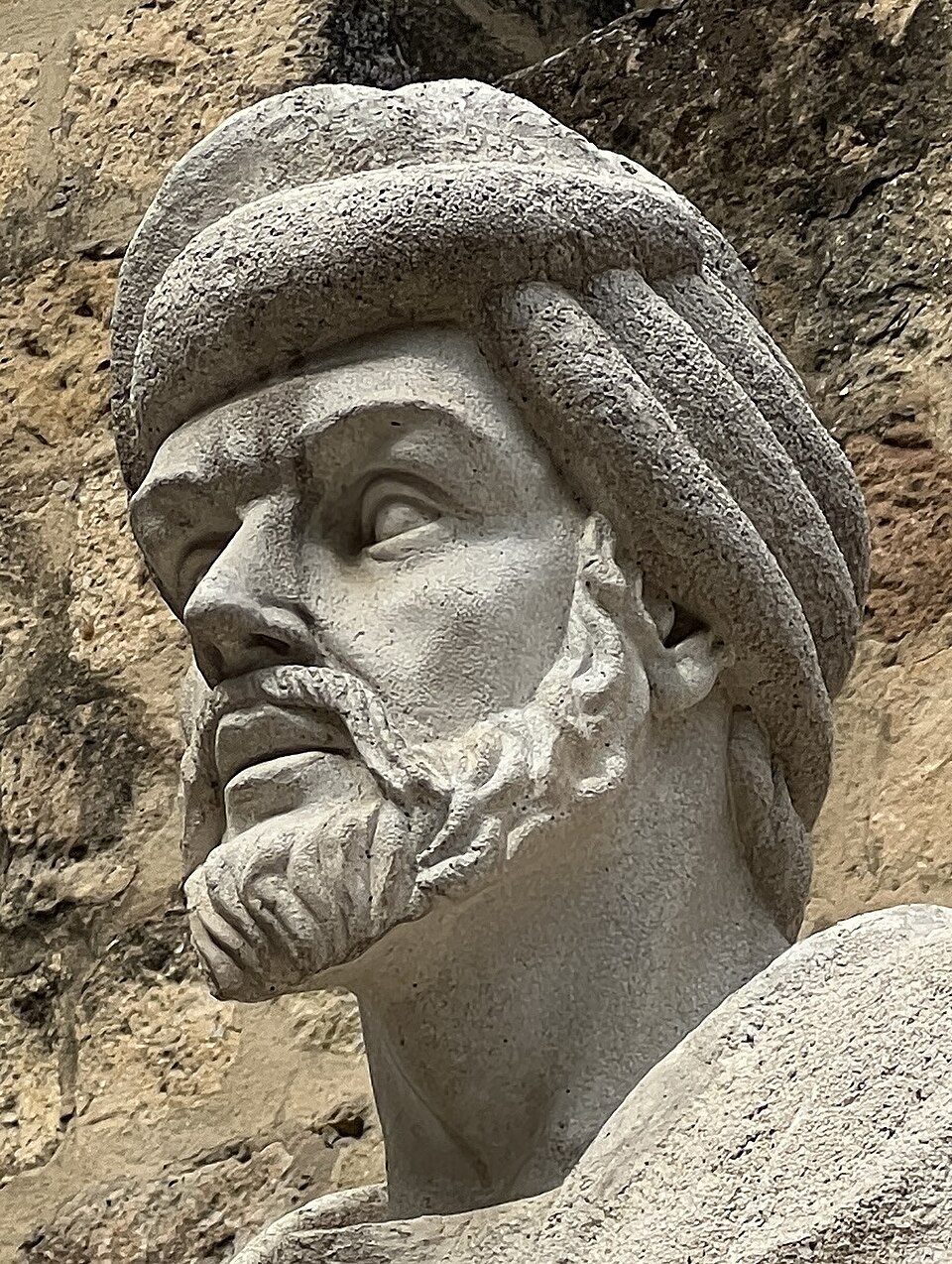
Ibn Rushd was born in 1126 CE in Córdoba, one of the most important cities of al-Andalus and a major center of Islamic learning. He came from an influential family closely associated with the Mālikī legal tradition: his father was a prominent judge, while his grandfather, also named Ibn Rushd, was a celebrated jurist and judicial authority. This environment placed jurisprudence and religious scholarship at the center of his early intellectual formation.
Although many details of Ibn Rushd's education remain uncertain, his later writings reveal an unusually broad command of Islamic law, theology, medicine, logic, and philosophy. His career developed during the rule of the Almohads, whose empire extended across North Africa and al-Andalus and whose court provided an important setting for philosophical and scientific activity during part of the twelfth century.
Ibn Rushd's connection with the Almohad court is traditionally linked to the philosopher Ibn Tufayl, who introduced him to the caliph Abu Yaqub Yusuf. According to later accounts, the ruler was interested in the difficulties of Aristotle's writings and encouraged Ibn Rushd to clarify them. Whether every detail of this famous story is historically certain or not, Almohad patronage was crucial to the circumstances in which Ibn Rushd produced much of his philosophical work.
Over the course of his life, Ibn Rushd combined scholarly activity with public service. He held important judicial positions in Seville and Córdoba and also became associated with the Almohad court as a physician. His career therefore illustrates the remarkable unity of disciplines in medieval Islamic intellectual life, where law, medicine, philosophy, and religious inquiry could all belong to the education of a single learned scholar.
Ibn Rushd as Qadi: Judge, Jurist, and Legal Scholar
Alongside his philosophical work, Ibn Rushd pursued a major career in Islamic jurisprudence and served as a qadi, or judge, within the Mālikī legal tradition dominant in much of al-Andalus and North Africa. His judicial background was not incidental to his intellectual life: he came from a family renowned for legal scholarship and spent substantial parts of his career engaged with the practical and theoretical problems of Islamic law.
His most important legal work, The Distinguished Jurist's Primer (Bidayat al-Mujtahid wa Nihayat al-Muqtasid), examines the causes of disagreement among jurists and compares different approaches to legal questions. Rather than merely listing rules, the work asks why qualified scholars reached different conclusions, paying close attention to evidence, interpretation, and methods of legal reasoning.
This analytical approach is important for understanding Ibn Rushd's wider philosophy. His defense of rational inquiry did not arise outside the religious tradition but was developed by a scholar deeply trained in its legal methods. For Ibn Rushd, careful reasoning, interpretation, and attention to the appropriate kind of evidence were essential not only in philosophy but also in the interpretation and application of religious law.
Ibn Rushd and Medicine: The Colliget
Ibn Rushd was also a physician, and his medical writings formed an important part of his scholarly output. His best-known medical work is al-Kulliyat fi al-Tibb, known in Latin as the Colliget. The title refers to the general or universal principles of medicine, and the work presents a systematic account of medical theory, including the body, health, disease, causes, and treatment.
The Colliget was conceived primarily as a work on general medical principles and was traditionally understood as complementary to more particular discussions of diseases and treatments. Like other physicians of the medieval Islamic world, Ibn Rushd worked within a medical tradition strongly shaped by Greek authorities, especially Galen and Aristotle, while participating in the broader scientific culture of his own time.
Ibn Rushd's work in medicine also reveals the connection he saw between philosophical and scientific inquiry. His natural philosophy examines living bodies, sensation, motion, and causation, while medicine studies these realities in relation to health and disease. The disciplines were distinct, but they shared assumptions about explanation, nature, and the search for causes.
His combination of jurisprudence, medicine, and philosophy makes Ibn Rushd one of the great polymaths of medieval Islamic civilization. Rather than representing unrelated occupations, these fields formed different parts of a learned culture in which logic and rational analysis could be applied to law, the natural world, and questions of philosophical truth.
Ibn Rushd's Commentaries on Aristotle
Ibn Rushd's central and most enduring philosophical project was his sustained engagement with the works of Aristotle. He wrote on a remarkably wide range of Aristotelian subjects, including logic, natural philosophy, psychology, metaphysics, and ethics. His goal was not simply to repeat Aristotle's conclusions, but to explain difficult arguments, resolve interpretive problems, and present philosophy as a disciplined form of demonstrative inquiry.
Ibn Rushd is especially famous for producing different kinds of commentaries. His short commentaries generally provide concise presentations of philosophical doctrines, while the middle commentaries offer fuller paraphrase and explanation. His long commentaries, composed for a smaller number of especially important works, engage much more closely with Aristotle's text and with the earlier tradition of commentary.
A major feature of Ibn Rushd's project was his conviction that Aristotle should be treated as the preeminent philosophical guide. He frequently criticized interpretations that, in his view, attributed doctrines to Aristotle that did not genuinely belong to him. This led him to disagree at times with earlier Islamic philosophers, including Avicenna, whose highly original philosophical system Ibn Rushd believed differed in important respects from Aristotle's own approach.
These commentaries later became extraordinarily influential in Jewish and Christian intellectual traditions. Through Hebrew and especially Latin translations, Ibn Rushd became one of the principal interpreters through whom medieval European scholars encountered Aristotle. This reputation eventually earned him the famous title "the Commentator."
The Incoherence of the Incoherence: Ibn Rushd's Reply to Al-Ghazali
Ibn Rushd's Incoherence of the Incoherence (Tahafut al-Tahafut) is a detailed response to Al-Ghazali's The Incoherence of the Philosophers, which had subjected major doctrines associated with philosophers such as Avicenna and Al-Farabi to sustained criticism. Ibn Rushd's work is not merely a general defense of philosophy; it examines Al-Ghazali's arguments in detail and responds to them point by point.
One of the central issues concerns causation. Al-Ghazali challenged the claim that observed natural events possess a necessary causal connection that human reason can establish independently of God's power. Ibn Rushd argued that abandoning stable causal relations in nature would seriously weaken scientific inquiry, since knowledge of the natural world depends upon investigating the regular connections through which causes and effects can be understood.
Ibn Rushd nevertheless did not simply repeat every doctrine associated with Avicenna. His response frequently distinguishes between positions he considered genuinely Aristotelian and later philosophical developments that he believed required criticism. On some questions, therefore, Ibn Rushd could defend philosophical inquiry against Al-Ghazali while also criticizing particular theories advanced by Avicenna and other philosophers.
The Incoherence of the Incoherence demonstrates Ibn Rushd's characteristic philosophical method: arguments must be answered by arguments, and disagreements should be examined through careful distinctions concerning demonstration, evidence, and the proper subject matter of each science. For this reason, the work remains one of the most important texts in the medieval debate over reason, causation, metaphysics, and religious authority.
Ibn Rushd's Decisive Treatise: Harmonizing Philosophy and Religion
In The Decisive Treatise (Fasl al-Maqal), Ibn Rushd presents his most direct argument for the legitimate place of philosophy within Islamic intellectual life. He maintains that demonstrative reasoning and revealed law cannot genuinely contradict one another because truth does not oppose truth. When a demonstrative conclusion appears to conflict with the apparent meaning of scripture, the problem may require interpretation rather than the rejection of either philosophy or revelation.
Ibn Rushd argues that reflection on the natural world is encouraged by the Quran and that those intellectually qualified for philosophical demonstration should undertake such inquiry. Philosophy is therefore not presented simply as an external or hostile activity, but as one legitimate path through which suitably trained individuals can deepen their understanding of truth.
An important part of his argument concerns different forms of reasoning. Ibn Rushd distinguishes demonstrative, dialectical, and rhetorical forms of argument and connects them with different kinds of premises and audiences. Demonstration provides the highest degree of certainty within philosophy, while dialectical and rhetorical reasoning can serve other legitimate purposes in intellectual and religious life.
This does not mean that Ibn Rushd taught two separate and contradictory truths, one philosophical and one religious. His central claim is instead that properly understood philosophical truth and genuine revelation ultimately agree. Later discussions of his thought sometimes transformed this complex position into the simpler idea of a "double truth," but that formula does not accurately summarize the position defended in the Decisive Treatise.
Ibn Rushd's Theory of the Unity of the Intellect
One of Ibn Rushd's most distinctive and controversial philosophical doctrines concerns the nature of human intellectual activity. In his mature interpretation of Aristotle's On the Soul, Ibn Rushd argued that the material intellect, which receives intelligible forms, is not an individual faculty separately possessed by each human being. Instead, he came to describe it as a single, separate, and eternal intellect shared in some sense by all human beings.
This theory must be understood alongside his account of sensation and imagination. Individual human beings possess bodily and psychological faculties through which they perceive particular things and form images. Abstract intellectual thought, however, concerns universal intelligible forms and therefore raised for Ibn Rushd the problem of how an immaterial act of understanding could belong to individual corporeal beings.
Ibn Rushd's solution also involved the agent intellect, which plays a role in making intelligible forms available for thought. His terminology and theory developed over the course of his career, and modern scholarship distinguishes between his earlier and later accounts. For this reason, the theory should not be treated as a completely simple doctrine with an unchanged meaning throughout all of his writings.
The doctrine became enormously controversial in later Jewish and Christian philosophy. It raised difficult questions about personal identity, individual understanding, and immortality, particularly for thinkers who held that each individual person must possess an intellect that remains personally distinct after death. Later critics therefore made Ibn Rushd's theory of intellect one of the central controversies of medieval philosophy.
Ibn Rushd's Metaphysics
Ibn Rushd's metaphysics is deeply shaped by Aristotle and by his wider commitment to explaining reality through the investigation of causes. He emphasizes concepts such as substance, matter, form, actuality, and potentiality, while also defending an ordered universe in which natural processes can be understood through stable causal principles.
Like Aristotle, Ibn Rushd connects the intelligibility of motion and change with the existence of a first principle that is itself unmoved. His discussions of the First Mover are closely related to his analysis of eternal motion and the structure of the cosmos. God is understood philosophically as a perfect and immaterial first principle rather than as merely one cause among other causes within the natural order.
Ibn Rushd was critical of some metaphysical developments associated with Avicenna and with Neoplatonic interpretations of Aristotle. His criticism did not mean that he rejected every innovation made by earlier philosophers, but he repeatedly attempted to distinguish what he regarded as Aristotle's own doctrines from later systems that had transformed or extended them.
His metaphysical project is therefore best understood as both Aristotelian and interpretive. Ibn Rushd was not merely reproducing ancient texts: he was constructing a philosophical account of reality through close engagement with Aristotle while defending that account against competing philosophical and theological interpretations.
Ibn Rushd's Theory of Knowledge
Ibn Rushd's epistemology follows a broadly Aristotelian account in which knowledge begins with engagement with the sensible world. Sense perception provides awareness of particular things, while imagination preserves and organizes sensory material. Intellectual knowledge then concerns the universal and intelligible aspects that cannot simply be identified with a single particular object of perception.
Logic plays a central role in this movement toward knowledge. Ibn Rushd treats logic as the discipline that guides the mind in forming correct concepts and giving assent to propositions. He distinguishes several kinds of argument, including demonstrative, dialectical, rhetorical, poetical, and fallacious reasoning, according to the character of the premises on which they depend.
For Ibn Rushd, demonstration occupies the highest place in philosophical inquiry because it aims at certainty through properly established premises and valid reasoning. This commitment to demonstration explains his admiration for Aristotle and his repeated effort to determine the appropriate degree of precision and certainty available within different fields of inquiry.
His epistemology also helps explain his approach to religion. Ibn Rushd does not claim that every religious question can be handled in exactly the same way as a scientific demonstration, but he insists that demonstrative reasoning has a legitimate role where the subject matter permits it. Different forms of discourse therefore have different functions, rather than all being judged by a single intellectual standard.
Ibn Rushd's Ethics and Political Philosophy
Ibn Rushd's ethical and political thought draws upon both Aristotle's Nicomachean Ethics and Plato's Republic. His surviving political commentary is particularly important because it presents Plato's arguments in a new intellectual and cultural context, examining questions of political order, education, virtue, and the relationship between knowledge and rule.
In his discussion of political life, Ibn Rushd considers the characteristics required for a well-ordered society and the qualities appropriate to political leadership. Like Plato, he gives philosophical knowledge a central place in the highest conception of rule, while also recognizing the practical importance of laws, institutions, education, and the moral formation of citizens.
Ibn Rushd's ethical thought connects human flourishing with the cultivation of virtue and the perfection of human capacities. The intellectual virtues are especially important because he regards the development of theoretical knowledge as a central element of human perfection. Ethical virtue, however, also remains necessary for the proper ordering of individual and collective life.
His political writings should therefore not be reduced to a simple defense of philosopher-kings. They form part of a broader inquiry into how reason, virtue, education, and law contribute to human flourishing. In adapting Greek political philosophy to his own intellectual world, Ibn Rushd became an important figure in the history of medieval political thought.
Ibn Rushd's Exile and Later Life
Despite his earlier prominence at the Almohad court, Ibn Rushd fell out of political favor late in his life. Around 1195 CE, during the reign of Abu Yusuf Yaqub al-Mansur, he was subjected to official condemnation and removed from his position at court. Accounts also associate this period with restrictions on certain philosophical writings and with his removal to Lucena, near Córdoba.
The precise reasons for Ibn Rushd's disgrace remain difficult to reconstruct with certainty. Political circumstances, changing religious policies, court rivalries, and suspicions surrounding philosophy may all have played a role. It is therefore misleading to explain the episode simply as a timeless conflict between "reason" and "religion"; it emerged from the specific political and religious conditions of the late Almohad period.
Ibn Rushd was later restored to favor, although the chronology and details of this restoration are not equally clear in every source. He died in Marrakesh in 1198 CE. Later tradition records that his remains were transferred to Córdoba, linking the end of his life symbolically with the city in which his intellectual career had begun.
The difficulties of his final years did not prevent his writings from acquiring an extraordinary afterlife. Indeed, some of his greatest influence developed after his death, particularly through the translation and circulation of his philosophical works in Hebrew and Latin.
Major Works of Ibn Rushd
Ibn Rushd produced a substantial body of writing across philosophy, logic, law, medicine, and religious inquiry. The survival and transmission of his works are unusually complex: some Arabic originals were lost, while important texts survived through Hebrew or Latin translations. His surviving corpus therefore reflects both the breadth of his own scholarship and the major role played by later translators and intellectual traditions in preserving his thought.
- Commentaries on Aristotle — Short, middle, and long commentaries covering nearly the entire Aristotelian corpus.
- The Incoherence of the Incoherence — A detailed philosophical response to Al-Ghazali's critique of Avicenna and Al-Farabi.
- The Decisive Treatise — Ibn Rushd's argument for the harmony of philosophy and Islamic religious law.
- The Distinguished Jurist's Primer — A major comparative work of Islamic legal scholarship.
- Colliget (al-Kulliyat fi al-Tibb) — Ibn Rushd's general medical encyclopedia.
- Commentary on Plato's Republic — An influential adaptation of Platonic political philosophy to an Islamic context.
Ibn Rushd's Main Philosophical Ideas
1. Philosophy and Religious Law Cannot Conflict
Ibn Rushd argued that genuine demonstrative truth cannot ultimately contradict true revelation. When an apparent conflict arises, the problem may require a more careful interpretation of the relevant scriptural text rather than the rejection of demonstrative reasoning or of religious law.
2. Aristotle as Philosophy's Preeminent Guide
Ibn Rushd regarded Aristotle as the greatest available guide to philosophical inquiry and devoted much of his career to explaining his difficult works. He also criticized interpretations that, in his view, introduced doctrines not genuinely belonging to Aristotle's own philosophical system.
3. The Unity of the Material Intellect
In his mature theory, Ibn Rushd held that the material intellect involved in abstract thought is a single, separate, and eternal intellect rather than an independently possessed faculty within each individual human being. This doctrine later became one of the most controversial aspects of his philosophy.
4. Demonstrative Reasoning as the Highest Knowledge
Ibn Rushd regarded demonstration as the most rigorous form of philosophical reasoning because it aims at certainty through properly established premises. At the same time, he recognized other forms of argument, including dialectical and rhetorical reasoning, as appropriate in different intellectual contexts.
5. Different Forms of Argument Serve Different Audiences
Ibn Rushd distinguished between rhetorical, dialectical, and demonstrative discourse and argued that they operate with different kinds of premises and degrees of certainty. His theory therefore emphasizes not simply who is intelligent, but the importance of using the appropriate form of reasoning for the subject matter and audience.
Ibn Rushd and Al-Ghazali: The Great Philosophical Debate
The relationship between Ibn Rushd and Al-Ghazali represents one of the most important intellectual confrontations in the history of medieval Islamic philosophy. The debate is expressed most famously through two works: Al-Ghazali's The Incoherence of the Philosophers and Ibn Rushd's The Incoherence of the Incoherence, written as a detailed response to its arguments.
Al-Ghazali subjected a number of philosophical doctrines to severe criticism, especially claims associated with the metaphysics of Avicenna and Al-Farabi. Ibn Rushd responded by defending the legitimacy of demonstrative philosophy and by arguing that philosophical questions should be addressed through the methods appropriate to their subject matter rather than through the rejection of rational inquiry itself.
Their disagreement over causation is particularly famous. Al-Ghazali questioned whether observation establishes a necessary connection between events in nature, emphasizing God's freedom and power. Ibn Rushd argued that the regularity of nature is indispensable to the possibility of scientific investigation, since inquiry depends upon the ability to identify and understand causal relations.
The debate should not be understood as a simple contest between an opponent of reason and a defender of reason. Both thinkers employed rigorous argument and were deeply engaged with questions concerning philosophy and religion. Their disagreement instead concerns the scope and authority of philosophical demonstration and the ways in which reason, revelation, and theological doctrine should be related.
Ibn Rushd and Avicenna: Agreement and Disagreement
Ibn Rushd's relationship with Avicenna was complex. Both belonged to the great tradition of Islamic philosophical inquiry shaped by Aristotle and Greek philosophy, and Ibn Rushd opposed the wholesale rejection of philosophy associated with some theological criticisms. Yet he also regarded Avicenna as an original philosopher whose system had, in important respects, moved beyond what Ibn Rushd considered to be Aristotle's authentic teaching.
Ibn Rushd criticized several Avicennian developments, including aspects of metaphysics and the interpretation of Aristotle. He was especially suspicious of philosophical constructions that he believed reflected later Neoplatonic influences rather than Aristotle's own arguments. His disagreements therefore concerned not only individual doctrines but also the larger question of how the Aristotelian tradition should be interpreted.
It is consequently too simple to describe Ibn Rushd as either Avicenna's defender or his opponent. He could defend the value of philosophy against Al-Ghazali's criticisms while also disputing Avicenna's own conclusions. Their relationship is best understood as an internal philosophical disagreement within the broader tradition of medieval Islamic Aristotelianism.
Latin Averroism and Ibn Rushd's Influence on Western Philosophy
Ibn Rushd's philosophical works circulated widely through Hebrew and Latin translation and became enormously influential in medieval European discussions of Aristotle. His commentaries were studied in major intellectual centers and helped establish the textual and conceptual framework through which many scholastic philosophers encountered Aristotelian natural philosophy, metaphysics, and psychology.
The term Latin Averroism is used by historians to describe certain medieval Latin philosophers who developed positions strongly associated with Ibn Rushd's interpretation of Aristotle. Figures such as Siger of Brabant became connected with debates over the unity of the intellect, the eternity of the world, and the proper relationship between philosophical argument and religious doctrine.
The category must nevertheless be used carefully. Medieval thinkers described as "Averroists" did not always reproduce Ibn Rushd's own positions exactly, and later opponents sometimes grouped together distinct doctrines under his name. Latin Averroism was therefore a complex European reception and transformation of Ibn Rushd's thought, not simply the direct continuation of his philosophy.
The famous theory of "double truth" is especially misleading when attributed straightforwardly to Ibn Rushd himself. His own writings insist that truth cannot genuinely contradict truth. Later European debates about the apparent conflict between philosophical conclusions and religious doctrine developed in more complicated ways and should not automatically be projected back onto Ibn Rushd.
Ibn Rushd and Thomas Aquinas
Ibn Rushd's commentaries had a profound impact on Thomas Aquinas and other scholastic philosophers. Aquinas frequently engaged with Ibn Rushd's interpretations when examining Aristotle, and the Andalusian philosopher had become such an important intellectual authority that disagreement with his views often required direct and detailed philosophical response.
Aquinas strongly rejected Ibn Rushd's mature theory of the unity of the intellect. For Aquinas, intellectual activity had to belong to individual human persons, and he regarded the theory of a single separate intellect as incompatible with individual understanding and personal immortality. He addressed these issues explicitly in his On the Unity of the Intellect against the Averroists.
Their relationship therefore illustrates an important feature of medieval intellectual history: influence did not require agreement. Aquinas could rely upon Ibn Rushd as an indispensable interpreter of Aristotle while simultaneously criticizing some of his most important philosophical conclusions.
The debate between them helped define later discussions of the soul, intellect, individuality, and immortality. Ibn Rushd's presence within these controversies demonstrates how deeply his interpretations had entered the philosophical culture of medieval Latin Christianity.
Ibn Rushd and the 1277 Condemnations in Paris
In 1277, Étienne Tempier, Bishop of Paris, condemned 219 philosophical and theological propositions associated with disputes taking place in the intellectual world of the University of Paris. The condemned theses came from multiple sources and traditions, but several were closely connected with Aristotelian and Averroist controversies that had become central to thirteenth-century philosophy.
Among the disputed issues were the eternity of the world, divine power, necessity, and the nature of the intellect. Ibn Rushd's interpretations of Aristotle had become especially important in debates surrounding the unity of the intellect, although it would be inaccurate to treat all 219 propositions condemned in 1277 as direct statements of Ibn Rushd's own philosophy.
The condemnations followed an earlier Parisian condemnation of 1270, which had targeted a smaller number of propositions associated with controversial Aristotelian and Averroist teachings. Together, these events reveal the intensity of the struggle over how Greek philosophy could be incorporated into a Christian intellectual framework.
The significance of these condemnations lies partly in the reach of Ibn Rushd's intellectual influence. A philosopher writing in twelfth-century al-Andalus had become a central reference point in debates occurring more than a century later in Latin Europe. His influence was powerful enough that "Averroism" became both an intellectual identity and a target of sustained philosophical and theological criticism.
Ibn Rushd's Broader Legacy in Islamic and World Philosophy
Ibn Rushd's later reception developed differently across intellectual traditions. His influence in the Arabic-speaking Islamic world did not take the same institutional form as his influence in Latin Europe, where his commentaries became deeply embedded in university debates. This difference should not be interpreted simply as the disappearance of philosophy from Islamic civilization, but as part of a broader transformation in the languages, institutions, and traditions through which philosophical thought continued to develop.
His influence within Jewish intellectual culture was substantial, particularly because many of his works were translated into Hebrew and became accessible to generations of Jewish philosophers and scholars. Ibn Rushd's thought formed part of the wider medieval conversation in which Jewish thinkers engaged with Aristotle, Islamic philosophy, law, and revealed religion.
In Latin Europe, Ibn Rushd became one of the most important medieval interpreters of Aristotle. His authority was so great that later philosophers frequently treated his commentaries as essential points of reference, whether they accepted his conclusions or wrote against them. His influence can therefore be seen not only in Averroist movements but also in the arguments of some of his most determined critics.
Ibn Rushd's lasting legacy is also methodological. He defended the possibility of demonstrative inquiry, insisted on careful attention to philosophical texts, and explored how different forms of reasoning operate within law, religion, science, and philosophy. Through these concerns, his work became part of a long global history of reflection on the relationship between reason, interpretation, and truth.
Ibn Rushd's Philosophy Explained Simply
Ibn Rushd can be understood as a philosopher who believed that serious reasoning should not be treated as an enemy of religion. He devoted much of his life to explaining Aristotle, defending the value of demonstrative knowledge, and showing how philosophical inquiry could have a legitimate place within a religious and legal tradition.
- Can philosophy and religion agree? Ibn Rushd argued that genuine truth cannot contradict genuine truth. When philosophy and scripture appear to conflict, careful interpretation may be required rather than the rejection of reason or revelation.
- What did he think of Al-Ghazali's attack on philosophy? He answered it in detail, defending philosophical demonstration and arguing that stable causal relations are essential to understanding the natural world.
- What was his most controversial idea? His mature theory that the material intellect involved in abstract thought is a single, separate, and eternal intellect rather than an independently possessed faculty within every individual person.
- Did he really teach "two truths"? Not in the simple sense often attributed to him. Ibn Rushd repeatedly argued that truth does not contradict truth; the later idea of "double truth" belongs to more complicated European debates.
- Why is he called "the Commentator"? Because his interpretations of Aristotle became enormously influential in medieval Europe, where he was regarded as one of the greatest authorities for understanding the Aristotelian tradition.
Why Is Ibn Rushd Important in the History of Philosophy?
Ibn Rushd is important because he stands at the intersection of several major intellectual traditions. He was a philosopher, jurist, and physician whose work brought Aristotelian philosophy into sustained conversation with Islamic law and religious inquiry. His writings also became fundamental sources for later Jewish and Christian philosophers.
His commentaries on Aristotle, his defense of demonstrative reasoning, his response to Al-Ghazali, and his theory of the intellect made him one of the most influential figures in medieval philosophy. Even where later thinkers rejected his conclusions, they were often forced to formulate their own positions in direct engagement with his arguments.
Ibn Rushd is particularly important for the history of the relationship between philosophy and religion. He rejected the assumption that serious rational inquiry and revealed law must inevitably become enemies, instead developing a sophisticated account of how different forms of reasoning and interpretation can operate in the search for truth.
His influence was therefore unusually wide-ranging. Few philosophers from medieval al-Andalus exercised such a lasting impact across Islamic, Jewish, and Christian intellectual traditions. Ibn Rushd remains a central figure not only in the history of Islamic philosophy but also in the larger history of how Aristotle, reason, religion, and human knowledge were understood in the medieval world.
Frequently Asked Questions About Ibn Rushd (Averroes)
Who was Ibn Rushd (Averroes)?
Ibn Rushd, known in the Latin West as Averroes, was a twelfth-century Andalusian philosopher, judge, and physician best known for his detailed commentaries on Aristotle and for defending philosophy against Al-Ghazali's critique.
What is Averroes known for?
Averroes is known for his extensive commentaries on Aristotle, his work The Incoherence of the Incoherence defending philosophy against Al-Ghazali, his theory of the unity of the material intellect, and his enormous influence on medieval Latin and Jewish philosophy.
What did Averroes believe about reason and religion?
In The Decisive Treatise, Averroes argued that philosophy and religious law come from the same source of truth and cannot ultimately conflict, and that trained thinkers have a religious obligation to study philosophy using demonstrative reasoning.
What is Averroes' theory of the unity of the intellect?
Averroes argued that the material intellect, the faculty responsible for abstract human thought, is a single, separate, immaterial intellect shared by all humanity rather than a distinct faculty belonging to each individual soul.
Did Averroes believe in double truth?
No. The idea that Averroes taught two separate and potentially contradictory truths, one philosophical and one religious, is a doctrine later associated with some Latin Averroists in medieval Europe rather than a position Averroes himself held; Averroes maintained that philosophy and religion express a single truth in different ways.
How did Averroes respond to Al-Ghazali?
Averroes wrote The Incoherence of the Incoherence as a detailed, point-by-point response to Al-Ghazali's The Incoherence of the Philosophers, defending Avicenna and Peripatetic philosophy against Al-Ghazali's objections, particularly on causation and the eternity of the world.
How did Averroes influence Western philosophy?
Averroes' commentaries on Aristotle were translated into Latin and Hebrew and became central to medieval European philosophy, earning him the title "the Commentator" among scholastic thinkers and directly shaping the work of philosophers such as Thomas Aquinas.
Related Islamic and Arabic Philosophers
Explore other major thinkers in the development of Islamic philosophy, Arabic philosophy, Persian philosophy, and medieval intellectual history.
Related Areas of Philosophy
Ibn Rushd's work connects the history of Islamic philosophy with metaphysics, epistemology, philosophy of mind, ethics, political philosophy, and the transmission of Aristotelian philosophy to the medieval West.
Why Ibn Rushd Still Matters
Ibn Rushd occupies a singular position in the history of world philosophy, standing at the meeting point of Islamic, Jewish, and Christian intellectual traditions. His meticulous commentaries on Aristotle, his defense of demonstrative reason against Al-Ghazali, and his argument for the essential harmony of philosophy and religious law shaped philosophical debate across three continents and multiple religious traditions.
His theory of the unity of the intellect, still debated by scholars today, and his enormous influence on medieval Latin philosophy, culminating in both deep engagement and formal condemnation at the University of Paris, demonstrate just how far-reaching his impact became.
Understanding Ibn Rushd also helps explain the intellectual bridge between classical Islamic philosophy and the university philosophy of medieval Christian Europe, a bridge built almost single-handedly through his commentaries.
Explore Great Philosophers