Who Was Aristotle?
Aristotle was an ancient Greek philosopher and polymath who lived from 384 to 322 BCE. He was born in Stagira, a city in northern Greece, and was the son of Nicomachus, a physician associated with the Macedonian royal court. At about the age of seventeen or eighteen, Aristotle travelled to Athens, where he entered Plato's Academy and remained connected with the institution for approximately twenty years.
Although Aristotle studied under Plato, he eventually developed philosophical positions that differed significantly from those of his teacher. After Plato's death in 348 or 347 BCE, Aristotle left Athens and spent time in Asia Minor and on the island of Lesbos, where he continued his philosophical and biological investigations. He was later invited to tutor the young Alexander, the future Alexander the Great, before eventually returning to Athens.
Around 335 BCE, Aristotle founded his own school in Athens, known as the Lyceum. The philosophical community associated with the Lyceum later became known as the Peripatetic school. Aristotle and his associates pursued research across an exceptionally broad range of subjects, collecting observations and examining questions concerning nature, living organisms, language, reasoning, ethics, politics, and human knowledge.
Aristotle's surviving works reveal the extraordinary scope of his intellectual interests. His writings address logic, metaphysics, ethics, politics, natural philosophy, psychology, rhetoric, poetics, and biology, among other fields. Rather than treating these subjects as isolated areas of inquiry, Aristotle often attempted to determine their proper principles, methods, causes, and objects of study, helping to establish systematic forms of investigation that influenced later intellectual traditions.
Aristotle remains one of the most influential thinkers in the history of philosophy because his ideas shaped intellectual life for centuries after his death. His works became central to later Greek and Roman scholarship and exercised profound influence within Islamic, Jewish, and Christian philosophical traditions, particularly during the Middle Ages. Although many of his conclusions about the natural world were later revised or rejected, his contributions to logic, ethics, metaphysics, political thought, and the systematic study of knowledge continue to be studied today.
Aristotle: Quick Facts
- Name — Aristotle
- Born — 384 BCE
- Died — 322 BCE
- Birthplace — Stagira, northern Greece
- Era — Classical Greek philosophy
- Teacher — Plato
- School — Lyceum in Athens
- Philosophical tradition — Ancient Greek philosophy and Aristotelian philosophy
- Known for — Logic, metaphysics, ethics, politics, natural philosophy, rhetoric, poetics, and biological inquiry
- Major works — Nicomachean Ethics, Politics, Metaphysics, Physics, De Anima, Poetics, Rhetoric, and works of the Organon
- Major ethical concept — Eudaimonia and virtue
- Major logical contribution — Systematic study of syllogistic reasoning
Aristotle's Life and Historical Context
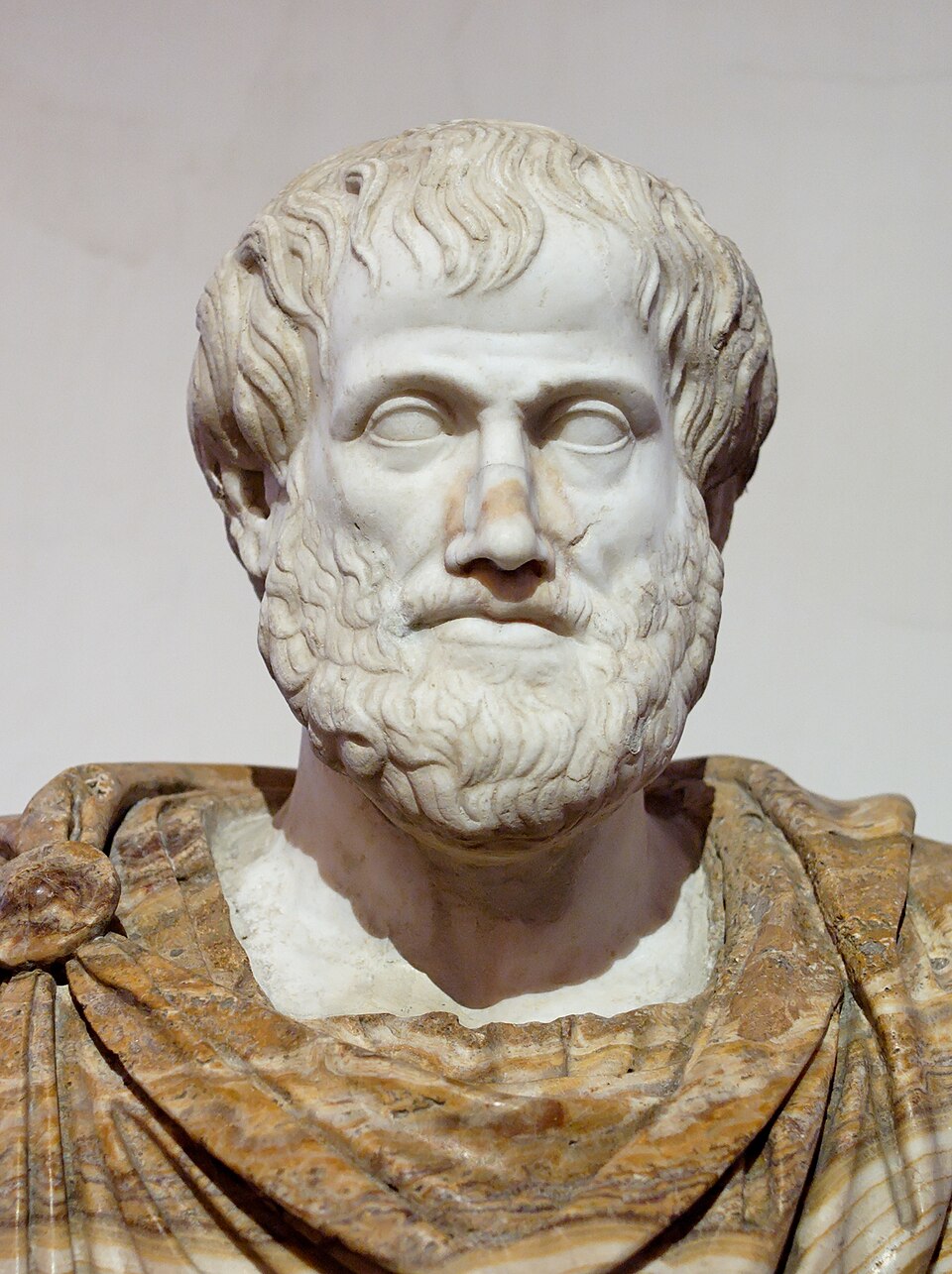
Aristotle was born in 384 BCE in Stagira, a Greek city in the region of Chalcidice in northern Greece. His father, Nicomachus, was a physician associated with the Macedonian royal court, while his mother was named Phaestis. Although the details of Aristotle's early education remain uncertain, his family background connected him from an early age with both Greek intellectual culture and the expanding political world of Macedon.
At approximately seventeen or eighteen years of age, Aristotle travelled to Athens and entered Plato's Academy, the most important philosophical institution of its time. He remained associated with the Academy for about twenty years, studying and participating in philosophical inquiry under Plato's influence. Aristotle deeply respected his teacher and inherited many of the central problems that concerned Platonic philosophy, even though he eventually developed important disagreements with Plato.
After Plato's death in 348 or 347 BCE, Aristotle left Athens and spent several years in different parts of the Greek world. He stayed at Assos in Asia Minor and later on the island of Lesbos, where he continued philosophical research and conducted important investigations into the natural world. During this period, his interest in the observation and classification of living organisms became an increasingly significant part of his broader intellectual work.
Aristotle later became associated with the Macedonian court and is traditionally known for having served as a tutor to the young Alexander, the future Alexander the Great. The precise extent and duration of this relationship remain matters of historical uncertainty, but Aristotle was connected with Alexander's education during the prince's youth. This association also placed Aristotle within the wider political transformations occurring as Macedon became the dominant power in the Greek world.
Around 335 BCE, Aristotle returned to Athens and established his own school at the Lyceum. There he and his associates pursued research across philosophy, logic, politics, rhetoric, and the natural sciences, and the school became associated with the later Peripatetic tradition. The Lyceum was not merely a place for repeating established doctrines but a centre for systematic investigation, collection, classification, and philosophical debate.
After the death of Alexander in 323 BCE, anti-Macedonian feeling intensified in Athens, and Aristotle left the city for Chalcis on the island of Euboea. Ancient accounts connect his departure with an accusation of impiety, though the circumstances must be understood within the tense political atmosphere of the period. Aristotle died at Chalcis in 322 BCE, ending a life whose surviving writings would profoundly influence philosophy and science for more than two thousand years.
Aristotle and Plato: What Was the Difference?
Aristotle studied for many years in Plato's Academy, but he did not simply repeat Plato's philosophy. Their relationship represents both intellectual continuity and serious philosophical disagreement. Aristotle inherited from Plato fundamental questions about knowledge, reality, the soul, ethics, and politics, while gradually developing methods and explanations of his own that would become central to the Aristotelian tradition.
One of their most important disagreements concerns the status of Forms. Plato gave a central role to Forms or intelligible realities that provide the basis for genuine knowledge and understanding. Aristotle criticized the idea that Forms should exist as separate entities apart from individual things, arguing that such separation created difficulties in explaining the relationship between universal characteristics and the particular objects encountered in the world.
Aristotle therefore developed an account in which form is closely connected with individual substances. In his mature philosophy, natural substances are commonly understood through the relationship between matter and form, a framework later called hylomorphism. This approach allowed Aristotle to explain individual things as concrete entities rather than treating their essential principles as existing in a separate realm in the Platonic manner.
Aristotle also placed greater emphasis on examining individual natural things, their characteristics, changes, causes, and patterns of development. His philosophical investigations often begin with phenomena as they appear to us and with the difficulties or accepted opinions surrounding a question. From there, he develops distinctions and explanations intended to identify the principles and causes underlying what is being investigated.
Their differences should not, however, be understood as a simple opposition between an abstract Plato and an entirely empirical Aristotle. Both philosophers sought knowledge of fundamental reality and both considered reason essential to philosophical inquiry. Aristotle's relationship with Plato is therefore best understood as one of critical inheritance: he adopted many questions from his teacher while believing that those questions required substantially different answers.
What Is Aristotle Famous For?
Aristotle is famous for developing influential theories across an extraordinary range of disciplines, including logic, metaphysics, ethics, politics, natural philosophy, psychology, rhetoric, poetics, and biology. His surviving writings do not form a single book or simple philosophical doctrine but a large body of investigations addressing different aspects of reality, knowledge, reasoning, human action, and the natural world.
In logic, Aristotle developed the first systematic treatment of syllogistic reasoning, analysing how conclusions can follow necessarily from premises of particular logical forms. His logical works were later collected under the title Organon, meaning "instrument" or "tool." Aristotelian logic became enormously influential in ancient, medieval, and early modern education and remained a major framework for logical study.
In ethics, Aristotle is especially known for his account of eudaimonia, a Greek term often translated as happiness, flourishing, or living well. He argued that the human good involves activity of the soul in accordance with virtue or excellence rather than merely the possession of pleasurable feelings. His ethical philosophy also examines the development of character and the role of practical judgment in human life.
In metaphysics, Aristotle investigated some of philosophy's most fundamental questions concerning being and reality. His discussions of substance, form, matter, causation, actuality, and potentiality became central concepts in later philosophical traditions. He sought to explain not only what things are, but also how they come to be, change, persist, and achieve the capacities characteristic of their nature.
Aristotle also became famous for his political philosophy, particularly his analysis of the polis, or Greek city-state, and different forms of government. He regarded political life as closely connected with questions about human flourishing and the good life. His famous description of human beings as political animals reflects his view that human capacities are developed within forms of organized social and political community.
Beyond philosophy in the narrow sense, Aristotle made extensive investigations into living organisms and natural phenomena. His biological writings contain detailed observations of animals and attempts at classification and explanation, making them an important part of the history of biological inquiry. Although many of his scientific conclusions were later superseded, the scale and systematic character of his research remain among the principal reasons for his enduring historical importance.
What Did Aristotle Believe?
Aristotle did not have one simple philosophical doctrine that can accurately summarize everything he believed. His philosophy is better understood as a broad and interconnected body of investigations into reality, nature, knowledge, reasoning, human action, political life, and the good life. Across these fields, he repeatedly sought to identify the principles, causes, and structures that make understanding possible.
In metaphysics, Aristotle investigated what it means for something to exist and what kinds of things are most fundamentally real. His discussions of substance, form, matter, actuality, potentiality, and causation provided an influential framework for explaining both stable things and processes of change. He held that understanding a thing requires attention to the different explanatory principles involved in its existence and development.
Aristotle's account of causation is especially important to his philosophy. He distinguished different kinds of causes, commonly described as material, formal, efficient, and final causes, in order to answer different aspects of the question "why?" A complete explanation, in many cases, requires more than identifying the physical material from which something is made; it may also involve its structure, source of change, and the end or purpose toward which a process is directed.
In ethics, Aristotle argued that human beings should seek eudaimonia, understood as the highest human good and often translated as flourishing or living well. He connected this good with rational activity performed in accordance with virtue or excellence. Moral virtues, in his account, are developed through habituation, while practical wisdom helps individuals judge how to act appropriately in particular circumstances.
In natural philosophy, Aristotle attempted to explain nature through systematic investigation of change, motion, living organisms, and their characteristic forms of development. He regarded natural things as intelligible and believed that inquiry should identify the causes and principles responsible for observable phenomena. His explanations frequently employ a teleological framework, examining the ends or functions characteristic of natural processes and living beings.
In logic, Aristotle examined the structures through which valid conclusions can follow from premises and developed systematic analyses of demonstration, definition, and scientific knowledge. He did not regard reasoning as detached from every other field of inquiry; logical analysis was an essential instrument for investigating philosophical and scientific questions. His work therefore helped establish standards for distinguishing sound argument from reasoning that merely appears convincing.
Aristotle's philosophy is consequently best understood not through one isolated belief but as a connected attempt to answer several fundamental questions: What exists? Why do things change? How can human beings know? What makes a life good? And what conditions allow people to flourish together? The answers he developed to these questions were not always consistent with modern knowledge, but the conceptual framework he created profoundly shaped the subsequent history of philosophy.
Aristotle's Philosophy: Main Ideas
Aristotle's philosophy covers a remarkably broad range of subjects, including metaphysics, logic, natural philosophy, psychology, ethics, politics, rhetoric, and the study of living organisms. Although his surviving works address many different questions, several fundamental concepts connect large parts of his thought. Among the most important are his accounts of substance, form and matter, actuality and potentiality, causation, and the purposive character of nature.
These ideas were not developed as isolated theories. Aristotle often uses them together when explaining what things are, how they change, and how they can be properly understood. His philosophical method repeatedly seeks the principles and causes responsible for the things we encounter in experience. For this reason, understanding these main concepts provides an important foundation for approaching his wider philosophy and the remarkable range of questions it attempts to answer.
Substance
Aristotle treats substance as central to understanding what exists. In his philosophical investigations, substances are among the primary realities to which other features or characteristics belong. Individual living beings and other concrete things therefore play an important role in his account of being. His analysis asks what things fundamentally are and how their properties, forms, and material components relate to their identity and existence.
Aristotle's account of substance develops in different ways across his writings, especially in the Categories and the Metaphysics. This has made the precise relationship between individual substances, matter, form, and composite objects a major subject of interpretation among scholars. Nevertheless, the central importance of substance remains clear: Aristotle seeks to understand what it is for something to be the particular kind of thing that it is.
Form and Matter
Aristotle develops a theory often called hylomorphism, according to which ordinary physical substances can be understood through the relationship between matter and form. Matter concerns that from which a thing is constituted, while form concerns the principle or structure through which that matter constitutes a determinate kind of thing. Natural objects and many artifacts can therefore be analysed as composites of these two fundamental explanatory elements.
Aristotle's distinction between matter and form is closely connected with his attempt to explain change without assuming that something comes from absolutely nothing. In a process of change, something may persist while another feature, structure, or form is gained or lost. The example of a statue illustrates the basic idea: the bronze can remain while acquiring the form that makes it a particular statue. Matter and form thus help Aristotle explain both persistence and change.
Actuality and Potentiality
Aristotle distinguishes between what something is actually and what it has the potential to become. This distinction plays an important role in his explanation of change, development, and being. A thing may have capacities that are not presently realized, while possessing the possibility of becoming or doing something under the appropriate conditions. Aristotle uses this framework throughout his metaphysics and natural philosophy to analyse processes of becoming and activity.
Actuality and potentiality are closely connected with Aristotle's distinction between form and matter. Matter can be understood as potentially capable of receiving a certain form, while the realization of that form makes the relevant thing actual in a particular respect. Aristotle's examples of natural development, such as an acorn becoming an oak tree, illustrate how potentiality can be directed toward a characteristic actuality rather than representing mere unlimited possibility.
Causation
Aristotle develops a four-part account of explanation commonly known as the four causes. These are material, formal, efficient, and final causes. The Greek term often translated as "cause" has a broader explanatory significance than the modern idea of one physical event mechanically producing another. Aristotle is therefore asking several different questions about why a thing exists, has its particular character, comes into being, or develops in a particular way.
His four-causal framework reflects the belief that a complete explanation may require attention to several distinct factors. We may ask what something is made from, what structure or form makes it the thing it is, what brought it about, and what end or purpose is involved. These questions identify different dimensions of explanation rather than simply competing answers to the same question. The four causes consequently became one of Aristotle's most influential philosophical contributions.
Teleology
Aristotle frequently explains natural processes in relation to ends or purposes. This aspect of his philosophy is known as teleology, from the Greek word telos, meaning end or goal. Aristotle often holds that understanding a natural process requires considering the characteristic end toward which its development is directed. This idea is closely connected with his accounts of final causation, actuality, and the development of living organisms.
Aristotelian teleology should not simply be understood as the claim that every event happens according to a consciously intended plan. Rather, Aristotle investigates whether natural things exhibit characteristic patterns of development and organization that can be explained by reference to what they are for or what they characteristically achieve. His teleological approach became deeply influential in later philosophy and science, while also becoming one of the most debated features of his account of nature.
What Are Aristotle's Four Causes?
Aristotle's four causes are one of his most famous approaches to explaining things. The word "cause" in this context is broader than the modern idea of one event mechanically producing another. Aristotle is concerned with different kinds of answers to questions about why something exists, what it is, how it came into being, and what end or purpose may be involved in its existence.
The four causes are the material, formal, efficient, and final causes. Aristotle presents them as distinct explanatory factors that may be required for an adequate understanding of a thing or process. A single object can therefore be explained in several complementary ways rather than by identifying only one immediate source of its existence. His familiar examples include artifacts such as statues, but the framework also plays an important role in his explanations of natural phenomena.
1. Material Cause
The material cause concerns what something is made from or that out of which it comes to be. For example, the material cause of a bronze statue is bronze, while the material of a house may include bricks, timber, and other physical components. This form of explanation directs attention to the underlying material from which a particular object is constituted rather than to the object's shape, maker, or purpose.
For Aristotle, identifying the material cause does not by itself always provide a complete explanation of a thing. Knowing that a statue is made of bronze tells us something important about it, but it does not explain why that quantity of bronze has the particular form of a statue or how it acquired that form. The material cause therefore represents one dimension of explanation within a broader framework of causes.
2. Formal Cause
The formal cause concerns the form, structure, pattern, or defining account of a thing. In the case of a statue, it concerns the particular arrangement through which the material becomes that determinate statue rather than merely remaining an undifferentiated quantity of bronze. The formal cause is consequently connected with Aristotle's wider interest in essence and with the question of what makes a thing the particular kind of thing that it is.
Aristotle's notion of form is especially important because he does not regard form as merely an external visual appearance. Form can function as an explanatory principle connected with the organization and nature of a thing. In living organisms, for example, questions concerning form are closely related to the characteristic organization and activities that make the organism the kind of living being it is. Formal causation is therefore central to Aristotle's metaphysics and natural philosophy.
3. Efficient Cause
The efficient cause concerns the source of change, motion, or the agent that brings something about. In the example of a statue, the sculptor can serve as the efficient cause because the sculptor acts upon the material and brings the statue into its finished form. Efficient causation is therefore the aspect of Aristotle's framework most closely related to the modern tendency to think of causes as events or agents producing particular effects.
Aristotle applies efficient explanation to natural as well as artificial processes. His broader philosophy of nature seeks to identify sources of change and motion rather than assuming that things simply transform without explanation. However, he does not treat efficient causes as the only causes relevant to understanding a phenomenon. A complete account may also require attention to the matter, form, and end involved in the process being investigated.
4. Final Cause
The final cause concerns the end, goal, or purpose for which something exists or occurs. In the case of an artifact, this may refer to the purpose for which it was made. A house, for example, can be understood partly by reference to the function it is intended to serve. Aristotle also extends final explanation beyond human artifacts to many processes found in nature, making final causation central to his teleological view of the natural world.
Final causes are among the most debated aspects of Aristotle's philosophy because modern scientific explanation often avoids explaining natural events through purposes or ends. Aristotle nevertheless regarded final explanation as indispensable in many areas of inquiry, particularly in understanding the development and characteristic activities of living organisms. For him, asking what something is for could reveal an important explanatory dimension that material and efficient accounts alone might fail to capture.
Aristotle's four causes are therefore a framework for asking different kinds of explanatory questions about a thing rather than merely identifying one immediate physical cause. The framework asks what a thing is made of, what makes it the kind of thing it is, what brings it about, and what end or purpose is involved. Although not every case necessarily involves all four causes in exactly the same way, the scheme profoundly influenced later philosophy and the history of scientific explanation.
Aristotle's Ethics: Virtue, Happiness, and the Good Life
Aristotle's ethical philosophy is most famously developed in the Nicomachean Ethics, a work concerned with the fundamental question of how human beings should live. Aristotle does not treat ethics merely as an abstract exercise in defining moral concepts. Ethical inquiry is practical because its ultimate concern is how people should act and what kind of life is genuinely worth choosing and pursuing.
Aristotle uses the concept of eudaimonia, often translated as happiness, flourishing, or well-being, to describe the ultimate human good. Eudaimonia is not simply a temporary feeling of pleasure or happiness. It concerns living and acting well over the course of a life and realizing the distinctive capacities associated with human beings. For this reason, Aristotle's ethics is often described as an ethics of flourishing rather than an ethics based solely on rules or consequences.
Aristotle argues that virtue is essential to living well. Virtues are not simply inborn feelings or theoretical knowledge that can be acquired by memorizing moral principles. Moral virtues become established through habituation: by repeatedly performing appropriate actions, individuals gradually develop stable dispositions of character. Ethical development therefore involves education, practice, and the formation of habits as well as reflection about what constitutes good action.
Aristotle distinguishes moral virtues, such as courage and temperance, from intellectual virtues associated with the development of reason and understanding. The moral virtues concern emotions and actions and require learning to respond appropriately in particular circumstances. A virtuous person does not merely happen to perform a correct action on one occasion but possesses a developed disposition to perceive and choose appropriately for the right reasons.
Ethical judgment therefore cannot always be reduced to a simple formula. Aristotle emphasizes the importance of practical wisdom, experience, character, and attention to the circumstances of an action. Practical wisdom, or phronesis, concerns the capacity to deliberate well about how one should act in the changing and particular circumstances of human life. His ethics consequently combines general reflection about human flourishing with careful attention to the complexity of practical decision-making.
Aristotle also understands human flourishing as connected with life in a community. His ethical and political writings are therefore closely related, since he believes that human beings develop their capacities within social and political institutions. Friendship, education, virtue, and participation in a political community all play important roles in his wider account of the good life. Aristotle's ethical philosophy thus presents flourishing as a sustained form of rational and virtuous human activity rather than a private feeling detached from the rest of life.
What Is Aristotle's Golden Mean?
Aristotle's idea commonly called the golden mean is part of his account of moral virtue. It does not mean that every virtue is simply a mathematical midpoint between two equal extremes. Aristotle instead argues that virtue often involves finding what is appropriate in relation to particular emotions and actions. The correct response depends upon the person, the situation, and the circumstances in which a decision must be made.
Aristotle describes moral virtue as concerned with finding an appropriate mean between forms of excess and deficiency. Both too much and too little can represent failures of character, while the virtuous response is appropriate to the circumstances. However, the mean is described as relative to us rather than as a fixed numerical point that can be calculated in exactly the same way for every individual and situation.
Courage provides a familiar example. Courage lies between the extremes of cowardice and rashness, although what counts as the appropriate response depends upon the circumstances. A person who experiences fear when danger is present is not necessarily cowardly, nor is a person who feels no fear necessarily courageous. Aristotle's concern is whether emotions and actions are appropriate to the situation and guided by a properly developed character.
The doctrine of the mean also applies to other virtues in different ways. Generosity, for example, concerns giving and taking wealth appropriately, while temperance concerns appropriate attitudes toward bodily pleasures. Aristotle does not claim that every action or emotion possesses a virtuous midpoint. Some actions, he argues, are wrong in themselves and cannot become virtuous merely by being performed in a moderate amount.
The doctrine of the mean therefore concerns appropriate action and emotional response guided by practical wisdom, rather than simply choosing the middle option. Determining what is appropriate requires experience and the capacity to judge particular circumstances well. The doctrine is consequently closely connected with Aristotle's concept of phronesis, or practical wisdom, which helps a virtuous person deliberate about how to act in the complexities of real human life.
Aristotle's Logic and the Syllogism
Aristotle is one of the most important figures in the history of logic. His logical writings contain the earliest systematic treatment of formal logic that has survived in such an extensive form. Aristotle investigated the structure of arguments, the relationship between premises and conclusions, the nature of definition, and the conditions under which knowledge can be demonstrated rather than merely asserted or believed.
A central part of Aristotle's logical theory is the syllogism, a form of deductive argument in which premises are used to establish a conclusion. Aristotle systematically analysed different possible forms of syllogistic reasoning and examined when a conclusion follows necessarily from the premises provided. His work therefore represented a major attempt to study valid reasoning according to its structure rather than according only to the subject matter being discussed.
What Is an Aristotelian Syllogism?
An Aristotelian syllogism typically involves propositions that connect terms in a structured way, allowing a conclusion to follow from the relationship established by the premises. A simple and familiar example demonstrates the general structure. If all members of one class belong to another class, and a particular individual belongs to the first class, then it follows that the individual belongs to the second class. The following example illustrates this form of deductive reasoning:
- All humans are mortal.
- Socrates is human.
- Therefore, Socrates is mortal.
Aristotle's logical investigations were preserved in a collection of works later known as the Organon, meaning "instrument" or "tool." The collection includes the Categories, On Interpretation, Prior Analytics, Posterior Analytics, Topics, and Sophistical Refutations. Together, these works investigate different aspects of language, argument, demonstration, scientific knowledge, dialectical reasoning, and errors in argument.
In the Prior Analytics, Aristotle provides his systematic treatment of syllogistic reasoning, while the Posterior Analytics investigates the nature of scientific demonstration and knowledge. Aristotle distinguishes demonstrative knowledge from other forms of reasoning and seeks to explain how conclusions can be derived from appropriate principles. Logic thus functions in his wider philosophy as an essential instrument for investigating and organizing knowledge.
Aristotle's logic was enormously influential for many centuries, particularly within ancient, Islamic, medieval Jewish, and Christian intellectual traditions. Later developments in symbolic and mathematical logic greatly expanded the study of formal reasoning beyond Aristotle's syllogistic system. Nevertheless, his systematic analysis of valid inference established a foundation for logical inquiry and remains one of the most important achievements in the history of philosophy.
Aristotle's Metaphysics: Being, Substance, and Reality
Aristotle's metaphysics investigates some of the most fundamental questions about reality and existence. He describes this inquiry in different ways, including the study of being qua being, first philosophy, wisdom, and theology. Rather than studying only one particular kind of object, metaphysics asks what belongs to beings insofar as they exist and seeks the most fundamental principles and causes underlying reality.
This inquiry differs from particular sciences because individual sciences investigate restricted domains, whereas Aristotle's first philosophy examines the most universal questions concerning being. Aristotle asks in what different senses things can be said to exist and whether there are fundamental principles that explain reality as a whole. His metaphysical investigations therefore bring together questions about essence, substance, causation, unity, change, and the highest principles of explanation.
A major concern is the nature of substance. Aristotle asks what it means for something to be a thing in its own right and investigates the relationship between substance, form, matter, and essence. Substances occupy a central position in his account of being because other features, such as qualities and quantities, are typically understood in relation to things that possess them.
Aristotle's account of substance is closely connected with his investigation of essence, often expressed through the question of what a thing is in its fundamental nature. His analysis seeks to distinguish what belongs essentially to a thing from features that may change while the thing remains the kind of thing it is. The precise interpretation of substance in Aristotle's different works remains a major subject of scholarly debate, but its importance to his metaphysical project is beyond question.
Another major distinction is between potentiality and actuality. Aristotle uses this framework to explain how change and development can occur without making change unintelligible. Something may possess a capacity or potential that is not yet realized and may subsequently become actual in a particular respect. This distinction allows Aristotle to analyse becoming as a transition involving real capacities rather than as an inexplicable emergence of something from absolute non-being.
Aristotle's metaphysics also develops an account of first principles and causes and eventually addresses theological questions concerning the first unmoved mover. In his account, the eternal motion of the cosmos requires a first principle that is itself unmoved, and this principle is characterized as pure actuality. The unmoved mover became one of the most influential and debated elements of Aristotle's metaphysical and theological legacy, particularly in later Islamic, Jewish, and Christian philosophy.
Aristotle's Natural Philosophy and Study of Nature
Aristotle devoted extensive attention to the natural world. His natural philosophy investigates motion, change, causation, place, time, living things, and natural processes. He regarded the study of nature as a systematic philosophical enterprise concerned with identifying the principles and causes responsible for natural phenomena rather than merely describing what appears to human observation.
For Aristotle, natural things differ from artifacts because they possess within themselves a principle of motion and rest. A plant, for example, grows and develops according to principles belonging to its nature, whereas an artifact such as a bed or a statue depends upon external human production. This distinction between natural and artificial things became fundamental to Aristotle's attempt to define the proper subject matter of the study of nature.
His work Physics provides an important theoretical framework for understanding nature and motion. Aristotle investigates what change is, how one thing can come to be from another, and what conditions are required for motion to occur. The work also examines fundamental concepts such as place, time, continuity, and infinity, connecting the study of physical change with broader philosophical questions about reality and explanation.
Aristotle's investigations of nature were closely connected with his theory of the four causes. He believed that understanding a natural phenomenon could require identifying its material basis, form, source of change, and final cause or characteristic end. This teleological framework is particularly important in his explanations of living organisms, whose structures and activities he frequently interpreted in relation to their functions and patterns of development.
Aristotle also wrote extensively about living organisms. His biological works contain observations and descriptions of animals, their structures, methods of reproduction, habitats, and behaviors. He and the researchers associated with his intellectual environment collected a remarkable range of information about the natural world, and Aristotle attempted to organize this material through comparison and classification.
Although many of Aristotle's scientific conclusions were later rejected or revised, his systematic investigation of natural phenomena became an important part of the history of natural philosophy. His enduring importance lies not only in particular observations but also in the scale of his attempt to develop explanatory frameworks for understanding nature. His work influenced scientific and philosophical inquiry for centuries, especially through the ancient, medieval, and Renaissance traditions that preserved and interpreted his writings.
Aristotle's Philosophy of the Soul and Mind
Aristotle's work De Anima, usually translated as On the Soul, investigates the nature and capacities of living things. The Greek word psychē, translated as "soul," has a broader meaning than many modern ideas associated with a purely mental or spiritual entity. Aristotle's inquiry therefore concerns the principles that distinguish living things from non-living bodies and explain their characteristic capacities and activities.
Aristotle does not treat the soul simply as a separate ghost-like entity inhabiting the body. Instead, his account connects the soul with the organization and activities of a living body. Using his wider distinction between form and matter, Aristotle describes the soul as the form or actuality of a natural body that has the potential for life. The soul and living body are therefore closely connected within his hylomorphic account of living organisms.
He distinguishes different capacities associated with living things, including nutrition and reproduction, perception, desire, movement, and thought. Plants possess nutritive capacities, while animals also possess capacities such as perception and desire. Human beings possess these capacities as living animals but are additionally characterized by rational capacities associated with thought and understanding.
Aristotle's account of perception attempts to explain how living beings receive sensible forms without literally becoming the external objects they perceive. He investigates the different senses and the relationship between perception, imagination, memory, and desire. These discussions form an important part of his broader attempt to understand how living organisms interact with and acquire knowledge about the world around them.
The intellect presents particularly difficult interpretive questions in Aristotle's philosophy. In De Anima, he distinguishes aspects of intellect that later commentators interpreted in very different ways, especially in discussions of the so-called active and passive intellect. These passages became enormously influential and controversial in later Greek, Islamic, Jewish, and Christian philosophical traditions.
Aristotle's philosophy of mind became highly influential in later discussions of psychology, metaphysics, and the relationship between body and mind. Although modern neuroscience and psychology operate with concepts unavailable to Aristotle, his attempt to understand mental capacities within the broader organization of living beings remains historically important. His approach also continues to attract philosophical interest as an alternative to both simple materialism and the idea of the mind as a completely independent substance.
Aristotle's Political Philosophy and the Ideal State
Aristotle's political philosophy is developed most extensively in his Politics. He investigates political communities, constitutions, citizenship, education, law, and the conditions required for a community to live well. For Aristotle, political inquiry is closely connected with ethics because the question of how a community should be organized cannot be separated from questions about human flourishing and the good life.
Aristotle famously describes the human being as a political animal, emphasizing that human beings naturally live in organized communities and develop their capacities through political and social life. He does not mean merely that people prefer living in groups. His argument connects human political life with language, reason, and the human capacity to deliberate about justice, advantage, and what is good or harmful.
Aristotle regards the polis, or city-state, as existing not merely for survival but ultimately for living well. Political community therefore has a normative purpose within his philosophy: its institutions should contribute to the conditions in which citizens can pursue a good life. This connection between ethics and politics is one of the central principles of Aristotle's political thought and reflects his broader teleological understanding of human activity and social organization.
Aristotle examines different forms of government and distinguishes between forms oriented toward the common good and forms that serve the interests of rulers alone. He classifies rule by one person, a few people, or many people and distinguishes what he regards as correct forms from their corrupt counterparts. His analysis includes monarchy, aristocracy, and polity, alongside tyranny, oligarchy, and democracy as these terms were understood within the political conditions of ancient Greek city-states.
Aristotle does not limit political philosophy to describing an ideal constitution. He also investigates existing political systems and asks what arrangements may be most stable or practically achievable under particular circumstances. His attention to comparative constitutions, social conflict, and the role of the middle class gives his political thought an empirical as well as normative dimension. He was concerned with both the best political order in principle and the preservation or reform of actual political communities.
His political theory is historically important, but some of its assumptions about citizenship, social hierarchy, women, slavery, and political participation reflect the social world of ancient Greece and are deeply incompatible with modern democratic ideals of equality. Aristotle defended forms of natural hierarchy and attempted to justify slavery in ways that have been extensively criticized and rejected. Any modern study of his political philosophy must therefore distinguish between his influential analysis of political life and the serious moral limitations of parts of his social and political theory.
What Is Eudaimonia in Aristotle's Philosophy?
Eudaimonia is one of the most important concepts in Aristotle's ethics. It is often translated as "happiness," but the translation can be misleading if it suggests only a feeling of pleasure or emotional satisfaction. Aristotle uses the term to identify the highest human good, something pursued for its own sake rather than merely as a means to achieving some further goal.
Aristotle's eudaimonia is better understood as human flourishing or living well. It concerns the quality and activity of an entire human life rather than a temporary emotional condition. A person may experience pleasure at a particular moment without thereby possessing eudaimonia, because flourishing concerns how a life is lived and whether its characteristic human capacities are exercised excellently.
Aristotle connects eudaimonia with excellent activity of the soul in accordance with virtue. This means that living well requires the development and exercise of human capacities rather than merely possessing external goods. Because Aristotle identifies rational activity as central to human nature, he argues that flourishing involves living and acting in ways guided by reason and performed excellently over the course of a complete life.
Virtue therefore occupies a central place in Aristotle's account of flourishing. Moral virtues help individuals act and feel appropriately, while intellectual virtues concern the development and excellent use of the rational capacities of the soul. Practical wisdom is particularly important for ethical life because it enables a person to deliberate well about what should be done in the particular and changing circumstances of human experience.
Aristotle nevertheless recognizes that a flourishing life is not entirely independent of external circumstances. His ethical writings acknowledge that goods such as friendship, health, sufficient resources, and a degree of good fortune can affect a person's ability to live well. This prevents his account of eudaimonia from being reduced to the simple claim that virtue alone can overcome every possible form of suffering or deprivation.
Friendship, virtue, pleasure, political community, and other aspects of human life also have important roles within Aristotle's broader account of flourishing. Human beings do not achieve the good life in complete isolation, and Aristotle considers friendship an important component of a well-lived life. His concept of eudaimonia therefore brings together ethical character, rational activity, social relationships, and the broader conditions required for human beings to live well over the course of their lives.
What Are Aristotle's Most Famous Works?
Aristotle's surviving philosophical works cover an exceptionally broad range of subjects and represent only part of the body of writing attributed to him in antiquity. Approximately thirty-one works are generally included among his surviving authentic treatises, although questions concerning the composition and transmission of individual texts remain important to modern scholarship. His writings are commonly organized into groups dealing with logic, theoretical philosophy, practical philosophy, and productive disciplines.
Aristotle himself distinguished forms of inquiry according to their purposes. Theoretical sciences seek knowledge for its own sake, practical sciences concern action and the good life, and productive disciplines are concerned with making or creating things. The surviving works known today under titles such as the Metaphysics, Physics, and Organon were also shaped by later processes of collection, editing, and transmission.
Nicomachean Ethics
The Nicomachean Ethics examines happiness or flourishing, virtue, moral character, practical wisdom, pleasure, friendship, and the good human life. Aristotle begins from the question of the highest human good and identifies eudaimonia as the ultimate end toward which human action is directed. The work develops one of the most influential accounts of virtue and human flourishing in the history of moral philosophy.
A central theme of the work is that moral virtue is developed through habituation rather than acquired simply through theoretical instruction. Aristotle also examines the doctrine of the mean, voluntary action, responsibility, friendship, pleasure, and the relationship between practical and contemplative forms of life. The Nicomachean Ethics remains one of the foundational texts of the philosophical tradition now commonly known as virtue ethics.
Politics
The Politics investigates political communities, constitutions, citizenship, education, law, and the conditions of a good political life. Aristotle connects political inquiry closely with ethics because he believes that the organization of a community affects the ability of its members to live well. The work examines both the nature of the best political order and the practical problems faced by existing constitutions.
Aristotle compares different forms of government and considers the causes of political stability, conflict, and revolution. He distinguishes constitutions according to whether rulers govern for the common good or primarily for their own interests. The work is historically important for its systematic analysis of political institutions, although some of its assumptions concerning slavery, women, citizenship, and social hierarchy are deeply incompatible with modern principles of equality.
Metaphysics
The Metaphysics investigates being, substance, essence, causes, actuality, potentiality, and first principles. The work contains Aristotle's attempt to study being qua being, meaning being considered in its most general and fundamental sense. Rather than concentrating on one particular class of objects, this inquiry seeks the deepest principles required for understanding reality.
The work also contains Aristotle's influential investigations into the nature of substance and essence, as well as his account of potentiality and actuality. In its later books, Aristotle considers the highest principles of reality and develops his account of an unmoved mover. The collection known as the Metaphysics became one of the most influential bodies of writing in the subsequent history of Greek, Islamic, Jewish, and Christian philosophy.
Physics
The Physics investigates nature, motion, change, causation, place, time, and related questions about the natural world. Aristotle seeks to identify the principles involved when things come into being, change, move, or cease to exist. The work therefore combines conceptual analysis with Aristotle's broader attempt to explain the causes and structures of natural processes.
A major concern of the Physics is how change can be understood coherently. Aristotle examines matter and form, potentiality and actuality, and the different kinds of causes involved in natural processes. He also develops influential analyses of place, time, continuity, infinity, and motion, making the work one of the central texts of ancient natural philosophy.
De Anima
De Anima, or On the Soul, investigates the nature and capacities of living things, including perception, desire, movement, and thought. Aristotle uses the concept of the soul to explain what distinguishes living organisms from non-living bodies and how different forms of life possess different characteristic powers and activities.
The work distinguishes capacities such as nutrition and reproduction, perception, desire, locomotion, and intellect. Aristotle's account connects the soul closely with the organization of a living body rather than simply describing it as an independent entity temporarily occupying physical matter. His discussions of perception and intellect became especially influential in later philosophical debates concerning the nature of mind and the relationship between body and thought.
Poetics
The Poetics examines poetry and artistic representation, with particular attention to tragedy and its structure. Aristotle analyses different forms of poetic imitation and considers the elements that contribute to a successful dramatic work. His discussion focuses especially on plot, character, thought, diction, melody, and spectacle as elements relevant to tragedy.
Aristotle gives particular importance to plot, arguing that the organization of events is central to tragedy. The work also contains his famous discussion of catharsis, although the precise meaning of this concept remains debated among scholars. Despite its relatively short surviving form, the Poetics became one of the most influential works in the history of literary theory and philosophical reflection on art.
Rhetoric
The Rhetoric investigates the art and methods of persuasion, including different forms of speech and the means by which audiences can be persuaded. Aristotle examines rhetoric systematically and distinguishes the principal modes of persuasion commonly known as ethos, pathos, and logos. These involve the perceived character of the speaker, the emotional condition of the audience, and the arguments or reasoning presented in a speech.
The work also distinguishes different kinds of rhetoric, including deliberative, judicial, and epideictic speech. Aristotle examines how speakers reason from generally accepted opinions and how arguments may be adapted to particular audiences and circumstances. His Rhetoric remains historically important not simply as a manual of persuasion but as a philosophical investigation of argument, emotion, language, and public communication.
The Organon
The Organon is the later name given to a collection of Aristotle's logical works. The title means "instrument" or "tool," reflecting the later view that logical analysis provides an essential instrument for philosophical and scientific inquiry. The collection includes the Categories, On Interpretation, Prior Analytics, Posterior Analytics, Topics, and Sophistical Refutations.
These writings investigate categories, propositions, terms, syllogistic reasoning, scientific demonstration, dialectical argument, and errors in reasoning. The Prior Analytics contains Aristotle's systematic treatment of syllogisms, while the Posterior Analytics examines demonstration and the nature of scientific knowledge. Together, the works of the Organon established a framework for logical inquiry that remained enormously influential for many centuries.
What Was Aristotle's Lyceum?
After returning to Athens in 335 BCE, Aristotle established a school known as the Lyceum. The school was associated with a public exercise area dedicated to Apollo Lykeios, from which its name was derived. Aristotle's return to Athens marked the beginning of the final major period of his intellectual life, during which he taught, conducted research, and worked with a community of students and associates across a wide range of fields.
The Lyceum became a center of philosophical and scholarly activity. Investigations associated with Aristotle and his followers covered a remarkably broad range of subjects, including philosophy, logic, biology, politics, mathematics, astronomy, rhetoric, and literature. This breadth reflected Aristotle's conception of inquiry as extending across both theoretical and practical forms of knowledge.
Research at the Lyceum involved more than philosophical speculation. Aristotle and members of his intellectual circle collected information, investigated natural phenomena, examined political constitutions, and studied earlier philosophical ideas. Ancient accounts also associate the Lyceum with the collection of manuscripts and documents, contributing to its reputation as one of the great centers of organized scholarship in the ancient world.
Aristotle's followers later became known as Peripatetics. The name is traditionally connected with the Greek term peripatos, associated with a covered walkway or ambulatory area at the school. Although the popular image of Aristotle teaching while walking is well known, the precise origin of the name is not completely certain and is more safely connected with the physical setting of the school and its walkways.
After Aristotle's departure from Athens and death, his intellectual tradition continued through successors such as Theophrastus, who became an important figure in the Peripatetic school. The Lyceum therefore represents an important part of Aristotle's intellectual legacy and his attempt to organize systematic inquiry across many fields of knowledge. Its model of collaborative research and specialized investigation contributed significantly to the later history of philosophical and scholarly institutions.
Did Aristotle Teach Alexander the Great?
Aristotle is traditionally reported to have been the tutor of Alexander III of Macedon, better known as Alexander the Great. According to ancient tradition, Aristotle was invited by Philip II of Macedon to participate in the education of his son when Alexander was still a young teenager. The association between one of antiquity's greatest philosophers and one of its most famous military conquerors has consequently attracted enormous historical interest.
Alexander was the son of Philip II of Macedon. Aristotle appears to have been associated with Alexander's education around 343 BCE, when Alexander was approximately thirteen years old. Modern historians generally accept that some period of tuition took place, although the surviving evidence does not allow the precise content, setting, or duration of Aristotle's teaching to be established with complete certainty.
The period of direct instruction may have lasted only a few years. By his mid-teens, Alexander had already begun assuming important political and military responsibilities within Macedon. Aristotle's connection with the Macedonian court nevertheless continued to shape his historical circumstances, and his association with Alexander remained one of the most famous relationships between philosophy and political power in the ancient world.
Ancient and later writers have often speculated about what Aristotle may have taught Alexander, including literature, ethics, politics, and other subjects appropriate to the education of a Macedonian prince. However, many detailed stories concerning Aristotle's influence are difficult to verify. The surviving evidence does not justify confidently reconstructing Alexander's entire education or treating later accounts of their relationship as straightforward historical fact.
The exact content and extent of Aristotle's influence on Alexander are therefore difficult to establish with certainty. It is safer to say that Aristotle was associated with Alexander's education than to attribute Alexander's later political or military actions directly to Aristotle's teaching. Alexander's conquests and imperial policies were shaped by complex military, political, and personal circumstances that cannot be reduced to the influence of a single teacher.
Aristotle's Ideas About Knowledge and Science
Aristotle believed that knowledge involves more than simply collecting observations. He investigated how demonstrations, definitions, causes, and principles contribute to genuine understanding. His account of epistēmē, often translated as scientific knowledge, concerns a form of understanding in which a person knows not merely that something is the case but also understands why it is the case.
In his philosophical works, Aristotle distinguishes different kinds of intellectual activity and different forms of knowledge. His investigations of science, demonstration, and explanation are closely connected with his theory of logic, particularly in the Posterior Analytics. For Aristotle, a scientific demonstration is not simply any valid argument but a form of reasoning capable of revealing explanatory and necessary relationships.
Aristotle therefore gives central importance to causal explanation. To understand something scientifically is, in an important sense, to understand the cause responsible for it and why that cause explains the phenomenon in question. Scientific inquiry seeks principles that reveal the deeper structure of its subject matter rather than merely producing a list of isolated observations or facts.
Aristotle also emphasized the importance of examining phenomena and established opinions before developing philosophical explanations. His approach often begins with what appears to be the case or with widely held and reputable views, which can then be analysed and tested through conceptual distinctions and logical argument. This method combines attention to experience with philosophical reflection rather than treating empirical observation and rational analysis as completely separate activities.
In his account of the acquisition of knowledge, Aristotle describes a progression from perception to memory and experience, eventually leading toward an understanding of more general principles. The precise interpretation of this process remains a subject of scholarly debate, especially concerning how knowledge of universal and necessary principles arises from experience. Nevertheless, Aristotle clearly regarded sense perception as an important starting point for much human inquiry rather than as something philosophy should simply ignore.
Aristotle's conception of science differs significantly from modern experimental science, and his theories should not be treated as direct equivalents of contemporary scientific methods. Yet his systematic investigation of demonstration, explanation, classification, and causes profoundly influenced the later history of knowledge. His approach combines empirical investigation with conceptual and logical analysis, making him one of the most important figures in the development of philosophical reflection on knowledge and scientific explanation.
Aristotle's Rhetoric and Persuasion
Aristotle's Rhetoric is one of the most influential ancient studies of persuasion. It investigates how speakers construct persuasive arguments in different contexts and how persuasion depends upon the relationship between a speaker, an audience, and a particular subject. Aristotle does not treat rhetoric simply as manipulation or ornamented speech, but as a systematic field concerned with discovering the available means of persuasion in a given situation.
Aristotle places rhetoric within the practical and political life of human communities, where people must deliberate about uncertain matters and make judgments about actions, events, and values. Unlike strict scientific demonstration, rhetorical argument often deals with subjects that do not admit of absolute certainty. The speaker must therefore reason from probabilities, generally accepted views, evidence, and the particular circumstances in which an audience must be persuaded.
Aristotle identifies three major modes of persuasion: ethos, pathos, and logos. These are not simply three independent tricks that can be mechanically added to a speech. They represent different ways in which persuasion can arise through the character presented by the speaker, the emotions experienced by the audience, and the arguments or reasoning contained within the speech itself.
- Ethos — persuasion connected with the character and credibility of the speaker.
- Pathos — persuasion connected with the emotional condition of the audience.
- Logos — persuasion connected with reasoning and argument.
Ethos concerns the way a speaker's character is presented within the act of speaking. Aristotle argues that audiences may be persuaded when a speaker appears trustworthy, sensible, and of good character. Pathos concerns the emotions of the audience, and Aristotle carefully examines emotions such as anger, fear, shame, pity, and friendship in order to understand the conditions under which they arise and influence human judgment.
Logos concerns persuasion through argument and reasoning. Aristotle examines forms of rhetorical reasoning, including the enthymeme, often described as a rhetorical counterpart to the syllogism. An enthymeme typically works from premises or assumptions that an audience is likely to accept, making rhetorical argument particularly suited to practical situations in which complete scientific demonstration is unavailable.
Aristotle also distinguishes three principal kinds of rhetoric: deliberative, judicial, and epideictic. Deliberative rhetoric concerns future action and questions of advantage or policy, judicial rhetoric concerns past actions and questions of justice, and epideictic rhetoric concerns praise and blame in the present. This classification reflects Aristotle's attempt to analyse persuasion according to the different purposes and contexts in which public speech takes place.
Aristotle's treatment of rhetoric connects closely with his work in logic, ethics, psychology, and political philosophy. His analysis of argument contributes to rhetorical reasoning, while his investigation of emotions helps explain how audiences respond to particular forms of speech. Because rhetoric operates within public and political life, the Rhetoric remains one of the most important ancient works for understanding the relationship between language, reasoning, emotion, character, and persuasion.
Aristotle's Poetics and Theory of Tragedy
Aristotle's Poetics is one of the most important surviving works in the history of literary and aesthetic theory. It examines artistic representation, which Aristotle describes through the concept of mimesis, often translated as imitation or representation. The surviving text gives particular attention to poetry and tragedy, while also discussing epic poetry and raising questions about the different forms and purposes of artistic creation.
Aristotle approaches poetry as a distinct form of human activity rather than simply judging literary works according to moral or factual truth. He distinguishes poetry from history by arguing that history is concerned with particular events that have happened, whereas poetry can represent more general patterns of human action and possibility. This distinction became highly influential in later discussions about the nature and value of literature and imaginative representation.
Aristotle analyzes tragedy in terms of its structure and elements, including plot, character, thought, diction, melody, and spectacle. Among these elements, he gives particular importance to plot, or the arrangement of events, because tragedy represents an action rather than merely presenting a collection of interesting personalities. A successful plot, in his analysis, possesses an intelligible structure and connects events in ways that produce a coherent dramatic whole.
His discussion of plot also examines concepts that became central to later literary criticism, including reversal, recognition, and suffering. Aristotle is especially interested in the ways a sequence of events can produce significant changes in the fortunes and understanding of the characters involved. His analysis therefore treats tragedy as a structured representation of human action rather than simply as a performance designed to display emotion or spectacle.
Aristotle's discussion of tragedy and catharsis became especially influential in later interpretations of drama. In his famous definition, tragedy is connected with pity and fear and with a catharsis associated with such emotions. However, the precise meaning of catharsis in Aristotle's text remains a subject of major scholarly debate, and it should not automatically be reduced to a simple modern idea of emotional release or purification.
The Poetics also considers character, language, and the relationship between artistic representation and human understanding. Although the surviving work is relatively short and appears incomplete in relation to the broader subjects Aristotle may have intended to cover, its influence has been enormous. It became a foundational text for literary theory, dramatic criticism, aesthetics, and later philosophical discussions about representation and the purpose of art.
Aristotle and the Study of Biology
Aristotle devoted considerable attention to living organisms, and his biological writings form a substantial part of his surviving corpus. He investigated animals through descriptions, comparisons, and attempts at systematic classification based on their structures, reproduction, movement, habitats, and behavior. His study of living things was closely connected with his wider philosophical interest in nature, causation, form, development, and the purposes served by different organic parts.
Aristotle's biological works include major treatises traditionally known as History of Animals, Parts of Animals, and Generation of Animals. These works differ in purpose and approach, with some concentrating heavily on the collection and organization of observations while others seek explanations for the structures and processes found in living organisms. Together they show the remarkable breadth of Aristotle's sustained investigation of animal life.
These investigations are significant because Aristotle treated the study of living things as a serious field of systematic inquiry. He did not merely collect isolated curiosities about animals but attempted to organize biological information and explain why different organisms possess particular structures and capacities. His approach combines observation with comparative analysis and broader philosophical principles concerning causation and the nature of living things.
A particularly important feature of Aristotle's biology is its teleological dimension. He frequently asks what a particular organ or structure is for and how it contributes to the life of the organism. This does not mean that every modern scientific explanation can be translated into Aristotle's language of purpose, but it shows how deeply his study of biology was connected with his broader philosophical account of natural forms and their characteristic activities.
Aristotle also relied on information from a variety of sources, including his own observations and reports obtained from others. Modern scholarship recognizes that some of his zoological observations were remarkably detailed, while others were incomplete or mistaken. His investigations must therefore be understood within the limits of ancient methods, available evidence, and the absence of modern instruments and scientific theories.
Some of his biological conclusions were incorrect by modern scientific standards, particularly where his observations were limited or his theoretical assumptions led him toward explanations now rejected. These errors should nevertheless be considered in their historical context. Aristotle was working long before modern experimental biology, genetics, microbiology, and evolutionary theory, and his surviving writings reveal an attempt to investigate living nature systematically on a scale unusual in the intellectual world of his time.
Nevertheless, Aristotle's surviving biological works remain important historical evidence of the breadth of his investigation of nature. Modern scholars frequently emphasize both the empirical character and the theoretical sophistication of his zoological research, even while rejecting many of its specific conclusions. His work helped establish biology as a major subject of philosophical and scientific investigation and remained influential, directly and indirectly, throughout later intellectual history.
How Did Aristotle Do Philosophy?
Aristotle's philosophical method was not identical across every subject. Different areas of inquiry require different kinds of evidence, explanation, and reasoning, and he repeatedly emphasizes the importance of adapting an investigation to the nature of its subject matter. Questions about mathematics, living organisms, ethics, and politics cannot all be approached with precisely the same degree of precision or the same form of demonstration.
In many investigations, Aristotle begins by examining phenomena, commonly held opinions, previous philosophical arguments, and conceptual distinctions. The Greek term phainomena can refer broadly to what appears to be the case, while his examination of reputable opinions often involves the views of earlier thinkers or beliefs widely held by thoughtful people. He then attempts to identify difficulties, distinctions, and explanatory principles capable of accounting for the evidence under consideration.
Aristotle frequently proceeds through the examination of problems or aporiai, meaning puzzles or difficulties that arise when apparently plausible claims come into conflict. Rather than ignoring such difficulties, he often presents competing positions and investigates what can be retained or rejected from each. This dialectical aspect of his method reflects his engagement with earlier philosophical traditions while also helping him develop his own systematic positions.
His approach also gives an important role to definition and classification. Aristotle often asks what something is and attempts to identify the features essential to understanding it. This can be seen in his discussions of substance, virtue, soul, motion, political community, and many other subjects. Careful distinctions between different meanings and categories are a characteristic feature of his philosophical writing.
Aristotle's account of scientific inquiry also emphasizes the importance of explanation through causes and principles. Knowledge, in the strongest sense developed in his theory of demonstration, involves more than knowing isolated facts. An investigator seeks to understand why something is the case and how it follows from explanatory principles appropriate to the particular field of inquiry.
This approach can be seen in his investigations of ethics, nature, logic, metaphysics, and politics. Aristotle often engages directly with earlier thinkers, including Plato and the Pre-Socratic philosophers, while developing alternative explanations of the problems they raised. His method therefore combines historical criticism, observation, conceptual analysis, logical argument, classification, and causal explanation rather than relying upon a single uniform procedure in every field.
Aristotle's Main Philosophical Ideas
Aristotle's philosophy is extensive and cannot be reduced to a short list of isolated doctrines, but several concepts are especially important for understanding his influence. These ideas are connected across his writings on ethics, metaphysics, natural philosophy, logic, psychology, and politics. Together they form part of Aristotle's larger attempt to explain what things are, how they change, how human beings acquire knowledge, and what it means to live well.
Eudaimonia
Human flourishing or living well is the central goal of Aristotle's ethical theory. Eudaimonia is often translated as happiness, but the term refers to more than a temporary emotional state or feeling of pleasure. Aristotle connects flourishing with the activity of the soul in accordance with virtue and considers it something that concerns the character and direction of an entire human life.
Virtue
Moral virtue is developed through habituation and enables a person to act and feel appropriately. Aristotle argues that people become just, courageous, or temperate through the repeated practice of appropriate actions, although virtue also requires rational guidance and cannot be understood as mere mechanical repetition. His ethical theory therefore places great importance on character, education, experience, and the gradual formation of good habits.
The Golden Mean
Moral virtue involves finding the appropriate response between extremes of excess and deficiency, guided by practical wisdom. The doctrine does not mean that virtue is always a mathematical midpoint or that one should simply choose the most moderate option available. What counts as appropriate depends upon the person and circumstances, which is why Aristotle emphasizes practical judgment in ethical life.
Four Causes
Aristotle identifies material, formal, efficient, and final causes as different kinds of explanation. The material cause concerns what something is made from, the formal cause concerns what it is or its defining structure, the efficient cause concerns the source of change, and the final cause concerns an end or purpose. Together these causes provide a broader explanatory framework than the modern tendency to use the word "cause" primarily for an immediately producing event.
Actuality and Potentiality
Aristotle uses the distinction between actuality and potentiality to explain change and different modes of being. Something may have the capacity to become or do something without yet being or doing it in actuality. This distinction became central to his analysis of motion, development, substance, and the possibility of explaining change without treating it as the appearance of something from absolute non-being.
Substance and Form
Aristotle's metaphysics examines substance, form, matter, and essence as central concepts for understanding reality. His account commonly known as hylomorphism explains ordinary physical substances through the relationship between matter and form. Rather than accepting Plato's account of Forms as separate entities, Aristotle generally investigates form in close relation to individual substances and their characteristic organization and activities.
Logic and Syllogism
Aristotle developed a systematic theory of syllogistic reasoning and formal inference. His logical writings examine how conclusions can follow necessarily from premises and distinguish valid forms of argument from reasoning that merely appears persuasive. The collection later called the Organon became enormously influential in the history of logic and scientific methodology, particularly before the development of modern symbolic logic.
Human Beings as Political Animals
Aristotle argues that human beings naturally belong to political communities and that political life is closely connected with human flourishing. His description of the human being as a political animal reflects his view that people possess language and reason and are capable of deliberating about justice and the common good. Political association, for Aristotle, therefore has a deeper role than merely providing protection or economic advantage.
How Do We Know About Aristotle's Philosophy?
Aristotle is unusual among ancient philosophers because a substantial body of writings attributed to him survives. However, the surviving works are not necessarily polished books intended for publication in the modern sense. Aristotle is known to have written other works, including dialogues intended for a wider audience, but many of these have been lost and are known only through fragments, quotations, or reports preserved by later authors.
Scholars generally describe many surviving Aristotelian texts as treatises, materials connected with teaching, or works that preserve philosophical investigations in a highly technical and sometimes unfinished form. Their condensed style and complex structure have led to continuing debate about their original composition, revision, and relationship to Aristotle's activity within philosophical schools. They nevertheless preserve a substantial and recognizable body of Aristotelian philosophical doctrine.
The Aristotelian Corpus
The surviving works are commonly referred to collectively as the Corpus Aristotelicum. The corpus includes works dealing with logic, natural philosophy, biology, psychology, metaphysics, ethics, politics, rhetoric, poetics, and other subjects. Not every work historically transmitted under Aristotle's name is accepted by modern scholars as authentic, and the boundaries and organization of the corpus have themselves changed during its long history of transmission.
The modern Aristotelian corpus is the result of a complex editorial and manuscript tradition rather than a collection preserved exactly as it left Aristotle's hands. Titles, ordering, divisions into books and chapters, and even questions concerning the authenticity of particular works have been shaped by ancient and later scholars. Modern critical editions attempt to reconstruct the most reliable possible texts by comparing surviving manuscript evidence and other ancient testimonies.
Ancient and Medieval Transmission
Aristotle's works were transmitted through complex ancient, Byzantine, Arabic, Latin, and medieval intellectual traditions. His writings were copied repeatedly by hand over many centuries, and this process was essential to their survival but also created possibilities for textual variation, loss, rearrangement, and editorial intervention. The earliest surviving manuscripts are separated from Aristotle's lifetime by many centuries, making textual criticism an important part of modern Aristotelian scholarship.
Aristotle's philosophy also entered different intellectual traditions through translation and commentary. Greek commentators, philosophers in the Islamic world, Jewish thinkers, and medieval Latin scholars all interpreted his writings within their own philosophical and religious contexts. These traditions did not simply preserve Aristotle unchanged; they also developed new interpretations and debates that profoundly shaped the historical understanding of his philosophy.
This long history of interpretation is one reason Aristotle's exact meaning remains debated in many areas of scholarship. Difficult passages may have multiple plausible interpretations, while questions about the chronology and development of his thought cannot always be settled with certainty. Modern understanding of Aristotle therefore depends both on the surviving texts and on continuing philological, historical, and philosophical research into how those texts were composed and transmitted.
What Do We Actually Know About Aristotle?
Aristotle is much better documented than philosophers such as Socrates, whose philosophy is known largely through later authors. A substantial body of texts associated with Aristotle survives, and ancient biographical traditions provide information about major events in his life. Nevertheless, questions remain about the dating, organization, authorship, transmission, and intended form of some Aristotelian texts, and modern scholarship must distinguish between well-supported evidence and later tradition.
The broad outline of Aristotle's life is relatively well established: he was born in Stagira, spent approximately two decades associated with Plato's Academy, later became connected with the education of Alexander, and eventually founded the Lyceum in Athens. Yet many details surrounding these events come from sources written after his lifetime and cannot always be confirmed independently. Historical confidence therefore varies considerably depending on the particular claim being made.
Well Established
- Aristotle lived from approximately 384 to 322 BCE.
- He was born in Stagira in northern Greece.
- He studied at Plato's Academy in Athens.
- He later established the Lyceum in Athens.
- He wrote extensively on philosophy and natural inquiry.
- His works profoundly influenced later philosophy.
These broad facts are supported by multiple strands of ancient evidence and by the surviving Aristotelian tradition. Aristotle's influence is also directly visible in the extensive preservation, translation, commentary, and adaptation of his works across later intellectual history. Although scholars may debate the interpretation of individual doctrines, there is no serious doubt about his central position in the development of ancient philosophy and later philosophical traditions.
Traditionally Reported
- Aristotle's role as tutor to Alexander the Great.
- Particular details concerning his activities outside Athens.
- Some details about the original organization and intended audience of individual works.
These claims are associated with ancient historical traditions, but the degree of certainty differs from one detail to another. Aristotle's connection with Alexander's education is widely accepted in broad terms, while the precise content and extent of his teaching remain difficult to reconstruct. Similarly, modern scholars can identify important stages in the transmission of Aristotle's writings without always being able to determine exactly how every individual treatise originally circulated or was organized during his lifetime.
Still Debated
- The exact development of some Aristotelian doctrines across his lifetime.
- The precise relationship between some surviving texts and Aristotle's original teaching materials.
- The interpretation of difficult passages in works such as Metaphysics and De Anima.
- The exact meaning of some concepts, including catharsis and certain aspects of Aristotle's account of the intellect.
These debates do not mean that Aristotle's philosophy is unknowable or that every aspect of his writings is uncertain. Rather, they reflect the complexity of interpreting ancient texts that have passed through long processes of composition, copying, editing, and translation. Different scholarly interpretations may therefore agree about the text itself while disagreeing about the precise philosophical doctrine Aristotle intended to establish in a particularly difficult passage.
Aristotle's Place in Ancient Greek Philosophy
Aristotle belongs to the great Classical Greek philosophical tradition that includes Socrates, Plato, and many earlier thinkers. He entered philosophy after generations of Greek inquiry into nature, knowledge, being, mathematics, ethics, and political life. His thought therefore developed within an already rich intellectual environment rather than appearing independently of the philosophical questions and arguments raised by his predecessors.
Aristotle's philosophy inherited important questions from the Pre-Socratic philosophers, who had investigated the fundamental principles of nature, change, unity, plurality, and reality. He frequently discusses earlier thinkers and examines their attempts to explain the natural world. Rather than simply accepting or rejecting their views as a whole, Aristotle often identifies particular insights and difficulties before developing his own accounts of causes, substance, motion, and the principles of being.
His relationship with Plato was especially important. Aristotle spent approximately twenty years associated with Plato's Academy, and many of the central problems of his philosophy emerged from questions already prominent in Platonic thought. At the same time, Aristotle developed significant disagreements with Plato, particularly concerning the status of Forms, the explanation of individual substances, and the appropriate methods for investigating the natural world.
Aristotle developed new and highly influential approaches to metaphysics, logic, ethics, politics, and the study of nature. His systematic treatment of syllogistic reasoning became foundational to the history of logic, while his ethical account of virtue and flourishing established a tradition that remains important in contemporary moral philosophy. His investigations of substance, causation, actuality, and potentiality likewise shaped philosophical vocabulary and debate for centuries.
Aristotle's influence also extends far beyond ancient Greece. After complex periods of transmission and interpretation, his works became central to major philosophical traditions in the medieval Islamic world and medieval Latin Europe. Philosophers including Ibn Sina, Ibn Rushd, Moses Maimonides, and Thomas Aquinas engaged deeply with Aristotelian ideas, although each interpreted and transformed them within different intellectual and religious frameworks.
Aristotle continued to influence philosophy during the Renaissance and modern periods, even when new scientific and philosophical movements strongly criticized important aspects of his natural philosophy. His legacy therefore cannot be measured simply by asking whether later thinkers accepted his conclusions. Many of the questions, distinctions, and conceptual frameworks he developed continued to shape debates about logic, ethics, metaphysics, science, politics, literature, and the nature of human knowledge long after the ancient Greek world had ended.
Aristotle's Influence on Philosophy and Science
Aristotle's influence extends across more than two thousand years of intellectual history. His writings shaped philosophical discussions of logic, metaphysics, ethics, politics, natural philosophy, psychology, rhetoric, and literary theory. Few thinkers have exercised influence across such a wide range of disciplines, and the survival and repeated transmission of his works made them central reference points for later philosophical and scientific traditions.
In antiquity, Aristotle's philosophical tradition continued through the Peripatetic school and later commentators who studied, organized, and interpreted his writings. His works subsequently entered Byzantine, Syriac, Arabic, Hebrew, and Latin intellectual traditions through complex processes of preservation and translation. These traditions did not merely reproduce Aristotle's ideas but frequently transformed them by combining Aristotelian concepts with new philosophical, scientific, and religious questions.
Medieval philosophers in the Islamic tradition engaged extensively with Aristotle's works and with the wider Greek philosophical tradition. Thinkers such as Avicenna and Averroes developed major and highly influential interpretations of Aristotelian ideas. Avicenna systematically reworked Aristotelian philosophy, particularly in logic and metaphysics, while Averroes became famous for his extensive commentaries and his efforts to interpret Aristotle's philosophical texts.
The transmission of Aristotle and Arabic philosophical interpretations into Latin Europe profoundly affected medieval intellectual life. Translations made available in the twelfth and thirteenth centuries transformed university curricula and philosophical debate. Aristotelian ideas became particularly important in natural philosophy, psychology, metaphysics, logic, and ethics, while the writings of Islamic philosophers helped shape the way many Latin thinkers initially encountered and understood Aristotle.
Aristotle became deeply influential in medieval European scholastic philosophy. Figures such as Albertus Magnus and Thomas Aquinas studied and commented extensively on his works, while attempting to address the relationship between Aristotelian philosophy and Christian theology. Aristotelian philosophy provided a major intellectual framework for much of medieval Christian philosophical discussion, although scholars and theologians disagreed sharply about how particular Aristotelian doctrines should be understood.
Aristotle's influence did not mean that later philosophers accepted all of his conclusions. His natural philosophy was increasingly challenged during the scientific transformations of the early modern period, and many of his scientific theories were eventually rejected or substantially revised. Philosophers also criticized, modified, and reinterpreted his metaphysical, logical, ethical, and political doctrines rather than treating Aristotelian philosophy as a fixed body of unquestionable truth.
Yet criticism did not bring Aristotle's philosophical importance to an end. His concepts and distinctions continued to influence later debates, and Aristotelian traditions remained active during the Renaissance and beyond. In modern and contemporary philosophy, his ideas have continued to inspire work in metaphysics, philosophy of mind, political philosophy, theories of explanation, and especially virtue ethics, which experienced a major revival in the twentieth century.
His continuing importance therefore comes not only from the doctrines he proposed but also from the philosophical questions and analytical frameworks that his works helped establish. Aristotle provided enduring ways of thinking about causation, substance, virtue, reasoning, explanation, political community, and living organisms. Even when later thinkers reject his answers, they often continue to engage with problems and distinctions that Aristotle helped formulate with exceptional systematic depth.
Aristotle Explained Simply
Aristotle was an ancient Greek philosopher who tried to understand reality, nature, human beings, reasoning, and society through systematic investigation. He believed that different subjects required careful examination rather than one simple explanation for everything. His writings therefore investigate questions ranging from how an argument works and how animals live to what makes a human life good and what it means for something to exist.
One of the easiest ways to understand Aristotle is to see him as a philosopher concerned with explanation. He repeatedly asks what things are, why they change, what causes events, and how human beings can understand the world around them. His answers often depend upon making careful distinctions between concepts that might otherwise appear similar, such as matter and form or potentiality and actuality.
In ethics, Aristotle asks what it means to live well. He argues that the ultimate human good is eudaimonia, commonly understood as flourishing or living well over the course of a life. Achieving this does not simply mean experiencing pleasure or possessing wealth; it involves developing one's capacities and acting excellently in accordance with the virtues appropriate to human beings.
Aristotle's philosophy is too broad to reduce to one idea, but several of his most famous concepts can be summarized simply. These concepts are connected with one another: his ethics concerns human flourishing, his logic investigates correct reasoning, his metaphysics studies fundamental aspects of reality, and his political philosophy considers the communities within which human beings live and act.
- Good life: Human beings should aim at flourishing, or eudaimonia.
- Virtue: Good character is developed through habituation and appropriate action.
- Golden mean: Virtue generally involves responding appropriately between extremes of excess and deficiency.
- Four causes: Things can be explained through material, formal, efficient, and final causes.
- Logic: Correct reasoning can be analyzed through formal structures such as syllogisms.
- Metaphysics: Reality can be investigated through concepts such as substance, form, matter, actuality, and potentiality.
- Politics: Human beings naturally live in political communities.
Put very simply, Aristotle wanted to understand both what things are and why they are the way they are. He investigated the physical world, living organisms, human thought, moral character, artistic expression, and political life as different but connected areas of inquiry. This extraordinary range is one reason why his philosophy continues to be studied more than two millennia after his death.
A Famous Saying Associated with Aristotle
“We are what we repeatedly do.”
Frequently Asked Questions About Aristotle
Who was Aristotle?
Aristotle was an ancient Greek philosopher who lived from 384 to 322 BCE. He studied at Plato's Academy and later founded the Lyceum in Athens.
What is Aristotle famous for?
Aristotle is famous for his work in logic, metaphysics, ethics, politics, natural philosophy, rhetoric, poetics, and the study of living things.
What did Aristotle believe?
Aristotle developed extensive theories about reality, nature, knowledge, ethics, politics, and reasoning. His ethical philosophy emphasizes human flourishing and virtue, while his metaphysics investigates substance, causes, actuality, and potentiality.
What is Aristotle's philosophy?
Aristotle's philosophy is a broad system of inquiry covering logic, metaphysics, ethics, politics, natural philosophy, psychology, rhetoric, and poetics. It cannot be reduced to a single doctrine.
What is Aristotle's golden mean?
The golden mean refers to Aristotle's account of moral virtue as a disposition concerned with finding the appropriate response between extremes of excess and deficiency. It is not simply choosing the mathematical middle.
What are Aristotle's four causes?
Aristotle's four causes are the material, formal, efficient, and final causes. They represent different ways of explaining a thing or process.
What is eudaimonia according to Aristotle?
Eudaimonia is the central goal of Aristotle's ethical philosophy. It is commonly translated as happiness, flourishing, or living well and refers to the fulfillment of human life rather than simply a temporary feeling.
What did Aristotle say about virtue?
Aristotle argues that moral virtue is developed through habituation and involves learning to respond appropriately to circumstances. Practical wisdom plays an important role in making good decisions.
What is Aristotle's contribution to logic?
Aristotle developed the earliest surviving systematic treatment of formal logic. His theory of syllogistic reasoning became enormously influential in the history of logic.
What is Aristotle's metaphysics?
Aristotle's metaphysics investigates being, substance, essence, causes, form and matter, actuality and potentiality, and first principles.
Did Aristotle teach Alexander the Great?
Ancient sources associate Aristotle with the education of Alexander the Great. However, the precise extent of Aristotle's influence on Alexander's later life and political actions is difficult to establish.
Was Aristotle a student of Plato?
Yes. Aristotle studied at Plato's Academy in Athens and remained associated with it for many years before developing his own philosophical positions.
What was Aristotle's school called?
Aristotle established the Lyceum in Athens. His followers later became known as Peripatetics.
What are Aristotle's most famous books?
Major surviving works associated with Aristotle include the Nicomachean Ethics, Politics, Metaphysics, Physics, De Anima, Poetics, Rhetoric, and the logical works later collected as the Organon.
Why is Aristotle important today?
Aristotle remains important because his works continue to influence debates about ethics, logic, metaphysics, political philosophy, philosophy of mind, science, rhetoric, and the nature of human flourishing.
Related Ancient Greek Philosophers
Aristotle belongs to a major tradition of Ancient Greek philosophy. Explore the thinkers who influenced him, challenged his ideas, or developed different approaches to questions about reality, knowledge, ethics, and human life.
Philosophy Branches Connected to Aristotle
Aristotle's work connects with many major branches of philosophy. His investigations into reality belong especially to metaphysics, his study of correct reasoning to logic, his theories of the good life to ethics, and his examination of political communities to political philosophy.
Why Aristotle Still Matters
Aristotle's importance in the history of philosophy comes from the extraordinary range of questions he investigated. He did not limit philosophy to one subject but examined reality, nature, reasoning, human character, politics, art, language, and knowledge.
His ideas have been criticized and revised repeatedly, and many of his scientific conclusions are no longer accepted. Yet his philosophical questions remain relevant. What makes an argument valid? What is reality? What makes a human life good? What causes things to change? How should a political community be organized?
More than two thousand years after his death, Aristotle remains one of the central figures in the history of philosophy because his works continue to provide concepts, arguments, and problems for philosophers to examine.
Explore Great Philosophers