Who Was Heraclitus?
Heraclitus of Ephesus was an ancient Greek philosopher who was active around 500 BCE. He belonged to the early Greek philosophical tradition commonly called Pre-Socratic philosophy and became one of the most influential thinkers in the history of ancient Greek thought. He came from Ephesus, an important Greek city on the coast of Asia Minor, in what is now western Turkey.
Heraclitus is especially known for his reflections on change, flux, opposites, fire, and the Logos. His surviving fragments suggest that reality is not simply a collection of separate and permanently unchanging things but an ordered process in which things continually transform. Change and stability, conflict and harmony, and the apparent opposition of things are therefore central themes in attempts to understand his philosophy.
He is traditionally associated with the idea that everything is in a state of becoming, although the popular phrase often translated as "everything flows" does not survive as a direct quotation from his extant fragments. Heraclitus nevertheless repeatedly emphasizes transformation and uses the image of a river to explore the relationship between continuity and change.
Another central concept in Heraclitus's philosophy is the Logos, a term that can refer to an account, principle, reason, or underlying order. Heraclitus appears to argue that the changing world is not therefore chaotic. Beneath the transformations of nature exists an intelligible order that human beings often fail to understand.
His philosophy is difficult to interpret because his original work does not survive as a complete text. Instead, later writers preserved individual passages and reports about his thought, often quoting him for their own philosophical purposes. For this reason, scholars continue to debate exactly how Heraclitus understood change, fire, the Logos, knowledge, and the unity of opposites.
Heraclitus of Ephesus: Quick Facts
- Name — Heraclitus of Ephesus
- Era — Late sixth to early fifth century BCE
- From — Ephesus, an ancient Greek city in Ionia
- Philosophical period — Pre-Socratic philosophy
- Known for — Change, flux, Logos, unity of opposites, fire, cosmology, ethics, and knowledge
- Central concept — The Logos as a common ordering principle or account
- Element traditionally associated with him — Fire
- Surviving writings — No complete work survives; Heraclitus is known primarily through fragments and later reports
- Famous philosophical theme — The relationship between change, stability, and opposites
- Historical importance — One of the most important early Greek philosophers of nature, reality, and human understanding
Heraclitus and Ancient Greek Philosophy
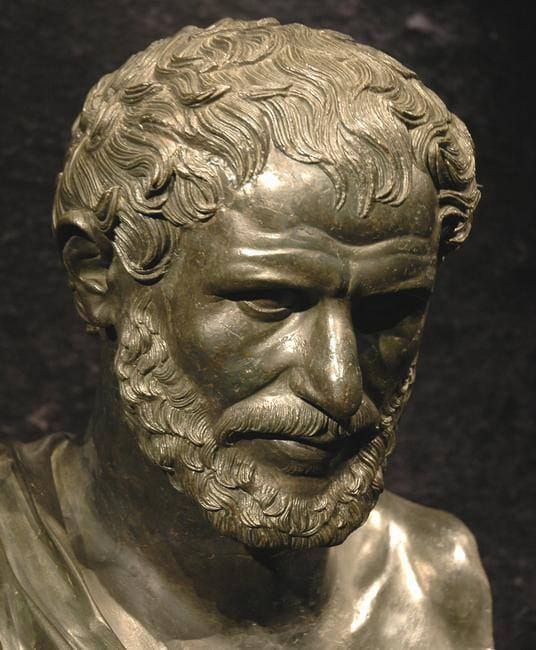
Heraclitus lived in Ephesus, an important Greek city in Ionia on the western coast of Asia Minor. He belonged to a period of early Greek philosophy in which thinkers increasingly sought natural and rational explanations for the structure of reality, asking fundamental questions about nature, knowledge, change, and the principles governing the cosmos.
Earlier Ionian philosophers such as Thales, Anaximander, and Anaximenes had searched for fundamental principles capable of explaining the natural world. Heraclitus developed a distinctive approach, focusing particularly on change, transformation, order, and opposition, while also asking how apparently conflicting processes could belong to a single intelligible world.
His thought emerged alongside wider debates among early Greek philosophers about whether reality is fundamentally stable or changing. Heraclitus became especially important because he refused to treat change as merely a secondary feature of otherwise permanent things. Transformation itself appears to be essential to his understanding of the way the world exists and operates.
Heraclitus did not simply argue that everything changes randomly. His surviving fragments suggest that change itself possesses an order, measure, and intelligible structure. This conviction is closely connected with his concept of the Logos, through which he attempted to explain the common order underlying the changing and apparently contradictory processes of reality.
Why Is Heraclitus Important?
Heraclitus is important because he made change and transformation central philosophical problems. Instead of treating change merely as something that happens to otherwise stable objects, he investigated how transformation itself contributes to the structure, continuity, and identity of the world.
His philosophy also explores the relationship between apparently opposite conditions. Day and night, hot and cold, waking and sleeping, life and death, and other contrasting states can be understood as interconnected moments within larger processes rather than as completely isolated and independent realities.
This emphasis on opposition led Heraclitus to examine the role of conflict and tension in the world. The interaction of opposing forces does not necessarily destroy order; in some of his most influential images, tension itself helps produce harmony and maintain the structure of things.
Heraclitus therefore raises a question that remains important throughout philosophy: How can something remain what it is while continually changing? His reflections on this problem influenced later discussions of identity, becoming, nature, metaphysics, and the relationship between permanence and transformation.
What Did Heraclitus Believe?
Heraclitus is traditionally associated with the view that reality is characterized by continual change and transformation. However, the popular statement that "everything changes" can oversimplify his philosophy, because his surviving fragments are concerned not only with movement but also with the order and intelligibility present within change.
His fragments suggest that transformation occurs according to an underlying order. This order is closely associated with the Logos, which Heraclitus presents as something common rather than merely a private teaching belonging to himself. The world changes, but its changes are not therefore without structure or measure.
Heraclitus also emphasizes the relationship between opposites. Opposing conditions are not simply unrelated or permanently separated from one another. Their interaction, tension, and transformation help constitute the ordered processes through which the world continually becomes what it is.
Fire is another major theme associated with Heraclitus. His fragments describe an everlasting world-order as an ever-living fire that is kindled and quenched in measures. Scholars continue to debate whether fire should be understood primarily as a physical substance, a symbol of perpetual transformation, or as a more complex feature of his cosmological account.
Taken together, these themes suggest a philosophy concerned with a world in which change, opposition, and order are inseparable. Heraclitus does not present reality as a motionless collection of permanent objects, but neither does he portray it as meaningless chaos. The changing world possesses patterns that human beings must learn to recognize.
What Is the Logos According to Heraclitus?
The Logos is one of the most important and difficult concepts in Heraclitus' philosophy. The Greek word has several related meanings, including "word," "account," "statement," and "reason," making it difficult to translate with a single English term without losing some of its philosophical complexity.
Heraclitus presents the Logos as something that is common. Human beings encounter the order expressed through the world, yet he argues that many people fail to understand it even when they hear accounts of it or experience its operations in everyday life.
The Logos is therefore not simply a word Heraclitus invented for his own private philosophy. In his surviving fragments, it points toward a deeper account of how things are ordered, related, and transformed. The apparent diversity and conflict of experience may nevertheless belong to a common underlying pattern.
Understanding the Logos requires more than collecting information. Heraclitus repeatedly criticizes superficial learning and the mere accumulation of knowledge, suggesting that a person may know many facts while still failing to understand how things are fundamentally connected.
The concept later acquired great importance in Greek, Jewish, and Christian philosophical traditions, but these later meanings should not simply be projected back onto Heraclitus. In his own philosophical context, the Logos is most closely associated with the intelligible order that structures a world of continual change and transformation.
What Is Heraclitus' Theory of Flux and Change?

Flux is the modern term commonly used to describe the Heraclitean emphasis on change and transformation. Heraclitus became famous for treating change as a fundamental feature of reality, but the exact phraseology of the popular doctrine that "everything flows" should not automatically be treated as a direct quotation from his surviving fragments.
The image of the river is central to later interpretations of his philosophy. Surviving ancient reports and fragments associated with Heraclitus describe people entering rivers in which different waters continually flow, creating a powerful image of something that possesses continuity while undergoing constant material change.
This image suggests a deeper philosophical problem: something can maintain continuity precisely through continual transformation. A river remains a recognizable river even though the particular water flowing through it does not remain permanently the same. Identity, therefore, need not always require complete material permanence.
Heraclitus' philosophy consequently connects change and stability rather than treating them as completely unrelated ideas. What appears stable may depend upon continuous processes of movement and transformation, while what appears to change may nevertheless participate in an enduring order.
For this reason, Heraclitus is better understood as a philosopher of becoming within order than simply as a thinker who claimed that everything dissolves into meaningless instability. The tension between permanence and change remains one of the central problems through which his philosophy continues to be interpreted.
What Did Heraclitus Mean by the River?
The river is one of the most famous images associated with Heraclitus. Ancient authors connected him with the idea that a person cannot encounter exactly the same river twice because the water is constantly flowing and the conditions of the river are continually changing. However, the popular wording of this idea should be treated carefully, since not every famous version survives as a direct quotation from him.
A surviving fragment gives a more precise picture. It describes people entering rivers while different waters continually flow around them. The river nevertheless remains identifiable as a river even though the particular waters composing it at any given moment do not remain permanently the same.
This is philosophically important because it shows how identity and change can coexist. A thing may remain identifiable as a continuing structure or process even while its material components are constantly changing. Continuity, in this sense, does not necessarily require complete permanence.
The river image therefore provides a useful way of understanding why Heraclitus is associated with both flux and continuity. The image does not merely say that everything disappears into instability; it raises the deeper question of how something can remain recognizably itself precisely through the processes that continually transform it.
Later philosophers and interpreters made the river one of the defining symbols of Heraclitean thought. It remains influential because it captures a problem that extends beyond ancient philosophy: whether identity should be understood as permanent sameness or as continuity maintained through ongoing change.
What Is the Unity of Opposites in Heraclitus?
The unity of opposites is one of the central themes associated with Heraclitus. He repeatedly draws attention to pairs such as day and night, hot and cold, waking and sleeping, living and dead, and other apparently opposed conditions that human beings often assume are completely separate.
Heraclitus does not necessarily mean that opposites are literally identical or that all differences disappear. Rather, his fragments often emphasize how opposing conditions are connected through processes of transformation and through their dependence upon one another for meaning and existence.
Something can become its opposite. What is cold can become hot, what is wet can become dry, and living things eventually pass into death while new life emerges through continuing processes of transformation. The boundary between opposing conditions is therefore often dynamic rather than permanently fixed.
Heraclitus also uses images of tension to explain how opposition can contribute to unity. Just as the opposing pull of a bow or lyre creates a functioning structure, apparently conflicting forces may belong to a deeper harmony that is not immediately obvious to ordinary perception.
Opposition therefore does not simply destroy order. For Heraclitus, tension between opposites can itself be part of the order of the cosmos. Understanding reality requires recognizing not only the differences between things but also the hidden relationships through which opposing conditions interact and transform into one another.
Why Is Fire Important in Heraclitus' Philosophy?

Fire occupies an important place in Heraclitus' cosmology. One famous fragment describes the world-order as an ever-living fire, kindling and being quenched in measures. This language connects fire with the larger themes of transformation, proportion, and order found throughout his surviving thought.
Fire is particularly suitable to Heraclitus' philosophy because it is never simply static. A flame exists through a continuous process of burning, consuming, transforming, and producing new conditions. It can therefore serve as a powerful example of something whose existence is inseparable from ongoing activity and change.
For this reason, fire can be understood not merely as an ordinary physical substance but also as a powerful image for process and transformation. Heraclitus appears to connect fiery processes with wider exchanges and transformations occurring throughout nature.
At the same time, scholars disagree about whether Heraclitus should be understood as saying that fire is literally the ultimate material substance from which everything else derives, or whether fire has a more complex symbolic and cosmological role within an ordered system of transformations.
It is therefore important not to reduce his philosophy to the simple formula that "everything is made of fire." Fire is undeniably central to the surviving fragments, but its exact relationship to the Logos, cosmic order, and the transformations of other elements remains one of the major interpretive questions in the study of Heraclitus.
Heraclitus' View of the Cosmos and Nature
Heraclitus presents the cosmos as an ordered reality rather than as a random collection of disconnected events. His surviving fragments describe a world governed by regular processes of transformation, in which change occurs through patterns and measures rather than through meaningless disorder.
One important fragment describes the world-order as something that no god or human created and that exists as an everlasting process of fire, kindling and being quenched in measures. The statement presents the cosmos as neither a temporary artifact nor a completely static object, but as an enduring and continuously active order.
This cosmological view is closely connected with Heraclitus' broader philosophy of change. The world is not a finished object existing outside transformation; its order is expressed through ongoing processes in which things arise, pass away, and become different while the larger cosmos remains intelligible.
Ideas of measure and proportion are especially important here. Change does not mean that anything whatsoever can happen without structure. Heraclitus appears to see natural transformation as taking place according to relationships that give the cosmos a recognizable order despite its continual movement.
Heraclitus therefore connects cosmology with deeper metaphysical questions about what it means for something to exist and remain ordered while constantly undergoing change. His account of nature attempts to explain how becoming, opposition, and continuity can all belong to a single world.
What Did Heraclitus Mean by War and Strife?
Heraclitus famously describes war or strife as a fundamental feature of the world. This language can sound disturbing to modern readers, but it does not mean that Heraclitus was simply celebrating military violence or treating ordinary warfare as morally desirable.
In his philosophy, conflict between opposites can describe the tension through which change occurs. Hot and cold, day and night, life and death, and other opposing conditions are interconnected through processes of transformation rather than existing as permanently isolated realities.
Strife therefore has a broader cosmological meaning. The world remains dynamic because opposing forces interact, resist, and transform one another rather than remaining permanently separated. Difference and tension are consequently part of the processes through which the visible world takes its changing forms.
Heraclitus' concept of strife is closely connected with his idea that order does not require the elimination of difference. Instead, harmony can emerge through the relationship between opposites. His famous comparisons involving instruments such as the bow and the lyre suggest that tension itself can help create a unified and functioning structure.
This idea challenges the assumption that harmony always means the absence of conflict. For Heraclitus, a deeper order may exist not despite opposition but through the dynamic relationships between opposing forces. The hidden unity of these tensions is one of the most influential and difficult themes in his philosophy.
Heraclitus on Knowledge and Understanding
Heraclitus was deeply concerned with the difference between merely possessing information and genuinely understanding reality. His surviving fragments repeatedly suggest that human beings can encounter the world every day while still failing to grasp the deeper order that connects its apparently separate events and processes.
He criticized forms of learning that merely accumulate information without producing wisdom. Heraclitus famously suggests that much learning does not by itself teach understanding; knowledge becomes philosophical only when a person recognizes the relationships and common principles underlying the many things they observe and experience.
This is closely connected with his concept of the Logos. The Logos is common rather than private, yet human beings often live as though each person possessed an entirely separate understanding of reality. Heraclitus therefore criticizes those who rely only on individual opinion without recognizing a wider order shared by all.
Philosophical understanding, for Heraclitus, therefore involves learning to perceive patterns within change, opposition, and transformation. Wisdom is not simply the possession of many facts but the capacity to understand how apparently different things belong to an interconnected and ordered cosmos.
Heraclitus' Philosophy of the Soul
Heraclitus also discusses the soul and its relationship to knowledge, life, and the wider order of the cosmos. Although his surviving remarks on the soul are fragmentary, they show that he regarded the inner life of human beings as connected with the same processes of transformation found throughout nature.
Several fragments connect the quality or condition of the soul with its capacity for understanding. Heraclitus does not present the soul simply as an isolated private possession separated from the world; instead, his language suggests a relationship between the soul, the Logos, and the broader order of reality.
Heraclitus also uses transformations involving fire, water, and earth when discussing both the soul and the natural world. These passages appear to connect the condition of the soul with processes of change, but their precise meaning remains difficult to determine from the limited fragments that survive.
It is therefore important not to reduce Heraclitus' remarks to a simple modern theory of psychology. His reflections on the soul belong to an ancient philosophical framework in which questions about human understanding, nature, cosmology, and transformation were closely connected rather than treated as completely separate disciplines.
Heraclitus' Ideas About Ethics and Human Life
Heraclitus' philosophy is not limited to cosmology and metaphysics. His surviving fragments also contain reflections on human character, wisdom, law, desire, and the way people ought to understand and conduct their lives within the larger order of the world.
He distinguishes genuine understanding from the ordinary habits of people who fail to recognize the common order of reality. Human beings may follow custom, pursue private interests, or accumulate knowledge without achieving wisdom. Ethical and intellectual improvement therefore requires a transformation in how a person understands the world.
Heraclitus also connects human law with a wider divine or cosmic law. Human communities create particular laws, but his fragments suggest that these should ultimately be understood in relation to an order greater than individual preference. This gives his reflections on human life a broader cosmological dimension.
His ethical thought is therefore closely connected with his metaphysics. To understand oneself properly requires understanding that human life takes place within a world of change, opposition, and order. Wisdom should consequently affect not only what a person knows but also how that person judges, acts, and lives.
Heraclitus' Main Philosophical Ideas
Although Heraclitus' surviving fragments are difficult to interpret and do not provide a complete philosophical system, several major themes consistently appear in discussions of his thought. Together, they reveal a philosophy concerned with the relationship between change, order, opposition, nature, and human understanding.
The Logos
Heraclitus presents the Logos as something common through which reality can be understood. The term can suggest an account, principle, or rational order, and it expresses his conviction that the changing world is not merely chaotic but possesses an intelligible structure.
Change and Flux
Change is a fundamental feature of reality in Heraclitus' philosophy. Things transform continuously, yet this does not necessarily mean that all identity disappears. His reflections on rivers and other processes investigate how continuity can exist through ongoing change.
The Unity of Opposites
Opposing conditions are interconnected through processes of transformation. Day and night, hot and cold, life and death, and other contrasts should not always be understood as completely isolated realities, because each can emerge through a changing relationship with its opposite.
Fire
Fire is a major element and image in Heraclitus' cosmology. His description of an ever-living fire expresses continual transformation and an ordered process within the cosmos, although scholars continue to debate exactly how literally his references to fire should be understood.
Strife and Harmony
Conflict between opposites is not simply destructive. Heraclitus emphasizes tension as a condition through which transformation occurs, suggesting that a deeper harmony can emerge not from eliminating difference but from the dynamic relationship between opposing forces.
Human Understanding
Heraclitus argues that people often fail to understand the common order of reality even though they encounter it constantly. Wisdom therefore requires deeper insight into patterns and relationships rather than merely accumulating information, memorizing facts, or relying entirely on private opinion.
Did Heraclitus Write a Book?
Heraclitus is traditionally said to have written a philosophical work, but the complete text has not survived. What remains are individual fragments preserved through quotations, paraphrases, and reports in the writings of later ancient authors who discussed his ideas.
Ancient tradition associated his work with subjects including cosmology, politics and ethics, and theology. Whether these categories accurately describe the original organization of his book, however, is uncertain, because the surviving fragments cannot be arranged with complete confidence into a continuous reconstruction of the lost work.
This makes Heraclitus different from philosophers such as Plato and Aristotle, whose surviving works allow readers to study long, connected arguments in their original literary form. Heraclitus is instead known through brief and often highly compressed statements separated from their original context.
When studying Heraclitus, it is therefore important to distinguish carefully between the surviving fragments themselves and the interpretations developed by later philosophers, ancient commentators, and modern scholars. His influence is immense, but reconstructing his complete philosophical system remains an interpretive task.
How Do We Know About Heraclitus?
Our knowledge of Heraclitus comes primarily from fragments attributed to him and from later ancient writers who quoted, interpreted, or discussed his philosophy. Because his original book has been lost, every reconstruction of his thought depends on evidence transmitted through other authors and traditions.
Heraclitus' Fragments
Individual fragments attributed to Heraclitus preserve statements concerning the Logos, change, opposites, fire, knowledge, human character, law, the soul, and the structure of the cosmos. These fragments provide the closest surviving evidence for his own thought, although many have been preserved only within later works.
Plato
Plato discussed ideas associated with Heraclitus and helped establish the influential connection between Heraclitean philosophy and radical change or flux. His discussions are historically important, but they also represent Plato's own philosophical engagement with earlier thinkers rather than a complete neutral record of Heraclitus' views.
Aristotle
Aristotle also discussed Heraclitus and philosophical positions associated with him, particularly in relation to change, opposition, knowledge, and the nature of reality. Like Plato, Aristotle is an essential source for the history of early Greek philosophy, though his interpretations must be distinguished from Heraclitus' surviving words.
Later Ancient Writers
Later authors and commentators preserved additional fragments, testimonies, and interpretations. These sources are indispensable for studying Heraclitus, but they must be used carefully because they often quote him for particular philosophical purposes and do not always provide the complete context in which his original statements appeared.
What Do We Actually Know About Heraclitus?
Heraclitus is an important example of the difficulty of studying ancient philosophy. His influence on later thought is enormous, and a substantial collection of fragments is associated with his name, but the direct evidence does not allow scholars to reconstruct his complete philosophical system with absolute certainty.
Relatively Well-Attested
- Heraclitus was associated with Ephesus.
- He was an important Greek philosopher active around 500 BCE.
- His surviving fragments discuss the Logos, change, opposites, fire, knowledge, and human conduct.
- Ancient and modern interpreters consistently connect him with a philosophy centered on transformation and order.
Traditionally Attributed
- A strongly developed doctrine of universal flux.
- A complete material theory in which everything is ultimately fire.
- A fully systematic theory of the unity of opposites.
Uncertain or Disputed
- The exact meaning of the Logos.
- Whether Heraclitus should be described as a material monist.
- Whether his theory should be understood as radical universal flux.
- The precise relationship between fire, change, and the Logos.
- The original organization and complete contents of his lost work.
Famous Quotes and Fragments of Heraclitus
Heraclitus is famous for his short, paradoxical, and often difficult statements, many of which survive only as fragments quoted or discussed by later ancient authors. Because the original context of many passages has been lost, translations differ and famous sayings attributed to him should be treated with care. Nevertheless, these fragments provide the most direct evidence available for understanding his distinctive philosophical thought.
The Logos
One important fragment states that it is wise to agree with the Logos that all things are one. This compressed statement reflects Heraclitus' belief that wisdom requires recognizing a common order underlying the apparent diversity and conflict of the world, rather than understanding reality as a collection of completely separate and unrelated things.
The River
Heraclitus is traditionally associated with the river image, in which different waters continually flow through rivers that nevertheless remain identifiable as the same rivers. The image became one of the most influential expressions of the philosophical problem of how continuity and identity can persist through an ongoing process of material change and transformation.
War and Strife
Another famous fragment describes war as common and strife as a force through which things come about. In this context, conflict should not be understood only as military violence but as a broader philosophical image for tension, opposition, and transformation. Opposing forces interact, and through their interaction the changing order of the world is maintained.
Fire
Heraclitus describes the world-order as an ever-living fire, kindling and being quenched in measures. The language suggests both continual activity and regularity: fire is constantly changing, yet its transformations occur according to measure. This fragment therefore brings together several major Heraclitean themes, including change, order, transformation, and cosmic continuity.
These statements are valuable not only as quotations but as examples of Heraclitus' distinctive philosophical style. His language is compressed, paradoxical, metaphorical, and often deliberately resistant to a single obvious interpretation. Rather than presenting a complete argument in each passage, the fragments invite readers to consider relationships and tensions that may not be immediately visible.
Why Is Heraclitus Called the Obscure Philosopher?
Heraclitus has often been described as difficult or obscure because his surviving statements are short, paradoxical, metaphorical, and capable of multiple interpretations. Ancient tradition itself associated him with an unusually enigmatic style, and the loss of his complete work makes the difficulty even greater because many individual fragments no longer possess their original literary and philosophical context.
Rather than presenting a long systematic argument, Heraclitus often expresses philosophical ideas through contrasts, images, wordplay, and compressed statements. Rivers, fire, sleep, waking, harmony, war, and opposites become philosophical images through which he investigates the deeper order of reality. Understanding a fragment may therefore require attention to both its literal language and its possible philosophical meaning.
This style has contributed to the many competing interpretations of his philosophy. Readers have understood him as a philosopher of material nature, metaphysics, process, knowledge, ethics, religion, and cosmic order. These interpretations often emphasize different fragments, which means that reconstructing a single complete and systematic doctrine remains difficult.
His difficulty is therefore not simply a problem with translation. The surviving fragments themselves are unusually dense and philosophically suggestive, while the absence of their complete original context creates further uncertainty. Heraclitus' obscurity has consequently become part of his philosophical legacy, continually encouraging new generations of readers to interpret his enigmatic account of reality.
Heraclitus' Influence on Western Philosophy
Heraclitus had a lasting influence on the history of Western philosophy. His ideas became an important reference point for later discussions of change, stability, knowledge, reality, and the relationship between unity and difference. Even philosophers who strongly disagreed with particular interpretations of his thought often treated Heraclitean ideas as essential to understanding fundamental problems about the nature of the world.
Plato and Aristotle both discussed Heraclitus, although their interpretations helped create some of the most influential later readings of his philosophy. Through Platonic and Aristotelian discussions, Heraclitus became especially associated with change and flux, an association that profoundly shaped how subsequent generations understood the contrast between becoming and stable being.
Later philosophers and philosophical traditions also returned to Heraclitean themes. The Stoics, for example, developed a distinctive cosmology involving fire and rational order that was influenced by earlier Heraclitean ideas, although Stoic philosophy should not simply be treated as a direct continuation of Heraclitus' own surviving doctrine.
In modern philosophy, Heraclitus became particularly important for thinkers interested in process, becoming, contradiction, and historical change. His thought has repeatedly been interpreted in relation to philosophers concerned with the dynamic and developmental character of reality. His fragments continue to influence debates about whether change is secondary to stable being or one of the most fundamental features of existence itself.
Heraclitus and Parmenides: Change vs Stability
Heraclitus is frequently compared with Parmenides, another major Pre-Socratic philosopher. Their philosophies are often presented as representing opposing approaches to change and being. The comparison became especially influential because both thinkers addressed fundamental questions about reality, although they approached those questions in very different ways.
Heraclitus emphasizes transformation, tension, and the dynamic character of reality, while Parmenides is famous for arguing that genuine being cannot come into existence or pass away. The traditional contrast therefore presents one philosopher as emphasizing becoming and the other as emphasizing the permanence and intelligibility of what truly is.
This contrast became one of the major ways later philosophers discussed the problem of change and permanence. How can something genuinely change without becoming something entirely different? And if reality is constantly transforming, what explains the continuity and order that make the world intelligible to human beings?
Modern scholarship, however, recognizes that the relationship between their philosophies is more complicated than a simple opposition between "everything changes" and "nothing changes." Heraclitus himself emphasizes order and continuity, while Parmenides' arguments are more philosophically complex than a simple rejection of all ordinary experience. The comparison nevertheless remains one of the most important starting points for studying early Greek metaphysics.
Heraclitus Explained Simply
Heraclitus was an ancient Greek philosopher who wanted to understand how reality can remain ordered even though everything around us is constantly changing. He observed a world of transformation and opposition and asked whether change itself might follow an intelligible pattern rather than being merely random or chaotic.
He believed that change is not simply random. The world has an underlying order, which he associated with the Logos. Human beings often fail to recognize this common order, but philosophical understanding involves looking beyond isolated appearances and recognizing the relationships that connect apparently separate things.
He also argued that opposites are deeply connected. Day depends on night, hot changes into cold, and living things are involved in processes that include both life and death. For Heraclitus, opposition and tension are not necessarily signs that the world lacks harmony; they can be part of the very processes through which order and transformation occur.
- Main question: How can reality be ordered while constantly changing?
- Key concept: Logos.
- Major theme: Change and flux.
- Another major idea: Unity and interaction of opposites.
- Important image: Fire.
- Famous example: The changing waters of a river.
- Historical importance: A foundational thinker in the philosophical study of change, reality, and cosmic order.
A Famous Fragment Associated with Heraclitus
“Listening not to me but to the Logos it is wise to agree that all things are one.”
Frequently Asked Questions About Heraclitus
Who was Heraclitus?
Heraclitus of Ephesus was an ancient Greek philosopher active around 500 BCE. He is one of the most important Pre-Socratic thinkers and is known for his ideas about change, the Logos, opposites, fire, and cosmic order.
What is Heraclitus famous for?
Heraclitus is famous for his philosophy of change and flux, the concept of the Logos, the unity of opposites, his association with fire, and his distinctive philosophical fragments.
What did Heraclitus believe?
Heraclitus believed that reality is characterized by transformation and that this change occurs within an underlying order. He connected this order with the Logos and emphasized the relationship between opposing conditions.
What is the Logos according to Heraclitus?
The Logos is one of Heraclitus' central concepts. It can mean something like word, account, or reason, and in his philosophy it is associated with the common order through which reality can be understood.
Did Heraclitus believe everything changes?
Heraclitus is traditionally associated with the doctrine of flux, but the claim that he simply believed "everything changes" is an oversimplification. His river fragment suggests that continuity and change can exist together.
What is the unity of opposites?
The unity of opposites refers to Heraclitus' emphasis on the interdependence and transformation of opposing conditions. Opposites such as hot and cold or day and night are connected within the processes of nature.
Why is fire important to Heraclitus?
Fire is central to Heraclitus' cosmological fragments. It represents an ever-changing process and is described as an ever-living fire that is kindled and quenched in measures.
What did Heraclitus mean by the river?
The river illustrates how change and continuity can coexist. Different waters flow through a river while the river remains recognizable as the same river.
Did Heraclitus really say "You cannot step into the same river twice"?
The famous wording is a later formulation associated with Heraclitus. A surviving fragment instead describes different waters flowing for those entering the same rivers. The popular quotation captures an important Heraclitean theme, but it should not automatically be treated as a direct quotation from a surviving original text.
Why is Heraclitus called the philosopher of change?
Heraclitus is called a philosopher of change because his fragments repeatedly emphasize transformation, opposition, and the dynamic processes through which things become what they are.
Did Heraclitus write a book?
Heraclitus is traditionally associated with a written work, but the complete text does not survive. Modern readers know his philosophy mainly through fragments and reports preserved by later authors.
Was Heraclitus a Pre-Socratic philosopher?
Yes. Heraclitus is generally classified as a Pre-Socratic Greek philosopher. He was active before Socrates and belongs to the early development of Greek philosophy.
Who influenced Heraclitus?
Heraclitus was influenced by and responded to earlier Greek thinkers, poets, and intellectual traditions, including the Milesian philosophers. He also developed positions that were distinctive from his predecessors.
Who influenced Heraclitus?
Heraclitus influenced later Greek philosophers and philosophical traditions, including Plato, Aristotle, and the Stoics. His ideas about change and process also became important to later philosophical discussions.
Why is Heraclitus important today?
Heraclitus remains important because he raises enduring philosophical questions about change, identity, opposition, order, knowledge, and the nature of reality.
Related Ancient Greek Philosophers
Heraclitus belongs to the wider tradition of Pre-Socratic and Ancient Greek philosophy. Explore thinkers who developed different answers to questions about nature, reality, knowledge, and change.
Philosophy Branches Connected to Heraclitus
Heraclitus' philosophy connects strongly with questions about reality, change, knowledge, nature, and human conduct. His ideas are especially relevant to metaphysics, epistemology, logic, and the philosophical study of nature.
Why Heraclitus Still Matters
Heraclitus remains one of the most challenging and influential philosophers of ancient Greece. His surviving fragments do not provide a simple philosophical system, but they repeatedly return to questions about change, order, opposition, knowledge, and reality.
His philosophy challenges us to think beyond the idea that change and stability must be completely opposed. A river can remain a river while its waters change, and a world can possess order while undergoing continual transformation.
The concepts associated with Heraclitus — the Logos, flux, fire, the unity of opposites, and the relationship between change and identity — became enduring problems in the history of philosophy.
Explore Great Philosophers