Who Was Jeremy Bentham?
Jeremy Bentham (1748–1832) was an English philosopher, jurist, social reformer, and the founder of classical utilitarianism. He became one of the most influential thinkers in modern moral and political philosophy because he argued that actions, laws, and institutions should be judged according to their consequences for human happiness and suffering. Bentham's philosophy developed during the Enlightenment and reflected a broader intellectual movement toward rational criticism, legal reform, and the systematic examination of inherited institutions. Rather than treating traditional customs as automatically legitimate, he asked whether they actually promoted human well-being.
The central principle of Jeremy Bentham's philosophy is often summarized as "the greatest happiness of the greatest number." Bentham believed that pleasure and pain play a fundamental role in human life and that moral and political decisions should aim to increase happiness while reducing unnecessary suffering. His utilitarian approach therefore evaluates conduct by considering its effects on the people involved rather than relying solely on tradition, intention, or established authority. The principle of utility became the foundation for Bentham's thinking about ethics, legislation, punishment, government, and social reform.
Bentham applied utilitarian thinking far beyond personal morality. He wrote extensively about law, punishment, prisons, democracy, education, economics, religion, political institutions, and social reform. He believed that these areas could be examined through reasoned analysis rather than being accepted simply because they had developed historically. His philosophy attempted to create a systematic method for asking whether a particular law or institution increased social happiness or produced unnecessary pain. This practical orientation made Bentham an important figure in the development of modern approaches to legal and political reform.
Bentham's philosophy of law was closely connected with his moral philosophy. He argued that laws should be evaluated according to their social consequences and that legal systems should be made clearer, more rational, and more consistent. He also criticized punishments that produced suffering without sufficient social benefit and considered how institutions such as prisons could be designed to influence behavior. His political thought similarly emphasized accountability, public interests, and institutional reform. These concerns demonstrate that Bentham understood philosophy not merely as an abstract intellectual discipline but as a method for examining concrete problems in society.
Jeremy Bentham's influence can be seen in modern utilitarian ethics, legal philosophy, welfare policy, political reform, and debates about public decision-making. His ideas strongly influenced later utilitarian thinkers, especially John Stuart Mill, although Mill modified and developed utilitarianism in important ways. Bentham's legacy also extends into contemporary discussions about how governments should compare competing interests, measure social benefits and harms, and justify public policies. His importance in the history of philosophy therefore rests not only on founding classical utilitarianism but also on his attempt to connect moral reasoning with practical questions concerning law, government, institutions, and human welfare.
Jeremy Bentham: Quick Facts
- Full name — Jeremy Bentham
- Born — February 15, 1748
- Died — June 6, 1832
- Nationality — British
- Philosophical tradition — British empiricism and classical utilitarianism
- Major fields — Ethics, political philosophy, philosophy of law, social reform
- Most famous theory — Utilitarianism
- Central principle — The greatest happiness principle
- Important idea — Pleasure and pain guide human action
- Important concept — Felicific or hedonic calculus
- Famous design — The Panopticon
- Major concern — Legal and political reform
- Influenced — John Stuart Mill and later utilitarian thinkers
Jeremy Bentham's Early Life and Education
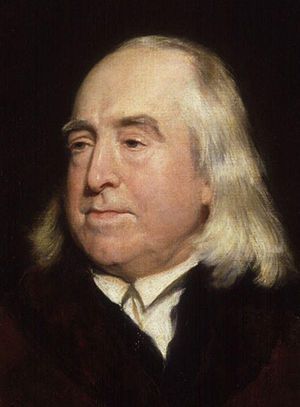
Jeremy Bentham was born in London, England, on February 15, 1748, into a prosperous family with strong connections to the legal profession. From an early age, he displayed remarkable intellectual ability and developed a strong interest in reading, languages, philosophy, and law. His childhood education prepared him for a conventional professional career, but his intellectual interests eventually led him beyond the expectations of a traditional legal career. The questions raised by law and government increasingly became philosophical problems for him, particularly questions concerning justice, authority, punishment, and the purpose of legislation.
Bentham studied at Queen's College, Oxford, where he entered the university at a remarkably young age. He subsequently trained in law and was called to the English bar, but he became increasingly dissatisfied with the practical and theoretical character of the legal system he encountered. He believed that many laws were unnecessarily complicated and that legal institutions often preserved historical practices without adequately considering their consequences for ordinary people. His dissatisfaction encouraged him to approach law from the standpoint of systematic philosophical criticism.
Instead of establishing himself primarily as a practicing lawyer, Bentham devoted much of his life to philosophical writing and proposals for institutional reform. He lived during a period when Enlightenment thinkers were increasingly questioning inherited political authority, religious assumptions, social privileges, and traditional legal institutions. Bentham shared this critical spirit, but he developed his own distinctive approach by asking whether particular institutions actually promoted human happiness. This practical and analytical orientation became a defining feature of his philosophical method.
Bentham's early engagement with philosophy also led him to examine the foundations of morality. He rejected the idea that moral judgments should rest simply on vague appeals to natural law, tradition, or customary authority. Instead, he argued that human beings are fundamentally influenced by pleasure and pain and that these experiences provide a basis for evaluating conduct. This became the foundation of his principle of utility and eventually developed into the systematic ethical theory known as classical utilitarianism.
His intellectual development therefore brought together several interests that remained central throughout his career: moral philosophy, jurisprudence, political theory, economics, and social reform. Bentham wanted philosophical reasoning to have practical consequences, particularly in the improvement of laws and public institutions. His writings increasingly addressed questions such as how punishment should be justified, how laws should be organized, how governments could be made accountable, and how social policies could increase general well-being. This combination of philosophical theory and institutional reform became one of the defining characteristics of Bentham's contribution to modern thought.
Why Is Jeremy Bentham Important?
Jeremy Bentham is important because he developed the most systematic early form of classical utilitarianism and made the consequences of human actions central to moral evaluation. Instead of asking only whether an action follows a traditional rule or conforms to an established custom, Bentham asked what effects the action produces for those affected by it. His approach established a powerful framework for comparing benefits and harms and provided a philosophical basis for evaluating individual conduct as well as laws and public institutions.
Bentham is also important in the history of philosophy of law. He argued that laws should be examined according to their purposes, consequences, and effects on human well-being. He opposed the idea that existing laws should be treated as legitimate merely because they had been inherited from the past. His insistence on analyzing law as a human institution contributed to the development of modern jurisprudence and strongly influenced later discussions concerning legal reform, legislation, codification, punishment, and the relationship between law and morality.
His political philosophy was similarly concerned with practical institutional reform. Bentham criticized political arrangements that protected inherited privilege and supported greater accountability of governments to the people. His democratic ideas developed through his utilitarian framework, since political institutions could be judged by whether they served the interests of the people rather than merely preserving the power of rulers or established elites. This made his work relevant to debates about representation, constitutional reform, political participation, and public administration.
Bentham's influence also extends into questions of punishment and prison reform. He believed that punishment itself produces suffering and therefore requires justification through its beneficial consequences. This led him to examine whether punishment could prevent greater harms, reform behavior, or protect society. His famous Panopticon prison design reflected his broader interest in creating institutions whose organization could influence behavior efficiently. Although the Panopticon was never constructed in the form Bentham originally proposed, the concept became historically influential in later discussions of surveillance, discipline, and institutional power.
Bentham remains important because many contemporary policy questions resemble the kinds of problems his philosophy was designed to address. Governments and institutions frequently have to compare competing benefits, costs, risks, and forms of suffering when deciding how resources should be distributed or which policies should be adopted. Modern utilitarianism has developed in many directions and is not identical to Bentham's original theory, but his central insight that moral and political decisions should take human welfare seriously continues to influence ethics, economics, law, public policy, and social philosophy.
Jeremy Bentham's Main Philosophical Ideas
1. The Principle of Utility
Bentham's most important philosophical principle is the principle of utility. According to this principle, actions and institutions should be judged by their tendency to produce pleasure or happiness and to prevent pain or suffering. Utility refers broadly to the capacity of something to promote well-being. Bentham therefore sought a standard that could be applied consistently to moral decisions, legislation, and public institutions rather than relying on personal preference or inherited moral conventions.
The principle of utility begins with Bentham's understanding of human experience. Human beings naturally respond to pleasure and pain, and these experiences influence their choices, desires, and behavior. For Bentham, this did not mean that every decision is consciously made through a calculation of pleasure and pain. Rather, pleasure and pain provide the fundamental basis for understanding why people value some outcomes and avoid others.
Bentham extended the principle of utility from individual conduct to society as a whole. A social institution cannot be evaluated only by considering the interests of the person who created or controls it. Instead, its consequences must be considered for all people affected by it. This gives Bentham's utilitarianism a universalizing character: each person's welfare counts in the moral assessment rather than only the welfare of rulers, elites, or politically powerful groups.
The principle of utility also provided Bentham with a method for criticizing existing institutions. If a law produces considerable suffering without generating sufficient benefits, its traditional status does not automatically make it morally acceptable. Similarly, if a reform can increase overall happiness while reducing unnecessary harm, there is a strong utilitarian reason to consider adopting it. Bentham thus connected ethical reasoning directly with social and political reform.
The importance of the principle of utility lies in its attempt to give moral philosophy a clear and practical standard. Bentham wanted ethical and political arguments to be open to rational examination rather than resting entirely on authority or custom. His approach became the foundation of classical utilitarianism and influenced later philosophers who developed more sophisticated versions of consequentialist ethics. The principle of utility therefore remains central to understanding Bentham's philosophy of morality, law, and government.
2. The Greatest Happiness Principle
Bentham believed that moral and political decisions should aim at the greatest happiness of the greatest number. The interests of society are connected with the interests of the individuals who make up that society, so a good policy should consider how its consequences affect the happiness and suffering of people. This principle expresses the collective dimension of Bentham's utilitarianism and requires decision-makers to consider the effects of their choices beyond a narrow group of beneficiaries.
The phrase "greatest happiness" should not be understood simply as encouraging people to pursue whatever gives them immediate pleasure. Bentham's theory is concerned with the overall consequences of an action or policy. A decision may produce pleasure for one person while causing much greater suffering to many others, in which case its total consequences may be negative. The utilitarian assessment therefore requires attention to both benefits and harms.
Bentham also rejected the idea that political rulers should naturally receive greater consideration than ordinary citizens. His utilitarian framework treats each person's happiness as morally relevant. This provided a powerful philosophical challenge to political systems based on inherited privilege, because social rank does not by itself determine the value of a person's interests. The principle therefore supported Bentham's broader interest in political and legal reform.
The greatest happiness principle also explains why Bentham applied utilitarianism to legislation. A law should not be considered good merely because it has existed for generations or because influential groups support it. Its justification depends partly on what it does for the people subject to it. Bentham therefore asked lawmakers to consider whether legal rules reduce harm, protect interests, prevent wrongdoing, and contribute to the general welfare.
The principle became one of the most influential formulations in the history of consequentialist ethics. Later utilitarians, particularly John Stuart Mill, retained the general concern with happiness while developing different views about the nature and quality of pleasures. Bentham's formulation nevertheless established the basic utilitarian ambition: moral and political institutions should be assessed by their consequences for the well-being of all affected individuals rather than by privilege, tradition, or authority alone.
3. Pleasure and Pain Govern Human Life
Bentham famously argued that human beings are placed under the governance of two sovereign masters: pleasure and pain. These forces influence what people desire, avoid, choose, and experience. Bentham believed that a realistic moral theory must therefore take human pleasure and suffering seriously. Rather than treating them as secondary features of ethical life, he made them central to his explanation of human motivation and moral evaluation.
Pleasure and pain in Bentham's philosophy are not restricted to physical sensations. Human experiences can involve many different sources of satisfaction and suffering, including intellectual enjoyment, social relationships, security, expectation, fear, and other forms of experience. Bentham's analysis therefore attempted to recognize the variety of ways in which human beings can benefit or suffer as a result of actions and circumstances.
Bentham's emphasis on pleasure and pain also reflects his attempt to ground morality in observable features of human life. He did not want moral philosophy to depend entirely on mysterious or inaccessible principles. If people experience happiness and suffering as real consequences of actions, then those experiences can become relevant to moral reasoning. This gave his ethical theory an empirical and practical orientation closely connected with his broader interest in rational social reform.
The importance of pleasure and pain becomes especially clear when Bentham discusses legislation and punishment. Punishment necessarily imposes suffering, so it must be justified by the benefits it is expected to produce. If punishment prevents greater harm or protects society, it may have utilitarian justification; if it creates suffering without sufficient benefit, its justification becomes much weaker. This approach made Bentham's theory particularly significant for the philosophy of criminal law.
Bentham's account of pleasure and pain ultimately provides the psychological foundation for his utilitarianism. Human beings are motivated by experiences that they find beneficial or harmful, while moral and political institutions can increase or decrease these experiences on a much larger scale. By connecting individual motivation with collective consequences, Bentham developed a theory that could move from personal morality to legislation, punishment, economics, and public policy without abandoning its central concern with human welfare.
4. Consequences Matter
Utilitarianism is a consequentialist theory because it evaluates actions largely according to their results. Bentham asked what an action actually produces rather than judging it only by the intention of the person performing it or by whether it follows an inherited moral rule. For him, intentions may be relevant when assessing the likely consequences of conduct, but they do not by themselves determine whether an action is morally right or wrong.
This emphasis on consequences distinguishes Bentham's approach from moral theories that give primary importance to duties, rules, or intentions. A rule may have been traditionally accepted and still produce harmful results, while an unconventional action may sometimes produce better consequences. Bentham's method therefore encourages philosophers and policymakers to examine what actually happens when a decision is implemented rather than stopping at abstract declarations about what ought to happen.
Consequentialist reasoning also requires attention to the people who are affected by an action. A decision cannot be evaluated adequately by looking only at its immediate effects on the person making the decision. Bentham's utilitarianism asks for a wider assessment of benefits and harms, including effects on other individuals and on society. This makes the theory particularly relevant to collective decisions in which one policy can affect large numbers of people in different ways.
Bentham's approach also explains his interest in systematic moral calculation. If consequences determine moral value, then philosophers need some way of comparing different forms and degrees of pleasure and pain. Bentham proposed the idea of a felicific calculus as a framework for considering factors such as intensity, duration, certainty, proximity, fecundity, purity, and extent. The proposal was an ambitious attempt to make moral reasoning more systematic, even though measuring happiness with precision presents serious philosophical and practical difficulties.
The focus on consequences remains one of Bentham's most enduring contributions to ethical thought. Modern consequentialist theories differ substantially in their understanding of value, welfare, and decision-making, but they continue to ask a question that Bentham made central: what difference does an action actually make to the lives of those affected by it? His answer was that morality should take those effects seriously, particularly when actions and institutions have the power to produce large amounts of happiness or suffering.
5. Institutions Should Be Reformed Rationally
Bentham believed that laws, governments, prisons, and other institutions should not be protected simply because they are old. Human institutions can be examined, criticized, and redesigned according to their actual consequences for society and individual well-being. Historical longevity, in his view, does not by itself provide a sufficient reason for preserving an institution if that institution produces unnecessary harm or fails to serve legitimate social purposes.
This commitment to rational reform was closely connected with Bentham's philosophy of law. He wanted legal systems to become clearer, more coherent, and easier to understand. Complicated legal traditions could create uncertainty and allow established interests to benefit from rules that ordinary people found difficult to navigate. Bentham therefore supported systematic approaches to legislation and legal organization that would make the purposes and effects of laws easier to examine.
Bentham also believed that punishment should be designed according to its social purpose. Because punishment imposes pain, it requires justification under the principle of utility. A rational penal system should therefore consider whether punishment deters harmful conduct, protects society, or produces other benefits sufficient to justify the suffering imposed. This approach challenged forms of punishment that were based primarily on revenge or inherited practice without examining whether they produced useful social consequences.
His interest in institutional design extended to prisons and other systems of social organization. The Panopticon was Bentham's famous proposal for a prison in which a central observer could potentially monitor prisoners housed in surrounding cells. The design was intended to make supervision more efficient and encourage disciplined behavior. Although the proposed prison was not realized as Bentham originally envisioned, the Panopticon became an enduring example of his attempt to apply rational design principles to social institutions.
Bentham's broader reform philosophy treated society as something that could be critically examined and improved through reasoned analysis. He believed that institutions should be judged by their purposes, operations, and consequences rather than by prestige or tradition alone. This practical reformism helped connect his ethical theory with jurisprudence, political philosophy, prison reform, and public administration. His legacy therefore includes not only a theory of morality but also a distinctive vision of philosophy as a tool for identifying social problems and designing institutions that better serve human welfare.
What Is Jeremy Bentham's Utilitarianism?
Utilitarianism is the ethical theory most closely associated with Jeremy Bentham. In its classical form, utilitarianism holds that the morally right action is generally the action that produces the greatest overall balance of happiness over suffering for everyone affected. Bentham's version therefore evaluates conduct by its consequences and treats the promotion of human well-being as the central standard of moral judgment. This makes utilitarianism a consequentialist theory rather than an ethical system based primarily on fixed duties or inherited rules.
Bentham's utilitarianism begins with individual experience. People experience pleasure and pain, seek things they find beneficial, and avoid things they experience as harmful. Bentham believed that these facts about human life provide a practical foundation for thinking about morality and social organization. Instead of starting with abstract moral commands, his theory begins with the experiences that make human lives better or worse and asks how those experiences should influence ethical and political decisions.
The theory is not simply a recommendation that each individual pursue personal pleasure without concern for others. Bentham's principle of utility requires consideration of the consequences for all those affected. A person's happiness matters, but so does the happiness of every other person involved. This universal scope is crucial to understanding Bentham's position because utilitarianism asks decision-makers to move beyond narrow personal interests and consider the wider effects of their actions on other members of society.
Bentham developed the idea of a felicific calculus as a way of thinking systematically about the pleasures and pains produced by actions. Factors such as intensity, duration, certainty, and extent could be considered when evaluating consequences. The purpose was not simply to turn every moral decision into a mechanical mathematical equation, but to encourage disciplined attention to the different dimensions of human benefit and suffering. This reflected Bentham's wider ambition to make moral and political reasoning more systematic and less dependent on prejudice or tradition.
Bentham therefore applied utilitarianism to collective decisions. A law, government policy, or institution should be evaluated by asking whether it increases overall well-being and reduces unnecessary suffering. This made utilitarianism especially influential in ethics, politics, law, economics, and public policy. Although later utilitarians developed the theory in different directions, Bentham's central contribution was to establish a clear philosophical framework in which the consequences of actions and institutions for human happiness became a central question of moral and political judgment.
Jeremy Bentham and the Greatest Happiness Principle
The phrase "the greatest happiness of the greatest number" is closely associated with Jeremy Bentham and classical utilitarianism. It expresses the idea that morality and public policy should consider the overall consequences of an action rather than protecting the interests of only a privileged minority. Bentham's principle of utility treats the happiness and suffering of individuals as morally relevant and asks whether a decision tends to increase overall well-being. This transformed happiness from a private concern into a central subject of ethical and political evaluation.
The principle challenges moral and political systems that give special importance to social rank, inherited privilege, political authority, or tradition. From a utilitarian perspective, the suffering of an ordinary person matters morally just as the interests of a socially powerful person matter. Bentham's approach therefore rejects the assumption that some people's welfare automatically deserves greater consideration because of their birth or social position. The relevant question is how an action or institution affects the well-being of everyone who is significantly affected by it.
Bentham's greatest happiness principle was particularly significant for political and legal reform. Laws and institutions can benefit particular groups while imposing costs, restrictions, or suffering on others, and utilitarian analysis asks whether the overall consequences justify those arrangements. This provided Bentham with a standard for criticizing institutions that preserved privilege without producing sufficient social benefit. Political authority could therefore be evaluated in practical terms rather than being accepted merely because it was historically established.
The principle also has an important connection with Bentham's conception of moral impartiality. Utilitarian calculation does not ordinarily begin by assigning greater intrinsic moral value to one person's happiness because that person is wealthy, powerful, educated, or socially prestigious. Instead, the interests of affected individuals enter the evaluation as interests that matter. This impartial orientation helped make utilitarianism a powerful critique of inherited hierarchies while also creating difficult questions about how competing interests should be balanced.
The greatest happiness principle creates several difficult philosophical problems that have remained central to utilitarian ethics. How should happiness be measured, compared, and aggregated? Can the interests of a minority legitimately be outweighed by much greater benefits for a majority? How should uncertain future consequences be considered? Bentham's theory provides a general answer by directing attention toward overall utility, but these problems have led later philosophers to develop, criticize, and modify utilitarianism. The principle therefore remains both the foundation of Bentham's ethics and one of the most debated ideas in modern moral philosophy.
Jeremy Bentham on Pleasure and Pain
Bentham's philosophy begins with the observation that human beings experience pleasure and pain. He regarded these experiences as fundamental facts of human motivation and moral life. People generally seek what they find pleasurable or beneficial and attempt to avoid suffering and harm. Bentham therefore believed that any serious theory of morality should take these experiences into account rather than treating them as irrelevant to ethical judgment. Pleasure and pain became the basic elements through which he analyzed human conduct.
This position is connected with hedonism, the view that pleasure has fundamental value and pain has fundamental disvalue. Bentham's moral philosophy therefore treats happiness as closely connected with the presence of pleasure and the reduction or absence of unnecessary suffering. His hedonism was not simply an argument for personal indulgence, however. Because utilitarianism considers the consequences for all affected individuals, the pleasure of one person must be considered alongside the pleasures and pains experienced by other people.
Bentham did not believe that moral philosophy should ignore the actual consequences of human experience. A law may sound noble, a punishment may appear deserved, or a tradition may seem respectable, but Bentham believed that philosophers should still ask whether such practices actually improve people's lives. This practical test separates his approach from moral reasoning that treats social institutions as justified simply because they possess historical or cultural authority. The effects of institutions therefore become central to their moral assessment.
Pleasure and pain also provide the foundation for Bentham's attempt to make ethical reasoning more systematic. If actions have consequences that affect happiness and suffering, then those consequences can at least be examined through identifiable characteristics. Bentham developed the idea that factors such as intensity, duration, certainty, and extent could help people compare the effects of different actions. His approach was an ambitious attempt to move moral reasoning away from purely intuitive judgments and toward a more disciplined analysis of consequences.
Bentham's emphasis on pleasure and pain also explains why his philosophy became so closely connected with law, punishment, politics, and social reform. Punishment creates pain and therefore requires justification; legislation can either reduce or increase suffering; and political institutions can distribute benefits and burdens across society. In each case, Bentham's question is ultimately connected with human welfare. His theory thus transforms pleasure and pain from merely personal experiences into central concepts for evaluating morality and public institutions.
What Is Jeremy Bentham's Felicific Calculus?
The felicific calculus, also called the hedonic calculus, was Bentham's attempt to provide a systematic way of evaluating pleasures and pains. The idea is not that every moral decision can be solved through a simple mathematical formula, but that consequences can be examined through identifiable factors. Bentham wanted moral reasoning to become more deliberate by requiring attention to the different characteristics of pleasurable and painful experiences.
Bentham proposed considering characteristics such as the intensity of a pleasure or pain, its duration, its certainty, and how soon it is likely to occur. A highly intense pleasure may have different consequences from a mild pleasure, while a long-lasting experience may matter differently from a brief one. Certainty and proximity also affect the expected value of an outcome because consequences that are unlikely or very distant may have a different practical significance from those that are immediate and predictable.
Bentham also considered whether a pleasure was likely to lead to additional pleasures and whether it was likely to be followed by pain. These dimensions are associated with the ideas of fecundity and purity. Fecundity concerns the likelihood that a particular experience will be followed by further experiences of the same kind, while purity concerns the likelihood that pleasure will not be accompanied or followed by pain, or that pain will not be accompanied or followed by pleasure. These considerations demonstrate the complexity of the consequences Bentham wanted utilitarian analysis to recognize.
The final factor, often called extent, concerns the number of people affected by an action. This is especially important because utilitarianism is not limited to the happiness of the person making a decision. A policy that produces a small benefit for one individual but creates substantial benefits or harms for thousands of people must be evaluated on a much broader scale. Extent therefore connects Bentham's analysis of individual experiences with his theory of social and political decision-making.
The felicific calculus demonstrates Bentham's broader ambition to make moral and political reasoning more rational and systematic. Critics have questioned whether pleasures and pains can actually be measured with sufficient precision and whether different people's experiences can be reliably compared. Bentham's proposal nevertheless remains historically important because it illustrates the distinctive consequentialist ambition of his philosophy: moral judgment should seriously examine the effects of actions and institutions on human happiness rather than relying entirely on intuition, tradition, or authority.
Jeremy Bentham's Quantitative Hedonism
Bentham is often associated with quantitative hedonism. This means that pleasures are primarily distinguished according to characteristics such as intensity, duration, certainty, proximity, and extent rather than according to an inherent hierarchy of higher and lower kinds of pleasure. Bentham's theory attempts to evaluate experiences according to their quantity and consequences rather than declaring certain pleasures superior simply because they belong to an intellectually prestigious or culturally respected activity.
Bentham's position is often illustrated by the idea that, if pleasures are equal in relevant quantity, one form of pleasure is not morally superior merely because it comes from a more intellectually respected activity. The utilitarian assessment concerns the actual pleasure and pain involved and their consequences. This approach reflects Bentham's attempt to establish a common standard for moral evaluation rather than allowing social conventions to determine which experiences count as valuable.
Quantitative hedonism does not mean that Bentham ignored every difference between pleasures. His felicific calculus considers several dimensions, including intensity, duration, certainty, proximity, fecundity, purity, and extent. These characteristics allow experiences to differ in their overall value even when they are all understood in terms of pleasure or pain. The important point is that Bentham did not establish an intrinsic ranking in which intellectual pleasures automatically possess greater moral value than physical or ordinary pleasures.
This position later became an important point of disagreement between Bentham and John Stuart Mill's version of utilitarianism. Mill accepted the general importance of happiness but argued that pleasures can differ not only in quantity but also in quality. He maintained that some intellectual, emotional, and moral pleasures have a higher character than merely physical forms of enjoyment. This became one of the most significant developments in the history of classical utilitarianism.
Bentham's quantitative approach also reflects his commitment to moral impartiality. He attempted to avoid giving privileged status to pleasures simply because they were associated with a particular social class, cultural tradition, or intellectual elite. In this respect, his hedonism forms part of his broader democratic and reformist philosophy. Every person's experiences matter to utilitarian calculation, and social prestige alone does not make one person's pleasure intrinsically more valuable than another's. This remains an important feature of Bentham's contribution to the history of ethical theory.
Jeremy Bentham's Ethical Philosophy
In ethics, Bentham's central question is practical: what should human beings do? His answer directs attention toward the consequences of actions. A morally good action should tend to increase happiness or reduce suffering when the interests of all affected individuals are considered. This makes Bentham's theory a form of consequentialism, because the moral evaluation of an action depends fundamentally on what that action produces.
This approach differs from moral theories that treat certain actions as absolutely right or wrong regardless of consequences. Bentham did not deny that rules can be useful, but he believed that rules themselves should ultimately be justified by their tendency to promote human well-being. A rule that prevents significant harm may be highly valuable, while a rule that causes unnecessary suffering should remain open to criticism even if it has been accepted for generations.
Bentham also challenged moral judgments based entirely on personal feeling or intuition. A person may strongly approve or disapprove of something, but that reaction alone does not demonstrate that the action produces good or bad consequences for society. Bentham wanted ethical reasoning to examine the effects of conduct rather than simply treating subjective approval as proof of moral correctness. This reflected his wider Enlightenment commitment to rational criticism and systematic analysis.
His ethical philosophy therefore encourages impartiality. The happiness of one person should not automatically count more than the happiness of another because of wealth, social position, nationality, education, or inherited privilege. Each affected person's welfare enters the utilitarian calculation as something morally relevant. This commitment helped make Bentham's philosophy an important challenge to social hierarchies, although it also raised difficult questions about how individual rights and minority interests should be protected.
Bentham's ethical philosophy ultimately connects individual morality with social reform. The same principle used to evaluate a personal action can be extended to laws, punishments, economic arrangements, and government policies. If an institution systematically produces unnecessary suffering, a utilitarian has reason to criticize and reform it. Ethics therefore becomes, in Bentham's philosophy, not merely a theory of personal conduct but a framework for evaluating the organization of society itself.
Jeremy Bentham and Moral Decision-Making
Bentham's philosophy encourages people to examine the actual effects of their decisions. Before deciding whether an action is morally justified, a utilitarian asks who will benefit, who may suffer, how serious those consequences will be, how probable they are, and whether alternative actions could produce better results. This method shifts ethical attention from intention alone toward the practical effects of conduct.
This makes utilitarian ethics particularly relevant to difficult practical situations. Medical decisions, public policy, environmental choices, criminal justice, education, and economic policy can affect large numbers of people and require some consideration of competing benefits and harms. Bentham's framework provides a general way of asking whether the expected consequences of one course of action are better or worse than those of another.
However, moral decision-making is rarely as simple as adding numbers. Consequences may be uncertain, different kinds of goods may be difficult to compare, and the effects of an action may extend far into the future. Decision-makers may also disagree about what counts as happiness or suffering and about how much weight should be given to risks that have not yet occurred. These difficulties create serious challenges for any attempt to calculate overall utility.
Another difficulty concerns the relationship between aggregate welfare and individual protection. A policy might produce substantial benefits for a large population while imposing serious costs on a small minority. This raises the question of whether maximizing total happiness is sufficient to establish justice. Critics of utilitarianism have often argued that individual rights, fairness, or constraints on what may be done to particular people need protection beyond an aggregate calculation of social benefits.
These difficulties do not remove Bentham's central insight: moral reasoning should not ignore the real consequences of human actions. He forced philosophers to ask whether moral theories genuinely improve human life or merely preserve rules whose practical effects have not been examined. Even when later thinkers reject aspects of Bentham's method, the demand to consider who benefits, who suffers, and what consequences follow from a decision remains an important feature of modern ethical reasoning.
Jeremy Bentham's Political Philosophy
Jeremy Bentham applied utilitarian principles to politics by arguing that governments should be judged according to their effects on the people they govern. Political institutions do not deserve respect merely because they are traditional; they should demonstrate that they contribute to security, welfare, liberty, and overall well-being. Government therefore becomes a human institution that can be examined and evaluated rather than an authority that is automatically justified by historical continuity.
Bentham was deeply concerned with the problem of political power. Governments can pursue the interests of rulers, officials, or privileged groups rather than the interests of the wider population. Political reform was therefore necessary to make institutions more accountable and to reduce opportunities for those exercising power to use public authority for private advantage. His analysis of government was closely connected with his broader belief that institutions should be designed according to their consequences.
Bentham's later political thought supported democratic reforms and greater public accountability. He believed that political institutions should be designed in ways that encourage decision-makers to consider the interests of the people affected by their actions. Public scrutiny, political participation, and institutional checks could help reduce the distance between those who exercise political power and those who experience its consequences.
His political philosophy was also shaped by his rejection of inherited privilege as a sufficient justification for political authority. Aristocratic status, historical prestige, or traditional political arrangements could not automatically establish that an institution was beneficial. Bentham instead asked whether particular political arrangements contributed to the general welfare. This utilitarian approach gave his political reformism a distinctly practical character.
Bentham's political philosophy is important because it combines moral theory with institutional analysis. Rather than discussing justice only as an abstract ideal, he asked how governments, laws, voting systems, and public institutions could actually be organized to produce better consequences. His work consequently connected ethics with practical questions about political accountability, representation, administration, and reform, helping establish a model of political philosophy concerned with the real operation of institutions.
Jeremy Bentham, Democracy, and Political Reform
Bentham became an important supporter of political reform because he believed that governments should not remain controlled by narrow privileged interests. Political institutions should be evaluated by asking whether they genuinely represent and protect the interests of the people affected by their decisions. His utilitarianism provided the moral standard for this evaluation: institutions should contribute to the welfare of the population rather than merely preserve the power of established groups.
He supported ideas associated with expanded political participation, accountability, and transparency. Bentham was suspicious of political arrangements that allowed officials to exercise power without adequate public scrutiny. If those who govern are able to conceal their actions or avoid meaningful accountability, they may have stronger incentives to pursue their own interests rather than the interests of the public. Political institutions therefore need mechanisms that make abuses of power more difficult.
His concern with transparency can be understood through utilitarian reasoning. If public officials know that their actions can be examined and criticized, institutions may be less likely to serve purely private interests at the expense of the wider public. Bentham therefore viewed publicity and accountability as practical safeguards rather than merely symbolic democratic ideals. Political arrangements should create incentives that encourage officials to act in ways consistent with public welfare.
Bentham's later political thought became increasingly associated with democratic reform in Britain. He supported reforms intended to make political institutions more representative and accountable and was critical of arrangements that allowed established elites to dominate political decision-making. His democratic ideas developed alongside his utilitarian analysis of interests, because he believed that institutions should give greater consideration to the interests of the people who are affected by government.
Bentham's political thought contributed to the broader nineteenth- century movement for legal and democratic reform in Britain. Although not every one of his proposals was adopted, his philosophy encouraged systematic criticism of institutions that many people had previously accepted without serious examination. His work helped establish the idea that political systems could be evaluated by practical standards of accountability, representation, and public benefit rather than simply by historical tradition.
Jeremy Bentham and the Philosophy of Law
Jeremy Bentham was one of the most important early modern thinkers on law and legal reform. He believed that laws should be clear, systematic, publicly understandable, and justified by their practical consequences for society. Law, in his view, was not something beyond human criticism; it was a human institution created and maintained by political authorities and therefore capable of being examined and improved.
Bentham strongly criticized the complexity of English common law. He believed that a legal system built gradually through scattered precedents could become difficult for ordinary citizens to understand and could preserve inconsistencies that no longer served a useful purpose. Excessive complexity could also make legal knowledge inaccessible and give specialized legal interests greater influence over people who were subject to the law.
His legal philosophy emphasized the importance of examining law as it actually exists rather than simply describing it through moral language. At the same time, Bentham believed that existing laws should be criticized and improved whenever they produced unnecessary harm. This distinction between describing legal systems and evaluating them became significant in the later development of analytical approaches to jurisprudence.
Bentham's approach to law was closely connected with his utilitarian ethics. Laws impose duties, create rights, authorize punishments, and influence human behavior, so their consequences matter. A legal rule should therefore be examined according to whether it promotes security, reduces harm, protects legitimate interests, and contributes to social welfare. This made jurisprudence part of Bentham's larger philosophical project of rational institutional reform.
Bentham's work helped shape later discussions of legal positivism, the family of theories holding that the existence and validity of law depend fundamentally on social and institutional facts rather than on whether the law is morally good. His influence can be seen particularly in later legal thinkers such as John Austin. Bentham's philosophy of law therefore occupies an important position between Enlightenment-era reformism and the development of modern analytical jurisprudence.
Jeremy Bentham and Legal Reform
Legal reform was one of Bentham's lifelong concerns. He believed that laws should serve identifiable social purposes and that lawmakers should examine whether particular rules actually reduce harm and improve the conditions of human life. A legal system should therefore be treated as an institution that can be studied, criticized, and redesigned when its consequences fail to serve the public interest.
Bentham criticized laws that survived only because of custom. A long tradition does not prove that an institution remains useful, and Bentham believed that societies should be willing to change laws when evidence and rational analysis show that they create unnecessary suffering or fail to achieve their intended purposes. This attitude reflected his broader opposition to treating historical inheritance as an unquestionable source of legitimacy.
He also wanted law to be more accessible. Citizens should not need to depend entirely on specialists to understand the rules that govern their lives. Clear and organized laws could reduce uncertainty and make legal institutions more predictable. Greater clarity could also help citizens understand their obligations and protections while making it easier to identify contradictions and defects within the legal system.
Bentham's reform program extended to the structure of legislation, criminal law, punishment, prisons, and political institutions. He believed that each of these areas could be analyzed according to its effects on human welfare. Reform should therefore not be driven simply by changing appearances or replacing one tradition with another; it should aim at producing demonstrably better consequences for society. This gave his reformism a systematic philosophical foundation.
Bentham's reforming spirit influenced later movements for the rationalization and codification of law. His work demonstrated that philosophy could be applied directly to practical institutions rather than remaining limited to purely theoretical questions. By combining jurisprudence with utilitarian ethics, Bentham created a framework in which laws could be judged according to their purposes, consequences, clarity, and contribution to social welfare.
Jeremy Bentham and the Codification of Law
Bentham strongly supported the codification of law, meaning the systematic organization of legal rules into a coherent written code. He believed that a rational legal system should make its principles and requirements as clear as possible. Codification could help replace scattered and difficult-to-understand rules with a more organized system whose structure and purposes could be examined by lawmakers and citizens.
Codification represented an alternative to a legal system that developed through numerous separate decisions, precedents, and traditions. Bentham believed that scattered and highly technical laws could create confusion, uncertainty, and opportunities for manipulation. A clearer legal code would make it easier to identify the rules that govern conduct and to evaluate whether those rules are consistent with the purposes of legislation.
A carefully designed legal code could, in Bentham's view, allow lawmakers to examine the purposes of laws directly. Rules could be organized around practical objectives such as security, property, welfare, and the prevention of harm. This would make legislation more deliberate and potentially reduce the influence of accidental historical developments that had accumulated without a coherent overall plan.
Bentham's support for codification was also connected with his belief that law should be accessible to ordinary citizens. If legal rules are excessively complex or difficult to locate, people may struggle to understand their rights and obligations. Greater clarity could improve predictability and make public institutions more accountable because citizens would have a clearer basis for understanding and criticizing governmental action.
Bentham's proposals for codification were ambitious and extended beyond the immediate reform of particular British laws. His writings contributed to a broader nineteenth-century belief that legal institutions could be deliberately redesigned through rational planning rather than simply inherited from the past. Even where Bentham's detailed proposals were not adopted, his insistence that legal systems should be systematic, intelligible, and justified by their social purposes became an important part of the history of modern jurisprudence.
Jeremy Bentham's Philosophy of Punishment
Bentham believed that punishment is itself an evil because it deliberately causes suffering. For this reason, punishment requires justification and should not be imposed simply because society wishes to take revenge on an offender. A utilitarian approach begins by recognizing the harm involved in punishment and then asks whether that harm is outweighed by benefits that are important enough to justify it.
From a utilitarian perspective, punishment may be justified when it prevents a greater amount of suffering than it causes. Punishment might discourage crime, protect potential victims, prevent future offenses, or contribute to public security. Its justification therefore depends on consequences rather than on the assumption that inflicting pain is automatically valuable because an offender deserves suffering.
This approach requires careful attention to proportionality. Excessive punishment may create more suffering than is necessary to achieve its purpose. Bentham therefore examined punishment in terms of its effectiveness, cost, and social consequences. If a severe punishment produces little additional deterrence or protection compared with a less severe alternative, a utilitarian analysis has reason to question the additional suffering it imposes.
Bentham's theory also recognizes several possible purposes of punishment, including deterrence and the prevention of future harm. The central issue is whether punishment produces beneficial consequences that justify the pain it creates. This made his approach different from purely retributive theories in which punishment is justified primarily because an offender deserves it. Bentham instead asks what punishment accomplishes for society.
His analysis remains important in contemporary debates about criminal justice. Questions about deterrence, rehabilitation, prison reform, proportional punishment, and the social consequences of imprisonment all involve problems that Bentham considered central to legal philosophy. Even modern theories that reject a purely utilitarian account of punishment continue to confront his fundamental challenge: when the state deliberately inflicts suffering, what justifies doing so, and what social purpose does the punishment actually serve?
What Was Jeremy Bentham's Panopticon?
The Panopticon was a design for an institutional building proposed by Jeremy Bentham, most famously associated with a prison. The design was intended to allow a central observer to potentially monitor many individuals housed in surrounding cells without those individuals always knowing when they were being watched. Bentham believed that the architectural arrangement could make supervision more efficient while encouraging orderly behavior.
Bentham believed that the possibility of observation could encourage discipline while reducing the need for constant direct supervision. The basic architectural principle involved visibility and uncertainty: individuals would know that observation was possible without necessarily knowing when observation was actually occurring. This uncertainty was intended to encourage people to regulate their own behavior.
Bentham did not imagine the Panopticon only as a prison. He considered whether similar principles could be applied to other institutions such as schools, hospitals, and workplaces. This reflected his broader interest in institutional design and management. He believed that carefully organized environments could influence behavior and make supervision more efficient.
The Panopticon also demonstrates the practical character of Bentham's philosophy. Rather than discussing punishment and discipline only in abstract terms, he attempted to design an institution that embodied his ideas about observation, management, incentives, and behavior. The project was connected with his broader belief that institutions could be deliberately redesigned when existing arrangements failed to produce satisfactory results.
The Panopticon later became famous for a very different reason through the work of Michel Foucault. In Discipline and Punish, Foucault used Bentham's design as a model for understanding modern surveillance and disciplinary power. Foucault's interpretation helped transform the Panopticon into a major concept in social theory, where it is associated with visibility, surveillance, self-regulation, and institutional power. The later significance of the Panopticon therefore extends far beyond Bentham's original prison proposal.
Jeremy Bentham's Criticism of Natural Rights
Jeremy Bentham was highly critical of the doctrine of natural rights, the idea that human beings possess certain rights independently of laws and political institutions. Bentham believed that many claims about natural rights were expressed in vague language without sufficient practical foundations. His criticism was especially directed at revolutionary declarations that treated abstract rights as existing independently of legal and political arrangements.
His most famous criticism described natural rights as "nonsense upon stilts." Bentham argued that rights become meaningful within systems of law because legal institutions establish, recognize, and protect specific claims and obligations. From his perspective, speaking about rights without identifying the legal or institutional arrangements that secure them can obscure the practical question of how those rights are actually protected.
Bentham's position does not mean that he opposed all rights or all protections for individuals. Instead, he questioned whether rights could be justified simply by declaring them natural or self-evident. Rights, in his view, required practical and institutional justification. The important philosophical issue was therefore not merely what people claimed to possess by nature, but what legal arrangements could effectively protect human interests and contribute to social well-being.
Bentham's criticism was also connected with his utilitarianism. He believed that legal rights should ultimately be assessed according to the benefits and protections they provide and the consequences of the institutions that enforce them. This placed his theory in tension with natural-rights traditions that treat certain rights as moral limits on government regardless of their consequences. Bentham instead wanted the justification of legal institutions to remain open to rational evaluation.
His criticism remains controversial because modern human rights theory often depends on principles that Bentham rejected. The disagreement raises an important philosophical question: are rights grounded in human nature, moral principles, social agreements, or legal institutions? Bentham's answer emphasizes law, social arrangements, and consequences, while natural-rights theories seek a foundation that exists independently of positive law. The debate remains central to contemporary political philosophy and jurisprudence.
Jeremy Bentham on Religion and Morality
Bentham was critical of the use of religious authority as the sole foundation for morality and political institutions. He believed that ethical and legal questions should be examined through their effects on human well-being rather than accepted simply because an authority declared a practice sacred or traditional. Moral reasoning, in his view, should remain open to rational examination and practical criticism.
His utilitarian philosophy therefore sought a secular basis for moral reasoning. The consequences of actions for happiness and suffering could, in principle, be examined by people regardless of their particular religious beliefs. Bentham's ethical standard did not require agreement about theology; instead, it directed attention toward experiences of pleasure and pain and the effects that institutions have on human lives.
Bentham was especially concerned about situations in which religious or traditional institutions prevented useful reforms. If a practice caused unnecessary harm, he believed that its historical or religious status should not automatically protect it from criticism. This was consistent with his broader Enlightenment commitment to questioning inherited authority and examining institutions according to their consequences.
His approach also reflects the distinction between moral authority and institutional authority. A religious institution may possess social or political influence, but that influence does not by itself establish that its practices are beneficial. Bentham's utilitarian method asks whether particular beliefs, practices, or institutions contribute to human happiness or produce avoidable suffering. In this respect, religious questions become part of his broader project of rational social evaluation.
Bentham's position reflects a broader Enlightenment commitment to reason and critical inquiry. Moral and political institutions should be open to examination, and no tradition should be considered permanently immune from rational criticism. His approach did not make religion irrelevant to human society, but it rejected the assumption that religious authority alone could settle questions of morality or public policy. The ultimate utilitarian concern remained the consequences for human beings.
Jeremy Bentham and Economics
Bentham's philosophy influenced economic thought because utilitarian ideas connect individual preferences with broader questions about social welfare. Economists and political thinkers became increasingly interested in how policies affect the well-being of individuals and populations. Bentham's framework provided a language for thinking about benefits, harms, incentives, and the consequences of different institutional arrangements.
His emphasis on pleasure, pain, incentives, and consequences was particularly relevant to later theories of economic behavior. Human beings often respond to expected benefits and costs, and institutions can influence behavior by changing those incentives. Bentham therefore treated legislation and economic arrangements as systems that could shape human conduct and affect the welfare of society.
Bentham did not create modern economics in its present form, but his utilitarian framework became highly influential in later discussions about welfare, policy, taxation, legislation, and the distribution of social benefits and burdens. His philosophy encouraged political thinkers to consider not only whether an economic arrangement was traditional or formally legal, but also what consequences it produced for the people living under it.
His concern with poverty and social welfare also demonstrates that his utilitarianism could extend beyond questions of individual choice. Economic institutions affect people's security, opportunities, and material conditions, and therefore their consequences can become morally significant. Bentham's approach encouraged consideration of whether economic policies reduce suffering and promote conditions in which people can experience greater well-being.
Bentham's connection with economics also demonstrates the broad scope of utilitarianism. The theory attempts to evaluate not only individual actions but also systems that influence the happiness, security, and material conditions of large numbers of people. This connection later became particularly important in the development of welfare-oriented approaches to economic policy, where questions about social benefits and costs are evaluated partly through their effects on human well-being.
Jeremy Bentham's Influence on John Stuart Mill
John Stuart Mill became one of the most famous later utilitarian philosophers, and his intellectual development was strongly connected with Bentham's ideas. Mill's father, James Mill, was closely associated with the Benthamite movement and introduced Mill to utilitarian thought from an early age. Bentham's writings therefore formed an important part of the intellectual environment in which the younger Mill developed his philosophical interests.
Mill accepted Bentham's basic commitment to the principle of utility but believed that Bentham's theory required important modifications. Mill argued that pleasures differ not only in quantity but also in quality. Some forms of intellectual, emotional, and moral experience, he maintained, possess a higher value than forms of enjoyment that may be physically pleasant but less demanding or enriching.
This disagreement produced one of the most important developments in utilitarian philosophy. Bentham's approach is commonly described as quantitative, while Mill's version introduced a distinction between higher and lower pleasures. Mill retained the central utilitarian concern with happiness but rejected the idea that the value of pleasure could be adequately described by quantity alone.
Mill also expanded utilitarian philosophy into broader discussions of individuality, liberty, political participation, and human development. His work therefore represents both a continuation and a transformation of Bentham's project. While Bentham concentrated heavily on systematic legal and institutional reform, Mill explored how utilitarian principles could be connected with personal freedom and the development of individual capacities.
Despite their differences, Bentham and Mill together established utilitarianism as one of the major traditions in modern ethics and political philosophy. Bentham provided the foundational framework of classical utilitarianism, while Mill revised and broadened it in response to philosophical and social concerns. Their relationship illustrates how philosophical traditions develop through both intellectual inheritance and critical revision, and why understanding Mill's utilitarianism requires understanding the Benthamite theory from which it emerged.
Jeremy Bentham's Major Works
An Introduction to the Principles of Morals and Legislation
Published in 1789, An Introduction to the Principles of Morals and Legislation is one of Bentham's most important philosophical works. The book presents the principle of utility and discusses pleasure, pain, punishment, legislation, and the systematic analysis of moral and legal questions. It provides one of the clearest statements of the philosophical foundations of classical utilitarianism.
Bentham uses the work to explain why pleasure and pain are fundamental to human motivation and why moral and legal institutions should be assessed according to their consequences. He also explores how legislation can be evaluated by examining the benefits and harms that laws produce. The book therefore connects ethical theory with Bentham's practical interest in law and institutional reform.
Defence of Usury
In Defence of Usury, Bentham criticized restrictions on lending money at interest. The work demonstrates his willingness to challenge accepted economic and legal assumptions by examining their practical consequences rather than accepting traditional restrictions without question. His argument reflects the broader utilitarian belief that economic regulations should be justified by the benefits they produce rather than simply by their historical acceptance.
The work is significant because it shows that Bentham's reformist philosophy extended into economic policy. He was interested in how restrictions influence individual decisions and whether legal intervention produces greater benefits or harms. His analysis illustrates the wider Benthamite method of examining institutions by considering incentives, consequences, and human interests.
Panopticon
Bentham's writings on the Panopticon developed his proposal for a system of institutional observation and management. The project was most famously associated with prison design, where a central observer could potentially monitor many prisoners while the prisoners remained uncertain about when they were being observed. Bentham believed this arrangement could make supervision more efficient.
The Panopticon also reveals Bentham's interest in applying rational design to social institutions. He considered whether principles of observation and supervision could be used beyond prisons, including in other organized institutions. Although the project was not realized as Bentham originally envisioned, it later became highly influential in discussions of surveillance and disciplinary power.
Constitutional Code
Bentham also devoted considerable attention to political and constitutional reform. His writings on constitutional organization explored how political institutions could be structured to increase accountability and reduce the misuse of public power. These writings demonstrate that his utilitarianism was intended to apply not only to individual morality but also to the design of government itself.
The Constitutional Code reflects Bentham's broader belief that political institutions should be deliberately designed rather than accepted simply because they are inherited. He examined questions concerning representation, accountability, administration, and the organization of political power. His constitutional writings therefore form an important part of his wider project of rational political reform.
Jeremy Bentham's Legacy and Influence
Jeremy Bentham's greatest legacy is the establishment of utilitarianism as a major philosophical tradition. His insistence that consequences matter forced moral philosophers to confront practical questions about happiness, suffering, and the real effects of human decisions. By making utility the central standard of moral evaluation, Bentham created a framework that could be applied to both individual actions and large-scale social institutions.
His influence on legal thought was also profound. Bentham encouraged lawyers and political reformers to examine whether laws actually serve useful social purposes. His work contributed to later developments in legal positivism, codification, criminal justice, and institutional reform. The idea that law can be systematically analyzed as a human institution became an important feature of modern jurisprudence.
Bentham also influenced the broader movement for democratic and social reform in nineteenth-century Britain. His ideas challenged inherited privileges and encouraged the belief that governments and institutions could be deliberately redesigned to serve human interests more effectively. His concern with political accountability and public welfare connected philosophical reasoning with practical campaigns for institutional change.
His influence extended beyond political philosophy and jurisprudence into economics, public policy, prison reform, and animal ethics. Bentham's insistence that suffering matters morally provided an important foundation for later philosophical arguments concerning the treatment of animals. His analysis of institutions also contributed to later debates about surveillance, discipline, punishment, and the organization of social power.
Today, Bentham's ideas remain relevant to philosophy, law, economics, public policy, artificial intelligence ethics, medicine, animal ethics, and political decision-making. Whenever people ask which policy will produce the best overall consequences, reduce suffering, or promote the greatest amount of well-being, they are confronting questions deeply connected with the utilitarian tradition Bentham established. His philosophy continues to be debated precisely because it offers both a powerful method for evaluating consequences and difficult questions about justice, rights, measurement, and minority protection.
Jeremy Bentham and Animal Ethics
Jeremy Bentham is also remembered for an important contribution to the history of animal ethics. He argued that the ability to suffer is morally significant and challenged the idea that non-human animals can simply be ignored because they do not possess the same intellectual abilities as human beings. This argument extended the utilitarian concern with pleasure and pain beyond the boundaries of the human species.
Bentham's famous question was not primarily whether animals can reason or speak, but whether they can suffer. This argument shifted attention toward sentience as a morally relevant characteristic. If an animal is capable of experiencing pain, then that suffering becomes relevant to a moral theory whose central concern is the reduction of suffering and promotion of well-being.
This position challenged human-centered assumptions that treated animal suffering as morally insignificant simply because animals were considered intellectually inferior. Bentham's utilitarian framework does not require every being to possess the same intellectual capacities in order for its suffering to matter. The relevant question is whether the being can experience pleasure and pain and therefore has welfare that can be affected by human actions.
The principle has become particularly influential in modern ethical debates. If suffering is morally important, philosophers must consider whether the suffering of animals should be included when evaluating human practices and public policies. Questions concerning animal experimentation, farming, hunting, entertainment, and other human uses of animals can therefore be examined through a utilitarian framework that considers the balance of benefits and suffering.
Later thinkers such as Peter Singer developed arguments that drew significantly on utilitarian reasoning about animal suffering. Bentham's contribution therefore remains central to the historical development of modern animal ethics. His argument illustrates one of the wider implications of utilitarian impartiality: if the capacity to suffer is morally relevant, then ethical consideration cannot be restricted automatically to members of one species.
Criticisms of Jeremy Bentham's Philosophy
One major criticism of Bentham's utilitarianism concerns the difficulty of measuring happiness. Pleasure and suffering are subjective experiences, and philosophers question whether they can be compared precisely between different individuals in the systematic way Bentham hoped. Even when people agree that a particular experience is beneficial or harmful, determining its exact magnitude may be extremely difficult.
Another criticism concerns justice and individual rights. If the greatest happiness of the greatest number becomes the only moral standard, critics worry that the interests of a minority could theoretically be sacrificed when doing so benefits a larger group. This creates a tension between maximizing aggregate welfare and protecting individuals from certain forms of treatment that may be considered unjust even when they appear to produce broader benefits.
Bentham's quantitative approach to pleasure was also criticized by John Stuart Mill and others. Critics argue that intellectual, emotional, aesthetic, and moral experiences may differ in ways that cannot be understood merely by comparing their amount or intensity. Mill's distinction between higher and lower pleasures was partly an attempt to address this concern while retaining the central utilitarian commitment to happiness.
Consequentialist reasoning can also be difficult when the future is uncertain. People often cannot know all the consequences of their actions, especially when decisions affect large and complex societies. A policy may appear beneficial in the short term but produce serious unintended consequences later. This creates a practical problem for utilitarian decision-making because moral evaluation depends on consequences that may be difficult to predict accurately.
Finally, critics question whether all morally important values can be reduced to pleasure, pain, or overall welfare. Concepts such as dignity, fairness, autonomy, rights, and justice may appear to possess importance that cannot always be captured by an aggregate calculation of happiness. These criticisms do not eliminate Bentham's influence, but they explain why later philosophers developed alternative forms of utilitarianism, rule-based approaches, rights theories, and other consequentialist frameworks.
Jeremy Bentham vs. John Stuart Mill
Jeremy Bentham and John Stuart Mill are both central figures in the history of utilitarianism, but they developed the theory differently. Bentham focused primarily on the quantity of pleasure and pain produced by actions and proposed a systematic framework for assessing their consequences. His version of utilitarianism is therefore commonly described as quantitative hedonism.
Mill accepted the importance of happiness but argued that pleasures differ not only in quantity but also in quality. Intellectual, artistic, emotional, and moral pleasures could therefore have a different value from pleasures that are primarily physical or immediately gratifying. Mill's distinction between higher and lower pleasures became one of the most important modifications of Benthamite utilitarianism.
Bentham's philosophy was also strongly focused on institutional and legal reform. He wanted to redesign laws, political institutions, prisons, and other social arrangements according to their consequences for human welfare. Mill inherited this reformist tradition but developed a broader philosophical interest in individuality, personal liberty, representative government, and the cultivation of human capacities.
The two philosophers also differed in their understanding of the relationship between happiness and human development. Bentham's framework emphasizes the measurable characteristics of pleasure and pain, while Mill argued that some forms of human fulfillment are inherently more valuable than others. This difference demonstrates how utilitarianism could develop internally through disagreement about the meaning and measurement of happiness.
Their differences demonstrate that utilitarianism is not a completely fixed doctrine. The tradition developed through debate about what happiness means, how consequences should be evaluated, and how individual freedom and justice can be protected within a consequentialist moral framework. Bentham established the foundational form of classical utilitarianism, while Mill transformed and expanded it, making their relationship one of the most important intellectual developments in modern ethical philosophy.
Jeremy Bentham and Michel Foucault's Panopticon
Jeremy Bentham's Panopticon received renewed philosophical attention through the work of the twentieth-century French philosopher Michel Foucault. Although Bentham designed the Panopticon as a practical institutional proposal, Foucault used it as a powerful model for understanding modern disciplinary power. The connection between the two thinkers has therefore made Bentham's architectural project important far beyond the original context of prison reform.
In Discipline and Punish, Foucault argued that the possibility of constant observation can influence individuals to regulate their own behavior. The Panopticon therefore became associated with surveillance, visibility, discipline, and the internalization of social control. Foucault's interpretation focused less on Bentham's utilitarian justification and more on what the architectural arrangement reveals about the relationship between visibility and power.
This connection has made Bentham's architectural proposal one of the most recognizable concepts in modern social theory. Discussions about cameras, digital surveillance, data collection, workplaces, schools, prisons, and other institutions frequently use the Panopticon as a conceptual reference point. The idea has consequently acquired a much wider meaning than Bentham's original proposal.
However, Bentham and Foucault approached the idea from very different perspectives. Bentham was interested in institutional efficiency, supervision, discipline, and practical reform, while Foucault used the design critically to analyze broader structures of power and discipline within modern society. Their purposes should therefore not be treated as identical, even though Foucault's analysis made Bentham's design philosophically significant in a new way.
The relationship between Bentham and Foucault demonstrates how a philosophical idea can acquire new meanings in later intellectual contexts. Bentham's Panopticon originated as an institutional design connected with his reformist and utilitarian concerns, but Foucault transformed it into a model for thinking about surveillance and disciplinary power. Studying both interpretations provides a fuller understanding of why the Panopticon remains influential in philosophy, sociology, political theory, and contemporary discussions of surveillance.
Famous Jeremy Bentham Quotes
"Nature has placed mankind under the governance of two sovereign masters, pain and pleasure."
This statement expresses the foundation of Bentham's utilitarian philosophy. Human beings seek pleasure and attempt to avoid pain, so moral and political reasoning should consider how actions and institutions affect these fundamental experiences. The statement also illustrates Bentham's attempt to ground ethical theory in features of human life rather than in purely abstract moral principles.
"It is the greatest happiness of the greatest number that is the measure of right and wrong."
This principle summarizes Bentham's belief that morality should consider overall human well-being. It became one of the defining formulations of classical utilitarianism and continues to influence consequentialist ethics. The principle captures Bentham's attempt to establish a general standard for evaluating actions, laws, and institutions according to their effects on happiness and suffering.
"The question is not, Can they reason? nor, Can they talk? but, Can they suffer?"
Bentham's statement about animals became historically important because it shifted ethical attention toward the capacity for suffering. The idea later became central to modern arguments about animal welfare and the moral consideration of non-human beings. It illustrates the impartial reach of Bentham's utilitarian approach: if suffering has moral significance, then the suffering of animals cannot automatically be excluded from ethical consideration.
Jeremy Bentham Timeline
1748 — Birth
Jeremy Bentham was born in London, England, on February 15, 1748. His early intellectual abilities and family background exposed him to education, law, and the intellectual culture of eighteenth-century Britain.
1760s — Education and Legal Training
Bentham studied at Oxford and later trained in law, experiences that contributed to his growing criticism of the British legal system. His dissatisfaction with legal education and practice encouraged him to approach jurisprudence through philosophical analysis and institutional reform.
1776 — Early Major Work
Bentham published A Fragment on Government, an important early work that established his reputation as a critic of political and legal institutions. The work reflected his broader attempt to evaluate government through rational criticism rather than unquestioned historical tradition.
1789 — Principles of Morals and Legislation
An Introduction to the Principles of Morals and Legislation presented many of the fundamental ideas associated with Bentham's utilitarian philosophy. The work developed his analysis of pleasure, pain, utility, punishment, and legislation and became one of the foundational texts of classical utilitarianism.
Late Eighteenth and Early Nineteenth Century — Reform Work
Bentham continued writing extensively about law, prisons, political institutions, democracy, economics, religion, and social reform. His later work demonstrated his determination to apply utilitarian principles to practical questions concerning the organization and improvement of society.
1832 — Death
Jeremy Bentham died on June 6, 1832, leaving behind an enormous body of philosophical and reformist writing. His ideas continued to influence utilitarian ethics, legal philosophy, political reform, economics, and later theories of institutions and social policy.
Why Is Jeremy Bentham Still Relevant Today?
Jeremy Bentham remains relevant because modern societies constantly make decisions involving competing benefits and harms. Governments, courts, hospitals, businesses, and individuals frequently need to consider which actions will produce the best overall consequences. These decisions may involve difficult trade-offs between competing interests, making Bentham's focus on consequences an enduring feature of ethical and policy discussions.
Public policy provides a clear example. Decisions about healthcare, education, taxation, environmental protection, transportation, and criminal justice can affect millions of people. Utilitarian reasoning offers one way of examining those consequences systematically by asking how different policies distribute benefits and harms and which option is expected to promote the greatest overall welfare.
Bentham's concern with transparency and institutional accountability is also highly relevant. Modern debates about government secrecy, surveillance, corruption, data collection, public administration, and institutional oversight all involve questions about how power should be organized and controlled. Bentham's broader reform philosophy encourages the examination of whether institutional arrangements actually serve the public purposes they claim to serve.
His philosophy is also relevant to contemporary debates about animal welfare and suffering. Bentham's emphasis on sentience helped establish a philosophical basis for asking whether the suffering of non-human animals should count in moral decision-making. Modern utilitarian thinkers have developed this question much further, making Bentham's contribution an important part of the history of contemporary animal ethics.
Although few philosophers accept every aspect of Bentham's original theory, his central challenge remains powerful: moral and political systems should be judged not only by their intentions or traditions but also by what they actually do to the lives of those affected by them. His emphasis on consequences, welfare, institutional accountability, and rational reform continues to make him an important figure in ethics, jurisprudence, political philosophy, economics, and debates about how societies should make decisions.
Frequently Asked Questions About Jeremy Bentham
Who was Jeremy Bentham?
Jeremy Bentham was an English philosopher, jurist, and social reformer who lived from 1748 to 1832. He is best known as the founder of classical utilitarianism and for his influential ideas about ethics, law, punishment, political reform, and the greatest happiness principle.
What is Jeremy Bentham famous for?
Jeremy Bentham is famous for utilitarianism, the greatest happiness principle, the principle of utility, the felicific calculus, legal reform, and the Panopticon. He was one of the most influential philosophers of ethics and the philosophy of law.
What was Jeremy Bentham's philosophy?
Jeremy Bentham's philosophy was based on utilitarianism. He argued that actions and institutions should be judged according to their consequences for happiness and suffering and should aim to promote the greatest overall well-being.
What is utilitarianism according to Jeremy Bentham?
According to Bentham, utilitarianism is the principle that actions and policies should be evaluated by their tendency to produce pleasure or happiness and reduce pain or suffering. The interests of all affected individuals should be considered.
What is the greatest happiness principle?
The greatest happiness principle is the idea that the morally right action or policy should aim to produce the greatest overall happiness. It is one of the central principles associated with Bentham's utilitarian philosophy.
What is the felicific calculus?
The felicific calculus is Bentham's proposed method for evaluating pleasures and pains by considering factors such as intensity, duration, certainty, and the number of people affected by an action.
What was Jeremy Bentham's Panopticon?
The Panopticon was Bentham's design for an institution, especially a prison, in which individuals could potentially be observed from a central position. The design later became famous through Michel Foucault's analysis of surveillance and disciplinary power.
What did Jeremy Bentham think about natural rights?
Bentham strongly criticized the idea of natural rights existing independently of law. He believed that rights require practical and institutional foundations and rejected declarations of rights that he considered vague or unsupported by legal reality.
How did Jeremy Bentham influence John Stuart Mill?
Bentham established the utilitarian tradition that strongly influenced John Stuart Mill. Mill accepted the principle of utility but modified Bentham's theory by arguing that pleasures differ not only in quantity but also in quality.
Why is Jeremy Bentham important today?
Bentham remains important because utilitarian reasoning continues to influence ethics, economics, public policy, law, animal ethics, and political decision-making. His work encourages people to examine the actual consequences of institutions and policies for human well-being.
Related Enlightenment and Modern Philosophers
Explore other major philosophers connected with Enlightenment philosophy, political theory, freedom, democracy, social contract theory, morality, and modern thought.
Jeremy Bentham's Philosophy and Lasting Importance
Jeremy Bentham was one of the great reforming philosophers of the modern world. His philosophy began with a simple but powerful question: what are the real consequences of human actions and institutions for happiness and suffering?
From this question, Bentham developed utilitarianism into a broad philosophical framework. He applied the principle of utility to morality, law, punishment, political institutions, economics, prisons, and social reform, demonstrating that philosophical ideas could be directly connected with practical problems.
Bentham's theory has been criticized for the difficulty of measuring happiness and for possible conflicts between overall welfare and individual rights. Nevertheless, these criticisms demonstrate the continuing importance of the questions he raised rather than making those questions disappear.
The lasting significance of Jeremy Bentham's philosophy lies in its demand that human institutions justify themselves through their effects on real lives. His commitment to reducing suffering, increasing well-being, and critically examining inherited systems continues to make him one of the most important philosophers in the history of ethics, law, and political thought.
Explore Great Philosophers