Who Was Montesquieu?
Montesquieu, formally Charles-Louis de Secondat, Baron de La Brède et de Montesquieu (1689–1755), was a French philosopher, political thinker, jurist, historian, and one of the most influential figures of the Enlightenment. His philosophy focused especially on government, political liberty, law, institutions, and the conditions that allow societies to preserve freedom. Unlike political thinkers who searched primarily for a single ideal system of government, Montesquieu examined the different circumstances in which political institutions arise and operate.
Montesquieu is best known for his theory of the separation of powers, which argued against concentrating political authority within a single institution or individual. His analysis distinguished legislative, executive, and judicial functions and emphasized the importance of institutional arrangements capable of preventing the abuse of power. The central purpose of this political structure was the preservation of liberty through a system in which power could restrain and balance other power.
His most famous work, The Spirit of the Laws, published in 1748, examined how laws and political institutions relate to different societies, histories, economies, religions, customs, and geographical conditions. Montesquieu therefore treated political philosophy partly as a comparative investigation of how institutions actually function rather than simply as an abstract search for one universally ideal form of government. He sought to understand the relationships between laws and the particular conditions of the societies in which they exist.
Montesquieu's intellectual importance extends beyond the famous formula of the separation of powers. He developed influential analyses of republics, monarchies, and despotism; explored the relationship between political liberty and the rule of law; and examined the effects of commerce, social customs, religion, and historical circumstances on political life. His approach helped establish important foundations for later political science, comparative politics, sociology, and the philosophy of history.
Through works such as Persian Letters and The Spirit of the Laws, Montesquieu became one of the Enlightenment's most important critics of arbitrary power and despotism. His ideas had a profound influence on later constitutional thought, particularly debates about limited government and the institutional protection of liberty. Although modern political systems do not simply reproduce his theories, Montesquieu remains one of the essential thinkers for understanding the historical development of constitutional government and political freedom.
Montesquieu: Quick Facts
- Full name — Charles-Louis de Secondat, Baron de La Brède et de Montesquieu
- Born — 1689
- Died — 1755
- Nationality — French
- Period — Early and High Enlightenment
- Fields — Political philosophy, law, history, sociology, and philosophy of government
- Best known for — Separation of powers and political liberty
- Major work — The Spirit of the Laws
- Other major work — Persian Letters
- Political concerns — Liberty, law, government, institutions, despotism, and constitutionalism
- Major influence — Modern constitutional and political thought
Montesquieu's Early Life and Historical Background
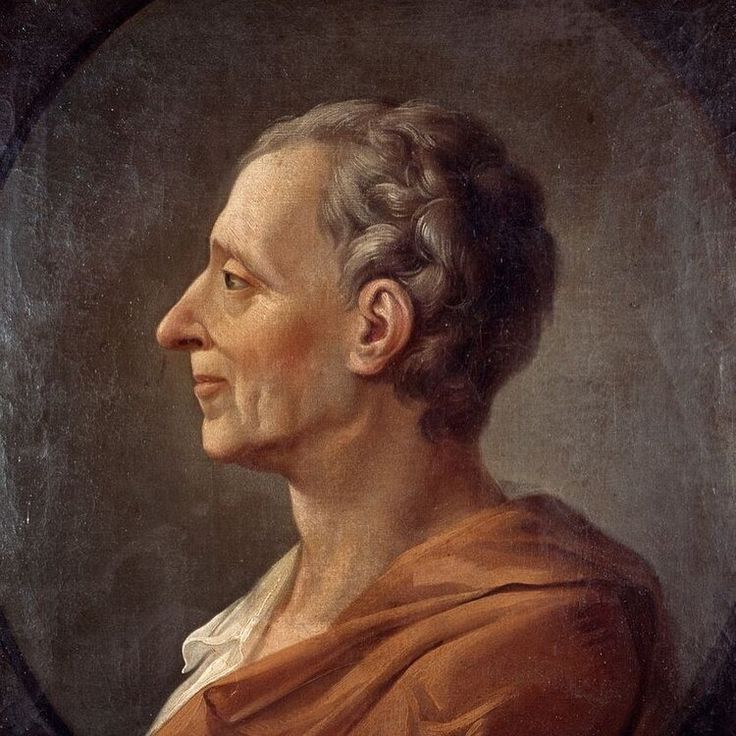
Charles-Louis de Secondat, Baron de La Brède et de Montesquieu, was born in 1689 at the Château de La Brède near Bordeaux, France, into a noble family. His social position gave him direct experience of the institutions and traditions of the French ancien régime, while his education introduced him to classical literature, history, law, and philosophy.
Montesquieu studied law and later inherited an important judicial office in the Parlement of Bordeaux. This experience gave him practical knowledge of legal institutions and political administration. It also helped shape his conviction that laws cannot be understood as isolated commands, but must be examined in relation to institutions, customs, historical circumstances, and social life.
He lived during the reign of Louis XIV and the period that followed it, when debates about monarchy, religious authority, commerce, and political liberty were becoming increasingly important. European intellectual life was beginning to question inherited forms of authority and to seek broader explanations of human societies through reason, observation, history, and comparison.
Montesquieu's later travels also broadened his perspective. His extended stay in England was especially important because it exposed him to English political institutions and constitutional debates. Rather than constructing his philosophy entirely from abstract principles, he increasingly sought to understand how different political arrangements operated in actual historical societies.
Montesquieu and the Enlightenment
Montesquieu was one of the major thinkers of the European Enlightenment, an intellectual movement associated with critical inquiry, reason, scientific curiosity, and criticism of arbitrary authority. His contribution to the Enlightenment was especially important in political philosophy, where he investigated how institutions could protect people from the abuse of power.
Unlike philosophers whose work concentrated primarily on metaphysics or the theory of knowledge, Montesquieu focused heavily on laws, political institutions, and social structures. He asked why governments differ from one another and why the same laws may not be equally suitable for every society. Political thought, in his view, required careful attention to historical and social circumstances.
His Enlightenment philosophy therefore combined normative questions about liberty and good government with a comparative investigation of existing societies. Montesquieu did not believe that political thinkers should simply design one ideal constitution and impose it conceptually upon every nation without considering differences in history, customs, economy, geography, and political tradition.
This approach made him distinctive among Enlightenment thinkers. Montesquieu sought to explain political diversity while remaining firmly opposed to arbitrary and despotic government. His work helped establish the idea that liberty depends not merely upon the good intentions of rulers, but upon institutions capable of limiting and organizing political power.
Montesquieu's Philosophical Method
Montesquieu's philosophical method was strongly comparative. Rather than studying one political system in isolation, he compared different societies, historical periods, laws, customs, religions, economies, and forms of government. Through comparison, he attempted to discover the relationships that help explain why institutions develop and function differently under different conditions.
His approach was also deeply historical. Montesquieu believed that political institutions emerge within particular circumstances and cannot always be understood independently of the societies that created them. Laws are shaped by traditions, historical events, patterns of social organization, economic activity, and relationships between different groups within a political community.
In The Spirit of the Laws, Montesquieu extended this method by examining the many factors to which laws may be related. These included the nature and principle of government, the size and situation of a country, economic life, customs, religion, and what he believed to be the effects of climate and geography.
His method was not identical to modern social science, and some of his empirical assumptions are now rejected. Nevertheless, his effort to explain political institutions through systematic comparison made him an important predecessor of comparative political science, political sociology, and the historical study of law.
What Was Montesquieu's Political Philosophy?
Montesquieu's political philosophy centers on the relationship between law, liberty, institutions, and political power. He was deeply concerned with the danger that authority could become oppressive when it was concentrated without effective restraint. Political freedom therefore required more than virtuous rulers; it required a constitutional structure capable of limiting power.
Montesquieu did not define political liberty as the unlimited freedom to do whatever one wishes. Liberty existed when citizens possessed security under a system of laws and were not constantly exposed to arbitrary political interference. His conception of freedom was thus closely connected to constitutional restraint and the rule of law.
A central principle of his political thought was that power should restrain power. When major governmental powers become concentrated in the same hands, the possibility of abuse increases. Political institutions should therefore be arranged so that authority is distributed and no single person or body can easily exercise unchecked control.
Montesquieu's philosophy also emphasized the importance of political moderation. He did not reduce good government to one universal institutional formula. Instead, he investigated the conditions under which different forms of government could remain stable while avoiding the continual danger of arbitrary and despotic power.
Montesquieu and The Spirit of the Laws
The Spirit of the Laws, published in 1748, is Montesquieu's most important work of political philosophy. Its French title, De l'esprit des lois, reflects his attempt to investigate the underlying relationships and principles that explain laws rather than merely describing individual legal rules.
The work examines forms of government, political liberty, law, commerce, religion, customs, geography, climate, and historical circumstances. Montesquieu attempted to show that laws exist within wider systems of social relationships and that institutions must be understood in relation to the particular conditions of the societies in which they operate.
One of the book's most influential arguments concerns the distribution of political power. Montesquieu analyzed legislative, executive, and judicial functions and argued that liberty is endangered when these powers are concentrated without effective institutional restraint.
The Spirit of the Laws was controversial as well as enormously influential. It provoked criticism and was later placed on the Roman Catholic Church's Index of Forbidden Books. Yet its analysis of constitutional government became central to later debates about limited government, political liberty, and the institutional design of modern states.
The book's lasting importance lies partly in its ambition to combine philosophy with comparative analysis. Montesquieu attempted not only to say what political institutions ought to achieve, but also to explain why institutions take different forms and what conditions contribute to their preservation or corruption.
What Was Montesquieu's Theory of Separation of Powers?
Montesquieu's theory of separation of powers is his most famous contribution to political philosophy. He argued that political liberty is endangered when the major powers of government are concentrated in the same person or governing body. Authority should therefore be distributed in ways that make arbitrary rule more difficult.
Montesquieu distinguished three major kinds of governmental power: legislative power, executive power in matters depending on the law of nations, and executive power in matters depending on civil law, the last of which is associated with judicial power. Later constitutional thought commonly expressed this framework as legislative, executive, and judicial branches.
His central concern was not merely administrative efficiency. If one authority can make laws, execute them, and determine legal judgments, citizens may be exposed to a dangerous concentration of political force. The division of governmental powers was therefore intended to create constitutional conditions in which power could encounter resistance from other powers.
Montesquieu's theory should not be understood as requiring every governmental institution to operate in complete isolation. His broader concern was the prevention of excessive concentration and the preservation of political moderation. The relationships among institutions mattered as much as their formal separation.
His analysis became enormously influential in later constitutional thought, especially in discussions surrounding the American Constitution and modern theories of limited government. However, modern constitutional systems developed the doctrine in different ways and should not be treated as exact copies of Montesquieu's own eighteenth-century model.
Montesquieu's Three Branches of Government
Legislative Power
The legislative power concerns the authority to make laws. Montesquieu regarded legislation as a fundamental political power because laws establish the general framework within which a society is governed. Yet legislative authority, like every other political power, could threaten liberty if exercised without constitutional restraint.
Executive Power
The executive power concerns the conduct of public affairs and the implementation of governmental decisions. In Montesquieu's analysis, executive authority was particularly connected with matters such as foreign relations, security, and the practical direction of government. It had to remain distinct from unlimited control over legislation and judgment.
Judicial Power
The judicial power concerns the application of law and the judgment of particular cases. Montesquieu considered this distinction important because citizens should not face a situation in which the same unchecked authority makes laws, enforces them, and determines guilt or innocence according to its own unrestricted will.
The three-part framework became highly influential in later constitutional thinking. Modern states do not always reproduce Montesquieu's model exactly, and the institutional meaning of legislative, executive, and judicial power has evolved considerably. Nevertheless, his analysis helped establish the enduring principle that governmental functions should not be dangerously concentrated.
Montesquieu and Checks and Balances
Montesquieu's political philosophy is closely associated with the principle that power should restrain power. A constitutional system should not assume that every ruler or political institution will consistently act wisely and virtuously. Instead, its structure should recognize the possibility of ambition, conflict, and abuse.
This principle later became closely connected with what modern constitutional theory calls checks and balances. The exact terminology and institutional mechanisms used in modern political systems were not simply copied from Montesquieu. Later constitutional thinkers developed and adapted his ideas to different political circumstances.
The purpose of institutional restraint is not necessarily to make government powerless or permanently ineffective. Montesquieu was concerned with political moderation: government must possess enough authority to maintain law and public order while remaining unable to transform its power easily into arbitrary domination.
His lasting contribution was to shift attention toward institutional design. Liberty could not depend entirely upon declarations of good intentions or the personal virtue of rulers. Political freedom required arrangements in which authority itself encountered legal and institutional limits.
Montesquieu's Philosophy of Liberty
Liberty is one of the central concepts in Montesquieu's political philosophy. He did not define political freedom simply as the absence of every restriction. Instead, liberty required political security and protection from the arbitrary exercise of governmental power.
For Montesquieu, laws could protect freedom when they established predictable limits upon both rulers and citizens. A person living under stable laws may possess greater security than someone whose political fate depends entirely upon the changing personal will of an individual ruler.
Political liberty therefore depended upon constitutional arrangements capable of preventing excessive concentrations of authority. The separation and distribution of governmental powers, together with legal restraints, were important because they made arbitrary domination more difficult.
Montesquieu's conception of liberty was consequently institutional as well as personal. He asked not only whether individuals possessed abstract rights, but also whether the actual structure of government created conditions in which citizens could live with reasonable security under the law.
Montesquieu on Political Freedom and Constitutional Government
Montesquieu believed that political freedom depends heavily upon the structure of government. A constitution should not merely identify rulers and establish procedures. It should organize relationships among political institutions in ways that make the excessive concentration of authority difficult.
Constitutional government, in this sense, is government constrained by established laws, institutions, and political arrangements. Leaders cannot legitimately exercise unlimited authority simply because they possess military force, wealth, popularity, or formal political office.
Montesquieu's political philosophy therefore placed institutional design at the center of the problem of liberty. Political freedom could not depend entirely upon the goodwill of individual rulers, because rulers change and even well-designed political systems may be corrupted when power is left without meaningful restraint.
He was especially interested in political moderation. The best constitutional arrangements were not necessarily those that promised unlimited popular power or unlimited executive authority, but those capable of preventing any political force from becoming sufficiently dominant to threaten the security of everyone else.
Montesquieu's Classification of Governments
Montesquieu classified governments into three broad forms: republics, monarchies, and despotisms. His classification did not depend only upon the number of people who ruled. He also examined the principles, institutions, and passions that sustained each form of political order.
A republic is a government in which the people as a whole, or a portion of the people, possess sovereign power. Montesquieu distinguished democratic republics from aristocratic republics according to whether political authority belongs broadly to the people or to a limited part of the population.
A monarchy is government by a single ruler who governs according to established and fixed laws. Montesquieu therefore did not simply treat monarchy as identical with arbitrary rule. Monarchical government could contain laws, traditions, and intermediate institutions that structured and restrained authority.
Despotism, by contrast, is characterized by rule according to the will of a single ruler without the stable legal and institutional restraints that distinguish lawful government. Montesquieu regarded despotism as a continual danger because it subjects political life to arbitrary and insecure power.
Each form of government also possessed what Montesquieu called a principle: a dominant political passion or motive that helps sustain it. Political systems could become corrupted when the principles necessary to their preservation were weakened or destroyed.
Montesquieu on Democracy and Republican Government
Montesquieu regarded republican government as one of the major forms of political organization. In a democratic republic, the people possess sovereign authority, while in an aristocratic republic political power is exercised by only a portion of the population. Both forms therefore belong to the broader category of republican government.
He believed that democratic republics depended upon a particular political principle that he called virtue. By this he did not primarily mean exceptional personal morality. He associated political virtue with a love of the laws, the political community, and the equality necessary to sustain republican government.
Montesquieu's analysis of democracy was therefore more complicated than a simple endorsement of majority rule. A political system could formally give authority to the people and still become unstable or corrupt if the social and political conditions required to sustain the system gradually disappeared.
His discussion also reflected the historical circumstances of the eighteenth century and his concern with relatively small republics. Modern representative democracies differ greatly from the political communities he analyzed, but his questions about civic commitment, institutional stability, equality, and political corruption remain important to democratic theory.
Montesquieu on Monarchy and Despotism
Montesquieu sharply distinguished monarchy from despotism. In a monarchy, a single ruler governs according to established and fixed laws. In despotism, political authority is exercised according to the unrestricted will of the ruler, without comparable legal and institutional limitations.
The principle associated with monarchy was honor. Montesquieu believed that monarchical society operated through distinctions of rank, ambition, and social expectations that encouraged individuals to pursue status while still acting within an established political order.
The principle associated with despotism was fear. Where stable laws and independent institutions are absent, obedience may depend increasingly upon the ruler's capacity to create insecurity and fear. Despotism therefore represented for Montesquieu one of the clearest forms of political corruption and domination.
This distinction demonstrates why Montesquieu's philosophy cannot be reduced to a simple preference for one governmental label. His deeper concern was how political power is organized, what principles sustain different institutions, and whether authority is exercised within stable limits capable of protecting people from arbitrary rule.
Montesquieu and The Persian Letters
The Persian Letters, published anonymously in 1721, was the work that first made Montesquieu famous. Written as an epistolary novel, it presents fictional Persian travellers who observe European society and describe its customs, institutions, religious practices, and political behavior from an unfamiliar perspective.
The device of the foreign observer allowed Montesquieu to make European society appear strange to itself. Customs that seemed natural to Europeans could be questioned when viewed through the eyes of outsiders. The work uses satire and irony to examine vanity, religious intolerance, political authority, social conventions, and intellectual pretension.
The book also contains an important criticism of despotism. Its narrative moves between observations of European society and the increasingly oppressive world of Usbek's household in Persia. This contrast raises difficult questions about domination, freedom, self-knowledge, and the contradictions between enlightened political ideals and the exercise of personal power.
The Persian Letters was therefore far more than a literary satire. It introduced themes that remained central to Montesquieu's later philosophy: the comparison of societies, the diversity of customs, the danger of despotism, and the difficulty of understanding one's own society from within its assumptions.
The Principles of Government: Virtue, Honor, and Fear
Montesquieu distinguished between the nature of a government and its principle. The nature of a government concerns its basic institutional structure and the way political authority is organized. Its principle concerns the dominant passion or motive that helps set the government in motion and sustain its operation.
The principle of republican government was virtue, especially political virtue. Montesquieu associated this with a love of the laws and of one's country. In a democratic republic, this also involved a commitment to the political equality required for citizens to sustain their common institutions.
The principle of monarchy was honor. Montesquieu believed that monarchical societies could channel ambition and the desire for distinction through systems of rank and established rules. Individuals might pursue personal status while remaining connected to a larger political structure.
The principle of despotism was fear. Because despotic government lacks the stable restraints and independent institutions that characterize more moderate political systems, obedience can depend upon insecurity and the continual threat of punishment.
Montesquieu used these principles to explain political stability and corruption. Governments are not preserved simply by their formal constitutions. They also depend upon the social and psychological conditions that make their institutions function. When those conditions collapse, the political system itself may gradually become corrupted.
Montesquieu and Intermediate Bodies
Montesquieu believed that political liberty could be strengthened when power was not concentrated entirely between an isolated ruler and an undifferentiated population. He therefore paid considerable attention to what are often called intermediate bodies: institutions and social groups situated between the central government and individual citizens.
In his discussion of monarchy, established institutions, legal bodies, and social orders could help prevent authority from becoming entirely arbitrary. These bodies did not necessarily represent democratic equality in the modern sense, and Montesquieu's views were shaped by the hierarchical society of his own time.
Their political importance lay in the dispersal of authority. When every form of social and political power is absorbed by one central authority, resistance to arbitrary government becomes more difficult. Independent institutions can therefore contribute to political moderation by creating additional centers of authority.
This aspect of Montesquieu's thought influenced later discussions of constitutionalism and civil society. Although modern democracies do not reproduce the social hierarchy of eighteenth-century France, the broader question of whether independent institutions can limit excessive state power remains central to political theory.
Montesquieu on Commerce and Society
Commerce occupies an important place in Montesquieu's political thought. He believed that economic activity could influence the character of societies and alter relationships between peoples. Commercial exchange connected communities that might otherwise remain politically and culturally isolated from one another.
Montesquieu is often associated with the idea that commerce can encourage more peaceful and moderate relations. The pursuit of trade creates interests in stability and exchange, making conflict potentially costly for those whose prosperity depends upon continued cooperation.
He did not, however, present commerce as a simple solution to every political problem. Economic life existed within wider systems of law, custom, and political institutions. Commerce could influence society, but its effects depended upon the circumstances in which commercial relationships developed.
His attention to commerce was significant because it connected political philosophy with changing forms of economic life. Montesquieu recognized that governments could not be understood solely through constitutions and rulers; social habits, wealth, occupation, and economic relationships also shaped political institutions.
Montesquieu on Religion and Toleration
Montesquieu examined religion primarily in relation to its social and political effects. In The Spirit of the Laws, he often asked how religious beliefs and institutions interact with laws, customs, forms of government, and civil society rather than attempting to construct his political philosophy directly from theological doctrine.
He was strongly critical of religious persecution and coercion. Montesquieu regarded attempts to force belief as politically and morally dangerous. His earlier writings, particularly The Persian Letters, used satire to challenge religious intolerance and the abuse of religious authority.
At the same time, some of his comparative judgments about particular religions reflected the assumptions and limitations of eighteenth- century European scholarship. His classifications should therefore be read historically and critically rather than treated as timeless sociological conclusions.
Montesquieu's enduring importance in this area lies in his defense of moderation and toleration. He contributed to the Enlightenment argument that political authority should not simply assume unlimited power over conscience and that religious diversity must be considered within the wider problem of maintaining civil peace.
Montesquieu's Theory of Climate and Geography
Montesquieu argued that climate and geography could influence human temperament, customs, and political institutions. In The Spirit of the Laws, he attempted to explain how physical conditions might form part of the wider circumstances to which laws should be adapted.
His climate theory was not intended as a completely simple claim that geography mechanically determines every political outcome. Montesquieu also emphasized the importance of laws, customs, religion, commerce, and political institutions. Nevertheless, he assigned climate a much greater explanatory role than modern political and social science generally accepts.
Many of his specific claims about the physical and psychological effects of climate are scientifically unsupported and reflect the limited empirical knowledge and cultural assumptions of the eighteenth century. For this reason, his theory must be studied critically rather than accepted as a valid scientific explanation of human differences.
Its philosophical significance lies partly in Montesquieu's broader attempt to understand political life contextually. Laws, in his view, should not always be treated as abstract rules floating above social reality. Political institutions operate within particular material, historical, and cultural environments.
Montesquieu's Influence and Philosophical Legacy
Montesquieu became one of the most influential political philosophers of the modern era. His analysis of the separation and distribution of governmental power profoundly influenced later constitutional thought and contributed to debates surrounding the design of modern political institutions.
His ideas were especially important to constitutional thinkers in the eighteenth century, including those involved in debates about the political structure of the United States. Later political systems adapted his principles in different ways, developing doctrines of separated powers, judicial independence, and institutional checks.
Montesquieu also influenced the development of comparative political analysis. His attempt to understand laws in relation to history, customs, economic life, geography, and political institutions encouraged later thinkers to examine political systems as complex social arrangements rather than merely as abstract constitutional diagrams.
Some parts of his thought, particularly aspects of his climate theory and his judgments about different societies, have been strongly criticized and rejected. His legacy must therefore be understood critically rather than treated as a collection of unquestionable doctrines.
Yet his central insight remains profoundly influential: political liberty cannot safely depend upon the permanent virtue of those who govern. A free political order requires institutions in which power is limited, distributed, and confronted by other powers. This principle remains one of the foundations of modern constitutional philosophy.
Montesquieu and Natural Law
Montesquieu's discussion of law begins with a broad conception of laws as necessary relations arising from the nature of things. In this sense, the universe is governed by different kinds of laws: physical laws governing the material world and laws connected with the nature and condition of human beings. His starting point therefore gave political and civil laws a place within a wider philosophical account of order.
Montesquieu distinguished these broader relationships from the particular positive laws created by human political communities. Human beings, unlike physical objects, are capable of error and are influenced by passion, ignorance, and changing social circumstances. For this reason, the laws created by different nations display considerable diversity.
His approach differed from theories that attempted to derive an entire political system directly from a small number of abstract principles of natural law. Montesquieu believed that political and civil laws must be understood in relation to the people for whom they are made, the nature of their government, their customs, religion, commerce, history, and other social conditions.
This does not mean that Montesquieu regarded every existing law as equally just or beyond criticism. His comparative philosophy allowed him to criticize arbitrary punishment, persecution, slavery, and oppressive forms of government while also insisting that successful political reform must take account of the circumstances of the society in which laws operate.
Montesquieu's philosophy of law therefore combines general questions about human reason, justice, and political order with an empirical investigation of particular societies. This combination is one of the reasons he is regarded as an important predecessor to modern comparative political science and the historical study of legal institutions.
Montesquieu on War, Peace, and International Relations
Montesquieu examined political communities not only as independent states but also as members of a wider international order. He distinguished laws governing relations among nations from political laws governing rulers and citizens within a state and civil laws governing relationships among individuals.
In his discussion of the law of nations, Montesquieu argued that states should seek to do one another as much good as possible in times of peace and as little injury as possible in war without sacrificing their genuine interests. His approach attempted to place international conflict within principles capable of limiting unnecessary destruction.
Montesquieu also examined the problem of political size and security. Small states may be vulnerable to external conquest, while excessively large states may face dangers created by their own internal administration and concentration of power. His discussion of federations explored one possible way in which smaller political communities might combine their strength without entirely losing their separate political existence.
He criticized conquest when it became an unlimited pursuit of domination and examined the relationship between war, victory, and political preservation. His analysis did not eliminate the possibility of defensive force, but it questioned the assumption that territorial expansion and military power were the highest purposes of political life.
Montesquieu's reflections on war and peace were closely connected with his views on commerce. Exchange between societies could create forms of mutual interest that differed from relationships based entirely on conquest. For this reason, his political philosophy contributed to later Enlightenment discussions about international order, trade, and the possibility of more peaceful relations among states.
Major Works of Montesquieu
Montesquieu wrote across political philosophy, history, literature, legal theory, and social analysis. His major works demonstrate the development of a distinctive comparative method that combined philosophical reasoning with historical observation and the study of political institutions.
Although The Spirit of the Laws remains his most influential work, Montesquieu's earlier writings are essential for understanding the development of his political thought. His satire, historical analysis, and later philosophical defense of his arguments reveal the breadth of his intellectual interests.
- Persian Letters (1721) — A satirical epistolary work that uses fictional Persian travellers to examine French and European society, religion, political authority, social customs, and cultural assumptions from the perspective of outsiders.
- Considerations on the Causes of the Greatness of the Romans and Their Decline (1734) — A historical and political analysis of the forces that contributed to the expansion of Roman power and the conditions that contributed to its transformation and decline.
- The Spirit of the Laws (1748) — Montesquieu's major work on laws, forms of government, political liberty, the distribution of governmental powers, commerce, religion, customs, climate, geography, and the historical circumstances shaping political institutions.
- Defence of The Spirit of the Laws (1750) — Montesquieu's response to criticisms of his major political and philosophical work, written to clarify and defend aspects of the arguments developed in The Spirit of the Laws.
Montesquieu's Main Philosophical and Political Ideas
1. Separation of Powers
Montesquieu argued that legislative, executive, and judicial powers should not become concentrated within the same authority. Dividing governmental functions helps protect political liberty and reduces the possibility of arbitrary rule.
2. Political Liberty
Political liberty requires security from arbitrary power. For Montesquieu, stable laws and constitutional institutions can provide citizens with greater freedom than government based solely on the personal will of rulers.
3. Rule of Law
Government should operate through established laws rather than unrestricted personal authority. Law provides a framework within which political power can be exercised and limited.
4. Comparative Political Analysis
Montesquieu compared different governments and societies in order to understand how political institutions develop. He emphasized that laws must be considered in relation to history, customs, geography, religion, and economic conditions.
5. Opposition to Despotism
Montesquieu regarded arbitrary concentrated power as one of the greatest threats to political freedom. His institutional theory was designed in large part to make such domination more difficult.
Montesquieu's Influence on the American Constitution
Montesquieu became highly influential in eighteenth-century discussions of constitutional government, particularly among American political thinkers. His analysis of separation of powers provided an important intellectual resource for those concerned with preventing excessive concentration of governmental authority.
The United States Constitution established separate legislative, executive, and judicial branches, although the American system developed its own institutional arrangements rather than simply copying Montesquieu's model. The resulting system also incorporated mechanisms through which the branches could limit one another.
Montesquieu's influence can therefore be seen in the broader constitutional principle that political power should be divided and constrained. His ideas became part of the intellectual background against which American constitutional government was designed.
His influence on American political thought helped make the separation of powers one of the most recognizable concepts in modern constitutional theory. The relationship between Montesquieu and the American Constitution remains an important topic in the history of political philosophy.
Montesquieu's Influence on Modern Democracy and Political Philosophy
Montesquieu's political thought continues to influence modern constitutional democracies because the problem he examined remains fundamental: how can governments possess enough authority to function while preventing that authority from becoming arbitrary?
His theory of separated governmental powers influenced constitutional discussions across Europe, North America, and other parts of the modern political world. The specific institutions vary between countries, but the principle of limiting concentrated political power remains widely important.
Montesquieu also contributed to the development of comparative political analysis. His attempt to explain political institutions through relationships among law, history, society, economy, religion, and geography anticipated later approaches in political science and sociology.
His legacy therefore extends beyond the separation of powers. Montesquieu helped establish a broader tradition of studying government as an institutional and social phenomenon rather than simply as an expression of political authority.
Montesquieu's Legacy and Criticisms
Montesquieu's influence on political philosophy has been enormous, particularly in discussions of constitutional government, liberty, institutional checks, and the separation of powers. His work became a central reference point for later thinkers concerned with limiting arbitrary political authority.
At the same time, modern scholars have criticized or questioned some aspects of his thought. His climate theory, for example, reflects assumptions of eighteenth-century European intellectual culture that do not correspond to contemporary scientific understandings of human societies.
His descriptions of different civilizations and political systems also contain historical limitations and assumptions that require careful interpretation. Montesquieu should therefore be read within the context of his period rather than treated as a completely contemporary political theorist.
Nevertheless, his central insight concerning the institutional limitation of political power remains one of the most influential contributions to modern political philosophy. His work continues to shape discussions of constitutionalism, liberty, law, and government.
Frequently Asked Questions About Montesquieu
Who was Montesquieu?
Montesquieu was an eighteenth-century French philosopher, political thinker, jurist, and major figure of the Enlightenment. He is best known for his analysis of government, political liberty, law, and separation of powers.
What was Montesquieu famous for?
Montesquieu is most famous for his theory of the separation of powers. He argued that legislative, executive, and judicial powers should not become concentrated within the same authority because concentrated political power can threaten liberty.
What was Montesquieu's philosophy?
Montesquieu's philosophy focused primarily on political institutions, law, liberty, government, and the conditions that prevent arbitrary rule. His political thought emphasized constitutional limits and the relationship between different forms of government and social circumstances.
What is Montesquieu's separation of powers?
Montesquieu's separation of powers is the principle that governmental authority should be divided among legislative, executive, and judicial functions. The purpose is to prevent excessive concentration of political power and protect political liberty.
What are the three branches of government according to Montesquieu?
Montesquieu identified legislative, executive, and judicial powers as distinct governmental functions. Modern constitutional systems often describe these as the legislative, executive, and judicial branches, although their precise institutional arrangements differ.
Did Montesquieu invent separation of powers?
Montesquieu did not create the idea of dividing governmental authority from nothing, since earlier political thinkers had discussed forms of mixed or divided government. His major contribution was developing a systematic analysis of separated governmental functions and connecting institutional division directly with political liberty.
What did Montesquieu mean by political liberty?
Montesquieu understood political liberty primarily as security from arbitrary government. Liberty requires laws and institutions that prevent rulers from exercising unrestricted personal authority over citizens.
What is The Spirit of the Laws by Montesquieu?
The Spirit of the Laws, published in 1748, is Montesquieu's major work on law, government, political liberty, separation of powers, society, commerce, religion, climate, and history. It is one of the foundational texts of modern political philosophy.
How did Montesquieu influence democracy?
Montesquieu influenced modern democratic and constitutional thought by emphasizing divided governmental authority, institutional restraints, political liberty, and the rule of law. His ideas became particularly influential in constitutional debates in the eighteenth century.
How did Montesquieu influence the American Constitution?
Montesquieu's writings provided an important intellectual influence on American constitutional thought, especially concerning the separation of governmental powers. The United States Constitution established separate legislative, executive, and judicial branches with mechanisms that allow each part of government to constrain others.
What did Montesquieu believe about government?
Montesquieu believed that different forms of government operate according to different principles and social conditions. He was particularly concerned with preventing arbitrary power and argued that constitutional institutions could help preserve political liberty.
What did Montesquieu think about despotism?
Montesquieu regarded despotism as a form of government in which political authority is concentrated and exercised according to the ruler's will rather than meaningful institutional restraints. He considered arbitrary power a major threat to political freedom.
What was Montesquieu's theory of climate?
Montesquieu argued that climate and geographical conditions could influence human behavior, customs, laws, and political institutions. His climate theory reflects eighteenth-century thought and should be interpreted historically rather than as a modern scientific theory.
Was Montesquieu an Enlightenment philosopher?
Yes. Montesquieu was one of the major philosophers of the European Enlightenment. His emphasis on reason, political liberty, historical comparison, institutional limits, and criticism of arbitrary authority made him an important Enlightenment thinker.
What were Montesquieu's major works?
Montesquieu's major works include Persian Letters, Considerations on the Causes of the Greatness of the Romans and Their Decline, and The Spirit of the Laws. The latter is his most influential work in political philosophy.
Why is Montesquieu important in political philosophy?
Montesquieu is important because he developed a powerful theory of constitutional government in which political liberty depends partly upon the institutional distribution and limitation of power. His analysis remains influential in modern political and constitutional thought.
Related Enlightenment Philosophers
Explore other major thinkers who shaped modern philosophy, Enlightenment political thought, theories of knowledge, liberty, government, and constitutionalism.
Related Areas of Philosophy
Montesquieu's philosophy connects political philosophy with ethics, law, history, liberty, government, social philosophy, Enlightenment thought, and the study of political institutions.
Why Montesquieu Still Matters
Montesquieu remains one of the most important figures in the history of political philosophy because he transformed the question of political liberty into a question of institutional design. Instead of relying entirely upon the character of rulers, he asked how political systems could be structured so that power itself would be limited.
His theory of separation of powers became a foundational idea in modern constitutional thought. By distinguishing legislative, executive, and judicial functions and emphasizing institutional restraints, Montesquieu provided one of the most influential philosophical arguments against concentrated political authority.
His broader philosophy was equally significant. Through The Spirit of the Laws, Montesquieu examined the relationship among law, history, society, commerce, religion, geography, and forms of government. His comparative approach helped establish a lasting tradition of studying political institutions within their social and historical contexts.
Understanding Montesquieu therefore helps explain the intellectual development of modern constitutionalism, political liberty, and democratic government. His central question remains relevant today: how can political power be made effective enough to govern while being limited enough to protect freedom?
Explore Great Philosophers