Who Was Diogenes of Sinope?
Diogenes of Sinope was an ancient Greek philosopher associated with Cynicism, a philosophical movement that emphasized virtue, self-sufficiency, simplicity, and living in accordance with nature rather than submitting uncritically to unnecessary social conventions, wealth, status, and public opinion. He became one of the most famous and unconventional figures in the entire history of ancient philosophy.
Diogenes became famous in antiquity for making his philosophy a way of life rather than merely a subject for theoretical discussion. He is traditionally portrayed as rejecting wealth, luxury, political status, and many ordinary expectations about respectability and success. His deliberately simple lifestyle was intended to demonstrate that human happiness and freedom depend less on external possessions than people commonly believe.
A central theme of Diogenes' philosophy was autarkeia, or self-sufficiency. He sought to reduce unnecessary desires and become as independent as possible from possessions, social approval, and the institutions that governed ordinary life. For Diogenes, a philosopher should not merely speak about virtue but should demonstrate philosophical convictions through personal conduct and everyday actions.
Diogenes is also remembered for his sharp wit, provocative behavior, and famous encounters with powerful people, especially the traditional stories involving Alexander the Great. Although many details about his life come from later ancient sources and some anecdotes may have been embellished, his reputation became one of the most distinctive in ancient Greek philosophy and made him a lasting symbol of radical independence and criticism of social convention.
Diogenes of Sinope: Quick Facts
- Name — Diogenes of Sinope
- Also known as — Diogenes the Cynic
- Era — Fourth century BCE
- Associated tradition — Cynicism
- Birthplace — Sinope, a Greek city on the Black Sea
- Approximate dates — c. 404–323 BCE
- Known for — Cynic philosophy, simplicity, self-sufficiency, virtue, freedom, and criticism of social conventions
- Famous association — Alexander the Great
- Philosophical ideal — Living according to nature and developing independence from unnecessary desires
- Surviving writings — No secure body of writings by Diogenes survives
Diogenes of Sinope and the World of Ancient Greece
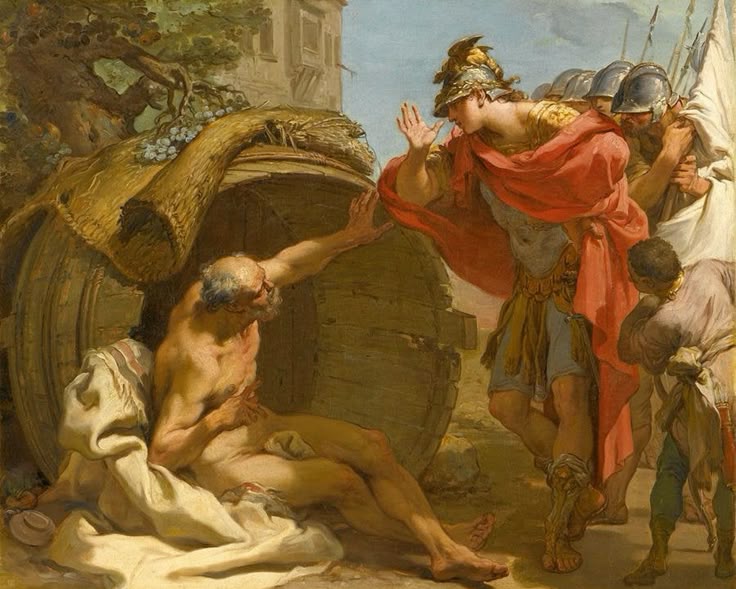
Diogenes lived during the fourth century BCE, a period of major political and intellectual change in the Greek world. He belonged to the generation after Socrates and lived during an era in which Greek philosophy developed increasingly diverse approaches to ethics, politics, knowledge, human nature, and the question of what it means to live a genuinely good life.
This was also the period in which Socratic philosophy continued to develop through different teachers and philosophical traditions. Thinkers associated with Plato, Aristotle, the Cynics, and other movements offered sharply different answers to questions about virtue, happiness, knowledge, and the relationship between the individual and the political community.
Cynicism developed from the wider Socratic tradition and became especially associated with a radical criticism of conventional ideas about wealth, reputation, political power, luxury, and social status. The Cynics argued that many things valued by society were neither necessary for virtue nor reliable sources of genuine happiness.
Diogenes became the movement's most famous representative. Unlike philosophers whose influence is primarily known through surviving books and systematic treatises, Diogenes is remembered largely through reports about his actions, sayings, conversations, and deliberately unconventional way of life. This makes the historical reconstruction of his philosophy more difficult, but it also reflects his central conviction that philosophy should be demonstrated through life itself.
Why Is Diogenes of Sinope Important?
Diogenes is important because he pushed the Socratic concern with virtue and the good life toward an unusually radical conclusion. He challenged the widespread assumption that wealth, comfort, social reputation, political influence, and material success are necessary conditions for happiness or for living a worthwhile human life.
His philosophy emphasized the idea that a person should become independent of unnecessary desires and learn to live with fewer material and social dependencies. The more a person's happiness depends entirely upon possessions, public approval, or changing circumstances, the more vulnerable that person becomes to forces outside their control.
Diogenes therefore transformed philosophical ethics into a demanding practical discipline. His deliberately simple way of life was intended to test whether people genuinely needed the things they spent so much of their lives pursuing. By rejecting many ordinary conventions, he exposed what he regarded as the difference between genuine human needs and artificial desires created by society.
Diogenes also demonstrated an important feature of Cynic philosophy: philosophy should be expressed through the way a person lives. His life itself became a philosophical argument against excessive attachment to conventional values. For this reason, his influence extends beyond particular doctrines and includes a lasting challenge to the relationship between philosophical ideas and everyday conduct.
What Did Diogenes Believe?
Diogenes is traditionally associated with the Cynic belief that virtue is more important than wealth, status, pleasure, or social approval. External goods may be useful or enjoyable, but they do not by themselves make a person wise, morally good, or genuinely free.
He rejected many conventional assumptions about what makes a person successful or happy. Instead of accumulating possessions and seeking social recognition, the Cynic ideal encouraged a simpler life based on self-sufficiency, discipline, and freedom from unnecessary desires. The goal was not simply poverty for its own sake, but greater independence from things that could easily be lost or controlled by others.
Diogenes also emphasized living according to nature rather than being controlled by social convention. This did not mean simply living like an animal. It meant questioning artificial desires and customs and learning to distinguish what is genuinely necessary for human life from what society merely teaches people to value because of habit, fashion, ambition, or fear of public opinion.
His philosophy therefore connected ethics with practical discipline. A person could become freer by training themselves to need less and by becoming less dependent upon wealth, comfort, praise, and social approval. For Diogenes, philosophical freedom required not only correct ideas but also the strength of character needed to live according to those ideas.
What Is Cynicism? Diogenes and Cynic Philosophy
Cynicism was an ancient Greek philosophical movement associated with a Socratic approach to ethics. Its central concern was how a person should live in order to become virtuous, independent, and genuinely free rather than simply successful according to the standards established by wealth, political power, or public reputation.
The Cynics challenged conventional assumptions about wealth, honor, political status, luxury, and social reputation. They argued that dependence on such things could make people less free rather than happier, because external goods are uncertain and often place human well-being under the control of circumstances beyond the individual's power.
Diogenes became the most famous Cynic because he turned these principles into an extremely unconventional lifestyle. Ancient accounts portray him deliberately minimizing possessions, rejecting luxury, and ignoring many ordinary social expectations. His behavior often appeared provocative because he used public actions and sharp remarks to challenge values that other people accepted without questioning.
The philosophical point was not simply to behave strangely. The unconventional behavior was connected to a deeper ethical argument: if a desire is unnecessary, becoming dependent on it can weaken one's freedom. Cynic philosophy therefore encouraged people to examine their desires critically and to ask whether the things they pursue genuinely improve their lives or merely make them dependent on social expectations.
Diogenes and the Cynic Idea of Living According to Nature
One of the central ideas associated with Diogenes is the contrast between nature and convention. Cynic philosophers questioned whether customs accepted by society were necessarily good simply because they were traditional, popular, or supported by powerful institutions. A widespread social practice could still be unnecessary or harmful.
Diogenes is therefore associated with a life that deliberately simplified ordinary human needs. Food, shelter, clothing, and other genuine necessities were treated differently from luxuries and desires that people might pursue primarily because of social expectations. This distinction allowed the Cynics to criticize forms of ambition based entirely on wealth, prestige, appearance, or public recognition.
Living according to nature was closely connected with the pursuit of autarkeia, or self-sufficiency. The less a person depends upon external possessions and social approval for their sense of well-being, the less power those things have over their happiness. Self-sufficiency did not necessarily mean complete isolation from other people, but rather freedom from unnecessary dependence.
This is one of the reasons Diogenes remains important in the history of ethical philosophy: he treated freedom not primarily as political power or the possession of external goods, but as freedom from unnecessary dependence and uncontrolled desire. His philosophy asks whether a person can become more independent not by acquiring more, but by learning which things they can genuinely live without.
Why Did Diogenes Live Such a Simple Life?
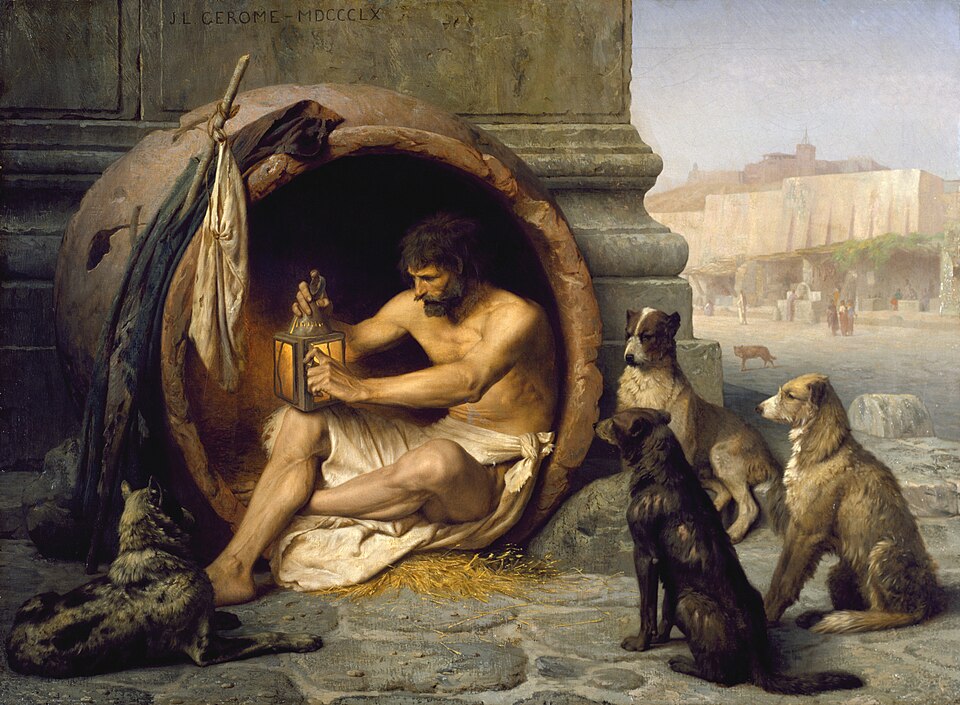
Diogenes' simple lifestyle was closely connected with his ethical philosophy. Cynic thinkers argued that many human desires are created or intensified by social conventions rather than by genuine necessity. Wealth, luxurious food, elaborate clothing, public status, and other commonly admired goods could therefore make people dependent on things that were neither essential to survival nor necessary for virtue. Diogenes attempted to expose this dependence by living with strikingly few possessions and treating simplicity as a form of philosophical discipline.
By reducing his dependence on possessions and comfort, Diogenes attempted to demonstrate that a person could live well with far less than conventional society considered necessary. The Cynic ideal was not simply poverty for its own sake, but self-sufficiency and freedom from unnecessary wants. Ancient accounts repeatedly connect Diogenes with the belief that human life had been made more difficult by the pursuit of luxuries and artificial refinements. The less a person required from fortune, wealth, or the approval of others, the more independent that person could become.
Ancient sources famously describe Diogenes as living in a large ceramic container, often translated as a "barrel." The original Greek term is generally understood as referring to a large storage jar or pithos, rather than the wooden barrel suggested by the popular image. The image nevertheless expresses an important aspect of the Cynic tradition: Diogenes was remembered as being willing to use whatever simple shelter was available rather than treating an expensive or permanent home as necessary for a good life.
His simplicity was also connected with the Cynic contrast between nature and convention. Diogenes and the later Cynic tradition questioned whether customs were justified merely because they were socially accepted. If nature required little while society continually taught people to desire more, then voluntary simplicity could serve as a way of recovering independence from convention. His lifestyle was therefore intended not merely as an eccentric personal choice, but as a visible challenge to prevailing assumptions about comfort, success, and human need.
The famous image should nevertheless be understood cautiously because much of Diogenes' biography comes from later literary reports rather than contemporary records. Stories about him were transmitted and reshaped as philosophical anecdotes, often designed to preserve a memorable saying or illustrate a Cynic ideal. For this reason, modern readers should distinguish between the broad historical importance of Diogenes' ascetic and unconventional way of life and the difficulty of verifying every dramatic detail preserved about him.
Diogenes on Virtue, Freedom, and Happiness
For Diogenes, the good life was closely connected with virtue. External possessions such as wealth, reputation, and political power were not reliable foundations for happiness because they depended on circumstances outside a person's complete control. A person who required constant prosperity, praise, protection, or luxury in order to feel secure remained vulnerable to loss and to the changing judgments of other people. Cynic philosophy therefore redirected attention from external advantages toward the cultivation of character.
The Cynic approach instead emphasized developing the character needed to remain independent of unnecessary external goods. This independence did not necessarily mean withdrawing from every relationship or social activity; rather, it meant refusing to treat wealth, fame, birth, or power as the measure of a person's worth. Ancient accounts of Cynicism repeatedly present virtue as the central good and regard many things ordinarily pursued by society as secondary or indifferent when compared with the condition of one's character.
Diogenes is also associated with the idea that philosophical training is necessary. A person cannot simply declare themselves independent; they must develop the discipline to resist desires and social pressures that make them dependent. The Greek Cynic tradition used the idea of askēsis, or training and exercise, to express this practical cultivation of endurance and self-control. Diogenes' severe way of life was thus presented as a kind of continuous exercise in reducing unnecessary dependence and strengthening the capacity to act according to reasoned conviction.
Freedom, in this context, was more than political liberty. A person could possess legal freedom and still be enslaved by greed, ambition, fear, vanity, or the desire for public approval. Diogenes' provocative independence was meant to demonstrate that genuine freedom required a degree of mastery over one's own desires. This ideal helps explain why Cynic writers and later admirers often associated needing little with a distinctive kind of strength: the person who can do without many external advantages is harder for fortune or powerful individuals to control.
In this sense, Cynic philosophy was practical ethics. Philosophy was supposed to transform the individual rather than remain only an intellectual exercise. Diogenes used argument, example, humor, and deliberately shocking behavior to force people to confront the gap between what they claimed to value and the way they actually lived. His importance therefore lies not in constructing a systematic philosophical theory comparable to those of Plato or Aristotle, but in making the conduct of everyday life itself a central arena of philosophical criticism and moral practice.
Why Did Diogenes Carry a Lantern in Daylight?

One of the most famous stories about Diogenes says that he walked through Athens carrying a lantern in broad daylight while claiming to be looking for a person. The apparent absurdity of using a light when the sun was already shining gave the action its philosophical force. In the ancient anecdotal tradition, Diogenes was not searching merely for any human being; the story is generally understood as a search for a genuine human being in the moral sense—a person whose character had not been corrupted by vice, convention, or false values.
The story is preserved in later ancient testimony and is usually interpreted as a philosophical criticism of human behavior. Diogenes was supposedly suggesting that genuinely virtuous people were difficult to find even though the city was full of people. Physical presence alone did not make someone fully admirable according to the Cynic conception of human life. A truly good person required moral understanding, self-control, courage, and independence from the false standards by which society commonly judged success.
The lantern also works as a memorable image of philosophical examination. Ordinary daylight allows people to see physical objects, but it does not automatically reveal the quality of a person's character. Diogenes' supposed search therefore turns a simple object into a criticism of moral blindness: people may see the world around them clearly while failing to recognize vanity, dishonesty, greed, or the absence of virtue in themselves and others.
The story illustrates his broader method of using provocative actions to challenge conventional ideas about virtue, honesty, and social respectability. Rather than delivering a formal lecture on the rarity of moral excellence, Diogenes was remembered as staging a public demonstration that condensed the criticism into a single striking image. This combination of philosophy, performance, irony, and confrontation became one of the most recognizable features associated with the Cynic tradition.
Because the account comes from later sources, it should be treated as an ancient anecdote about Diogenes rather than as a securely documented event recorded by Diogenes himself. Much of what is known about his life survives through collections of sayings and stories whose historical reliability varies. The anecdote remains philosophically important, however, because it accurately reflects the image of Diogenes preserved by the tradition: a thinker who used shocking public gestures to question whether people were truly living in accordance with virtue.
Diogenes and Alexander the Great: What Really Happened?
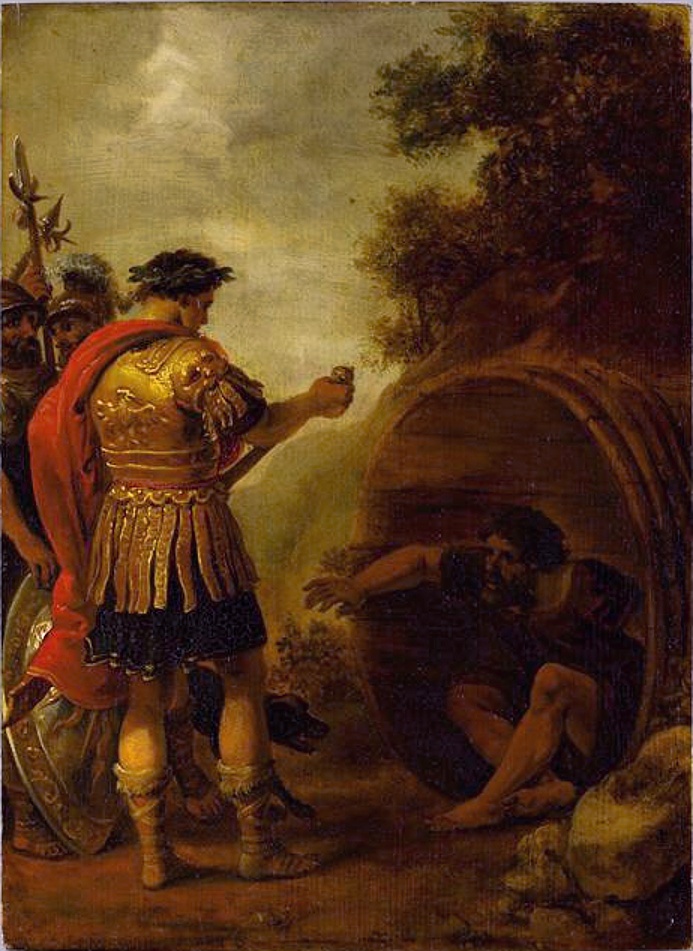
The most famous story about Diogenes concerns his reported encounter with Alexander the Great. It has become one of the defining images of ancient philosophy because it brings together two radically different forms of human power: the military and political power associated with Alexander and the moral independence represented by the Cynic philosopher. The dramatic force of the story depends precisely on this contrast between a ruler capable of granting immense favors and a philosopher who claims to need almost nothing from him.
According to the ancient tradition, Alexander approached Diogenes and offered to grant him a request. Diogenes supposedly asked Alexander simply to move out of the sunlight. Versions of the story differ in their details and wording, but the central point remains the same: Alexander's extraordinary power could provide Diogenes with no essential good that he believed he lacked. The only thing the ruler was asked to do was stop obstructing something freely available to everyone—the warmth of the sun.
The story became famous because it presents a striking contrast between political power and philosophical independence. Alexander was one of the most powerful rulers of the ancient world, while Diogenes supposedly demonstrated that he did not need wealth, political favors, or royal protection. From a Cynic perspective, the person who desires little may possess a kind of freedom unavailable to someone whose life depends upon conquest, status, possessions, or the constant expansion of power. Diogenes' response therefore expresses the ideal of self-sufficiency in its most dramatic form.
The anecdote also reverses ordinary assumptions about who should be impressed by whom. Social convention would normally require an obscure and impoverished individual to show deference to a king; Diogenes instead treats Alexander as simply another person whose presence may be useful or inconvenient. This reversal illustrates the Cynic refusal to equate external rank with moral superiority. Philosophical worth, in this tradition, depended upon virtue and freedom of character rather than upon military achievement or royal authority.
The encounter is preserved in ancient sources, but the exact historical circumstances cannot be independently established. The surviving evidence for many episodes in Diogenes' life is anecdotal, and scholars therefore approach such stories with caution. It is best understood as an important ancient anecdote that expresses the Cynic ideal rather than as an event whose every detail can be verified. Its enduring significance lies in the philosophical contrast it presents: a person who commands an empire may still encounter someone who believes that the most important goods cannot be granted by a king.
What Did Diogenes Teach Through His Encounter with Alexander?
The story of Diogenes and Alexander became philosophically important because it dramatizes the Cynic attitude toward external power. Alexander represented extraordinary military and political authority, while Diogenes was remembered as deliberately living without the possessions, status, and protection that powerful people could offer. The anecdote therefore places two radically different ideas of human success in direct confrontation.
Alexander could offer Diogenes possessions or favors, but the Cynic philosopher supposedly regarded these things as unnecessary. The encounter therefore illustrates the idea that a person who needs very little is difficult for powerful people to control through material rewards. In Cynic thought, reducing unnecessary desires could produce a form of independence that wealth itself could not guarantee, because the person was no longer easily influenced by promises of luxury or fear of losing possessions.
The anecdote also challenges the ordinary assumption that political power automatically deserves philosophical admiration. Alexander may have commanded armies and territories, but the story asks whether external power makes a person morally superior or genuinely happy. Diogenes' apparent indifference suggests that virtue and independence belong to a different scale of value from conquest, reputation, or royal authority.
The anecdote also expresses Diogenes' rejection of conventional hierarchy. He is portrayed as speaking to a king without treating the king's social position as a reason for submission or admiration. This reversal was characteristic of the Cynic challenge to social status: a person's birth, office, wealth, or public importance did not determine the quality of their character.
At the same time, the philosophical meaning of the story should be distinguished from its uncertain historical details. The encounter survives through ancient anecdotal traditions, and its exact form cannot be independently verified. Its lasting importance lies less in proving every detail of the meeting than in the ideal it expresses: the claim that genuine freedom may consist in needing so little from the powerful that their power cannot easily purchase one's allegiance.
Diogenes and the Idea of Being a Citizen of the World
Diogenes is traditionally associated with one of the earliest explicit expressions of cosmopolitanism in Western philosophy. The Greek term kosmopolitēs literally connects the kosmos, or world, with the idea of a politēs, or citizen. In the political culture of the ancient Greek city-state, citizenship normally connected a person's identity and obligations to a particular polis, making Diogenes' reported answer a striking challenge to conventional civic identity.
When asked where he came from, he is reported to have described himself as a citizen of the world, or kosmopolitēs. The statement is especially significant because Diogenes was traditionally associated with Sinope but lived much of his philosophical life outside his native city. Rather than defining himself primarily through membership in a particular political community, the anecdote presents him as refusing the assumption that one's deepest identity must be limited by local citizenship.
The statement is significant because it refuses to define a person's identity entirely through membership in a particular city. Instead, Diogenes is portrayed as identifying himself with the wider human and cosmic community. However, this early Cynic cosmopolitanism should not automatically be understood as a fully developed political theory of world government or universal institutions. The surviving evidence does not provide a systematic political programme comparable to later philosophical theories of cosmopolitanism.
In the Cynic context, the idea was closely connected with the contrast between nature and convention. Political boundaries, inherited status, and local customs could be treated as conventional arrangements rather than the ultimate measure of human worth. The Cynic who attempted to live according to nature could therefore claim a standpoint extending beyond the particular customs and loyalties of a single city.
Later Stoic philosophers developed more systematic forms of cosmopolitan thought. Diogenes' Cynic position is therefore important in the history of the idea, although his surviving evidence does not provide a complete political theory of world citizenship. His reported declaration remains historically influential because it introduced, in a particularly memorable form, the possibility of understanding human identity on a scale wider than the boundaries of one's own city, people, or political community.
What Is Self-Sufficiency in Diogenes' Philosophy?
Self-sufficiency, often discussed using the Greek concept autarkeia, is central to the Cynic way of life. The ideal concerns the capacity to live without excessive dependence on external possessions, comforts, reputation, or favorable fortune. For the Cynics, a person whose happiness required continual access to wealth and luxury remained vulnerable because circumstances outside that person's character could always be lost.
Self-sufficiency does not mean that a person literally needs no other human being. In the Cynic context, it concerns reducing dependence on unnecessary external goods and developing the ability to live well without constantly seeking wealth, luxury, or social approval. Human beings naturally require food, shelter, and social interaction, but Cynic self-sufficiency questioned the much larger collection of desires that convention often teaches people to regard as necessities.
Diogenes' extreme lifestyle was intended to demonstrate this principle practically. By learning to live with fewer possessions and comforts, a person could become less vulnerable to changes in fortune. Voluntary hardship could function as philosophical training, preparing the individual to endure cold, hunger, poverty, or public disapproval without allowing these circumstances to destroy their independence of judgment.
This ideal was closely related to the Cynic practice of askēsis, or disciplined training. Self-sufficiency was not assumed to arise automatically simply because someone owned little. A person had to cultivate endurance and self-control, learning to distinguish genuine needs from desires created by habit, vanity, and social competition. Diogenes' way of life was therefore presented as an ethical exercise rather than merely an economic condition.
The philosophical goal was therefore freedom through disciplined simplicity rather than wealth through accumulation. The less a person required from possessions and public approval, the less easily that person could be controlled by fortune or manipulated by others. Although Diogenes carried this principle to an unusually radical extreme, the underlying Cynic question remains clear: how many of the things people believe they need are actually necessary for living virtuously and well?
Famous Sayings and Anecdotes Associated with Diogenes
Diogenes is one of the most frequently quoted philosophers of antiquity. However, many sayings associated with him survive through later ancient authors rather than through writings by Diogenes himself. His philosophical reputation was transmitted largely through short anecdotes, sharp replies, and stories in which an apparently simple action was used to challenge wealth, convention, political power, or assumptions about virtue.
This form of transmission creates an important difficulty for modern readers. A saying may preserve a genuine Cynic idea without allowing us to establish with certainty the exact words spoken by the historical Diogenes. Ancient biographical traditions often shaped memorable stories around the character of a philosopher, and different versions of the same anecdote could circulate over time. These accounts should therefore be read both as evidence for the tradition surrounding Diogenes and with appropriate historical caution.
“I am a citizen of the world.”
This saying is associated with Diogenes' rejection of a narrowly defined civic identity and is important in the history of philosophical cosmopolitanism. The Greek term kosmopolitēs presents him as a citizen of the kosmos rather than merely a member of one particular polis. Its importance lies not in providing a complete political programme, but in challenging the idea that human identity and moral concern must end at the boundaries of a particular city or community.
Diogenes and the Lantern
The famous lantern story portrays Diogenes searching for a genuinely virtuous person in broad daylight. The apparently unnecessary lantern turns the search into a philosophical image: although people are physically visible everywhere, genuine honesty and virtue may be much harder to find. As with many anecdotes about Diogenes, the story is preserved through later testimony and is best treated as an important expression of his philosophical reputation rather than as a securely documented event.
Diogenes and Alexander
The story of Alexander being asked to move out of Diogenes' sunlight expresses the Cynic rejection of dependence on wealth and political power. The contrast between the great conqueror and the philosopher dramatizes the ideal of self-sufficiency: Alexander can offer immense external advantages, yet Diogenes supposedly requires nothing from him except the removal of an immediate inconvenience. The anecdote became a lasting symbol of philosophical independence from worldly authority.
These stories are philosophically valuable, but they should not all be presented as verbatim quotations from Diogenes. Ancient biography frequently preserved philosophical ideas through memorable anecdotes. Their historical reliability varies, but together they reveal the image of Diogenes that became central to the Cynic tradition: a thinker who used direct speech, humor, provocation, and personal example to make philosophy visible in the ordinary situations of life.
Did Diogenes of Sinope Write Any Books?
No complete philosophical writings securely attributable to Diogenes of Sinope survive. Unlike Plato or Aristotle, we cannot study his philosophy through an extant body of works whose authorship is firmly established. This absence has made the reconstruction of his thought particularly difficult, since modern understanding depends heavily on later reports, sayings, and anecdotes preserved by other writers.
Ancient traditions nevertheless associate Diogenes with written works, and the question of whether he composed philosophical texts remains disputed. If he did write, those works have not survived in a form that allows modern scholars to reconstruct a secure corpus. It is therefore more accurate to say that no writings by Diogenes survive with secure attribution than to claim with complete certainty that he never wrote anything at all.
Our knowledge of Diogenes comes largely from later ancient authors, especially biographical and philosophical traditions that preserved stories about Cynic philosophers. Diogenes Laertius is one of the most important surviving sources, although he wrote many centuries after Diogenes lived. Other ancient authors also preserve references and anecdotes, but none provides the equivalent of a complete, contemporary record of Diogenes' philosophical teaching.
This creates an important historical limitation. Some statements attributed to Diogenes may reflect genuine Cynic teachings, while others may have been shaped by later writers who wanted to illustrate his distinctive character. The anecdotal form of the evidence is not therefore useless, but it requires interpretation: historians must distinguish, as far as possible, between traditions that are early or well-supported and stories whose primary function may be literary or philosophical.
For this reason, the safest way to study Diogenes is to distinguish between ancient testimony and claims that can be established directly from surviving writings. His historical importance is beyond doubt, but the precise boundaries of his own thought are harder to determine than those of philosophers whose works survive. This uncertainty is itself central to the study of Diogenes: the philosopher known for making his life a philosophical demonstration is remembered primarily through the stories that later generations told about that life.
How Was Diogenes Influenced by Socrates?
Diogenes belongs to a philosophical tradition strongly influenced by Socrates. Socrates had emphasized the importance of examining one's life and had challenged conventional assumptions about wealth, reputation, and virtue. In the Socratic tradition, the condition of the soul or character mattered more fundamentally than external success, creating an intellectual background from which later ethical movements, including Cynicism, developed.
The connection is especially visible in the importance both traditions place upon virtue. Socrates questioned whether wealth and public recognition could make a person good, while the Cynics developed a radical suspicion toward external goods that appeared to distract from moral independence. Both traditions therefore challenged the common tendency to measure a successful life primarily through possessions, political influence, or the opinions of others.
The Cynics pushed some of these themes in a more radical direction. Instead of merely questioning conventional values through dialogue, Diogenes is portrayed as making his entire lifestyle a demonstration of philosophical independence. His voluntary simplicity and deliberate violation of accepted expectations transformed philosophy into a public practice in which the philosopher's conduct itself became an argument against the values of ordinary society.
There were nevertheless important differences in style and method. Socratic philosophy, as represented especially in Plato's dialogues, often proceeds through sustained questioning and argument. The Diogenes of the Cynic tradition is remembered for sharp replies, public gestures, satire, and deliberate provocation. These methods could serve a similar purpose of exposing unexamined assumptions, but Diogenes expressed the challenge through a far more visibly ascetic and confrontational way of life.
The relationship between Socrates and Cynicism is therefore important for understanding Diogenes. The Cynic movement can be viewed as one branch of the wider post-Socratic philosophical world, although it developed its own distinctive practices and ideals. Diogenes inherited and radicalized the ethical demand that philosophy should concern how one lives, making independence from convention and disciplined simplicity central features of his philosophical identity.
Was Antisthenes the Teacher of Diogenes?
Ancient tradition connects Diogenes with Antisthenes, a philosopher associated with the Socratic tradition and commonly regarded as an important predecessor of Cynicism. Antisthenes was associated with an emphasis on virtue, endurance, and independence from conventional ideas of wealth and status. These themes later became strongly identified with the Cynic tradition represented above all by Diogenes.
Later sources portray Diogenes as becoming associated with Antisthenes' philosophical tradition and carrying its emphasis on virtue and independence to an extreme. One famous ancient story describes Diogenes persistently seeking instruction from Antisthenes despite being initially rejected. The anecdote is memorable and became part of the traditional narrative of Cynicism, but its historical reliability cannot be assumed simply because it appears in a later biographical source.
The exact historical relationship between the two men is difficult to reconstruct because the evidence comes from later sources. Questions about chronology and the nature of the surviving testimony have led scholars to treat the direct teacher-and-student relationship with caution. It is possible to identify important intellectual connections between the Socratic tradition associated with Antisthenes and the Cynicism represented by Diogenes without claiming certainty about every personal encounter described in ancient anecdotes.
Antisthenes is therefore significant less as a securely documented biographical teacher in every detail than as an important figure in the intellectual background from which Cynicism emerged. The emphasis on virtue rather than external possessions and the willingness to challenge conventional standards formed part of the wider Socratic inheritance that the Cynics developed in their own distinctive way.
It is safest to describe Antisthenes as a major figure in the tradition that led to Cynicism and to acknowledge that ancient sources strongly associate him with Diogenes. This approach preserves the traditional connection without presenting a disputed biographical relationship as an unquestionable historical fact. Diogenes' philosophical importance ultimately rests on the distinctive form that Cynic ethics took in his life and reputation, whether or not every story of his education can be historically confirmed.
Diogenes' Main Philosophical Ideas
Although Diogenes left no secure body of surviving philosophical writings, several ideas are strongly associated with the Cynic tradition represented by him. These ideas should not always be treated as parts of a single systematic doctrine written down by Diogenes himself. Instead, they emerge from ancient testimony about his sayings, actions, lifestyle, and the wider Cynic tradition that developed around his example.
Taken together, these themes present philosophy as a practical way of transforming one's desires and character. Diogenes repeatedly became associated with independence from wealth, criticism of convention, disciplined simplicity, and the demand that virtue should be expressed in action. The following ideas therefore provide a useful summary of the philosophical outlook traditionally connected with him while retaining appropriate caution about the limits of the surviving evidence.
Virtue Above Wealth
Diogenes is associated with the view that virtue is more valuable than wealth, possessions, reputation, or social status. External advantages could disappear through changes in fortune, whereas the cultivation of character offered a more stable foundation for living well. Cynic philosophy therefore challenged the assumption that material success and moral excellence naturally go together.
Living According to Nature
Cynic philosophy emphasized living according to nature rather than allowing artificial social conventions to determine one's desires. Diogenes' challenge was to ask whether a supposed necessity was truly required by human life or had merely become desirable through custom, fashion, habit, and social competition. This contrast between nature and convention became central to the Cynic critique of ordinary values.
Self-Sufficiency
Diogenes' lifestyle demonstrated the Cynic ideal of reducing dependence on external goods and becoming capable of living with fewer necessities. This ideal of autarkeia did not mean literally needing no one, but developing freedom from excessive dependence on wealth, luxury, and public approval. The ability to need less was understood as a source of resilience and independence.
Freedom from Social Convention
Diogenes deliberately challenged conventional expectations in order to expose assumptions about respectability, wealth, status, and proper behavior. His provocative conduct forced observers to ask whether their moral reactions were based on genuine ethical principles or simply on habits accepted by society. This critical attitude toward convention became one of the most distinctive features of Cynicism.
Philosophy as a Way of Life
For the Cynics, philosophy was not merely theoretical knowledge. A philosophical commitment had to be expressed through one's actions and habits. Diogenes became the most famous example of this approach because his lifestyle itself was presented as a continuous experiment in simplicity, endurance, independence, and resistance to values he considered artificial or corrupting.
Cosmopolitanism
Diogenes is associated with the claim that he was a citizen of the world, an important early expression of a philosophical identity extending beyond the boundaries of a particular city. Later philosophers, especially the Stoics, developed cosmopolitanism more systematically, but Diogenes' reported declaration remains historically significant for challenging the assumption that political membership in one local community defines the limits of human identity.
Diogenes' Philosophy of Life Explained
Diogenes' philosophy can be understood as a radical attempt to answer one of philosophy's oldest ethical questions: What does a person actually need in order to live well? Rather than beginning with abstract theories about the universe, Diogenes became associated above all with a practical examination of human needs, desires, and habits. His life was intended to test whether the things most commonly pursued by society were genuinely necessary for happiness or merely objects of convention and habit.
His answer was very different from the assumptions of ordinary society. He believed that people often make themselves unhappy by becoming dependent on things they do not genuinely need. A desire can initially appear to promise satisfaction but gradually become a source of anxiety when a person fears losing the object desired or continually seeks more of it. Cynic philosophy therefore questioned not only whether people possessed enough, but whether their desires themselves had been shaped by reasonable and natural needs.
Wealth, luxury, reputation, political influence, and social approval can become sources of dependence. The Cynic response was to train the individual to need less. This did not simply mean possessing little by accident; voluntary simplicity was connected with discipline and the cultivation of endurance. By reducing unnecessary wants, the individual could become less vulnerable to changes in fortune and less dependent on the approval or assistance of powerful people.
Diogenes also challenged the distinction between what human beings genuinely require and what society teaches them to regard as necessary. Customs surrounding status, comfort, appearance, and respectability could acquire enormous power even when they contributed little to moral character. The Cynic contrast between nature and convention encouraged people to examine such assumptions rather than accepting them simply because they were widely shared.
In this sense, Diogenes' philosophy was simultaneously ethical, psychological, and practical. It asked people to change their desires rather than simply trying to acquire everything they desire. Philosophy was therefore not merely a collection of arguments to be discussed in a school; it was a discipline directed toward transforming one's habits, fears, and attachments. The central Cynic challenge was whether a person could become freer by learning to desire wisely rather than by endlessly increasing the number of things they possessed.
Why Is Diogenes Famous for His Unusual Lifestyle?
Diogenes became famous because he practiced Cynic principles in an unusually visible and provocative way. Ancient philosophical traditions remembered him not simply for a set of doctrines but for making his own conduct part of his philosophical teaching. His simplicity, sharp speech, and willingness to disregard social expectations made him one of the most recognizable figures of ancient philosophy.
Ancient accounts portray him as minimizing possessions, rejecting luxury, criticizing social conventions, and behaving in ways that challenged conventional ideas about dignity and respectability. Many stories emphasize his willingness to endure conditions that others would consider humiliating or uncomfortable. Whether every anecdote can be accepted as historically exact is another question, but together they consistently preserve the image of a philosopher determined not to let ordinary standards of comfort and status govern his life.
His lifestyle was therefore part of his philosophical method. Instead of merely telling people that wealth and status were not necessary for happiness, he attempted to demonstrate the claim through his own life. A Cynic argument could be expressed through action as well as speech: if Diogenes could live with very little while remaining independent, then his existence itself challenged the assumption that comfort and possessions were essential conditions of a good life.
His deliberately provocative behavior also served a critical purpose. By violating expectations that most people followed automatically, Diogenes forced observers to consider why those expectations existed. A feeling of embarrassment or outrage could reveal the extraordinary power that custom exercised over human behavior. His provocations were therefore often presented as philosophical tests of the difference between genuine moral principles and conventions followed merely because they were familiar.
This approach explains why Diogenes became such a memorable figure. His philosophy was difficult to separate from the dramatic example he created through his behavior. Unlike philosophers remembered primarily through surviving treatises, Diogenes became known through a tradition of sayings and anecdotes in which his actions themselves carried philosophical meaning. The uncertainty surrounding some individual stories does not remove their importance for understanding how the ancient world remembered the Cynic ideal he came to represent.
Diogenes' Influence on Cynicism and Stoicism
Diogenes became the central figure associated with the Cynic tradition. His emphasis on virtue, independence, simplicity, and freedom from unnecessary external desires influenced later philosophical discussions about the good life. Although Cynicism did not develop around Diogenes in the form of a tightly organized philosophical system, his example became fundamental to the identity of the movement and shaped the way later generations understood the Cynic philosopher.
Cynicism also had an important relationship with the development of Stoicism. The Stoic philosopher Zeno of Citium is traditionally associated with studying under the Cynic Crates, who continued the Cynic tradition after Diogenes. Ancient accounts and later philosophical histories therefore place Cynicism within the intellectual background of early Stoicism, even though Stoicism drew upon several philosophical traditions rather than developing from Cynicism alone.
Stoicism developed a much more systematic philosophical framework than Cynicism, including theories of logic, physics, and ethics. Even so, the two traditions share important ethical themes, especially the rejection of excessive dependence on external goods and the importance of virtue. Both traditions also valued philosophical training and associated a good life with a degree of independence from circumstances that cannot be completely controlled by the individual.
The differences between the schools are equally important. Cynicism remained closely associated with radical simplicity, public provocation, and a direct challenge to social convention, whereas Stoicism developed a comprehensive account of nature, reason, knowledge, and ethical duty. Stoic philosophers did not simply reproduce the lifestyle of Diogenes; they incorporated some Cynic ethical themes into a broader and more systematic philosophical framework.
Diogenes therefore occupies an important position in the history of ancient ethical philosophy, particularly in the development of ideas about virtue, independence, and the good life. His influence is visible most directly in the Cynic tradition and indirectly in the intellectual background from which Stoicism emerged. The connection between the two schools demonstrates how a radical philosophical experiment in the way one lives could contribute to later traditions with far more elaborate theoretical systems.
What Can We Learn from Diogenes' Philosophy?
Diogenes raises a philosophical challenge that remains relevant: How much of what we want is actually necessary for a good life? The question does not require everyone to imitate the extreme lifestyle traditionally associated with Diogenes. Its deeper purpose is to examine the relationship between desire and freedom and to ask whether acquiring more always produces greater independence, satisfaction, or happiness.
His philosophy questions the assumption that happiness automatically increases with wealth, possessions, social recognition, or political influence. These things may be useful or desirable, but Diogenes' example challenges the idea that they can provide a secure foundation for a good life. If happiness depends entirely on circumstances that fortune can remove, then the individual remains vulnerable regardless of how much has been accumulated.
It also raises questions about conformity. If a society considers something valuable, does that automatically make it valuable? Diogenes believed philosophical examination should be willing to challenge even widely accepted conventions. His method encourages a distinction between accepting a value because it has been carefully examined and accepting it simply because it is traditional, fashionable, or socially rewarded.
Another important lesson concerns the discipline of desire. Modern readers need not accept every Cynic practice to recognize the underlying philosophical question: can a person become more content by changing their relationship to desire rather than endlessly pursuing its objects? Diogenes placed extraordinary emphasis on reducing unnecessary wants because he believed that freedom required some capacity to live without constant satisfaction, luxury, or public approval.
His approach remains provocative because it turns philosophy into a test of one's actual way of life rather than simply a subject of intellectual discussion. Diogenes forces the uncomfortable question of whether our stated values are visible in our habits and choices. This remains his lasting philosophical significance: he challenged people not merely to define virtue or discuss the good life, but to consider whether the way they actually live reflects what they claim to believe.
What Do We Actually Know About Diogenes of Sinope?
Diogenes is a particularly important example of the difficulties involved in studying ancient philosophers whose writings do not survive. Much of what later generations knew about him was preserved through sayings, anecdotes, philosophical biographies, and reports written after his lifetime. These sources are historically valuable, but they differ in reliability and often combine biographical memory with literary storytelling and philosophical interpretation.
For this reason, the historical Diogenes must be distinguished, as far as possible, from the legendary figure who developed through centuries of ancient tradition. Some broad features of his philosophical identity are strongly supported by the evidence, while the precise circumstances surrounding many famous stories remain difficult to establish. Modern scholarship therefore treats Diogenes as both a historically influential philosopher and a figure whose surviving biography requires continual critical interpretation.
Relatively Well-Attested
- Diogenes was associated with Sinope.
- He became the most famous representative of ancient Cynicism.
- Ancient philosophical traditions associate him with simplicity, self-sufficiency, virtue, and living according to nature.
- He became famous for challenging social conventions.
- Later philosophical traditions preserved many sayings and anecdotes associated with him.
These points represent the broad philosophical image of Diogenes that appears consistently across the surviving ancient tradition. Even when individual anecdotes cannot be independently verified, the association of Diogenes with radical Cynic ethics, criticism of convention, and ascetic self-sufficiency is central to the way ancient and later writers understood his significance. The difficulty lies less in identifying these major themes than in determining exactly how each particular saying or action should be attributed to the historical man.
Traditionally Attributed
- His association with living in a large ceramic jar or pithos.
- The famous encounter with Alexander the Great.
- The story of carrying a lantern while searching for a person.
- Various witty replies and provocative actions.
These traditions are among the most famous parts of Diogenes' legacy and have enormous philosophical and cultural importance. They should not simply be dismissed because they are anecdotal, since ancient philosophical traditions often preserved ideas through memorable stories. At the same time, their literary force means that they cannot automatically be treated as modern-style documentary records of events whose details have been independently confirmed.
Uncertain or Difficult to Verify
- The precise historical circumstances of many famous anecdotes.
- The exact wording of sayings attributed to Diogenes.
- The complete details of his philosophical teaching.
- The exact historical relationship between Diogenes and Antisthenes.
- Whether every anecdote preserved by later writers accurately represents an event from Diogenes' life.
Historical caution does not mean that nothing can be known about Diogenes. Instead, it requires different levels of confidence. A broad association with Cynic philosophy may be considerably more secure than the exact wording of a famous reply, while a story may accurately express a Cynic ideal even if its precise historical setting remains uncertain. This distinction allows Diogenes to be studied seriously without turning every ancient anecdote into unquestionable fact.
How Do We Know About Diogenes?
Our knowledge of Diogenes comes mainly from later ancient sources rather than from surviving works written by Diogenes himself. The evidence is scattered across biographical collections, philosophical discussions, rhetorical works, and traditions concerning Cynicism. This means that understanding Diogenes requires comparing sources and considering when they were written, what purposes they served, and how far they stood from the events they describe.
Diogenes Laertius
Diogenes Laertius is especially important for the later ancient tradition about Diogenes and other Greek philosophers. His Lives of Eminent Philosophers preserves numerous stories, sayings, and philosophical reports concerning the Cynics. Book VI is particularly important because it contains an extensive collection of material concerning Diogenes, Antisthenes, Crates, and other figures associated with the Cynic tradition.
Diogenes Laertius, however, was not a contemporary witness to the fourth-century BCE philosopher. His work preserves material from earlier sources, some of which are themselves lost, but it also presents traditions whose historical status must be assessed carefully. Scholars therefore use his testimony as indispensable evidence without assuming that every story contained in it has the same degree of reliability.
Other Ancient Philosophical Sources
Diogenes is also discussed indirectly in philosophical traditions that examine Cynicism and its relationship to Socratic ethics and later Hellenistic philosophy. Ancient writers such as Dio Chrysostom and Epictetus contributed to the later image of the Cynic philosopher, while other authors preserved references to Cynic practices, sayings, and ethical ideals. These sources are valuable because they show how Diogenes continued to function as a philosophical model long after his lifetime, although later interpretations could also reshape his image.
The Problem of Ancient Anecdotes
Ancient philosophical biographies frequently used memorable stories to illustrate a philosopher's character or teachings. Such stories are valuable historical evidence, but they should not automatically be treated as verbatim records of events. A short anecdote could preserve a philosophical attitude more effectively than a systematic argument, but its literary form may also have encouraged exaggeration, adaptation, and the repetition of stories whose original circumstances were no longer recoverable.
For this reason, claims about Diogenes should be presented with appropriate historical caution, especially when discussing famous quotations and dramatic encounters. The safest approach is to identify whether a claim concerns a broadly attested Cynic theme, an ancient tradition about Diogenes, or a detail that cannot be independently verified. This does not diminish the philosophical value of the anecdotes; rather, it helps distinguish historical reconstruction from the powerful literary tradition through which Diogenes became famous.
Diogenes and the Cynic School of Philosophy
Diogenes is the philosopher most strongly associated with the mature image of ancient Cynicism. Although the precise origins and early development of the Cynic movement remain matters of scholarly discussion, Diogenes became its most famous representative and the figure through whom later generations most readily imagined the Cynic philosopher. His radical lifestyle gave visible form to ethical ideals that would become central to the tradition.
The Cynics emphasized practical ethics and argued that human beings should cultivate virtue rather than pursue conventional measures of success. Wealth, noble birth, public reputation, and political power could all be valued by society while contributing little to genuine moral character. Cynicism therefore directed philosophical attention toward the formation of the individual and the question of how a person could become free from unnecessary dependence on external circumstances.
- Virtue — The foundation of the good life.
- Self-sufficiency — Reducing dependence on external goods.
- Nature — Living in accordance with what is genuinely necessary rather than artificial convention.
- Freedom — Becoming less controlled by wealth, reputation, and unnecessary desires.
- Philosophical practice — Demonstrating philosophy through one's way of life.
These principles were closely connected rather than isolated doctrines. Self-sufficiency supported freedom, disciplined simplicity reduced dependence on external goods, and the criticism of convention encouraged people to examine whether their desires served virtue or merely reflected social expectations. The Cynic philosopher was therefore expected not only to discuss these ideas but to embody them through personal conduct.
Diogenes' extreme lifestyle made these principles especially visible and helped establish his reputation as the archetypal Cynic philosopher. His importance lies partly in the transformation of philosophy into a public way of life: his actions, appearance, speech, and refusal to conform could all function as challenges to conventional assumptions. Whether later anecdotes preserve every historical detail accurately, they consistently present Diogenes as the exemplary figure through whom the radical ethical character of Cynicism was expressed.
Important Ideas in Diogenes' Cynic Philosophy
Virtue
Virtue is treated as more important than external possessions, reputation, or wealth. In the Cynic tradition, the good life depends fundamentally upon the condition of one's character rather than upon advantages that can be granted or removed by fortune. This emphasis allowed Diogenes to challenge conventional ideas of success and ask whether a wealthy or powerful person was necessarily living better than someone who possessed little but had greater moral independence.
Autarkeia
Autarkeia refers to self-sufficiency and independence from unnecessary external needs. It does not mean that a human being can literally exist without food, shelter, or other people; rather, it concerns reducing excessive dependence on luxury, possessions, and social approval. The Cynic ideal was that a person who needed less could become more resilient and less vulnerable to changes in fortune.
Nature
Cynic philosophy contrasts living according to nature with excessive dependence on social conventions. The distinction encouraged people to ask whether a desire or practice answered a genuine human need or had acquired authority simply through habit and custom. This did not always provide a simple rule for every situation, but it became a powerful critical tool for questioning luxury, artificial status, and socially constructed ideas about what a successful life required.
Convention
Social conventions are customs and expectations that may be accepted by society without necessarily being examined philosophically. Diogenes became famous for deliberately challenging such conventions in order to reveal their power over human behavior. The Cynic criticism was not merely that every convention was false, but that social acceptance alone could not prove that a custom was morally good or necessary for human flourishing.
Freedom
Diogenes' philosophy connects freedom with reducing dependence on external goods and social approval. A person might be politically free while still being controlled by fear, greed, ambition, or the constant need for praise. Cynic freedom therefore involved a form of inner and practical independence developed through disciplined simplicity and the willingness to resist pressures that encouraged conformity.
Cosmopolitanism
Diogenes is traditionally associated with the idea of being a citizen of the world, an early expression of cosmopolitan identity. The reported statement challenges the assumption that a person's deepest identity must be confined to a particular polis or political community. Later Stoic philosophers developed cosmopolitanism into more systematic forms, but Diogenes remains an important early figure in the history of the idea.
Diogenes of Sinope Explained Simply
Diogenes was an ancient Greek philosopher associated with Cynicism. Instead of believing that wealth, status, luxury, and social approval were necessary for happiness, he argued for a simpler and more independent way of life.
He believed that people should develop virtue, reduce unnecessary desires, and live according to nature rather than allowing social conventions to determine everything they value.
- Philosopher: Diogenes of Sinope
- School: Cynicism
- Main concern: How should a person live?
- Central value: Virtue
- Important ideal: Self-sufficiency
- Major criticism: Dependence on wealth, status, and social convention
- Famous association: Alexander the Great
- Historical influence: Cynicism and later Stoic ethical thought
A Famous Saying Associated with Diogenes
“I am a citizen of the world.”
Frequently Asked Questions About Diogenes of Sinope
Who was Diogenes of Sinope?
Diogenes of Sinope was an ancient Greek philosopher associated with Cynicism. He became famous for advocating virtue, simplicity, self-sufficiency, and independence from unnecessary social and material desires.
What is Diogenes famous for?
Diogenes is famous for Cynic philosophy, his unconventional lifestyle, his criticism of social conventions, and famous ancient anecdotes involving figures such as Alexander the Great.
What did Diogenes believe?
Diogenes is associated with the belief that virtue is more important than wealth, status, luxury, and social approval. He emphasized self-sufficiency and living according to nature.
What is Cynicism according to Diogenes?
Cynicism was an ancient philosophical tradition that emphasized virtue, simplicity, self-sufficiency, and freedom from unnecessary dependence on social conventions and external goods.
Why did Diogenes live in a barrel?
Ancient sources describe Diogenes as living in a large ceramic container, often translated popularly as a "barrel." The story is associated with his Cynic commitment to extreme simplicity and independence from conventional material comforts.
Did Diogenes really live in a barrel?
Ancient testimony describes Diogenes living in a large ceramic vessel, but the popular image of a wooden barrel is misleading. The Greek term is generally understood as referring to a large storage jar or pithos.
Did Diogenes really meet Alexander the Great?
Ancient sources preserve a famous story about an encounter between Diogenes and Alexander the Great. The story is important in the philosophical tradition, although the precise historical details cannot be independently verified.
What did Diogenes say to Alexander the Great?
According to the famous ancient anecdote, Alexander offered Diogenes a request, and Diogenes asked him to move out of his sunlight. The story illustrates the Cynic's indifference to wealth and political power.
Why did Diogenes carry a lantern during the day?
An ancient anecdote says that Diogenes carried a lantern during the day while searching for a person. The story is commonly interpreted as a criticism of the difficulty of finding genuine virtue among people.
What does "citizen of the world" mean in Diogenes' philosophy?
Diogenes is traditionally reported to have described himself as a citizen of the world. The statement is important in the history of cosmopolitanism because it places human identity beyond membership in one particular city.
Was Diogenes a Stoic?
No. Diogenes was associated with Cynicism, not Stoicism. However, Cynicism influenced later Stoic philosophy, particularly through Cynic teachers such as Crates of Thebes and the development of ethical ideas about virtue and independence from external goods.
Did Diogenes write any books?
No complete philosophical writings by Diogenes survive. Much of what we know about him comes from later ancient reports, anecdotes, and philosophical traditions.
Who influenced Diogenes?
Diogenes is traditionally connected with the Socratic philosophical tradition and with Antisthenes, an important predecessor of Cynicism. The precise historical details of their relationship are uncertain.
Why is Diogenes important in philosophy?
Diogenes is important because he turned philosophical ideas about virtue, freedom, simplicity, and independence into an extreme way of life. His Cynic philosophy influenced later ethical thought, particularly the development of Stoicism.
Related Ancient Greek Philosophers
Diogenes belongs to the Socratic and Cynic traditions of ancient Greek philosophy. Explore the philosophers who developed different ideas about virtue, knowledge, reality, politics, and the good life.
Philosophical Schools Connected to Diogenes
Diogenes is most closely associated with Cynicism. His philosophical tradition also influenced later Stoic ethics and contributed to the development of ideas concerning virtue, self-sufficiency, freedom, and cosmopolitanism.
Philosophy Branches Connected to Diogenes
Diogenes' philosophy is especially connected with ethics because his central concern was how human beings should live. His criticism of social conventions also raises questions about human values, freedom, society, and the relationship between individual life and social expectations.
Why Diogenes of Sinope Still Matters
Diogenes of Sinope remains one of the most striking figures in the history of ancient philosophy. His importance does not come from a surviving philosophical system or a collection of books. Instead, it comes from the radical way in which he connected philosophical ideas with everyday life.
His central challenge remains simple but difficult: Do we actually need the things society tells us we need in order to live well?
By questioning wealth, reputation, luxury, social convention, and dependence on external goods, Diogenes made the philosophical search for the good life into a practical experiment.
His Cynic philosophy influenced later ethical traditions and helped shape ideas about virtue, independence, simplicity, and cosmopolitan identity. Even when his famous anecdotes cannot be verified in every detail, the philosophical questions associated with him remain an important part of ancient Greek thought.
Explore Great Philosophers
Why Did Diogenes Reject Social Conventions?
Diogenes became famous for deliberately violating or questioning conventional expectations. His actions were intended to expose what Cynics regarded as the artificial character of many social values. The important contrast in Cynic thought was often expressed as that between nature and convention: practices established by custom, law, fashion, or public opinion did not automatically possess moral authority simply because a community had accepted them.
Instead of accepting a custom simply because society approved of it, Diogenes encouraged people to ask whether the custom contributed to genuine virtue and human flourishing. This approach could be applied to attitudes toward wealth, status, reputation, noble birth, bodily shame, and public behavior. The Cynic challenge was not that every social rule must be rejected, but that customs should be examined rather than treated as self-evident truths. A convention that produced vanity, dependence, or moral corruption could not be defended merely by appealing to its respectability.
This is why his philosophy can appear deliberately provocative. His behavior was often designed to make people uncomfortable with ideas they normally accepted without examination. Rather than presenting his criticism only through abstract argument, Diogenes reportedly used dramatic actions and sharp remarks as philosophical demonstrations. Such acts could function as a kind of practical challenge: if an observer felt immediate outrage, Diogenes' behavior forced that person to consider whether the outrage arose from genuine moral principle or simply from the violation of a familiar custom.
His rejection of convention also expressed a broader criticism of social hierarchy. Public admiration could be directed toward powerful, wealthy, or highly born individuals who possessed little moral wisdom, while a person without status might nevertheless possess courage, self-control, and integrity. Diogenes repeatedly became associated with the refusal to measure human worth by external rank. This stance later contributed to the Cynic reputation for fearless speech and uncompromising criticism of those who claimed authority.
His criticism was therefore philosophical as well as social: what society calls respectable is not necessarily what is good. Diogenes' lasting challenge was to ask whether people were living according to considered judgments about virtue or merely performing the roles expected by their society. Even when the dramatic anecdotes about him cannot be verified in every detail, they consistently preserve this central image of the Cynic philosopher as someone who tested accepted values by confronting them directly rather than politely accepting them.