Who Was Jean-Paul Sartre?
Jean-Paul Sartre (1905–1980) was a French philosopher, writer, playwright, novelist, and political intellectual. He is one of the most influential figures associated with existentialism, a philosophical movement concerned with freedom, human existence, responsibility, consciousness, and the problem of creating meaning in a world without predetermined purpose.
Sartre's philosophy begins with a powerful claim about human beings: people are not born with a fixed essence that completely determines what they must become. Instead, human beings exist first and define themselves through their choices, actions, relationships, and commitments. This idea became famous through the expression "existence precedes essence."
His philosophical work examined some of the most difficult questions of modern philosophy. What does it mean to be free? Are we responsible for the people we become? Can we escape social expectations? What is consciousness? Why do human beings deceive themselves? Sartre's answers made him a central figure in twentieth-century philosophy.
Sartre was also deeply involved in literature and politics. His novels and plays explored existential themes through fictional characters, while his later writings engaged with Marxism, colonialism, political struggle, and social responsibility. His philosophy therefore connects metaphysics, phenomenology, ethics, literature, and political thought.
Jean-Paul Sartre: Quick Facts
- Full name — Jean-Paul Charles Aymard Sartre
- Born — June 21, 1905
- Died — April 15, 1980
- Nationality — French
- Philosophical tradition — Existentialism and phenomenology
- Major influences — Edmund Husserl, Martin Heidegger, Søren Kierkegaard, Friedrich Nietzsche, and Karl Marx
- Major subjects — Freedom, consciousness, being, nothingness, ethics, authenticity, politics, and human existence
- Most famous philosophical work — Being and Nothingness
- Famous lecture — Existentialism Is a Humanism
- Famous philosophical phrase — "Existence precedes essence"
- Literary partner and intellectual collaborator — Simone de Beauvoir
Jean-Paul Sartre's Early Life and Education
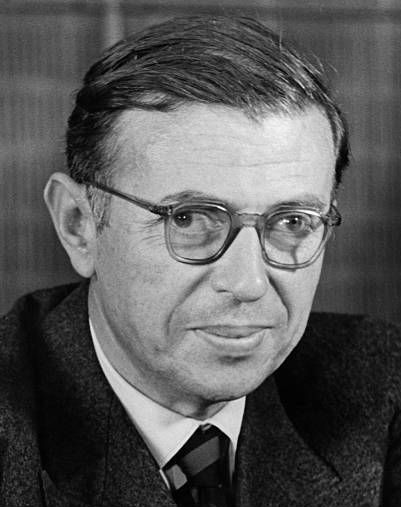
Jean-Paul Sartre was born in Paris in 1905. His father died when Sartre was very young, and he spent much of his childhood in the care of his mother and maternal family. His early education exposed him to literature and intellectual culture, interests that remained central throughout his philosophical and literary career.
Sartre later studied at the prestigious École Normale Supérieure in Paris, where he developed important philosophical relationships and encountered ideas that would shape his intellectual development. It was also during this period that he formed his lifelong intellectual relationship with Simone de Beauvoir.
During the 1930s, Sartre became increasingly interested in phenomenology, particularly the philosophy of Edmund Husserl. Phenomenology emphasized the direct investigation of human experience and consciousness. Sartre adapted this approach while developing his own distinctive philosophical account of freedom, consciousness, and existence.
The political and historical crises of the twentieth century also shaped Sartre's thought. World War II, the German occupation of France, political संघर्ष, colonialism, and debates about communism influenced his understanding of freedom and responsibility. For Sartre, philosophy could not remain completely separated from human action and historical reality.
What Is Existentialism According to Jean-Paul Sartre?
Existentialism is a philosophical approach that places concrete human existence at the center of philosophical investigation. Rather than beginning with an abstract definition of human nature and then asking how individuals fit that definition, Sartre begins with the fact that human beings find themselves already existing in a world and must decide, through action, how they will live and what they will become.
Sartre's existentialism emphasizes human freedom, but this does not mean that people exist outside all conditions or limitations. Every individual is born into a particular historical period and social world and encounters circumstances involving the body, family, language, economic conditions, and the actions already performed in the past. Human freedom is therefore always exercised within a concrete situation rather than in an imaginary condition of unlimited power.
Nevertheless, Sartre argues that these circumstances do not normally provide a complete definition of what a person is. Human beings must take some position toward their situation, form projects, make commitments, and act. In this sense, individuals participate in creating themselves through what they do. Sartre therefore rejects the comforting idea that people can always excuse their actions by claiming that an unchangeable character or predetermined nature forced them to behave in a particular way.
Sartre's philosophy is often associated with anguish because freedom can be difficult rather than comforting. If there is no completely predetermined moral script capable of deciding every important question for us, then individuals must act despite uncertainty. Existentialism therefore confronts human beings with freedom, responsibility, contingency, and the difficult task of giving direction to a life that cannot simply be lived according to a fixed essence.
What Did Sartre Mean by "Existence Precedes Essence"?
The phrase "existence precedes essence" is one of the best-known statements associated with Jean-Paul Sartre's philosophy. It expresses the existentialist idea that human beings do not possess a completely predetermined purpose or finished nature that defines every aspect of their lives before they begin existing and acting in the world.
Sartre explained this idea by contrasting human beings with manufactured objects. A tool such as a knife is ordinarily produced according to a prior concept: its intended function forms part of the plan behind its creation. According to Sartre's atheistic existentialism, human existence cannot be understood in exactly this way. There is no divine designer whose predetermined concept supplies a complete human essence before individual human beings exist.
Human beings first find themselves existing and subsequently define themselves through actions, projects, commitments, and relationships. This does not mean that a person creates an identity through a single isolated decision. A human life develops across time, and what someone becomes is connected with the concrete choices they repeatedly make. For Sartre, identity is therefore something lived and enacted rather than merely a hidden essence waiting to be discovered.
This principle does not mean that Sartre believed people can magically become anything whatsoever. Social class, history, the body, previous actions, and external circumstances create genuine constraints. However, even within such limitations, human beings must take a position toward their situation and project themselves toward possible futures. Sartre's point is not that circumstances do not matter, but that human existence cannot be reduced completely to a fixed definition supplied in advance.
Jean-Paul Sartre's Philosophy of Freedom
Freedom is one of the central concepts in Sartre's philosophy. Sartre argues that human beings are not merely passive objects whose actions can be understood entirely as the mechanical effects of external causes. Consciousness allows people to take positions toward what they encounter, form projects, imagine alternatives, and orient themselves toward possibilities that are not yet actual.
Sartre's account of freedom is demanding because he does not define freedom simply as the ability to obtain whatever one desires. Human beings always exist within conditions they did not entirely choose, including their historical period, physical body, social environment, language, and past actions. Sartre describes these given dimensions of existence as part of human facticity, the concrete reality within which every individual must live.
Yet facticity does not eliminate freedom completely. A person may not choose the circumstances into which they were born, and many external conditions can severely restrict what is practically possible, but they must still relate to and respond to their situation. Sartre therefore understands human existence as a tension between what has already been given and the possibilities toward which consciousness projects itself.
This radical conception of freedom can produce discomfort because certainty is frequently unavailable. People may want an external authority, a fixed nature, or an unquestionable rule to determine exactly what they must become. Sartre argues that human beings often cannot escape the need to choose. Freedom therefore involves responsibility, uncertainty, and the necessity of acting without possessing complete knowledge or control over the future.
Freedom and Responsibility in Sartre's Philosophy
Sartre believed that freedom cannot be separated from responsibility. Choices are not merely private events occurring inside the mind; they are expressed through concrete action and contribute to the kind of person an individual becomes. A person's identity is therefore not simply a hidden inner essence waiting to be discovered but is continually manifested through commitments, decisions, and ways of acting in the world.
Sartre's argument becomes especially demanding when people attempt to escape responsibility by appealing to a supposedly fixed nature. Someone might claim, "I cannot help being this way," or insist that a social role completely determines every possible action. Sartre examines forms of self-deception of this kind through his concept of bad faith, in which individuals attempt to conceal either their freedom or the concrete conditions of their existence.
Responsibility also has a broader ethical dimension in Sartre's existentialism. When individuals choose projects and values, they do more than express a momentary preference: they commit themselves to a particular understanding of what they consider worth doing. Sartre's famous existentialist account therefore treats choice as something serious, because individuals cannot simply separate the lives they create from the values embodied in their actions.
Critics have questioned whether Sartre's early philosophical emphasis on freedom sometimes gives insufficient weight to social, economic, and political structures. Sartre's later work became increasingly concerned with history, institutions, class, and collective conditions while continuing to investigate human agency. This development shows that the problem of freedom in Sartre's philosophy extends beyond the isolated individual and eventually becomes connected with the concrete historical conditions within which individuals make their choices.
What Is Bad Faith in Sartre's Philosophy?
Bad faith, or mauvaise foi, is one of Jean-Paul Sartre's most important philosophical concepts. It refers to a form of self-deception in which a person attempts to escape the anxiety and responsibility associated with freedom by giving an incomplete and misleading account of what they are.
Human beings exist in a complex condition involving both facticity and transcendence. On one hand, individuals have factual characteristics: a past, a body, a profession, a social situation, and actions that have already been performed. On the other hand, they are not simply identical with these facts because consciousness can take a position toward them and project itself toward possibilities that have not yet been realized.
Bad faith occurs when someone treats themselves as nothing more than a fixed object or social role. A person may convince themselves that they are simply "a waiter," "a failure," or "the kind of person who cannot change." Sartre's famous example of the café waiter illustrates the attempt to identify completely with a role. Such descriptions may express genuine facts about a person's situation, but bad faith arises when they are treated as a complete definition that conceals the individual's continuing capacity to take positions and act.
The opposite mistake is also possible. Someone may deny all factual limitations and pretend that they have no past, responsibilities, or concrete circumstances. Sartre's philosophy does not require denying reality in the name of freedom. The central problem is the attempt to reduce human existence entirely either to facticity or to unrestricted transcendence. A more lucid attitude must acknowledge both the conditions that shape a life and the freedom through which a person continues to relate to those conditions.
Sartre's Concept of Authenticity
Although authenticity is strongly associated with existentialism, Sartre's philosophical treatment is more complicated than the simple instruction to "be yourself." For Sartre, there is no completely fixed inner self that can merely be discovered and expressed without change. Human consciousness does not possess the stable identity of an ordinary object.
An authentic attitude must therefore confront the tension between freedom and facticity. Human beings have real histories, bodies, social situations, and limitations, but they are also capable of taking positions toward those conditions and choosing projects that give direction to their lives. Authenticity cannot mean pretending that circumstances do not exist, nor can it mean allowing those circumstances to become an excuse for denying all freedom.
Authenticity is consequently connected with resisting bad faith. A person attempts to live more lucidly when they do not hide completely behind a social role or fixed identity and do not pretend that freedom makes them independent of every concrete reality. Sartre's account is demanding because it requires an awareness of the instability and ambiguity of human existence rather than the comforting belief that a person can become permanently identical with a finished definition of themselves.
Sartre did not provide a simple formula for authenticity in Being and Nothingness, and the concept became more explicitly developed in later discussions of ethics and existential conversion. It should therefore not be understood as a permanent state achieved once and for all. Human beings continually encounter new situations, possibilities, and forms of self-deception, making the challenge of living without bad faith something that must repeatedly be confronted.
Jean-Paul Sartre's Philosophy of Consciousness
Sartre's philosophy was deeply influenced by phenomenology, especially the tradition that investigates the structures of lived experience and consciousness. He rejected the idea that consciousness should be understood simply as a container filled with mental objects or internal representations. Instead, consciousness is fundamentally directed beyond itself toward the world.
Consciousness is always consciousness of something. When a person sees a tree, remembers an event, fears the future, loves another person, or imagines a possibility, consciousness is directed toward an object, event, person, or possibility. This intentional structure means that consciousness cannot simply be understood as an isolated substance existing independently of everything it encounters.
Sartre believed that consciousness possesses a distinctive openness because it is not identical with a fixed thing. Consciousness can take distance from its present situation, question what exists, imagine alternatives, and consider possibilities that are not yet actual. This capacity for negation and transcendence is closely connected with Sartre's account of freedom.
His theory of consciousness therefore connects phenomenology with existentialism. Because human consciousness can relate both to what exists and to what is absent or possible, individuals are capable of forming projects and giving new directions to their lives. Conscious existence is thus characterized not merely by the passive reception of reality but by an active relationship with possibilities that extend beyond the immediate present.
Being-in-Itself and Being-for-Itself
In Being and Nothingness, Sartre distinguishes between different modes of being. One of his most important philosophical distinctions is between being-in-itself (en-soi) and being-for-itself (pour-soi). This distinction provides a foundation for his analysis of consciousness, freedom, identity, and human existence.
Being-in-itself refers broadly to the mode of existence associated with things that simply are what they are. A physical object does not question its own identity, interpret its situation, or project itself toward future possibilities. Sartre describes the in-itself as self-contained and self-identical in a way fundamentally different from conscious existence.
Being-for-itself refers to conscious existence. Human consciousness is not simply identical with itself in the way an ordinary object is. Conscious beings can reflect on themselves, question their identities, negate possibilities, and project themselves toward futures that do not yet exist. Sartre therefore describes conscious existence in paradoxical terms as a being that does not completely coincide with what it presently is.
This distinction is central to Sartre's philosophy because it helps explain why human existence is characterized by possibility and instability. A person has a past and possesses factual characteristics, yet cannot be understood merely as the sum of those facts. Conscious existence continually reaches beyond what has already occurred toward possible futures, creating the fundamental tension between facticity and transcendence that Sartre connects with human freedom.
Nothingness in Sartre's Philosophy
The concept of nothingness is essential to Sartre's philosophical analysis of consciousness. Nothingness does not simply mean empty space or the total absence of everything. Instead, Sartre investigates the way conscious experience involves absence, negation, lack, and the recognition that reality could be different from what it presently is.
Sartre illustrates this idea with the example of going to meet a friend in a café and discovering that the expected person is absent. The absence is not experienced merely as another physical object in the café. Rather, the entire situation can become organized around the recognition that the person who was expected is not there. Consciousness is therefore capable of encountering the world not only in terms of what is present but also in relation to what is missing.
This capacity to relate to what is not presently given is closely connected with human projects. A person can recognize that their present situation does not satisfy a particular goal, imagine a different career, reject an existing condition, or work toward a future that has not yet become real. The ability to introduce such possibilities into experience helps explain why nothingness is closely connected with Sartre's account of freedom.
Sartre's analysis of nothingness also challenges the belief that human beings possess a completely fixed identity. Consciousness can take distance from its present condition and relate to itself as something that could be otherwise. This does not mean that the past disappears, but it means that conscious existence is never exhausted by what has already happened. Human life remains open to reinterpretation, new projects, and transformation.
Sartre and the Problem of the Other
Human existence is not lived in complete isolation. Sartre devoted significant attention to the philosophical problem of other people and to the way individuals experience themselves in relation to other consciousnesses. The existence of the Other introduces a perspective that cannot simply be controlled from within one's own consciousness.
When another person looks at us, we may become aware that we are being perceived from a perspective outside our own. We are no longer simply the subject who observes the world; we may also experience ourselves as an object within someone else's world. Sartre considers this shift philosophically important because it reveals that self-experience is partly transformed through encounters with other conscious beings.
This experience can produce tension because other people may describe, judge, categorize, misunderstand, or attempt to define us. A person may consequently feel trapped by an identity imposed through social expectations or another individual's interpretation. At the same time, Sartre's analysis also recognizes that each person encounters others as subjects with their own perspectives and freedom rather than merely as objects available for complete control.
Sartre's philosophy of the Other therefore investigates shame, desire, conflict, recognition, objectification, and social identity. His often pessimistic account of interpersonal conflict became highly influential, while later philosophers, including Simone de Beauvoir, developed these questions in different directions through analyses of gender, oppression, reciprocity, and human relationships.
Sartre's Concept of the Look
The Look, or le regard, is Sartre's famous analysis of the experience of becoming aware that another person sees us. The Look reveals an important feature of social existence: the presence of another consciousness can transform the way we experience ourselves by making us aware that we can be perceived from a perspective outside our own.
Sartre illustrates this idea through experiences such as shame. A person may be absorbed in an action without reflecting on themselves, but the sudden awareness that another person is watching can cause them to experience themselves from an external perspective. The individual becomes aware not only of what they are doing but also of themselves as someone who can be seen, judged, and interpreted.
Through the Look, an individual may experience themselves as an object in another person's world. This creates a tension between one's own lived freedom and the interpretations imposed by others. Human relationships can therefore involve struggles in which individuals attempt to preserve their own subjectivity while simultaneously confronting the irreducible freedom and perspective of another person.
Sartre's analysis of the Look influenced later discussions of social identity, objectification, power, surveillance, shame, and interpersonal relationships. Although philosophers have criticized and revised aspects of his account, the concept remains one of the most recognizable contributions of twentieth-century existential and phenomenological philosophy.
What Did Sartre Mean by "Hell Is Other People"?
The phrase "Hell is other people" comes from Sartre's play No Exit. It is one of his most frequently quoted statements, but it is often misunderstood as meaning that Sartre hated other people or believed that friendship, love, and all human relationships were inherently bad. The philosophical context of the phrase is considerably more specific.
The phrase concerns the difficulty of existing under the judgments and interpretations of others. Human beings may become trapped when they depend entirely upon another person's perspective to define who they are. The problem arises when an external judgment appears to freeze a living person into a fixed identity from which they cannot escape.
Sartre was particularly interested in the tension between existing as a free subject and appearing as an object in someone else's perception. The problem is therefore not simply that other people exist. It concerns relationships in which individuals attempt to control one another's freedom, reduce one another to fixed objects, or become imprisoned by the identities imposed through another person's judgment.
Therefore, "Hell is other people" should not be treated as a simple rejection of friendship or society. It is a dramatic expression of Sartre's philosophical concern with conflict, vulnerability, shame, objectification, and the complexity of becoming conscious of oneself among other conscious human beings. The phrase belongs to the broader existential problem of how free subjects can coexist while continually encountering one another as objects of perception and judgment.
Jean-Paul Sartre's Being and Nothingness Explained
Being and Nothingness, published in 1943, is Jean-Paul Sartre's major philosophical treatise and one of the central works of twentieth-century existentialism. The book develops a complex phenomenological and ontological investigation of consciousness, freedom, being, nothingness, bad faith, the body, action, and human relationships with other people.
Sartre examines the difference between things that simply exist and conscious beings capable of relating to themselves and imagining possibilities. His distinction between being-in-itself and being-for-itself provides the foundation for his account of human freedom. Conscious existence does not completely coincide with itself as an ordinary object does because it can negate its present situation and project itself toward possibilities that are not yet actual.
The book also contains Sartre's detailed analysis of bad faith. Human beings often attempt to escape the anxiety of freedom by pretending that they are completely determined by social roles, past actions, or external circumstances. Yet Sartre also warns against the opposite error of denying facticity and pretending that consciousness is independent of every concrete limitation. Human existence must instead be understood through the difficult relationship between transcendence and facticity.
Being and Nothingness remains challenging because Sartre combines phenomenology, ontology, psychology, and existential analysis in a highly technical philosophical system. Nevertheless, its central questions remain accessible and influential: What are we? How are we free within concrete circumstances? Why do we deceive ourselves? What does it mean to encounter another consciousness? And how can human beings understand themselves without reducing their existence to a completely fixed identity?
Sartre's Atheism and Philosophy of God
Jean-Paul Sartre was an atheist philosopher, and his atheism played an important role in his existentialist thought. Sartre argued that if there is no divine creator who designed human beings for a predetermined purpose, then human beings must confront the problem of creating meaning through their own lives and actions.
This is closely connected with the claim that existence precedes essence. Without a divine plan establishing what every human being is supposed to become, there is no universally predetermined human identity that can automatically guide every decision.
Sartre did not present atheism simply as a celebration of unlimited freedom. The absence of a divine authority also creates a difficult philosophical situation. People cannot always appeal to an absolute external source to remove the burden of moral and personal choice.
His atheistic existentialism therefore emphasizes responsibility. Human beings must choose and act in a world that does not provide a complete set of predetermined answers. Meaning is connected with human projects, relationships, actions, and commitments rather than being guaranteed in advance.
Sartre on Anxiety, Anguish, and Despair
Sartre believed that freedom can produce anguish. This is not necessarily the same as an ordinary psychological fear of a specific danger. Existential anguish arises when an individual becomes aware of the seriousness of freedom and the responsibility connected with important decisions.
A person may want certainty before acting, but complete certainty is often impossible. Human beings must frequently choose without knowing every consequence of their actions. Sartre believed that this condition is part of human existence rather than a philosophical problem that can simply be eliminated.
Sartre also discussed despair in relation to the limits of human control. People can choose their actions, but they cannot control every event in the world. A rational approach to action requires recognizing the difference between what depends upon one's choices and what lies outside one's control.
These ideas connect Sartre with earlier existential thinkers such as Søren Kierkegaard, although their philosophical and religious positions were significantly different. Sartre transformed existential anxiety into part of a broader secular philosophy of freedom and responsibility.
Jean-Paul Sartre's Ethics and Moral Philosophy
Sartre did not create a simple moral system consisting of a fixed list of universal rules that could solve every ethical problem. His existentialism begins from the fact that individuals must make choices in concrete and often complicated situations.
This does not mean that Sartre believed "anything is acceptable." His philosophy emphasizes responsibility and the ethical importance of freedom. A person must recognize that choices express values and have consequences for both themselves and other people.
Sartre's later work increasingly examined the relationship between individual freedom and social conditions. He became more concerned with oppression, economic structures, political institutions, and collective action. Freedom, in this context, could not be understood only as a private psychological experience.
His ethical thought therefore developed across his career. The central problem remained the same: how can human beings act responsibly when they are free but also situated within complex historical and social circumstances?
Existentialism Is a Humanism
Existentialism Is a Humanism is one of Sartre's most famous public explanations of existentialist philosophy. Based on a lecture delivered in 1945, the work attempted to answer critics who believed existentialism was excessively pessimistic, immoral, or concerned only with despair.
Sartre argued that existentialism places human responsibility at the center of philosophy. Because individuals are not simply defined in advance by a fixed essence, they participate in creating themselves through their actions and commitments.
The lecture explains the meaning of "existence precedes essence" in relatively accessible language. Sartre emphasizes that people are responsible for what they become and cannot simply wait for an external authority to tell them exactly what their lives must mean.
The work became enormously influential and introduced Sartre's ideas to a wider audience. Although some scholars consider it less philosophically precise than Being and Nothingness, it remains one of the best known introductions to Sartrean existentialism.
Sartre's Political Philosophy
Jean-Paul Sartre believed that intellectuals should engage seriously with political and historical problems. His political thought changed considerably during his lifetime, particularly as he became increasingly concerned with colonialism, economic inequality, class conflict, and political oppression.
Sartre attempted to connect his earlier philosophy of individual freedom with the social analysis associated with Marxism. He recognized that individuals do not make choices in an empty space but live within institutions and historical conditions that shape the possibilities available to them.
His political writings therefore investigated the relationship between individual agency and collective structures. Sartre wanted to preserve the existentialist emphasis on freedom while also recognizing the power of material and historical conditions.
Sartre's political positions remain controversial. Nevertheless, his attempt to connect philosophy with political responsibility made him one of the most publicly engaged intellectuals of twentieth-century France.
Jean-Paul Sartre and Marxism
Sartre became increasingly interested in Marxism after World War II. He considered Marxist analysis important for understanding social structures, class conflict, economic conditions, and historical development.
However, Sartre did not simply abandon existentialism. He attempted to create a dialogue between existentialist philosophy and Marxist social theory. His concern was that purely structural explanations could sometimes overlook the concrete choices and experiences of individual human beings.
In later works such as Critique of Dialectical Reason, Sartre investigated how individual actions become connected with collective movements and historical processes. He examined the tension between human freedom and the powerful structures created by society.
Sartre's relationship with Marxism was complex and changed over time. His importance lies partly in his attempt to address a major philosophical problem: how can individual freedom be understood within a world shaped by social institutions, economic forces, and collective history?
Jean-Paul Sartre and Simone de Beauvoir
Jean-Paul Sartre and Simone de Beauvoir shared one of the most significant intellectual relationships in modern philosophy. Their partnership involved philosophical discussion, literary collaboration, personal correspondence, and decades of mutual intellectual influence.
Although Beauvoir is often introduced only in relation to Sartre, she was an original philosopher with her own major contributions to existentialism, ethics, feminism, and political thought. Her work should therefore be understood independently rather than simply as an extension of Sartre's philosophy.
Both philosophers explored freedom, ambiguity, human relationships, responsibility, and oppression. Beauvoir developed these themes in distinctive ways, particularly through her analysis of gender and the social construction of women's position in The Second Sex.
Their intellectual relationship demonstrates the importance of dialogue in philosophy. Sartre's existentialism developed alongside conversations with Beauvoir and other twentieth-century thinkers who challenged, revised, and expanded the philosophical questions surrounding freedom and human existence.
Major Works of Jean-Paul Sartre
- Being and Nothingness — Sartre's major philosophical work on consciousness, freedom, being, nothingness, bad faith, and the Other.
- Existentialism Is a Humanism — An influential introduction to Sartre's existentialist philosophy and the idea that existence precedes essence.
- Nausea — A philosophical novel exploring existence, contingency, alienation, and the experience of the world.
- No Exit — A famous play containing the phrase "Hell is other people" and exploring conflict and human relationships.
- The Flies — A dramatic work dealing with freedom, responsibility, guilt, and resistance.
- Critique of Dialectical Reason — Sartre's major attempt to engage existentialism with Marxism and historical social analysis.
- Being and Nothingness remains the central text for understanding Sartre's philosophical system and existential ontology.
Jean-Paul Sartre's Main Philosophical Ideas
1. Existence Precedes Essence
Human beings are not born with a completely predetermined purpose that defines their lives in advance. They exist first and develop themselves through choices, actions, projects, and commitments.
2. Human Beings Are Free
Sartre argues that human consciousness allows individuals to take positions toward their circumstances and imagine possibilities beyond what is immediately given. Freedom remains central even though people live within real limitations.
3. Freedom Creates Responsibility
People cannot always escape responsibility by blaming a fixed human nature or social role. Sartre argues that individuals participate in creating themselves through action and must confront the consequences of their choices.
4. Bad Faith Is Self-Deception
Bad faith occurs when people deny either their freedom or their factual situation. Someone may pretend to be completely determined by a role or, conversely, deny the real circumstances and responsibilities that shape their life.
5. Consciousness Creates Possibility
Consciousness can recognize absence, imagine alternatives, and project itself toward futures that do not yet exist. This openness explains why human existence cannot be reduced to a fixed object.
6. Other People Shape Our Self-Experience
Through the Look, individuals become aware that they can be seen and judged by others. Human relationships therefore involve complicated tensions between freedom, identity, recognition, and objectification.
Sartre's Influence on Literature and Culture
Jean-Paul Sartre was unusual among major philosophers because he expressed philosophical ideas through novels, plays, essays, and literary criticism as well as technical philosophical writing. His literature brought existential questions to a much wider audience.
His fictional characters often confront freedom, alienation, social conflict, responsibility, and the apparent contingency of existence. Rather than merely presenting abstract arguments, Sartre used literature to show how philosophical problems appear within concrete human lives.
Sartre's influence extended beyond academic philosophy into theatre, literature, political activism, psychology, and popular culture. Existentialist themes became particularly influential in the decades following World War II.
His literary work also demonstrates an important feature of existential philosophy: philosophical questions are not limited to classrooms or technical texts. Questions about freedom, identity, death, relationships, and meaning appear throughout ordinary human experience.
Jean-Paul Sartre's Influence on Existentialism
Sartre became one of the most internationally recognized representatives of existentialism. Although existential philosophy included many thinkers with different ideas, Sartre's writings gave the movement a particularly influential modern and secular form.
His work was influenced by earlier philosophers such as Kierkegaard, Nietzsche, Husserl, and Heidegger. Sartre transformed ideas from these traditions into his own philosophical framework centered on consciousness, freedom, nothingness, responsibility, and concrete human existence.
Sartre influenced later discussions in phenomenology, literary theory, feminism, political philosophy, psychology, and social theory. His relationship with Simone de Beauvoir was particularly important in the broader development of existentialist and feminist thought.
Even philosophers who rejected aspects of Sartre's system continued to engage with the questions he made central. His work forced twentieth- century philosophy to confront the relationship between individual freedom and the powerful social structures surrounding human life.
Jean-Paul Sartre's Philosophy Explained Simply
Sartre's philosophy begins with a simple but difficult idea: human beings are not completely finished products with a predetermined meaning. We find ourselves alive, surrounded by circumstances, and must decide what we will do with the possibilities available to us.
- What does "existence precedes essence" mean? People exist before they develop a fixed identity or purpose through their choices and actions.
- Are human beings free? Yes, according to Sartre, although freedom exists within real limitations such as history, society, and the body.
- What is bad faith? It is self-deception in which people deny their freedom or deny the real circumstances that shape their lives.
- Why does freedom cause anxiety? Because people must often make important decisions without complete certainty or an external authority providing every answer.
- What is Sartre's main question? How should human beings understand themselves and act responsibly when they are free but live within uncertain and complex situations?
Why Is Jean-Paul Sartre Important in the History of Philosophy?
Jean-Paul Sartre is important because he developed one of the most influential philosophical accounts of human freedom in modern thought. His existentialism placed concrete human existence, rather than abstract metaphysical systems alone, at the center of philosophical investigation.
Sartre also created a sophisticated philosophical analysis of consciousness. His discussions of being, nothingness, possibility, and self-deception extended phenomenology in new directions and influenced generations of philosophers and intellectuals.
His work connected philosophy with literature and politics. Sartre believed that philosophical ideas should confront real human problems, including oppression, war, colonialism, inequality, and the difficulty of acting responsibly within society.
Whether one agrees with Sartre or not, his questions remain powerful. Are we truly free? How much responsibility do we have for who we become? Can we escape social definitions? And how should we live when the world does not provide a predetermined meaning for human existence?
Frequently Asked Questions About Jean-Paul Sartre
Who was Jean-Paul Sartre?
Jean-Paul Sartre was a French philosopher, writer, and political intellectual. He is one of the most important philosophers associated with existentialism and is famous for his ideas about freedom, consciousness, responsibility, bad faith, and human existence.
What was Jean-Paul Sartre's philosophy?
Sartre's philosophy was a form of existentialism influenced by phenomenology. It focused on freedom, consciousness, existence, nothingness, responsibility, bad faith, authenticity, and the complex relationship between individuals and other people.
What does "existence precedes essence" mean?
The phrase means that human beings do not possess a completely fixed purpose or identity before they begin living. People exist first and develop themselves through choices, actions, projects, and commitments.
What is bad faith according to Sartre?
Bad faith is a form of self-deception in which a person attempts to escape responsibility for freedom. Someone may pretend that they are completely determined by a fixed role or, alternatively, deny the real circumstances and responsibilities that shape their life.
What did Sartre believe about freedom?
Sartre believed that human beings possess a fundamental capacity to choose and take positions toward their circumstances. However, freedom exists within facticity, meaning that people also live within real historical, physical, and social limitations.
What is Being and Nothingness about?
Being and Nothingness is Sartre's major philosophical work. It examines consciousness, freedom, being, nothingness, bad faith, human relationships, the body, and the problem of understanding oneself in relation to other people.
What did Sartre mean by "Hell is other people"?
The phrase comes from Sartre's play No Exit. It does not simply mean that all people are terrible. It refers to the difficulty of being trapped by the judgments and interpretations of others and losing one's freedom within destructive relationships.
Was Jean-Paul Sartre an atheist?
Yes. Sartre was an atheist philosopher. His atheism was connected with his existentialist argument that, without a predetermined divine purpose, human beings must create meaning and take responsibility for their choices.
What is Sartre's theory of consciousness?
Sartre argued that consciousness is fundamentally directed toward the world rather than existing as a container filled with mental objects. Consciousness can recognize possibilities, imagine alternatives, and take a position toward what currently exists.
What is the difference between being-in-itself and being-for-itself?
Being-in-itself refers broadly to things that simply exist as they are, while being-for-itself refers to conscious existence. Human consciousness can reflect upon itself and project possibilities beyond its present condition.
What is Sartre's relationship with Simone de Beauvoir?
Sartre and Simone de Beauvoir shared a lifelong intellectual and personal partnership. Both made major contributions to twentieth-century philosophy, although Beauvoir developed her own original work in ethics, existentialism, feminism, and political thought.
Why is Jean-Paul Sartre important?
Sartre is important because he developed one of the most influential forms of modern existentialism. His ideas about freedom, responsibility, consciousness, bad faith, and human existence influenced philosophy, literature, politics, psychology, and modern culture.
Related Existentialist and Modern Philosophers
Explore other major philosophers connected with existentialism, phenomenology, modern philosophy, ethics, freedom, and the philosophy of human existence.
Related Areas of Philosophy
Jean-Paul Sartre's philosophy connects existentialism with metaphysics, ethics, epistemology, phenomenology, philosophy of mind, political philosophy, and questions about freedom and human consciousness.
Why Jean-Paul Sartre Still Matters
Jean-Paul Sartre remains one of the most important philosophers for understanding modern ideas about freedom and human existence. His philosophy challenges the comforting belief that identity is completely predetermined by nature, society, or an external authority.
Sartre's existentialism argues that human beings live within real circumstances but must still respond to those circumstances through choices and actions. This combination of freedom and limitation remains relevant to questions about identity, responsibility, politics, and the meaning of human life.
His analysis of bad faith continues to challenge the ways people hide behind social roles and fixed identities. His philosophy of consciousness and the Other also remains important for understanding relationships, social judgment, and the difficulty of existing among other free human beings.
Understanding Sartre means confronting one of philosophy's most difficult questions: if human beings are not given a completely predetermined meaning, what responsibility do they have for creating themselves and shaping the world in which they live?
Explore Great Philosophers