Who Was Simone de Beauvoir?
Simone de Beauvoir (1908–1986) was a French philosopher, writer, intellectual, and one of the most influential figures in twentieth-century existentialism and feminist philosophy. Her work examined freedom, responsibility, oppression, gender, embodiment, relationships, and the conditions under which human beings attempt to create meaningful lives.
Beauvoir is particularly famous for The Second Sex, her major philosophical and feminist study of women's historical, social, cultural, and existential situation. Published in 1949, the work became a foundational text for modern feminist thought and transformed philosophical discussions about gender, identity, embodiment, social roles, and women's freedom.
Her philosophy developed in close conversation with existentialism. Beauvoir argued that human beings are situated within concrete historical and social conditions while still possessing the capacity for freedom and choice. Her philosophical project therefore connects existentialist questions about freedom and responsibility with an analysis of oppression and unequal social structures.
Beauvoir's importance extends beyond feminism. Her writings explore ethics, phenomenology, existentialism, political responsibility, aging, death, love, sexuality, and the human condition. She remains a major figure in modern philosophy because she connected abstract questions about freedom with the lived experiences of embodied human beings.
Simone de Beauvoir: Quick Facts
- Full name — Simone Lucie Ernestine Marie Bertrand de Beauvoir
- Born — 9 January 1908
- Died — 14 April 1986
- Nationality — French
- Known for — Existentialism, feminist philosophy, ethics, literature, and social criticism
- Major philosophical subjects — Freedom, ethics, oppression, gender, embodiment, ambiguity, the Other, and human existence
- Most famous philosophical work — The Second Sex
- Major ethical work — The Ethics of Ambiguity
- Other major work — Pyrrhus and Cineas
- Philosophical tradition — Existentialism, phenomenology, feminist philosophy
- Associated thinkers — Jean-Paul Sartre, Maurice Merleau-Ponty, and other twentieth-century French intellectuals
Simone de Beauvoir's Early Life and Education
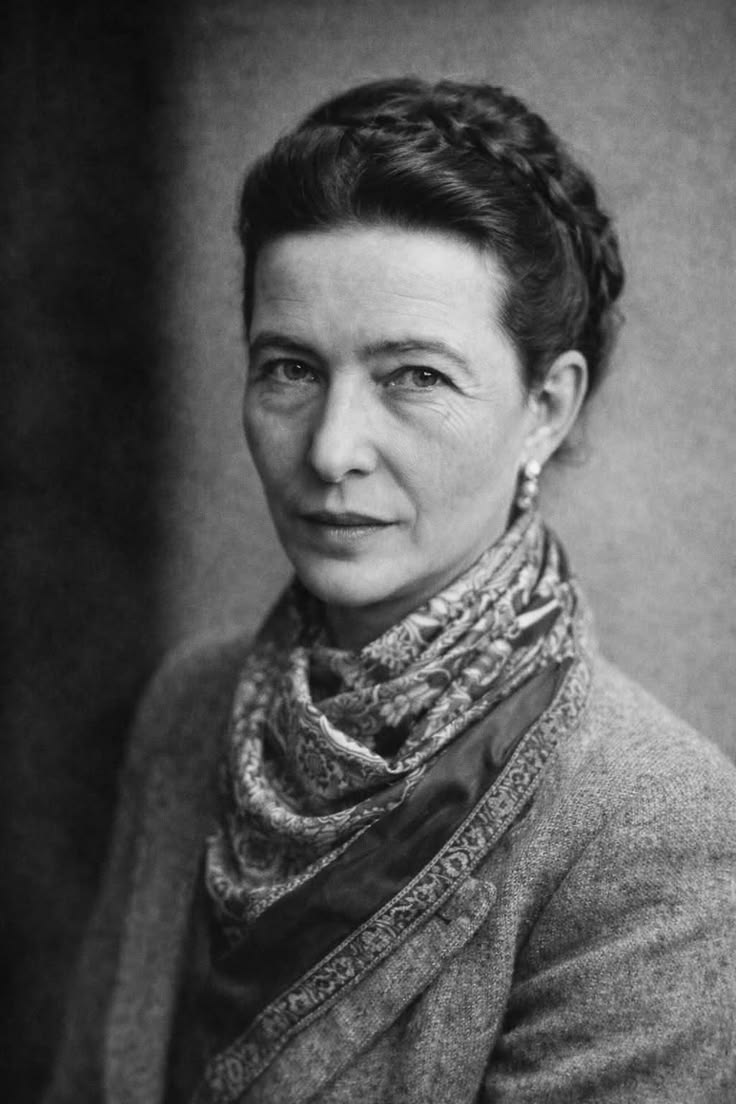
Simone de Beauvoir was born in Paris in 1908 and grew up in a relatively traditional Catholic family. Her early education exposed her to literature, philosophy, religion, and questions concerning morality. As she grew older, she increasingly questioned the religious assumptions that had shaped her childhood.
Beauvoir developed an intense interest in philosophy and pursued higher education in Paris. She studied philosophy at the Sorbonne and prepared for the demanding agrégation examination in philosophy. Her academic training gave her a strong foundation in philosophical history while her later work increasingly challenged established assumptions about human nature and social identity.
In 1929, Beauvoir successfully completed the agrégation in philosophy, ranking second. Jean-Paul Sartre ranked first that year. The two philosophers subsequently developed a lifelong intellectual relationship that became one of the most famous partnerships in twentieth-century French intellectual history.
Beauvoir's education was important to the development of her philosophical method. She combined rigorous philosophical argument with literature, biography, phenomenological description, and attention to concrete human experience. This combination later became particularly important in her analyses of women's lives and social conditions.
Simone de Beauvoir and the Intellectual World of Paris
Beauvoir's intellectual development took place within the rich philosophical, literary, and political culture of twentieth-century Paris. French intellectual life during this period was shaped by major debates concerning phenomenology, existentialism, Marxism, literature, religion, politics, and the meaning of human freedom. Philosophy was not confined to universities alone but was closely connected with novels, journals, theatres, publishing houses, and public political debate.
Beauvoir became part of an important intellectual circle that included Jean-Paul Sartre, as well as writers, philosophers, and political thinkers associated with postwar French intellectual life. Through teaching, writing, publishing, and later her work with the journal Les Temps Modernes, she participated directly in philosophical and political discussions that extended far beyond academic philosophy.
The historical circumstances through which Beauvoir lived also deeply influenced her thought. She experienced the First World War during childhood, the political crises of interwar Europe, the rise of fascism, the German occupation of France during the Second World War, and later political struggles concerning colonialism and women's liberation. These events reinforced her conviction that philosophy must confront the concrete historical world rather than retreat into purely abstract speculation.
This intellectual and historical environment strengthened Beauvoir's interest in situated freedom. For her, human beings make choices, create projects, and assume responsibilities, but they always do so within conditions they did not entirely choose. Freedom therefore exists within a world of historical circumstances, social institutions, economic realities, relationships, and embodied existence.
Simone de Beauvoir and Existentialism
Existentialism is central to Simone de Beauvoir's philosophy. Existentialist thought investigates concrete human existence and raises questions concerning freedom, responsibility, meaning, choice, anxiety, mortality, authenticity, and the relationship between individuals and the world they inhabit. Rather than beginning primarily with an abstract definition of human nature, existentialist thinkers ask what it means for a person to exist as a conscious and self-interpreting being.
Beauvoir shared the existentialist emphasis on human freedom but developed a distinctive account of what freedom means in lived experience. Human beings are not isolated consciousnesses making choices without limits. They are embodied beings who are born into particular historical periods, social classes, cultures, families, political systems, and material circumstances that shape the range of possibilities available to them.
This idea of situated freedom became especially important in Beauvoir's feminist philosophy. A person's formal or abstract capacity for choice does not guarantee that all possibilities are genuinely open to them. Economic dependence, discrimination, restrictive social expectations, political institutions, and cultural ideas about gender can profoundly limit a person's ability to pursue independent projects.
Beauvoir therefore used existentialist philosophy to investigate both individual responsibility and structural oppression. Her work asks not only whether human beings are free in some abstract sense, but also what material, political, and social conditions allow freedom to become concrete and meaningful. This concern helped extend existentialism beyond an exclusive focus on individual choice toward questions of ethics, oppression, reciprocity, and collective responsibility.
What Was Simone de Beauvoir's Philosophy?
Simone de Beauvoir's philosophy centers on the relationship between freedom, situation, embodiment, transcendence, and responsibility. She rejected the idea that human existence can be adequately understood through an abstract definition of a fixed and unchanging human nature. Instead, she examined how individuals become themselves through projects, actions, relationships, and choices made within concrete circumstances.
Her existentialist philosophy emphasizes that human beings are simultaneously free and constrained. A person cannot choose the historical period into which they are born, their body, their initial social circumstances, or every condition imposed by the world. Yet these facts do not reduce the individual to a completely passive object. Human beings respond to their situations, interpret them, and attempt to create possibilities through action.
Beauvoir also developed the concepts of transcendence and immanence to describe important dimensions of human existence. Transcendence refers to the human capacity to move beyond what is already given through projects directed toward the future, while immanence can describe forms of repetitive or enclosed existence in which this capacity is restricted. These concepts became especially significant in her analysis of women's social position.
Beauvoir extended her existentialism into ethics. Freedom is not simply the ability to do whatever one wants, nor can an individual's freedom be understood in complete isolation from other people. Human beings live in a shared world, and ethical action must recognize others as free subjects rather than treating them merely as objects or instruments for one's own purposes.
This philosophical framework became particularly powerful in her analysis of women's oppression. In The Second Sex, Beauvoir investigated how women have historically been positioned as the "Other" in relation to men and how economic dependence, social institutions, cultural expectations, and ideas about femininity can restrict women's possibilities for transcendence and self-directed freedom.
Simone de Beauvoir's Philosophy of Freedom
Freedom is one of the most important concepts in Beauvoir's philosophy. Like other existentialist thinkers, she understood human beings as beings capable of choosing, acting, and projecting themselves toward possibilities rather than being completely determined by a fixed essence. However, she rejected an overly simple understanding of freedom as unlimited personal choice or independence from every external condition.
Human beings are always situated. A person's possibilities are shaped by their body, economic circumstances, historical period, political institutions, relationships, education, and social expectations. These conditions do not necessarily eliminate freedom, but they help determine which projects are realistically available and how difficult particular forms of action may become.
Beauvoir therefore distinguishes between an abstract account of human freedom and the concrete conditions required to exercise that freedom. Severe poverty, political domination, economic dependence, or social oppression can make meaningful projects extremely difficult or even impossible to pursue. For this reason, political and material conditions are not secondary concerns but essential to understanding how freedom exists in actual human lives.
Her philosophy also gives freedom an ethical and intersubjective dimension. Because other people are themselves free subjects, an individual's freedom cannot be pursued without regard for theirs. Beauvoir increasingly emphasizes that the realization of one's own freedom is connected with the existence of conditions in which others can also act, choose, speak, and pursue meaningful projects.
A society that systematically prevents particular groups from developing their capacities and possibilities therefore creates an ethical problem as well as a political one. Beauvoir's philosophy of freedom ultimately connects individual existence with broader questions about oppression, justice, reciprocity, and the responsibility to oppose conditions that reduce human beings to passive objects.
Freedom, Choice, and Human Responsibility
Beauvoir connects freedom inseparably with responsibility. Human beings must make choices without relying upon a predetermined moral order that can decide every question for them. Yet this responsibility does not mean that each person creates values in complete isolation, because every choice takes place within a world shared with other conscious and free beings.
For this reason, Beauvoir's existentialist ethics cannot be reduced to the slogan that everyone should simply "do whatever they choose." Freedom is not equivalent to arbitrary preference or unrestricted individual self-assertion. A genuinely ethical exercise of freedom must recognize that one's actions can either expand or restrict the possibilities available to other people.
Beauvoir therefore develops an ethics of reciprocity. The freedom of the individual is connected with the freedom of others, and she argues that one cannot genuinely affirm one's own freedom while systematically denying the freedom of other human beings. Ethical action consequently involves concern for the social and material conditions that make meaningful freedom possible.
At the same time, Beauvoir does not ignore the power of circumstance. People exist within situations shaped by history, poverty, oppression, political institutions, and relationships of dependence. These conditions can severely restrict what a person is actually able to do, and her philosophy therefore rejects the simplistic idea that all individuals are equally free in every concrete situation.
Human responsibility must therefore be understood concretely rather than abstractly. A person is responsible for how they respond to their situation and for the projects they undertake, but ethical judgment must also take account of whether oppression or coercion has deprived them of meaningful possibilities for action. Beauvoir's conception of responsibility thus combines individual agency with a serious recognition of social reality.
Simone de Beauvoir and The Ethics of Ambiguity
The Ethics of Ambiguity, published in 1947, is one of Simone de Beauvoir's most important philosophical works. In this book, she develops an existentialist account of ethics based on the ambiguous character of human existence. Human beings are neither pure, disembodied consciousness nor merely objects determined by external forces; they are free subjects who nevertheless exist within concrete situations they did not entirely choose.
This ambiguity arises from the relationship between freedom and facticity. Each person is capable of transcending their present circumstances through projects, choices, and action, yet every person is also shaped and limited by a body, a past, social conditions, historical circumstances, and the material world. Beauvoir argues that an ethical philosophy must begin by accepting both dimensions rather than reducing human existence to only one of them.
Beauvoir rejects the attempt to escape this condition by pretending that life possesses an absolutely predetermined meaning or that a fixed moral authority can resolve every ethical problem in advance. Human beings must create and pursue values through their projects, but these values cannot simply be treated as eternal objects existing independently of human freedom and concrete action.
At the same time, Beauvoir does not conclude that the absence of absolute guarantees makes ethical life impossible. Freedom itself creates ethical responsibilities because human beings act in a world shared with other people. Her central principle is often expressed through the idea that to will oneself free also requires willing the freedom of others. Freedom, therefore, cannot be understood as purely private self-assertion.
The book also examines different ways in which people attempt to escape the burden of freedom. Beauvoir criticizes attitudes in which individuals surrender responsibility to supposedly absolute values, authorities, or ideologies. Such attempts can provide psychological certainty, but they also risk allowing people to avoid responsibility for the meanings and consequences of their own actions.
The Ethics of Ambiguity is especially important because it shows that Beauvoir's philosophy was never limited to the analysis of women's oppression alone. She developed a broader existentialist ethics concerned with freedom, responsibility, oppression, political action, violence, and the relationship between individual projects and the shared conditions of human existence. These ethical concerns would later become more concretely developed in her feminist and political writings.
What Does Ambiguity Mean in Beauvoir's Philosophy?
Ambiguity describes a fundamental feature of human existence in Beauvoir's philosophy. Human beings are conscious subjects capable of reflection, projects, and choices, yet they are also embodied beings situated within a material and social world. They experience dependence, limitation, aging, suffering, and ultimately death.
Human beings therefore cannot be reduced either to completely free consciousness or to passive objects determined entirely by circumstances. Beauvoir's philosophy attempts to hold these two dimensions together. People possess the capacity to transcend aspects of their situation, but they never escape situation altogether. Freedom is always exercised by someone who exists somewhere, at a particular time, and under particular conditions.
This idea distinguishes Beauvoir's account from a simplified version of existentialism in which every person is imagined as possessing unlimited freedom regardless of social reality. Poverty, oppression, political domination, bodily vulnerability, and historical circumstances can profoundly affect the possibilities available to an individual. For Beauvoir, these limitations must be taken seriously within ethical and philosophical analysis.
Accepting ambiguity also means recognizing that ethical life cannot be reduced to a simple formula capable of eliminating every conflict. Decisions may involve competing values, incomplete knowledge, uncertain consequences, and situations in which no available choice is entirely free from difficulty. The ethical individual must therefore confront concrete problems rather than escape into abstract certainty.
Beauvoir regards attempts to deny ambiguity as forms of philosophical and ethical evasion. A person may attempt to treat themselves as a fixed thing with a predetermined identity, or alternatively imagine that freedom can completely escape the constraints of the body and the world. Both approaches fail to describe the actual complexity of human existence.
To live authentically, therefore, is not to eliminate ambiguity but to assume it. Human beings must act despite uncertainty, pursue projects despite their finitude, and accept responsibility despite the fact that neither the meaning nor the future of human life is completely guaranteed. Ambiguity is consequently not merely a problem for Beauvoir; it is the unavoidable condition from which ethical freedom begins.
Simone de Beauvoir's Philosophy of the Other
The concept of the Other is central to Beauvoir's analysis of gender and human relationships. In The Second Sex, she argues that women have historically been represented not simply as another group of human subjects but as the Other in relation to men. This philosophical structure helps explain how inequality can become embedded within social ideas about what counts as normal, universal, or fully human.
In this relationship, man is positioned as the norm or universal subject, while woman is defined in relation to him. The masculine can appear as the neutral or general category of "human," whereas the feminine is represented as particular, secondary, or different. Woman is consequently treated not primarily as an independent subject but as man's opposite, complement, or subordinate counterpart.
Beauvoir's concept of the Other is connected with her broader existentialist concern with subjectivity and recognition. Every human being experiences themselves as a subject who acts and pursues projects, but each person also encounters other people who possess their own perspectives and freedom. Ethical and social relations become distorted when one group claims the position of full subjectivity while systematically reducing another group to an object or subordinate Other.
Beauvoir's analysis shows that othering is not merely a matter of individual prejudice. Cultural narratives, laws, traditions, economic structures, educational systems, and social expectations can reproduce a distinction between those treated as autonomous subjects and those treated as secondary, dependent, or less capable of defining their own lives.
This is one reason why The Second Sex moves beyond an abstract theory of freedom toward an examination of concrete social situations. Beauvoir investigates how women's possibilities are shaped by embodiment, family structures, education, work, sexuality, and economic dependence. The question is not simply whether an individual is theoretically free but whether social conditions provide meaningful opportunities for freedom.
Beauvoir's philosophical account of the Other became highly influential in feminist philosophy and social theory. Later thinkers expanded, criticized, and transformed the concept in discussions of colonialism, race, class, sexuality, and other forms of social exclusion. Its continuing importance lies in its attempt to explain how differences between groups can become organized into unequal relationships of subjectivity and power.
Simone de Beauvoir and Feminist Philosophy
Simone de Beauvoir is one of the most influential figures in modern feminist philosophy. Her work challenged the idea that women's social position could be explained simply by biology or by an eternal and unchanging feminine nature. Instead, she examined the social, historical, economic, and cultural processes through which women are encouraged, expected, and often pressured to occupy particular roles.
Beauvoir's feminism is closely connected with existentialism. If human beings are capable of freedom, transcendence, and self-definition, then social systems that systematically restrict women's ability to develop independent projects raise serious philosophical and ethical questions. Oppression is not simply an unfortunate difference between individuals; it can involve the active restriction of another person's possibilities for freedom and self-development.
In The Second Sex, Beauvoir examines numerous dimensions of women's lived situation, including childhood, education, sexuality, marriage, motherhood, work, economic dependence, and cultural images of femininity. Her analysis attempts to show how social institutions and expectations can shape the ways women understand themselves and the possibilities that appear open to them.
One of Beauvoir's most influential insights is her distinction between biological fact and social meaning. Bodily differences exist, but she argues that biology alone cannot explain the complex social position assigned to women. Human societies interpret bodies through cultural values, institutions, traditions, and systems of power, producing social expectations that may then appear natural or inevitable.
Beauvoir therefore argues that women must be understood as complete human subjects rather than primarily through roles constructed around men. Motherhood, marriage, domestic life, or sexuality may be important parts of an individual's life, but they should not automatically determine the entire meaning or social value of a woman's existence. A central concern of her philosophy is whether women possess genuine opportunities to pursue projects of their own.
Her feminist philosophy also emphasizes material and social conditions. Legal equality alone cannot necessarily produce substantive freedom if economic dependence, unequal expectations, restricted educational opportunities, or institutional barriers continue to limit what people are actually able to do. Beauvoir's later work therefore connects existential freedom with the concrete conditions required for that freedom to become meaningful.
Beauvoir's influence extends far beyond a single school of feminism. Although later feminist thinkers have criticized and revised aspects of her work, The Second Sex remains a foundational text for the philosophical study of gender, oppression, embodiment, freedom, and social construction. Her lasting importance lies partly in the way she connected abstract existential questions about freedom with the concrete realities of women's lives.
What Is The Second Sex?
The Second Sex, published in 1949, is Simone de Beauvoir's most famous philosophical work and one of the foundational texts of twentieth-century feminist thought. Combining existentialism, phenomenology, history, literature, biology, psychology, and social analysis, the work investigates what it means to live as a woman in a world whose institutions and cultural traditions have historically been organized around masculine experience.
Beauvoir examines how women have been represented and treated throughout history. Rather than accepting traditional claims that women possess a fixed and universal "feminine nature," she investigates the historical and social processes through which femininity is formed, interpreted, and imposed. Her analysis asks how biological differences acquire social meaning and how those meanings can become connected with unequal forms of power.
One of the book's central arguments concerns the relationship between woman and man as Subject and Other. Beauvoir argues that masculine experience has frequently been treated as the universal or neutral human norm, while women have been defined relationally in opposition to men. Woman is consequently represented not simply as an independent subject but as secondary, different, complementary, or subordinate to the supposedly universal masculine subject.
The Second Sex also investigates women's lived experience across different stages and situations of life, including childhood, adolescence, sexuality, marriage, motherhood, work, aging, and social expectations. Its philosophical importance lies partly in connecting these apparently ordinary experiences with larger questions about freedom, embodiment, identity, transcendence, immanence, and oppression.
The book became enormously influential in later feminist theory and helped establish questions about gender, embodiment, socialization, and oppression as central subjects of modern philosophical debate. Later feminists have criticized, revised, and extended important aspects of Beauvoir's analysis, including some of its assumptions about sexuality, race, motherhood, and gender. Nevertheless, The Second Sex remains a landmark work whose philosophical influence continues across feminism, phenomenology, existentialism, and social and political philosophy.
Simone de Beauvoir and the Social Construction of Woman
Beauvoir's famous discussion of becoming a woman challenges the idea that a person's social identity can be explained entirely through biological characteristics. Her argument draws attention to the cultural, historical, and social processes through which societies form expectations about femininity and teach individuals what it supposedly means to occupy the social position of "woman."
From childhood onward, individuals can be encouraged toward different behaviors, ambitions, responsibilities, appearances, and limitations according to gender. Family life, education, religion, literature, popular culture, economic institutions, and everyday social customs can all participate in shaping these expectations. What appears natural or inevitable may therefore partly be the result of a long process of socialization.
This does not mean that Beauvoir believed biological embodiment was irrelevant. On the contrary, the body is an important dimension of her philosophy because human beings encounter the world through embodied existence. Her point is that biological facts do not by themselves determine a complete social destiny. The meaning assigned to bodily differences is shaped by particular historical, economic, cultural, and political circumstances.
Beauvoir's analysis therefore became highly influential in later debates concerning sex, gender, identity, embodiment, and socialization. Her work encouraged philosophers to ask how supposedly natural roles are produced, justified, and maintained through social practices. Although later theories of gender developed concepts that go beyond Beauvoir's own terminology, her analysis provided an important philosophical foundation for questioning the assumption that femininity is simply a fixed natural essence.
Gender, Society, and Oppression in Beauvoir's Philosophy
Oppression is a central concept in Beauvoir's analysis of women's situation. Oppression occurs when social, political, and economic arrangements systematically restrict the possibilities through which people can exercise their freedom and pursue meaningful projects. It is therefore not simply a matter of one individual disliking or mistreating another; oppression can be embedded within the wider structures that organize social life.
Beauvoir's account emphasizes that institutions and material conditions can shape the opportunities available to different groups. Economic dependence, unequal access to education and work, legal inequality, cultural expectations, and restrictions surrounding sexuality and family life can all influence a person's ability to become an independent agent. Women's dependence on men was therefore, for Beauvoir, not merely a psychological condition but also a social and economic reality.
Oppression is closely connected to Beauvoir's existentialist understanding of freedom. Human beings may possess the capacity to act and project themselves toward the future, but concrete circumstances can severely restrict the possibilities through which that capacity can be exercised. Social conditions that systematically close possibilities for particular groups therefore create not only political inequality but also a serious ethical problem.
Her analysis consequently suggests that liberation requires more than a change in individual attitudes. Challenging oppressive conditions may involve transformations in economic arrangements, education, employment, political and legal rights, social expectations, and interpersonal relationships. Beauvoir thus connects existential freedom with a broader analysis of the material and institutional conditions required for human beings to pursue genuinely independent projects.
Immanence and Transcendence in Simone de Beauvoir's Philosophy
Immanence and transcendence are important concepts in Beauvoir's analysis of human existence. Transcendence refers broadly to the human capacity to move beyond what is immediately given through action, projects, creation, and possibilities directed toward the future. Immanence, by contrast, refers to dimensions of existence in which life remains enclosed within repetition, maintenance, and immediate conditions rather than opening toward freely chosen possibilities.
Beauvoir does not simply treat immanence as something inherently negative. Human beings are embodied and situated, and ordinary life necessarily includes repetition, physical maintenance, dependence, and material responsibilities. No human existence consists entirely of transcendence. The philosophical problem arises when a person or social group is systematically denied opportunities for transcendence and confined predominantly to activities and conditions imposed by others.
In The Second Sex, Beauvoir uses these concepts to analyze women's historical situation. Traditional gender arrangements often assigned women primary responsibility for domestic labor, reproduction, childcare, and service to others, while men were more readily encouraged to pursue public, political, intellectual, artistic, and economic projects. Beauvoir's argument concerns not the intrinsic worthlessness of domestic or bodily activities but the unequal social organization of possibilities and freedom.
Her analysis therefore connects everyday social roles with existential freedom. A central feminist question becomes whether women possess genuine opportunities to move beyond socially imposed identities and pursue projects of their own. Liberation, in this framework, requires social conditions in which women can be recognized as full subjects capable of both embodied existence and self-directed transcendence.
Simone de Beauvoir on the Body and Human Experience
The body plays an essential role in Beauvoir's philosophy. Human beings do not exist as abstract minds separated from physical reality. We encounter the world through embodied existence, and the body is simultaneously something through which we act and a reality that can be seen, interpreted, evaluated, and regulated by others. This makes embodiment inseparable from questions about freedom and social situation.
In The Second Sex, Beauvoir examines menstruation, sexuality, pregnancy, motherhood, aging, and other dimensions of bodily experience. Her purpose is not simply to describe biological processes but to investigate how societies assign meanings, expectations, and values to those processes. The same bodily reality can therefore be experienced differently according to a person's historical and social circumstances.
The body can consequently become a source of both possibility and social limitation. Biological processes are real, but their social significance is not determined by biology alone. Cultural institutions and political arrangements can transform bodily differences into expectations about appropriate work, behavior, sexuality, appearance, and social status, sometimes producing hierarchies that restrict individual possibilities.
Beauvoir's approach helped make embodiment a major subject in later feminist philosophy and phenomenology. Her work encouraged philosophers to investigate the lived body rather than treating physical existence as irrelevant to consciousness or freedom. At the same time, aspects of her account of female embodiment have been extensively debated and criticized by later feminist thinkers, demonstrating the continuing importance of her work for philosophical discussions of bodies, identity, and social power.
Simone de Beauvoir on Love, Relationships, and Independence
Beauvoir's philosophy also examines love and human relationships. From an existentialist perspective, a relationship between two people raises difficult questions about freedom, dependence, recognition, desire, and the temptation to treat another person as an object. Human relationships are significant because individuals seek connection with others while also remaining distinct subjects with their own projects and perspectives.
Beauvoir was critical of romantic ideals that encourage one person to make another the absolute center or ultimate justification of their existence. If an individual abandons their own projects entirely in order to live through another person, their possibilities for independence and self-directed activity can become severely restricted. This problem becomes especially important when unequal gender expectations encourage women to define themselves primarily through men.
In Beauvoir's philosophical framework, a valuable relationship should involve recognition of both people as free subjects. Love need not require the destruction of individuality or the absorption of one person's existence into another's. Ideally, a relationship can involve reciprocity in which two individuals recognize each other's distinct freedom while sharing experiences and pursuing both common and individual projects.
These ideas connect Beauvoir's philosophy of relationships with her broader criticism of gender inequality. Traditional expectations surrounding romance, marriage, and femininity can encourage women to sacrifice independent ambitions or to derive their entire identity from relationships. Beauvoir's analysis therefore asks how intimacy might become compatible with freedom rather than reproducing dependence and unequal power.
Simone de Beauvoir and Jean-Paul Sartre
Simone de Beauvoir and Jean-Paul Sartre met while studying philosophy in Paris and developed one of the most famous intellectual relationships of the twentieth century. Both became major figures in existentialism and participated actively in French literary, philosophical, and political life. Their long intellectual exchange influenced the development of their ideas, but their philosophical relationship should not be understood as the simple dependence of one thinker upon the other.
Sartre's existentialist philosophy was an important influence on Beauvoir, particularly through questions concerning consciousness, freedom, responsibility, and human projects. Beauvoir engaged deeply with these philosophical problems and shared many elements of the existentialist intellectual environment. However, she developed distinctive arguments and increasingly directed philosophical attention toward questions that could not be adequately understood through abstract accounts of freedom alone.
Beauvoir's work placed particular emphasis on embodiment, concrete social conditions, intersubjective relationships, oppression, and lived experience. Her account of freedom is strongly situated, meaning that philosophical analysis must consider the actual material and historical circumstances in which people live. This orientation became especially important in The Second Sex, where existentialist concepts are used to analyze the concrete situation of women.
Their intellectual relationship therefore belongs to the history of existentialism without erasing Beauvoir's independent philosophical contribution. Contemporary scholarship has increasingly emphasized Beauvoir as a major philosopher in her own right and has examined the ways her work develops original contributions to existential ethics, phenomenology, feminist philosophy, political thought, and the philosophy of embodiment.
Simone de Beauvoir's Philosophy of Existential Ethics
Beauvoir's existential ethics begins from the recognition that human beings do not simply discover a complete and predetermined moral meaning written into the universe. They exist in an uncertain and changing world in which they must make choices, undertake projects, and assume responsibility for their actions. Ethical life therefore cannot be reduced to mechanically following a universal formula that eliminates every difficulty of decision.
This does not imply that every choice is equally good. Beauvoir argues that freedom has an ethical dimension because human actions take place within a world shared with other free beings. A person who treats another's freedom as irrelevant, or who seeks to dominate and reduce others to instruments, creates conditions that contradict the broader possibilities of reciprocal human freedom.
Her ethics consequently combines personal responsibility with concern for others. Freedom cannot be understood entirely as private independence because human beings exist within relationships, institutions, and shared historical circumstances. The possibilities available to one person can be expanded or restricted by the actions of others, making ethical reflection inseparable from questions about reciprocity and responsibility.
Beauvoir's ethics also became important for political philosophy because it connects individual freedom with struggles against oppression. Ethical action may require confronting institutions and social conditions that systematically prevent people from exercising meaningful freedom. Her existential ethics therefore moves beyond the isolated individual and asks how human beings can create a shared world in which freedom becomes a concrete possibility rather than merely an abstract principle.
Major Works of Simone de Beauvoir
Simone de Beauvoir wrote philosophy, novels, memoirs, essays, and political works. Her literary writing often develops philosophical questions through concrete characters and situations, while her philosophical works directly examine freedom, ethics, gender, and human existence.
- The Second Sex — Beauvoir's landmark work on women's situation, gender, oppression, embodiment, and freedom.
- The Ethics of Ambiguity — An existentialist account of freedom, responsibility, ambiguity, and ethical action.
- Pyrrhus and Cineas — An early philosophical essay concerning action, projects, freedom, and relationships with others.
- She Came to Stay — A philosophical novel exploring relationships, freedom, consciousness, jealousy, and existential conflict.
- The Blood of Others — A novel dealing with freedom, responsibility, political commitment, and the consequences of human action.
- All Men Are Mortal — A philosophical novel exploring mortality, historical existence, freedom, and the meaning of an individual life.
- The Coming of Age — A major study of aging and the social position of older people.
- A Very Easy Death — A deeply personal philosophical and literary reflection on illness, death, suffering, and human vulnerability.
Simone de Beauvoir's Main Philosophical Ideas
1. Human Beings Are Free but Situated
Beauvoir understands freedom as existing within concrete conditions. People make choices, but those choices occur within historical, economic, bodily, political, and social circumstances. Freedom is therefore neither complete determinism nor unlimited choice.
2. Freedom and Responsibility Are Connected
Human freedom creates responsibility because actions affect a shared world. Beauvoir's ethics asks people to recognize both their own freedom and the freedom of others rather than treating other human beings as objects.
3. Women Have Historically Been Made the Other
Beauvoir argues that women have frequently been defined in relation to men rather than recognized as independent subjects. This concept of the Other became one of the central ideas of modern feminist philosophy.
4. Gender Is Shaped by Social Experience
Beauvoir challenged the assumption that social femininity follows automatically from biological sex. Childhood, education, culture, institutions, and expectations all influence how gendered identities are lived and understood.
5. Oppression Restricts Freedom
Oppressive social structures can limit the possibilities available to individuals. Beauvoir therefore connects feminist liberation with the broader existentialist problem of creating conditions in which people can genuinely pursue meaningful projects.
6. Human Existence Is Ambiguous
Human beings are simultaneously free subjects and embodied beings subject to limitation, dependence, aging, suffering, and death. Beauvoir's concept of ambiguity provides the foundation for much of her existentialist ethics.
Simone de Beauvoir and Feminist Existentialism
Feminist existentialism brings existentialist questions about freedom, identity, responsibility, and human existence into direct contact with the lived realities of gender. Simone de Beauvoir is widely regarded as one of its foundational figures because she showed that the philosophical problem of freedom cannot be separated from the social conditions in which different people actually live.
Beauvoir's contribution was distinctive because she refused to treat the individual as an abstract consciousness existing outside history and society. A woman may experience herself as a free subject while simultaneously encountering institutions and expectations that shape what she is encouraged to desire, how she should behave, and which possibilities appear open or unavailable to her.
Her feminist existentialism therefore asks how freedom can be exercised within circumstances that individuals did not choose. Human beings always begin from a particular situation, yet situations are neither philosophically irrelevant nor necessarily permanent. Social arrangements can restrict possibilities, but they can also be criticized and transformed.
This approach helped establish an enduring philosophical connection between individual agency and structural oppression. Later feminist thinkers developed, criticized, and revised Beauvoir's ideas while extending debates about embodiment, gender identity, social construction, oppression, and the conditions required for genuine human freedom.
Simone de Beauvoir's Influence on Feminism and Philosophy
Beauvoir's influence on feminist philosophy has been profound. The Second Sex helped transform the philosophical study of women by demonstrating that gender inequality raises fundamental questions about freedom, identity, embodiment, social institutions, and the meaning of human existence.
Her analysis contributed to later debates about sex and gender, embodiment, reproductive politics, women's work, sexuality, family structures, and social identity. Feminist philosophers have both drawn upon and criticized her arguments, particularly her treatment of biological difference, social construction, and the relationship between women as a social category and diverse individual experiences.
Beauvoir also made an important contribution to phenomenological approaches to embodiment. Her attention to lived experience showed how apparently abstract concepts such as freedom and subjectivity are experienced through the body, everyday social practices, relationships, work, and institutions.
Her influence extends beyond academic philosophy. Beauvoir became a major public intellectual whose writings and political engagements connected philosophical reflection with questions about women's liberation, colonialism, political responsibility, and social justice. Her example helped demonstrate that philosophy could engage critically with the concrete conflicts of historical life.
Simone de Beauvoir, Politics, and Social Liberation
Beauvoir's philosophy increasingly engaged with political questions concerning oppression, liberation, war, colonialism, and social inequality. Her existentialist understanding of freedom led her to ask not merely whether people possess freedom in principle, but under what historical and material conditions they can genuinely exercise it.
She rejected the idea that philosophy should remain entirely detached from lived political realities. Human beings always act within particular situations, and political institutions, economic arrangements, and social hierarchies can profoundly affect the possibilities available to different individuals and groups.
Beauvoir's political thought therefore connects existential ethics with social transformation. If freedom is a central human value, then conditions that systematically reduce people to dependence, prevent them from pursuing projects, or deny them meaningful agency demand both ethical and political criticism.
Her political writings and activism also reveal an important development in her philosophy: freedom cannot always be understood adequately from the perspective of an isolated individual. The struggle for liberation involves collective conditions, conflicts between groups, and institutions capable of either expanding or restricting human possibilities.
Simone de Beauvoir's Philosophy of Aging and Death
Beauvoir's philosophical interests extended far beyond gender to questions concerning aging, mortality, and death. Her work repeatedly examines the limits imposed by embodiment and the unavoidable fact that human projects unfold within finite lives rather than from a position of unlimited freedom.
In The Coming of Age, Beauvoir offers a wide-ranging analysis of old age and argues that aging cannot be understood as merely a biological process. The social meaning of growing old is shaped by economic conditions, work, family relationships, public institutions, and cultural attitudes toward older people.
Her analysis is particularly concerned with the way older people may be marginalized or treated primarily as objects of social management rather than as subjects with histories, projects, relationships, and continuing capacities. Aging therefore becomes another example of the interaction between bodily reality and social interpretation.
Beauvoir's reflections on death likewise connect personal experience with philosophical questions about freedom and meaning. Human beings can pursue projects and transform aspects of their world, yet they cannot escape mortality. This tension between possibility and limitation is another expression of the ambiguity at the center of existential existence.
Simone de Beauvoir as a Philosopher and Writer
Beauvoir did not restrict philosophical thinking to traditional academic treatises. She wrote novels, memoirs, essays, biographies, philosophical works, and political commentary. Literature gave her a distinctive way to investigate philosophical questions through individual lives and concrete situations rather than through abstract argument alone.
Her novels frequently explore freedom, relationships, responsibility, jealousy, political commitment, mortality, and the difficulty of understanding other people. Fiction allowed Beauvoir to show how philosophical problems emerge within decisions whose consequences are often uncertain and emotionally complex.
This relationship between philosophy and literature is characteristic of much twentieth-century French existentialist writing. Beauvoir's literary work complements her theoretical philosophy by making concepts such as freedom, ambiguity, dependence, and responsibility visible within the ordinary circumstances of human life.
Her memoirs are also philosophically significant because they examine the formation of a self within a particular historical and social world. Taken together, her philosophical and literary writings challenge the assumption that rigorous reflection on human existence must always take the form of impersonal or purely systematic philosophy.
Simone de Beauvoir's Philosophical Legacy
Simone de Beauvoir left a lasting legacy in existentialism, feminist philosophy, ethics, phenomenology, political thought, and literary studies. Her analysis of women's situation transformed philosophical approaches to gender and demonstrated that lived social experience could be investigated with serious philosophical rigor.
Her concept of the Other, her account of situated freedom, and her philosophy of ambiguity continue to shape discussions about identity, oppression, and human agency. Later thinkers have adapted these concepts while also challenging some of Beauvoir's assumptions and extending her questions to other forms of social difference and exclusion.
Beauvoir's work remains especially important because it resists a simple opposition between individual freedom and social structure. People possess agency, but agency is exercised through bodies, relationships, institutions, histories, and material circumstances. Freedom is therefore real without being unlimited or equally available to everyone.
Today, Beauvoir remains one of the most widely studied philosophers of the twentieth century. Her work continues to generate debate because it raises difficult questions about freedom, gender, embodiment, responsibility, equality, oppression, and what it means to become a person within a particular social and historical world.
Simone de Beauvoir's Philosophy Explained Simply
Beauvoir's philosophy can be understood as an investigation of how human beings attempt to live freely within circumstances they did not choose. She believed that people are capable of creating projects and making choices, but their possibilities are influenced by society, history, embodiment, and relationships.
- Are human beings free? Yes, but freedom is always situated within concrete social, historical, bodily, and material conditions.
- What is the Other? The Other is a person or group defined as secondary in relation to a dominant subject. Beauvoir uses this concept to analyze women's historical position in relation to men.
- What did Beauvoir say about gender? She argued that social femininity is shaped through cultural, historical, and social processes rather than being explained by biology alone.
- Why is freedom important? Freedom allows people to pursue projects and create meaning, but it also creates responsibility toward other people.
- What is ambiguity? Human beings are simultaneously free subjects and embodied beings who experience limitation, dependence, suffering, aging, and death.
- Why is The Second Sex important? It connects women's lived experiences with philosophical questions about freedom, gender, embodiment, identity, and oppression.
Why Is Simone de Beauvoir Important in the History of Philosophy?
Simone de Beauvoir is important because she expanded existentialist philosophy beyond abstract discussions of freedom and responsibility toward the concrete social conditions in which people actually live. Her work demonstrated that philosophical questions about freedom can be inseparable from questions about gender, embodiment, economics, relationships, and political power.
Her analysis of women challenged the assumption that philosophical accounts of "the human" automatically represent everyone's experience. By examining women's lives as a philosophical subject, Beauvoir exposed how supposedly universal concepts can sometimes reflect the experiences of particular social groups.
Her work also created an enduring connection between existentialism and feminist philosophy. Questions about freedom, identity, and meaning became connected to questions about oppression and the social conditions necessary for genuine autonomy.
For these reasons, Beauvoir is now studied not merely as an important companion to Sartre or as the author of a famous feminist book, but as a major philosopher whose ideas continue to shape contemporary debates about freedom, gender, ethics, embodiment, and social justice.
Frequently Asked Questions About Simone de Beauvoir
Who was Simone de Beauvoir?
Simone de Beauvoir was a French philosopher, writer, and intellectual best known for her contributions to existentialism and feminist philosophy. Her major works examine freedom, ethics, gender, oppression, embodiment, relationships, and human existence.
What was Simone de Beauvoir famous for?
Beauvoir is most famous for The Second Sex, a landmark work of feminist philosophy published in 1949. She is also known for The Ethics of Ambiguity and for her contributions to existentialist philosophy, ethics, and twentieth-century French intellectual life.
What was Simone de Beauvoir's philosophy?
Simone de Beauvoir's philosophy focused on freedom, responsibility, ambiguity, embodiment, relationships, oppression, and the social conditions of human existence. Her existentialist philosophy argues that people are free but always situated within concrete circumstances.
Was Simone de Beauvoir an existentialist?
Yes. Beauvoir is widely associated with existentialism, although her philosophical position should not simply be reduced to Jean-Paul Sartre's existentialism. She developed distinctive ideas about situated freedom, ambiguity, ethics, embodiment, oppression, and women's lived experience.
What is The Second Sex about?
The Second Sex examines women's historical and social situation through philosophy, history, biology, literature, and lived experience. Beauvoir investigates how women have been defined as the Other and how gendered social structures can restrict freedom.
What did Simone de Beauvoir mean by "One is not born, but rather becomes, a woman"?
The statement expresses Beauvoir's argument that social femininity is not simply determined by biological sex. Socialization, culture, education, institutions, and expectations contribute to the process through which a person becomes socially understood as a woman.
What is Simone de Beauvoir's feminism?
Beauvoir's feminism is strongly influenced by existentialism. She argued that women should be recognized as free subjects capable of independent projects rather than being confined to roles defined primarily through men, marriage, motherhood, or traditional social expectations.
What is the Other in Simone de Beauvoir's philosophy?
The Other describes a position in which one group is defined as secondary or different in relation to a dominant subject. Beauvoir argues that women have historically been positioned as the Other in relation to men, who have often been treated as the universal human subject.
What is existentialist feminism?
Existentialist feminism applies existentialist ideas about freedom, responsibility, identity, and meaning to women's lived experience. Beauvoir's work is foundational because it investigates how social conditions can restrict women's freedom while also examining the possibility of liberation.
What is The Ethics of Ambiguity?
The Ethics of Ambiguity is Beauvoir's major philosophical work on existentialist ethics. It examines freedom, responsibility, uncertainty, human limitation, and the ethical relationship between one's own freedom and the freedom of others.
What did Simone de Beauvoir believe about freedom?
Beauvoir believed that human beings possess freedom but that freedom is always situated within concrete circumstances. Social, economic, historical, bodily, and political conditions can expand or restrict the possibilities through which people exercise their freedom.
What did Simone de Beauvoir say about gender?
Beauvoir argued that gendered identity is shaped by social and historical processes rather than being explained entirely by biology. Her philosophy examines how childhood, culture, institutions, and social expectations influence the way femininity is lived.
How did Simone de Beauvoir influence feminism?
Beauvoir helped establish gender, embodiment, oppression, and women's freedom as major subjects of philosophical inquiry. Her work influenced later feminist theories concerning gender, social construction, sexuality, embodiment, identity, and liberation.
What was Simone de Beauvoir's relationship with Jean-Paul Sartre?
Beauvoir and Jean-Paul Sartre were lifelong intellectual and romantic partners. They shared an important intellectual environment and influenced one another, but Beauvoir developed philosophical ideas of her own, particularly concerning situated freedom, embodiment, oppression, and women's experience.
What are Simone de Beauvoir's major philosophical works?
Her major philosophical works include The Second Sex, The Ethics of Ambiguity, and Pyrrhus and Cineas. Her novels, memoirs, essays, and studies of aging and death also contain substantial philosophical analysis.
Why is Simone de Beauvoir important today?
Beauvoir remains important because her philosophy connects individual freedom with social conditions. Her ideas continue to influence feminist philosophy, existentialism, phenomenology, ethics, political philosophy, and debates about gender, embodiment, oppression, and human autonomy.
Related Modern and Existentialist Philosophers
Explore other major philosophers connected with existentialism, modern philosophy, ethics, freedom, consciousness, and feminist thought.
Related Areas of Philosophy
Beauvoir's philosophy connects existentialism with ethics, feminist philosophy, metaphysics, epistemology, social and political philosophy, philosophy of the body, and modern philosophical thought.
Why Simone de Beauvoir Still Matters
Simone de Beauvoir occupies a foundational position in modern existentialist and feminist philosophy. Her work transformed philosophical discussions of women's lives by connecting gender with questions of freedom, embodiment, social identity, oppression, and human responsibility.
Her philosophy demonstrates that freedom cannot be understood only as an abstract capacity to choose. People are situated within bodies, relationships, economies, cultures, histories, and political institutions that shape the possibilities available to them. Genuine freedom therefore requires attention to the conditions under which human beings can pursue meaningful projects.
From The Second Sex to The Ethics of Ambiguity, Beauvoir developed a philosophy that connected existential questions with concrete human experience. Her concepts of ambiguity, the Other, situated freedom, immanence, and transcendence continue to influence philosophical debates about gender, ethics, identity, and liberation.
Understanding Beauvoir also helps explain the development of twentieth-century philosophy. She expanded existentialism into a sustained examination of social and embodied existence and helped make feminist philosophy a major field of philosophical inquiry. Her work remains relevant wherever questions of freedom, equality, responsibility, and human possibility are debated.
Explore Great Philosophers