Who Was Albert Camus?
Albert Camus (1913–1960) was a French writer, philosopher, journalist, playwright, and public intellectual whose work became central to twentieth-century discussions of meaning, freedom, revolt, morality, and the absurd. Although he is frequently associated with existentialism, Camus rejected the label and developed a distinctive philosophical position commonly known as absurdism.
Albert Camus's philosophy begins with a fundamental human problem: people naturally search for meaning, order, and explanation, yet the universe does not appear to provide clear answers to those demands. The conflict between the human desire for meaning and the apparent indifference of the world is what Camus called the absurd.
Camus did not believe that the recognition of the absurd should lead automatically to despair, suicide, or complete nihilism. Instead, he explored whether human beings could live fully without absolute certainty or a predetermined purpose. His answer emphasized lucidity, freedom, rebellion, solidarity, and continued engagement with life.
Through works such as The Myth of Sisyphus, The Stranger, The Plague, and The Rebel, Camus became one of the most influential modern thinkers on the problem of meaning. His philosophy continues to attract readers because it directly addresses questions about suffering, death, happiness, purpose, injustice, and how to live in an uncertain world.
Albert Camus: Quick Facts
- Full name — Albert Camus
- Born — 7 November 1913
- Died — 4 January 1960
- Birthplace — Mondovi, French Algeria
- Known for — Philosophy of the absurd, absurdism, revolt, freedom, literature, and political thought
- Philosophical period — Twentieth-century and modern philosophy
- Frequently associated with — Existentialism, although Camus rejected the label
- Major philosophical concept — The absurd
- Major work — The Myth of Sisyphus
- Famous novels — The Stranger and The Plague
- Major political-philosophical work — The Rebel
- Major award — Nobel Prize in Literature, 1957
Albert Camus's Early Life and Historical Background

Albert Camus was born on November 7, 1913, in Mondovi, French Algeria, into a poor family of European settler background. His father, Lucien Camus, was killed during the First World War when Camus was still an infant, and he was raised primarily by his mother and other relatives in modest circumstances in Algiers. His childhood in Algeria would remain deeply important to his imagination, political thought, and literary work.
Despite his family's poverty, Camus received an education that opened the possibility of intellectual and literary development. Important teachers recognized his abilities and encouraged him to continue his studies. He later studied philosophy at the University of Algiers, where he developed interests in classical thought, literature, religion, politics, and the fundamental questions of death and human existence.
Camus's early experience of illness also influenced his understanding of human vulnerability. He suffered from tuberculosis, which interrupted some of his academic ambitions and prevented him from following certain careers. The fragility of physical existence therefore became an immediate reality rather than merely an abstract philosophical subject.
Before becoming internationally famous, Camus worked in journalism and the theatre. These experiences helped shape his distinctive intellectual style: rather than separating philosophy completely from literature, politics, and ordinary experience, he explored philosophical problems through essays, novels, plays, journalism, and public debate.
Albert Camus and Algeria
Algeria was central to Albert Camus's life and work. He was born into the French settler community in colonial Algeria, yet his experiences also exposed him to the severe inequalities and political injustices of colonial society. As a young journalist, Camus wrote about poverty and deprivation among Algeria's Muslim population, making colonial inequality an important concern in his early political writing.
Camus wrote about Algeria's landscapes with extraordinary intensity, often emphasizing sunlight, the sea, heat, physical sensation, and the immediate experience of the natural world. His attachment to the Mediterranean world contributed to his suspicion of philosophies that sacrificed present human life entirely for abstract theories or promises of a perfect future.
His relationship with Algeria became increasingly controversial during the Algerian War of Independence. Camus opposed colonial injustice and condemned violence against civilians, but he also struggled to reconcile his concern for Algeria's Arab population with his emotional attachment to the European community in which he had grown up.
For this reason, Camus's position on Algeria cannot easily be reduced to a simple political slogan. His writings reveal genuine opposition to colonial injustice, but also serious limitations and contradictions in his response to Algerian nationalism and independence. The subject remains one of the most debated aspects of his political legacy.
What Was Albert Camus's Philosophy?
Albert Camus's philosophy is primarily concerned with the human confrontation with a world that does not provide an obvious, final, or universally demonstrable meaning. Human beings naturally ask why they exist, whether suffering has a purpose, and what their lives are ultimately for, yet the universe appears unable to provide a final answer that settles these questions once and for all.
Camus called the confrontation between these two realities the absurd. The absurd is not simply the world by itself, nor is it simply a feeling inside the individual. It emerges from the relationship between the human desire for meaning, order, and intelligibility and a world that does not guarantee that those demands will be satisfied.
For Camus, recognizing the absurd creates a philosophical problem: how should a person live once they understand that existence may not possess a predetermined cosmic purpose? His response was neither passive resignation nor the invention of false certainty. Instead, he explored a life based on lucidity, freedom, revolt, and direct engagement with existence.
Camus's thought also developed over time. His earlier philosophical writing focuses especially on the absurd and the individual confrontation with mortality, while his later work increasingly examines rebellion, political violence, justice, moral limits, and solidarity. The movement from The Myth of Sisyphus to The Rebel is therefore one of the most important developments in understanding his philosophy.
What Is the Absurd in Albert Camus's Philosophy?
The concept of the absurd is the foundation of Albert Camus's best-known philosophical writing. Human beings naturally ask questions such as: Why am I here? What is the meaning of life? Does suffering have a purpose? Is there a final explanation for existence? Camus believed that these questions express a deep human desire for intelligibility.
The problem arises because the universe does not necessarily provide answers that satisfy this desire. Nature continues without explaining itself, death eventually arrives, and human history contains suffering that cannot always be justified by a larger visible purpose. The conflict between the human demand for meaning and this apparent silence creates the absurd.
Camus did not mean that life is simply ridiculous or meaningless in every possible sense. Nor did he argue that human beings experience the absurd as a permanent emotion. The absurd describes a tension: people seek certainty and ultimate explanation, while reality does not guarantee that these demands can be fulfilled.
The philosophical challenge is therefore not merely to define the absurd but to decide how to live with it. Camus believed that an honest response requires lucidity: the willingness to see reality without immediately escaping into comforting illusions or absolute systems that claim to solve every uncertainty.
Albert Camus and the Meaning of Life
Albert Camus is often associated with the question, "What is the meaning of life?" His philosophy does not provide a simple universal answer that applies equally to every person. Instead, Camus investigates what happens when human beings discover that the universe may not contain a clearly given purpose.
This does not mean that Camus believed nothing could matter. He distinguished between the absence of an objectively guaranteed cosmic purpose and the actual experiences, relationships, commitments, and values that make human life significant. A person can still love, create, struggle, enjoy beauty, and care for others.
Camus therefore directs attention away from the expectation that philosophy must discover a final metaphysical answer. The question becomes how human beings can live honestly and intensely when no ultimate explanation has been guaranteed to them.
His answer is not to invent meaning arbitrarily and then pretend that it has solved the problem of existence. Instead, Camus emphasizes living within the tension itself: experiencing the world, exercising freedom, creating, and remaining conscious of mortality without demanding that uncertainty disappear.
What Did Albert Camus Say About Suicide?
The problem of suicide occupies an important place in The Myth of Sisyphus. Camus begins by asking whether the apparent absurdity of existence makes life unworthy of living. He treats this as a serious philosophical question because beliefs about existence can affect the way people understand whether life itself should be affirmed.
Camus rejected the idea that recognizing the absurd logically requires suicide. For him, suicide removes the conscious person who is experiencing the conflict rather than confronting the conflict itself. It therefore does not provide a philosophical resolution to the tension between the human desire for meaning and the silence of the world.
Camus instead argued for continued living with full awareness of the absurd. This response involves refusing both physical escape and what he described as forms of philosophical escape—attempts to overcome uncertainty by making a leap toward an absolute certainty that, in his view, has not been adequately justified.
His discussion should therefore be understood as a philosophical argument for affirming life despite uncertainty, suffering, and the absence of a guaranteed ultimate purpose. Camus emphasizes living, experiencing, creating, and resisting rather than surrendering consciousness to despair.
Albert Camus's The Myth of Sisyphus
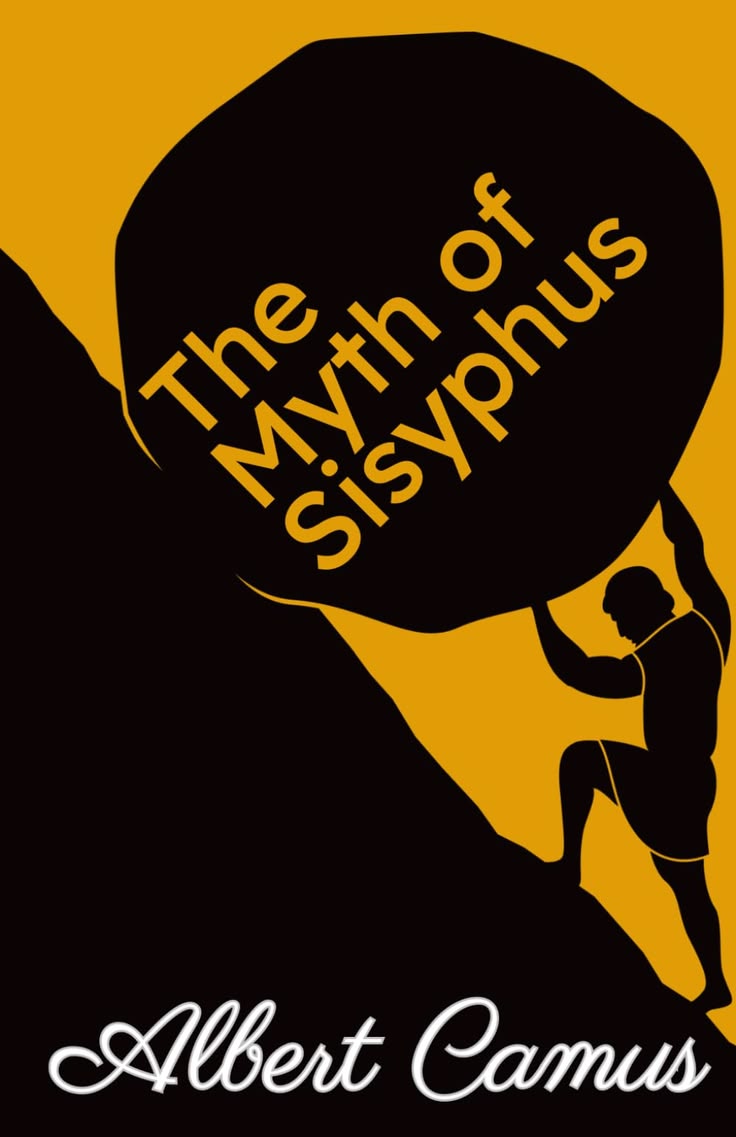
The Myth of Sisyphus, published in 1942, is Albert Camus's most important philosophical essay and the work most closely associated with his concept of the absurd. Camus uses the ancient Greek myth of Sisyphus to explore the human condition and the possibility of living without a final, predetermined meaning.
In the myth, Sisyphus is condemned to push a heavy rock up a mountain. Each time he reaches the top, the rock rolls back down, forcing him to repeat the same task forever. The punishment appears pointless, repetitive, and without final completion.
Camus saw in this image a resemblance to aspects of human existence. People often repeat daily activities, pursue goals that eventually disappear, and live with the knowledge that death will ultimately end individual life. The question is whether such repetition necessarily makes existence worthless.
Camus's famous conclusion is that "one must imagine Sisyphus happy." The point is not that suffering automatically produces happiness. Rather, Camus imagines Sisyphus becoming fully conscious of his condition and refusing to allow the absurdity of his situation to destroy his capacity for awareness and defiance.
Why Does Albert Camus Say We Must Imagine Sisyphus Happy?
The statement that Sisyphus should be imagined as happy is one of the most famous ideas associated with Albert Camus. Sisyphus cannot change the external conditions of his punishment, but Camus suggests that consciousness changes his relationship to those conditions.
Once Sisyphus understands his fate completely, he no longer needs to pretend that his task will eventually lead to a final victory. He confronts the truth of his situation directly. This awareness becomes a form of resistance because he refuses both false hope and complete despair.
Camus uses this image to suggest that human freedom can exist even when people cannot control every external circumstance. A person may not choose mortality, suffering, or the fundamental conditions of existence, but they can still shape their conscious response to those conditions.
Sisyphus therefore represents neither optimism nor pessimism in the ordinary sense. He represents a difficult form of affirmation: continuing to live and act without demanding a final victory that would permanently eliminate the absurd.
What Is Absurdism? Albert Camus's Philosophy Explained
Absurdism is the name commonly used to describe the philosophical outlook most closely associated with Albert Camus. The term is useful, although Camus himself was generally resistant to being reduced to a fixed philosophical school or system. His thought begins with the recognition of the tension between the human desire for meaning and a universe that does not provide a guaranteed answer.
The absurdist response is not simply to conclude that nothing matters. Camus believed that the absence of absolute certainty could create a different awareness of freedom. If there is no predetermined purpose capable of solving every question, people must confront the responsibility of living and acting within uncertainty.
This response emphasizes lucidity, or clear awareness of reality, and revolt, meaning the continued refusal to surrender life to despair or nihilism. In Camus's later thought, revolt also becomes a social and political concept connected with justice and solidarity.
Camus's philosophy ultimately asks how a person can affirm life despite its limitations. His answer involves experiencing the world intensely, creating, loving, acting, and continuing the struggle without pretending that all uncertainty has been permanently solved.
Was Albert Camus an Existentialist?
Albert Camus is frequently described as an existentialist, but he did not accept this label for himself. His work shares important concerns with existentialist philosophy, including freedom, death, meaning, individuality, and the problem of living in an uncertain world.
Camus was associated with existentialism partly because he moved in similar intellectual circles and had an important relationship with Jean-Paul Sartre. Both thinkers examined the absence of easy metaphysical certainty and the responsibility of individuals to confront the conditions of human existence.
Nevertheless, Camus developed his own philosophical vocabulary. The concept of the absurd is not simply identical to Sartre's account of existence or freedom. Camus was particularly concerned with the tension between human demands for meaning and the apparent silence of the world, and he criticized forms of philosophy that he believed escaped this tension too quickly.
It is therefore more accurate to say that Camus was closely connected with existentialist debates while developing a distinctive philosophical outlook of his own. His ideas about absurdity, revolt, limits, morality, and political violence cannot simply be reduced to existentialism.
Albert Camus and Jean-Paul Sartre
Albert Camus and Jean-Paul Sartre were two of the most prominent French intellectuals of the twentieth century. They were initially associated with overlapping literary and philosophical circles and shared concerns about freedom, politics, war, oppression, and the moral problems created by modern history.
Their relationship later deteriorated because of serious philosophical and political disagreements, particularly after the publication of The Rebel. One major issue concerned revolutionary violence and the relationship between political ideals and moral limits. Camus feared that movements promising a better future could justify terrible actions in the present.
Sartre became increasingly engaged with Marxist thought, while Camus increasingly criticized political systems that justified oppression or killing through appeals to historical necessity. Their disagreement became one of the most famous intellectual conflicts in postwar France.
The conflict was not simply a personal quarrel. It represented a deeper disagreement about whether political action can temporarily suspend ordinary moral limits in pursuit of historical transformation. Camus insisted that political justice must remain accountable to the actual human beings affected by its methods.
Albert Camus's Philosophy of Freedom
Freedom plays an important role in Albert Camus's response to the absurd. If human beings cannot discover a guaranteed cosmic purpose that determines every action, they become more conscious of the openness and uncertainty involved in choosing how to live.
Camus did not understand freedom as unlimited power. Human beings remain subject to physical limitations, mortality, social conditions, and historical circumstances. Freedom exists within these limits rather than outside them.
The recognition of the absurd can nevertheless free a person from the expectation that reality must provide absolute justification for every experience. Camus believed that this awareness could encourage people to live more directly rather than postponing life entirely for a promised final resolution.
Freedom, for Camus, is therefore connected with responsibility and consciousness. A free individual must confront the consequences of action and cannot simply justify everything by appealing to unquestionable destiny, ideology, or historical necessity.
What Did Albert Camus Mean by Revolt?
Revolt is one of the central concepts of Albert Camus's later philosophy. In the context of the absurd, revolt means the continued refusal to surrender to despair or to abandon life simply because existence does not provide complete metaphysical certainty.
Revolt is not merely anger or violent rebellion. It begins with a refusal to accept humiliation, injustice, or the complete destruction of human dignity. When a person says "no" to oppression, that refusal also implies that there is something about human existence worth defending.
Camus believed that revolt could create solidarity. The individual who recognizes a limit to what can be done to them can also recognize that other human beings possess a similar vulnerability. This development from individual rebellion toward a shared human condition is one of the most important ideas in The Rebel.
This idea became especially important in Camus's political philosophy. He wanted resistance to oppression without allowing rebellion itself to become unlimited and destructive. For Camus, revolt required moral limits because a movement that destroys all human dignity can betray the values that originally inspired resistance.
Albert Camus's The Rebel
The Rebel, published in 1951, is one of Albert Camus's most important works of political and moral philosophy. In the book, Camus investigates rebellion and revolution and asks what happens when the desire to resist injustice develops into movements seeking to transform society completely.
Camus was particularly concerned with the danger of justifying present violence by appealing to a future ideal society. He argued that political movements could begin by defending human freedom and dignity but eventually justify oppression if they treated individuals merely as instruments of history.
His philosophy of revolt therefore emphasizes limits. Camus believed that opposition to injustice should not become a justification for unlimited violence. The value of human life must remain morally important even when people struggle against oppressive political systems.
The Rebel made Camus an important critic of nihilism and totalitarian political violence, while also provoking major controversy for the breadth of some of his historical judgments. The book continues to raise difficult questions about whether moral principles can survive political conflict and whether any future goal can justify unlimited suffering in the present.
Albert Camus and Nihilism
Albert Camus is sometimes mistakenly described as a nihilist because his philosophy rejects the idea that the universe obviously provides a predetermined meaning. However, Camus did not believe that the absence of an absolute cosmic purpose required the conclusion that nothing has value.
In fact, much of his philosophy attempts to resist nihilism. Camus was concerned that the rejection of traditional meaning could lead people to believe that all actions were equally acceptable. Such a conclusion, he feared, could make cruelty, murder, and oppression easier to justify.
Camus instead argued that the experience of revolt reveals a concern for human limits and dignity. When people resist being treated as completely disposable, they implicitly affirm that something about human existence must not simply be destroyed.
His rejection of nihilism therefore does not depend on proving a final metaphysical system. It emerges from the practical and moral implications of revolt, solidarity, and the recognition that other human beings share the same vulnerability to suffering and death.
Albert Camus's Ethics and Human Solidarity
Although Camus is famous for writing about absurdity and the absence of ultimate certainty, his philosophy also contains an important ethical dimension. He repeatedly asks how people should treat one another in a world where suffering, death, and injustice are unavoidable features of human history.
Camus believed that the shared experience of vulnerability could create solidarity. Human beings may disagree about religion, politics, and metaphysics, but they share mortality, suffering, limitation, and the possibility of being harmed by others.
This recognition helps explain why Camus opposed political systems that treated individuals as expendable. Even when a movement claimed to serve a noble historical goal, Camus insisted that the suffering of actual human beings could not simply be ignored or transformed into an abstract statistic.
His ethics therefore emphasizes moderation, responsibility, limits, and solidarity. Rather than searching for a perfect political system capable of eliminating every human problem, Camus focused on the continuing responsibility to reduce suffering and resist injustice where possible.
The Stranger and Albert Camus's Philosophy
The Stranger, published in 1942, is Albert Camus's most famous novel and one of the most widely read works of twentieth-century literature. The novel follows Meursault, a man whose emotional responses and behavior appear deeply disconnected from the social expectations of the people around him.
The novel is frequently connected with the philosophy of the absurd. Meursault's experience raises questions about social conventions, death, emotional authenticity, judgment, and the human desire to impose clear moral narratives on complicated events.
The Stranger should not be treated simply as a philosophical textbook explaining Camus's ideas. It is a literary work with its own artistic structure, ambiguity, and historical context, including the colonial setting of French Algeria. Nevertheless, its themes strongly connect with questions developed more explicitly in The Myth of Sisyphus.
The novel remains philosophically important because it dramatizes the confrontation between an individual and a society that expects certain explanations, emotions, and forms of meaning. Through Meursault, Camus explores what happens when a person does not fit easily into those expectations.
The Plague and Albert Camus's Philosophy of Solidarity
The Plague is one of Albert Camus's most important novels and presents a powerful philosophical exploration of suffering, death, responsibility, and collective action. The story describes a community confronted by a devastating epidemic that disrupts ordinary life and forces people to confront mortality.
The novel can be read both literally and symbolically. It explores disease and human suffering while also being widely interpreted in relation to the experience of fascism and the Nazi occupation of Europe during the Second World War. Its symbolism, however, should not eliminate the importance of its literal concern with illness and mortality.
One of the central philosophical questions in The Plague is how people should respond when they cannot eliminate suffering completely. Camus emphasizes action and solidarity rather than waiting for a perfect explanation of why tragedy occurs.
The novel therefore reflects an important development in Camus's thought: human beings may not be able to solve the ultimate problem of suffering, but they can still work together, care for others, and resist the forces that threaten human life.
Albert Camus and the Second World War
The Second World War had a profound influence on Albert Camus's political and moral thought. During the German occupation of France, he became involved with the French Resistance and later became associated with the underground newspaper Combat, eventually serving as one of its leading editors after the Liberation.
The experience of war made questions about violence, oppression, collaboration, resistance, and political responsibility especially urgent. Camus was not discussing abstract moral problems from a distance; he lived during a period in which political decisions could involve imprisonment, torture, execution, and mass destruction.
These historical experiences contributed to Camus's later concern with moral limits. He believed that opposition to oppression was necessary, but he also worried that movements of resistance could eventually imitate the cruelty of the systems they originally opposed.
The war therefore helped move Camus's thought beyond the primarily individual confrontation with absurdity toward questions of collective responsibility and solidarity. This development becomes especially visible in The Plague and later in The Rebel.
Albert Camus's Political Philosophy
Albert Camus's political thought cannot easily be placed within a single ideological category. He criticized colonial injustice, fascism, totalitarianism, political terror, and systems that justified unlimited violence in the name of historical progress.
A central concern in his political philosophy was the relationship between ends and means. Camus questioned whether a future political goal, however attractive it appeared, could justify any action necessary to achieve it.
He believed that political action required limits because human beings are not merely abstract representatives of a class, nation, or historical process. They are individuals capable of suffering, and political movements must remain accountable for the methods they use.
Camus's political philosophy therefore remains relevant to debates about revolution, terrorism, state violence, human rights, and the moral responsibilities of people who resist oppression. His central warning is against allowing an imagined future to make present human suffering morally invisible.
Albert Camus, God, and Religion
Questions about God and religion are closely connected with Albert Camus's philosophy of the absurd. Camus was concerned with whether the universe provides a final explanation for human suffering and whether religious belief offers an answer to the apparent silence of the world.
Camus did not simply dismiss religious questions as unimportant. He took seriously the human desire for meaning, justice, and transcendence. However, he was critical of philosophical or religious positions that, in his view, escaped the absurd by asserting a certainty that went beyond what human experience could justify.
In The Myth of Sisyphus, he criticized what he called forms of philosophical escape, including attempts to begin with radical uncertainty and then resolve that uncertainty through a leap toward transcendent meaning. His criticism was directed at a philosophical method rather than merely at private religious belief.
Camus's work therefore remains focused on the human world and the present life. Even when confronting questions about God, he repeatedly returns to the responsibility people have toward one another within the limits of mortal existence.
Albert Camus on Happiness
Albert Camus did not believe that happiness requires the complete removal of suffering or uncertainty. His philosophy recognizes that human life contains loss, death, injustice, and unanswered questions. The possibility of happiness must therefore exist within these conditions rather than after they have disappeared.
Camus was deeply interested in the immediate pleasures of existence: sunlight, nature, friendship, physical experience, art, love, and the beauty of the world. His early Mediterranean writings are particularly important for understanding this affirmative side of his thought.
The happiness of Sisyphus represents this difficult form of affirmation. It is not happiness based on the belief that everything will eventually become perfect. It is the possibility of affirming life while remaining fully conscious of its limitations.
Camus's philosophy is therefore more complex than the popular image of him as a thinker of despair. Alongside absurdity and death, his work repeatedly celebrates beauty, friendship, sensual experience, artistic creation, and the temporary but genuine joy of being alive.
Albert Camus and the Problem of Death
Death is one of the most important realities underlying Albert Camus's philosophy. The certainty of death prevents human beings from possessing complete control over their lives and raises the question of whether any permanent achievement can provide an ultimate answer to existence.
Camus did not believe that awareness of death should automatically produce despair. On the contrary, mortality can make the present more significant because human life is temporary. The limited nature of existence gives urgency to experience, relationships, creativity, and action.
Death also creates an important philosophical limit. Human beings may dream of permanent political, religious, or historical solutions, but individual lives remain fragile and finite. Camus's concern with limits is partly rooted in this recognition of mortality.
The problem of death therefore connects many parts of Camus's thought: the absurd, the rejection of suicide, the affirmation of life, revolt against injustice, and his suspicion of political ideologies willing to sacrifice living individuals for an imagined future.
Why Did Albert Camus Use Literature to Explore Philosophy?
Albert Camus occupies a unique position between philosophy and literature. He did not confine his ideas to technical philosophical treatises. Instead, he explored philosophical problems through novels, plays, essays, journalism, speeches, and fictional characters.
This method allowed Camus to show how philosophical problems are actually experienced. The absurd appears differently when discussed in an essay than when dramatized through a character confronting death, social judgment, violence, illness, or political oppression.
The Myth of Sisyphus develops philosophical arguments directly, while The Stranger explores related problems through fiction. The Plague examines solidarity through the actions of a community, and The Rebel returns to more explicit historical and philosophical argument.
Camus's literary method is one reason for his enormous influence. His work demonstrates that philosophical questions do not exist only inside academic systems; they also appear in ordinary experience, political conflict, human relationships, suffering, and the stories people tell about their lives.
Major Works of Albert Camus
Albert Camus wrote philosophical essays, novels, plays, journalism, and political reflections. His literary and philosophical works often overlap, with fictional characters and narratives exploring problems that he also examined directly in his essays.
- The Myth of Sisyphus — Camus's major philosophical essay on the absurd, suicide, freedom, and the possibility of living without ultimate certainty.
- The Stranger — A famous novel exploring death, social judgment, alienation, and themes connected with the absurd.
- The Plague — A philosophical novel about suffering, collective responsibility, resistance, and human solidarity.
- The Rebel — A major work examining rebellion, revolution, political violence, nihilism, and moral limits.
- The Fall — A novel exploring judgment, guilt, hypocrisy, responsibility, and self-deception.
- Caligula — A play examining power, freedom, death, absurdity, and the destructive consequences of absolute power.
Albert Camus's Main Philosophical Ideas
1. The Absurd
The absurd emerges from the tension between the human desire for meaning and the apparent silence or indifference of the universe. Camus believed that this tension should be confronted honestly rather than immediately removed through false certainty.
2. Lucidity
Camus valued clear awareness of reality. Lucidity means recognizing uncertainty, mortality, and limitation without allowing fear or the desire for comfort to completely replace honest philosophical reflection.
3. Freedom
The absence of a predetermined cosmic purpose can create a new awareness of freedom. Human beings remain limited by reality, but they must still decide how to live and what actions they are willing to take.
4. Revolt
Revolt is the refusal to surrender to despair, injustice, or the destruction of human dignity. It represents continued engagement with life and develops into a social concern for justice and solidarity.
5. Human Solidarity
Camus believed that shared human vulnerability could connect people across ideological differences. Recognizing the suffering of others creates an ethical responsibility to resist unnecessary cruelty and oppression.
6. Limits
Camus argued that political and personal action requires limits. Neither revolutionary ideals nor promises about a future society should automatically justify unlimited violence against actual human beings.
Albert Camus's Nobel Prize and Final Years
Albert Camus received the Nobel Prize in Literature in 1957, becoming one of the most internationally recognized writers of his generation. By this time, his novels, philosophical essays, journalism, and political writings had established him as a major figure in twentieth-century intellectual life.
The Nobel Prize reflected the unusual scope of Camus's work. He was neither simply a novelist nor simply an academic philosopher. His writing addressed what he regarded as some of the central problems of modern life: suffering, violence, meaning, justice, rebellion, and the responsibilities of the individual.
Camus died in a car accident in France on January 4, 1960, at the age of forty-six. His early death ended a career that had already produced some of the most influential literary and philosophical works of the twentieth century.
His unfinished work and early death have also contributed to continued debate about how his philosophy might have developed. What remains clear is that his existing writings continue to generate discussion across philosophy, literature, political theory, ethics, and cultural history.
Albert Camus's Influence and Legacy
Albert Camus became one of the most widely read and influential thinkers of the twentieth century. His works reached audiences far beyond academic philosophy because he presented philosophical questions through essays, novels, plays, journalism, and literary narratives.
His philosophy influenced discussions of existentialism, absurdity, political violence, resistance, ethics, literature, and the problem of meaning. Writers and readers continue to return to Camus because his questions remain directly connected with ordinary human experience.
The Myth of Sisyphus remains one of the most frequently discussed philosophical texts about meaning and existence, while The Stranger and The Plague have become classics of modern world literature.
Camus's political writings also remain important because they ask whether people can resist injustice without becoming indifferent to the human cost of their own actions. This question continues to have relevance in political philosophy and contemporary moral debate.
Albert Camus's Philosophy Explained Simply
Albert Camus can be understood as a thinker who began with a simple but difficult observation: human beings want life to make complete sense, but the universe does not always explain why things happen or provide a final purpose for existence.
- What is the absurd? The absurd is the tension between the human search for meaning and a world that does not provide a guaranteed final answer.
- Does Camus believe life has no value? No. Camus rejects the idea that the absence of cosmic certainty means that human life, relationships, beauty, and action are worthless.
- What should we do about the absurd? Camus argues for living consciously, experiencing life, exercising freedom, creating, and continuing to resist despair.
- What is revolt? Revolt is the refusal to surrender to injustice, despair, or the destruction of human dignity, and it can create solidarity with other people.
- Why is Sisyphus important? Sisyphus represents the possibility of confronting a difficult and repetitive existence without allowing the absurd to completely destroy consciousness and inner freedom.
- Was Camus an existentialist? He was closely connected with existentialist debates, but he rejected the label and developed his own distinctive philosophical approach.
Why Is Albert Camus Important in the History of Philosophy?
Albert Camus is important because he addressed philosophical problems that are both intellectually difficult and personally immediate. His work asks how people should live when they cannot obtain complete certainty about meaning, God, death, history, or the ultimate purpose of existence.
He also developed a distinctive response to the problem of meaninglessness. Rather than accepting despair, Camus explored the possibility of freedom, happiness, creativity, and solidarity within a world that may never provide a final explanation for itself.
His political philosophy remains equally important. Camus examined the moral dangers involved when political movements justify violence in the name of a perfect future. His emphasis on human limits continues to challenge theories that place abstract ideals above individual human lives.
Albert Camus therefore occupies a unique position between philosophy and literature. His ideas are not confined to technical philosophical arguments; they are explored through stories, characters, historical events, political conflicts, and direct reflections on how human beings experience life. This combination is a major reason why his work remains influential far beyond professional philosophy.
Frequently Asked Questions About Albert Camus
Who was Albert Camus?
Albert Camus was a French writer, philosopher, journalist, playwright, and public intellectual born in Algeria in 1913. He became famous for developing the philosophy of the absurd and writing major works such as The Myth of Sisyphus, The Stranger, and The Plague.
What was Albert Camus's philosophy?
Albert Camus's philosophy focused on the absurd, meaning, freedom, revolt, suffering, and human solidarity. He explored what happens when human beings search for ultimate meaning but encounter a universe that does not provide clear or final answers.
What is the absurd according to Albert Camus?
The absurd is the conflict between the human desire for meaning, order, and explanation and the apparent silence or indifference of the universe. Camus believed that this conflict should be confronted honestly rather than escaped through despair or false certainty.
Was Albert Camus an existentialist?
Albert Camus is frequently associated with existentialism, but he rejected the existentialist label for himself. His philosophy shares important concerns with existentialism, yet his distinctive concept of the absurd is usually described as the foundation of absurdism.
What is absurdism?
Absurdism is the philosophical position most closely associated with Albert Camus. It describes the tension between humanity's desire for meaning and a universe that does not provide a guaranteed ultimate purpose, while still defending active engagement with life.
What did Albert Camus say about suicide?
Camus examined suicide as a philosophical response to the absurd and rejected the idea that the absence of ultimate meaning logically requires ending one's life. He argued instead for confronting the absurd through continued living, awareness, freedom, and revolt.
What is The Myth of Sisyphus about?
The Myth of Sisyphus is Albert Camus's major philosophical essay on the absurd. Using the Greek myth of Sisyphus, Camus explores whether life can be affirmed despite repetition, suffering, mortality, and the absence of a predetermined cosmic meaning.
Why does Camus say we must imagine Sisyphus happy?
Camus suggests that Sisyphus can achieve a form of inner freedom by becoming fully conscious of his condition and refusing to surrender to despair. The statement represents the possibility of affirming life even when its difficulties cannot be completely removed.
What is revolt in Albert Camus's philosophy?
Revolt is the refusal to surrender to despair, oppression, or the destruction of human dignity. Camus connects revolt with freedom and solidarity while also arguing that rebellion must maintain moral limits.
What did Albert Camus believe about meaning?
Camus did not believe that the universe provides a guaranteed, predetermined meaning for every human life. However, he did not conclude that nothing matters. He emphasized lived experience, relationships, creativity, freedom, beauty, and solidarity.
What is Albert Camus's most famous book?
Albert Camus's most famous philosophical work is The Myth of Sisyphus. His most famous novels include The Stranger and The Plague, both of which explore important themes connected with his philosophical thought.
What was Albert Camus's relationship with Sartre?
Albert Camus and Jean-Paul Sartre were initially connected through French intellectual life and shared concerns about freedom and politics. Their relationship later broke down because of important disagreements about revolution, Marxism, political violence, and moral limits.
Was Albert Camus a nihilist?
No. Although Camus rejected the idea that existence has an obvious predetermined cosmic meaning, he also criticized nihilism. His philosophy of revolt and solidarity attempts to defend human dignity without relying on absolute metaphysical certainty.
Why is Albert Camus important today?
Albert Camus remains important because his philosophy addresses questions about meaning, uncertainty, suffering, freedom, political violence, and how to live honestly in a world that does not provide simple answers. These questions continue to be relevant to modern life.
Related Modern and Contemporary Philosophers
Explore other major philosophers connected with existentialism, nihilism, modern philosophy, political philosophy, freedom, morality, and twentieth-century thought.
Related Areas of Philosophy
Albert Camus's philosophy connects with existentialism, ethics, political philosophy, philosophy of life, philosophy of death, nihilism, freedom, meaning, and the broader history of modern and contemporary philosophy.
Why Albert Camus Still Matters
Albert Camus continues to matter because he addressed one of the most fundamental human questions: how should we live when we cannot obtain complete certainty about the meaning of existence? His philosophy does not remove the difficulty of this question, but it offers a way of confronting it without surrendering to despair.
His philosophy of the absurd encourages lucidity rather than false certainty, freedom rather than passive resignation, and revolt rather than surrender. At the same time, Camus insists that freedom and rebellion must remain connected with human dignity and moral limits.
Through The Myth of Sisyphus, The Stranger, The Plague, and The Rebel, Albert Camus created a body of work that connects philosophy directly with the experiences of ordinary life, suffering, death, love, political conflict, and the continuing search for meaning.
Understanding Albert Camus helps explain why the question of meaning remains philosophically important even when no final answer is available. His response was not to escape life, but to confront it consciously and continue living, creating, resisting, and sharing the human world with others.
Explore Great Philosophers