Who Was Karl Marx?
Karl Marx (1818–1883) was a German philosopher, political theorist, economist, historian, journalist, and revolutionary whose ideas profoundly influenced modern philosophy, politics, economics, and social theory. He is best known as one of the founders of Marxism, a broad intellectual tradition concerned with capitalism, class struggle, history, labor, and the possibility of a communist society.
Karl Marx began his intellectual career within the philosophical world shaped by German idealism, especially the philosophy of G. W. F. Hegel. Over time, however, Marx developed a more materialist approach to understanding society. He argued that human history cannot be understood only through ideas, religion, or political institutions because material life, production, labor, and economic relationships also play a fundamental role.
Marx's philosophy became increasingly focused on the structure of capitalism. He investigated how capitalist societies organize production, why social classes come into conflict, how workers relate to their labor, and how economic systems change over time. His analysis of capitalism, especially his concepts of alienation, exploitation, class struggle, and surplus value, remains central to discussions of Marxist philosophy.
Although Karl Marx is often remembered primarily as a political revolutionary, he was also a major philosopher. His writings address questions concerning human nature, history, freedom, labor, ideology, morality, the state, religion, and social transformation. Understanding Karl Marx therefore requires seeing the close connection between his philosophy, economics, and political theory.
Karl Marx: Quick Facts
- Full name — Karl Heinrich Marx
- Born — 5 May 1818
- Died — 14 March 1883
- Born in — Trier, Prussia
- Died in — London, England
- Philosophical tradition — Marxism, materialism, social and political philosophy
- Major influences — Hegel, Feuerbach, political economy, French socialism
- Major collaborator — Friedrich Engels
- Major philosophical subjects — History, labor, capitalism, class struggle, alienation, ideology, politics
- Famous work — The Communist Manifesto
- Major economic work — Das Kapital
- Known for — Historical materialism, class struggle, alienation, and criticism of capitalism
Karl Marx's Early Life and Education
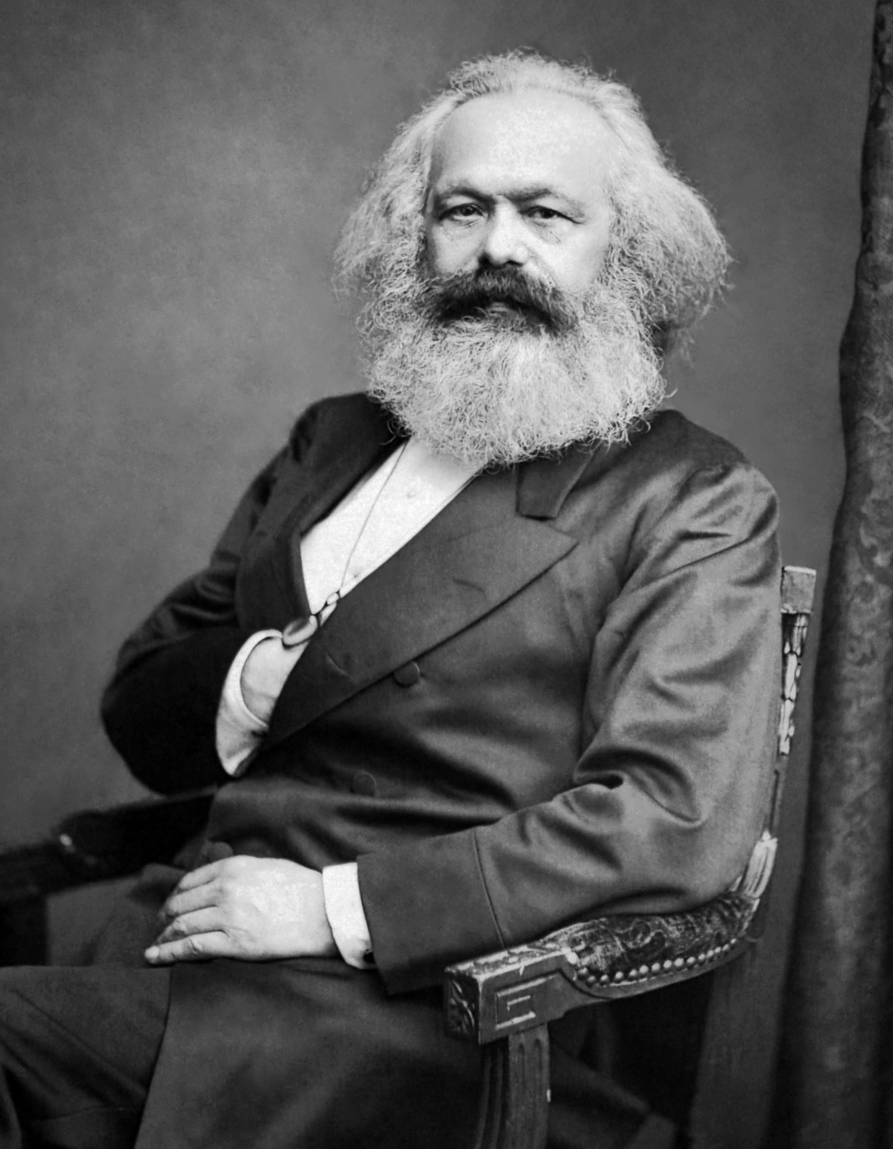
Karl Marx was born in Trier on May 5, 1818, in the Rhineland region of the Kingdom of Prussia. He grew up in an educated middle-class family and received a classical secondary education before entering university. Marx initially studied law, but his intellectual interests increasingly moved toward philosophy, history, literature, and the major political and intellectual debates of nineteenth-century Germany. His early education therefore exposed him to the classical humanistic tradition as well as the rapidly changing intellectual environment of modern Europe.
Marx first attended the University of Bonn and later continued his studies at the University of Berlin. Berlin was one of the most important intellectual centers in Germany, and the philosophy of G. W. F. Hegel remained deeply influential even after Hegel's death in 1831. Marx became increasingly interested in Hegelian philosophy and in the philosophical, political, and religious questions raised by contemporary criticism. His university years marked a decisive movement away from the conventional study of law toward a much broader investigation of philosophy and historical society.
While in Berlin, Marx became involved with intellectual circles influenced by Hegel and began examining the relationship between philosophical ideas, religion, politics, and historical change. He encountered debates concerning idealism, religious criticism, human freedom, and the nature of the state. These debates encouraged him to question whether established institutions could be understood simply through their official principles and stated ideals. Marx increasingly sought explanations that connected philosophical claims with the concrete social and historical circumstances in which people actually lived.
Marx completed his doctoral dissertation in 1841. It compared the ancient philosophies of nature developed by Democritus and Epicurus, demonstrating his serious engagement with classical Greek philosophy. The dissertation examined questions concerning material reality, human freedom, and the philosophical significance of ancient theories of nature. Marx's intellectual career therefore began within academic philosophy long before his name became primarily associated with political economy, communism, revolutionary politics, and the critique of capitalism.
Marx's early education is important because it shows that his later social theory developed from a sustained philosophical engagement rather than appearing suddenly as a political doctrine. His encounter with Hegelian philosophy, classical thought, religious criticism, and the political conditions of nineteenth-century Prussia contributed to the formation of his mature intellectual outlook. Over the following years, Marx would move increasingly from academic philosophy toward journalism, political criticism, economics, and the study of social class. This development eventually produced the distinctive combination of philosophy, history, political economy, and social criticism associated with Marxism.
Karl Marx and the Young Hegelians
During his early intellectual development, Karl Marx became associated with the Young Hegelians, sometimes called the Left Hegelians. This loose intellectual movement used ideas derived from Hegel to criticize religion, traditional authority, and aspects of the existing Prussian political order. Its members believed that critical philosophy could expose contradictions hidden within accepted beliefs and institutions. The movement was not a unified political organization, but rather a network of thinkers engaged in intense debates about religion, philosophy, politics, and human emancipation.
Marx initially shared many of these concerns. Like other Young Hegelians, he was interested in the criticism of religion and in the philosophical question of human emancipation. Religious beliefs could be examined as historical and human phenomena rather than simply accepted as unquestioned authorities. However, Marx gradually became dissatisfied with explanations that treated mistaken ideas or religious consciousness as the deepest source of social problems. He increasingly asked why particular forms of consciousness emerged under particular social and historical conditions.
Marx increasingly argued that criticism had to move beyond consciousness alone and examine the practical circumstances in which people lived. Human beings must work, produce their means of subsistence, enter into relationships with others, and organize social life through particular economic and political institutions. Ideas therefore exist within forms of practical activity rather than floating independently above material life. This shift encouraged Marx to investigate labor, property, social organization, and the historical conditions that shape human relationships.
This transition was crucial to the development of Marx's materialism. Marx did not conclude that ideas were unimportant, nor did he deny that philosophy and consciousness can influence social life. Instead, he rejected the view that history could be adequately explained by ideas acting independently of material and social conditions. His later philosophy increasingly examined how human activity, production, labor, and social relationships shape institutions and forms of consciousness while also being transformed by human historical action.
Marx's break with the Young Hegelian approach therefore represented an important transformation in his method of social criticism. He increasingly believed that philosophical criticism must be connected with an analysis of the institutions and material relationships that organize everyday life. Questions about religion, politics, and consciousness could not be fully understood without examining the social conditions within which those ideas developed. This movement from philosophical criticism toward material and historical analysis became one of the foundations of Marx's mature theory of society.
Karl Marx and Hegel
The philosophy of G. W. F. Hegel was one of the deepest and most lasting influences on Karl Marx. Hegel understood reality and history as dynamic processes involving development, conflict, contradiction, and transformation. Marx retained the importance of historical movement and contradiction while developing a fundamentally different account of the forces shaping social life. Hegel consequently remained both an intellectual influence and a major philosophical opponent whose concepts Marx repeatedly reinterpreted and criticized.
Hegel's philosophy gave a central place to the development of consciousness, spirit, and forms of social self-understanding. Marx increasingly argued that philosophical accounts of history must pay greater attention to the material conditions of human existence. Human beings do not live as pure thinkers: they must eat, work, produce, cooperate, reproduce social life, and organize the material conditions necessary for existence. Marx therefore redirected philosophical attention toward practical human activity and the social relationships through which material life is produced.
Marx therefore did not simply abandon Hegel, nor can his philosophy be reduced to the simple claim that he merely "turned Hegel upside down." Marx remained deeply engaged with Hegelian ideas while criticizing their idealist foundations. He attempted to understand historical contradiction through practical activity and social relationships rather than primarily through the development of ideas or consciousness. His criticism involved transforming the analytical framework inherited from Hegel rather than simply rejecting every element of Hegel's philosophy.
This relationship is especially important for understanding Marx's analysis of history and capitalism. Concepts such as contradiction, development, conflict, mediation, and transformation became important to Marx's intellectual method. Yet Marx applied these concerns to historically specific forms of production and social organization. Capitalism was thus analyzed not as a timeless economic arrangement but as a historically developing social system containing tensions that could produce significant changes in social relationships.
Marx's relationship with Hegel therefore illustrates a broader feature of his philosophy: critical inheritance. Marx took important concepts from an earlier philosophical tradition while changing their meaning and field of application. Hegel's emphasis on historical development helped Marx think about society as a process rather than a fixed structure, while Marx's materialist orientation redirected that analysis toward labor, production, property, class, and social relations. Marxist thought consequently remains deeply connected to the Hegelian tradition even where Marx most strongly rejected Hegel's philosophical conclusions.
Karl Marx and Ludwig Feuerbach
Ludwig Feuerbach was another major influence on Karl Marx's early philosophical development. Feuerbach criticized religion by arguing that human beings project their own powers, ideals, and essential qualities onto the idea of God. Qualities that human beings admire in themselves are imagined as belonging independently and perfectly to a divine being. His critique challenged traditional religious explanations by placing human beings and their own activity at the center of the analysis of religious consciousness.
This critique influenced Marx's developing understanding of alienation. Marx accepted much of Feuerbach's argument that human creations can appear independent from the people who create them. However, Marx became increasingly concerned with explaining the social and material conditions that produce such forms of alienation. Religious alienation could not, in Marx's developing view, be adequately understood without examining the forms of social life that make particular experiences of powerlessness, dependence, and separation possible.
Marx appreciated Feuerbach's rejection of Hegelian idealism and his emphasis on human beings as natural and material creatures. Yet Marx believed that Feuerbach's materialism remained too contemplative because it did not give sufficient importance to practical activity, labor, social relationships, and historical transformation. Human beings are not merely objects of philosophical observation; they actively produce and transform their world. This emphasis on activity became increasingly important to Marx's own understanding of human nature and social change.
Marx's Theses on Feuerbach, written in 1845, represents an important stage in this intellectual development. Marx argued that human beings should not be understood merely as observers who contemplate the world. They actively transform nature and society through practical activity, and philosophical criticism must therefore be connected with an understanding of human practice and historical change. The famous final thesis on Feuerbach expresses this practical orientation by distinguishing between merely interpreting the world and transforming it.
Marx's criticism of Feuerbach helped him move toward a distinctive theory of human activity and historical materialism. Instead of explaining social life primarily through religious projection or abstract philosophical categories, Marx increasingly examined labor, production, cooperation, property, and social relations. This did not mean abandoning Feuerbach's materialist insight that human beings must be understood as real, embodied creatures. Rather, Marx sought to develop that insight into a historical and practical account of how people collectively create and transform their social conditions.
What Was Karl Marx's Philosophy?
Karl Marx's philosophy cannot be reduced to a single doctrine. His thought combines philosophy, history, political economy, political theory, and social criticism. At its center is an attempt to understand how human beings produce their social world through practical activity, labor, cooperation, conflict, and historically changing forms of economic organization. Marx's philosophical questions therefore concern both the structure of society and the possibility of changing that structure through conscious collective action.
Marx rejected explanations of history that treated ideas alone as the primary force behind social development. He argued that people live within concrete material circumstances and that the organization of production plays a fundamental role in shaping social institutions and forms of consciousness. Political and philosophical ideas are therefore connected with historically specific forms of social life. At the same time, Marx's position should not be reduced to crude economic determinism, because human action, political struggle, institutions, and consciousness also participate in historical development.
His philosophy also contains a powerful critique of capitalism. Marx examined wage labor, private ownership of the means of production, the accumulation of capital, class relationships, profit, and the forms of inequality and dependence generated within capitalist society. His analysis sought to show how apparently ordinary economic relationships can contain deeper social relationships involving ownership, power, labor, and distribution. Capitalism was therefore treated as a historically specific social system rather than as a natural or permanent form of economic life.
Marx was also concerned with human freedom and alienation. He asked whether people genuinely control the social conditions they collectively create or whether institutions and economic forces come to dominate the individuals who live within them. Alienation can occur when human productive activity and its products confront individuals as forces independent of their own collective purposes. Marx's concern with alienation consequently connects his early philosophical writings with his later critique of capitalist labor and social organization.
The practical dimension of Marx's thought is equally important. His philosophical project was not limited to interpreting society. Marx sought to understand the historical conditions under which human beings might collectively transform social relationships and overcome forms of domination, exploitation, and alienation. His philosophy therefore joins explanation with critique and historical analysis with the possibility of social transformation. This combination is one reason Marx became influential not only in philosophy but also in sociology, economics, political theory, history, cultural criticism, and social movements.
Karl Marx's Materialist Philosophy
Materialism is central to Karl Marx's philosophy, but Marx's materialism should not be understood simply as the claim that physical matter is the only thing that exists. His philosophical materialism begins with human beings as practical and social creatures who must actively produce the conditions necessary for their existence. The starting point is therefore not an abstract theory of matter but the concrete activities through which human beings live, work, cooperate, and reproduce social life.
Human beings live within concrete material circumstances. They work with nature, use tools, develop skills and technologies, cooperate with others, and create institutions through which production and social life are organized. For Marx, these practical activities provide an essential starting point for understanding history. Before people can engage in philosophy, politics, art, or religion, they must participate in forms of social production that sustain human existence.
Marx therefore emphasized social relations of production. The organization of labor affects relationships between individuals and social groups. Different historical systems create different forms of property, authority, cooperation, dependency, and conflict. A society organized around slavery, feudal obligations, or wage labor will therefore generate different social relationships because people occupy different positions within the organization of production and ownership.
Marx's materialism also differs from a passive view in which human beings are simply determined by external circumstances. People inherit conditions they did not choose, but they also act within those conditions and can collectively transform them. Human activity and material circumstances are therefore connected through a dynamic historical relationship. Individuals are shaped by society, but society itself is continually reproduced and altered through human activity, conflict, cooperation, and collective action.
This approach became the foundation of Marx's broader theory of history. Rather than viewing history primarily as the development of abstract ideas, Marx examined how changing productive capacities and social relationships contribute to the transformation of institutions, political structures, and forms of consciousness. His materialism consequently places labor, technology, production, property, and social organization at the center of historical explanation while still recognizing that politics, culture, and ideas interact with material social conditions.
What Is Historical Materialism?
Historical materialism is the name commonly given to Marx's materialist approach to understanding history. Marx did not present the theory in one single systematic work, and scholars reconstruct it from several writings, especially The German Ideology and the preface to A Contribution to the Critique of Political Economy. The term therefore refers to a broader method of historical and social analysis rather than to a single formula that Marx presented as a complete theory in one text.
The basic idea is that human societies must organize the production of the material conditions necessary for life. People must produce food, clothing, shelter, tools, and other necessities, and this activity requires particular forms of labor, technology, cooperation, and relationships of ownership. The way production is organized consequently becomes an important dimension of historical explanation. Marx's analysis begins from the fact that human beings must actively produce and reproduce the conditions of their existence.
Marx examined these arrangements through concepts such as productive forces and relations of production. Productive forces include human labor, knowledge, tools, technology, and productive capacities, while relations of production concern the social relationships through which production is organized and controlled. These concepts allow Marx to examine how societies organize work and ownership and how those arrangements affect relationships between different social groups.
As productive capacities develop, existing social relationships may eventually come into tension with them. Marx argued that contradictions between productive development and established forms of property or social organization can create pressures for major historical transformation. Such tensions do not necessarily produce immediate or automatic political change, but they can contribute to periods in which established institutions become increasingly difficult to reconcile with changing economic and social conditions.
Historical materialism should not be understood as claiming that every political event, cultural idea, or individual decision has one simple economic cause. The relationship between economic life, politics, culture, ideas, and individual action remains complex and has been interpreted in different ways by Marxists and critics. Marx's historical writings themselves often analyze political struggles, institutions, and contingent events in considerable detail rather than reducing them to a single economic mechanism.
Nevertheless, Marx's central contribution was to insist that history must examine the material and social conditions within which ideas and institutions develop. This approach made economics, labor, technology, property, and social class central subjects in the philosophical study of historical change. Historical materialism consequently encouraged later thinkers to investigate how economic structures interact with political institutions, cultural practices, legal systems, and forms of consciousness across different historical periods.
Karl Marx and Dialectical Materialism
The term dialectical materialism is strongly associated with the Marxist tradition, but an important historical distinction is necessary. Marx himself did not leave behind a single systematic doctrine under that exact name in the form later associated with twentieth-century Marxism. Friedrich Engels and later Marxist thinkers played an important role in developing and systematizing the concept. The expression therefore should not be treated as a straightforward label for a fully developed philosophical system explicitly written out by Marx himself.
Marx nevertheless retained from Hegel the importance of contradiction, development, and historical movement. Social systems are not treated as permanently fixed. They develop through time and contain tensions that can contribute to their transformation. Marx's use of contradiction is particularly significant because he sought to identify tensions internal to actual social relationships rather than treating dialectical conflict as merely a sequence of opposing philosophical propositions.
Marx attempted to analyze contradictions within material and social life. Capitalist society, for example, contains tensions connected with class interests, production, competition, technological development, and the accumulation of capital. These contradictions are historical relationships, not merely conflicts between abstract ideas. They arise within concrete arrangements of labor, ownership, production, exchange, and social power and can influence the ways in which an economic system develops.
A dialectical approach therefore examines society as a process rather than as a collection of isolated and unchanging institutions. Economic systems, political arrangements, and social relationships emerge historically, develop under particular conditions, and can eventually be transformed. This perspective encourages analysis of relationships and processes rather than treating social categories as timeless realities. Capitalism, for example, must be understood through its historical emergence and internal development rather than assumed to be the permanent form of economic life.
It is important not to reduce Marxist dialectics to a mechanical formula in which history automatically passes through predetermined stages. Marx's writings are complex, and philosophers continue to disagree about the precise role that dialectical reasoning plays in his method and theory of history. A careful reading therefore distinguishes Marx's analysis of historical contradictions from later simplified interpretations that turn dialectics into a rigid prediction that every society must follow an identical sequence of historical stages.
Karl Marx's Theory of History
Karl Marx viewed history as a process shaped by changing forms of human production and social relationships. Human societies do not remain permanently organized in the same way because productive capacities, technologies, property relationships, political institutions, and class structures change over time. Historical development therefore involves transformations in the ways people produce their livelihoods and organize cooperation, authority, ownership, and social life.
A central concept in Marx's analysis is the mode of production. A mode of production involves both the productive forces available within a society and the social relationships through which production is organized, including relationships involving property and control. Marx used this framework to distinguish different historical forms of social organization and to investigate the tensions that can arise when productive development changes the conditions under which existing social relationships operate.
Marx examined historical societies partly through the changing relationships between social groups. He was especially interested in societies divided between groups that control important productive resources and groups whose labor is necessary for production. These divisions can affect access to wealth, political influence, security, and social power. Marx therefore treated class relationships as structural relationships connected with the organization of production rather than merely as differences in income or personal status.
Class conflict therefore occupies an important place in Marx's theory of history. Social classes can possess conflicting interests because they occupy different positions within systems of property and production. These conflicts take different forms in different historical circumstances and may involve economic struggles, political movements, legal institutions, or wider conflicts concerning the organization of society. Class conflict is consequently both an economic and a political phenomenon.
Marx's theory should not be treated as a simple universal timetable through which every society must pass in exactly the same sequence. His historical writings contain detailed analyses of particular events and political situations, and these often reveal a more complex and contingent view of history than simplified summaries of Marxism suggest. His theory is better understood as a framework for examining relationships among production, property, class, political institutions, and historical change than as a rigid prediction of every society's future development.
Karl Marx's Base and Superstructure Theory
The concepts of base and superstructure are commonly used to explain Marx's analysis of the relationship between economic life and other parts of society. The economic base refers broadly to the productive forces and relations of production through which a society organizes its material life. This includes the ways in which labor, technology, production, property, and economic relationships are structured within a particular historical society.
The superstructure refers broadly to political and legal institutions and is often discussed alongside cultural, religious, philosophical, and ideological forms of social life. Marx argued that economic relationships play an important role in shaping the wider institutions and forms of consciousness that develop within a society. Political and legal arrangements are therefore not treated as completely independent of the material organization of social life.
This relationship should not be understood as a simple mechanical process in which every political law, philosophical idea, or work of art can be directly reduced to one economic cause. Marx's own writings and later Marxist interpretations have produced extensive debate about the precise relationship between economic structures and other dimensions of society. Politics, law, culture, religion, and intellectual life can possess their own forms of organization and can also influence the development of economic and social relationships.
The broader importance of the theory lies in its challenge to explanations that treat ideas and institutions as existing independently of historical circumstances. Marx encouraged thinkers to examine the connection between social consciousness and material social conditions. Instead of asking only what people believe or what institutions formally claim to represent, his approach asks how those beliefs and institutions relate to the organization of social life and the relationships through which people produce and reproduce their existence.
Political institutions and cultural beliefs develop within particular historical societies. Marx's framework therefore asks not only what people believe, but also how those beliefs relate to the social relationships, institutions, and material conditions in which people live. This makes the base-superstructure model useful as a starting point for studying ideology, law, politics, culture, and economic organization, provided that the relationship is treated as historically complex rather than as a simple one-way causal chain.
What Did Karl Marx Mean by Class Struggle?
Class struggle is one of the most famous concepts in Karl Marx's philosophy. Marx argued that many historical societies have been divided into groups with different relationships to property, labor, and the means through which material life is produced. These divisions are not simply differences in wealth or social prestige; they are connected with people's structural positions within systems of production and ownership.
These groups can possess conflicting interests. A class that controls important productive resources may benefit from maintaining existing property relationships, while groups whose position depends upon selling labor or working under those arrangements may seek better conditions, greater political power, or fundamental social change. The resulting conflicts can appear in everyday economic relations as well as in broader political and social struggles.
Under capitalism, Marx focused especially on the relationship between the bourgeoisie, associated with ownership and control of the means of production, and the proletariat, whose members generally depend upon selling their labor power for wages. This distinction concerns their different positions within capitalist production. The bourgeoisie and proletariat therefore occupy structurally different roles in the production and distribution of wealth, creating the possibility of conflicting economic interests.
Class struggle does not mean that every individual consciously participates in political conflict at every moment. Marx used the concept to describe deeper structural tensions arising from different positions within an economic and social system. Workers and owners may participate in these relationships without continuously understanding them in theoretical terms. Class consciousness, political organization, and collective action can develop historically rather than being automatically present in every member of a social class.
These tensions can appear in struggles over wages, working conditions, political representation, property, and the organization of society itself. Marx believed that class conflict could become a major force of historical transformation when existing social relationships entered into serious contradiction. His concept therefore connects everyday economic struggles with larger questions about political power, ownership, social inequality, and the possibility of transforming the institutions through which production and social life are organized.
Karl Marx: Bourgeoisie and Proletariat
In Marxist theory, the bourgeoisie refers broadly to the capitalist class associated with ownership or control of the means of production. These include productive resources such as factories, machinery, businesses, land, financial assets, and other forms of capital used to organize production. Marx's concept is therefore primarily concerned with a class's economic position within a system of production rather than simply with wealth, lifestyle, or social status.
The proletariat refers broadly to wage workers who do not possess sufficient productive property to support themselves independently and therefore generally depend upon selling their labor power in exchange for wages. Marx regarded the growth of the working class as one of the major social developments associated with industrial capitalism. The proletariat included workers whose daily lives were increasingly organized around factories, machinery, wage contracts, and the discipline of capitalist production.
The relationship between these classes is central to Marx's analysis because their positions within production differ. The capitalist class controls productive resources and organizes production, while workers sell their capacity to labor within enterprises they generally do not own or control. Marx believed that this difference in economic position created structural interests that could conflict over wages, working conditions, working time, ownership, and the distribution of the value generated through production.
Marx did not claim that every society consists only of two perfectly simple classes. His historical and political writings discuss landowners, peasants, small proprietors, professionals, and other intermediate groups whose positions could vary considerably. Nevertheless, the relationship between bourgeoisie and proletariat became central to his analysis of mature capitalist society because these classes represented opposing positions within the organization of capitalist production.
Class, for Marx, was therefore not simply a matter of personal identity or income level. It concerned a person's relationship to property, production, and the organization of economic life. The conflict between bourgeoisie and proletariat became important because Marx believed that capitalism continually reproduced the conditions that separated owners from workers. His analysis of these classes consequently became one of the foundations of his theories of exploitation, class struggle, political conflict, and historical transformation.
Karl Marx's Criticism of Capitalism
Karl Marx's criticism of capitalism is among the most influential aspects of his work. Marx did not simply criticize individual wealthy people or individual employers. He attempted to analyze capitalism as a historically developed economic system organized around commodity production, wage labor, private ownership, competition, markets, and the accumulation of capital. His objective was to understand the structural relationships that make capitalist production possible and reproduce it over time.
Marx recognized capitalism's extraordinary productive power. Industrial development, technological innovation, expanding markets, international commerce, and new forms of cooperation created enormous capacities for producing wealth. He therefore did not treat capitalism as merely a collection of irrational practices. Instead, he emphasized its historically transformative character while asking why a system capable of producing unprecedented wealth could simultaneously generate poverty, insecurity, exploitation, and severe inequalities of economic power.
Marx focused particularly on the social relationships through which capitalist production operates. Workers participate in producing commodities but generally do not own the means of production or control the conditions under which production is organized. Their capacity to work becomes a commodity sold on the labor market, while capital owners control productive resources and direct investment. Marx believed that this institutional arrangement created a structural relationship between capital and labor that could not be explained simply by individual choices.
Marx also argued that competition places continual pressure on capitalist enterprises to increase productivity, reduce costs, introduce new technologies, reorganize labor, and accumulate capital. A capitalist who fails to respond to competitive pressures may lose markets to other enterprises. Consequently, the pursuit of profit is connected with a wider economic dynamic that encourages continuous expansion and technological change. Marx believed these forces could transform both economic life and the social conditions experienced by workers.
Marx believed capitalism contained significant contradictions. It could generate enormous wealth while also producing inequality, economic insecurity, unemployment, alienation, and conflicts between different social interests. His critique therefore combined philosophical questions about freedom and human flourishing with a detailed investigation of political economy. Rather than seeing capitalism as a timeless economic order, Marx treated it as a historical system whose institutions could eventually undergo profound transformation.
What Is Karl Marx's Theory of Alienation?
Alienation is one of Karl Marx's most important early philosophical concepts. Marx used the idea to describe a condition in which human beings become separated from important aspects of their own activity, social existence, or capacity for meaningful self-development. The concept is particularly important because it connects economic organization with philosophical questions concerning freedom, creativity, human relationships, and the possibility of living a genuinely human form of life.
Marx's early writings focus particularly on alienated labor. Under particular conditions, workers may create products that they do not own or control. The product of their own activity can therefore confront them as something external, belonging to another power rather than expressing their own purposes. The worker's productive capacity consequently appears to produce an object that stands apart from and potentially dominates the person who created it.
Marx also argued that workers can become alienated from the process of labor itself. Work may be experienced primarily as an activity required for survival rather than as a freely directed and meaningful expression of human capacities. When the worker has little control over what is produced, how it is produced, or the conditions under which production occurs, labor can become an external necessity rather than an activity through which the individual freely develops and expresses creative powers.
Alienation can also affect relationships between people. Economic relationships may cause individuals to encounter one another primarily as buyers and sellers, employers and employees, owners and workers, or competitors rather than as members of a freely cooperative human community. Marx therefore connected alienation with a broader social condition in which human relationships become mediated by economic institutions and property relationships that individuals themselves may have little ability to control.
Marx's theory of alienation is therefore broader than simple unhappiness at work. It raises philosophical questions about freedom, creativity, human flourishing, labor, and social relationships. Although Marx's later economic writings use a different and more developed vocabulary, the problem of human beings being dominated by social forces they collectively create remained an important theme throughout his work. Alienation consequently provides an important bridge between Marx's early philosophical writings and his later critique of capitalist political economy.
Karl Marx's Theory of Alienated Labor
Marx's theory of alienated labor is especially associated with his Economic and Philosophical Manuscripts of 1844. In these early writings, Marx examines how labor under particular social conditions can become separated from the worker's control and self-development. The concept is philosophical as well as economic because Marx asks what happens to human beings when an activity that could express their productive capacities instead becomes an externally controlled necessity.
One important dimension concerns the product of labor. Workers create goods, yet under capitalist property relationships those products belong to the owners of the productive enterprise. The products of human activity can therefore appear as independent objects controlled by forces outside the worker. Marx saw this as a reversal in which the worker's own productive activity creates objects that confront the worker as something separate and potentially opposed to the worker's interests.
Another dimension concerns the activity of labor itself. When workers have little control over the purpose, organization, rhythm, or conditions of their work, labor can be experienced as an external necessity rather than as freely directed creative activity. The worker may perform labor because it is required for material survival, while the actual organization and purpose of the activity are determined by institutions and individuals outside the worker's direct control.
Marx also connected alienated labor with alienation from other people and from what he called species-being. This difficult concept refers broadly to distinctively human capacities for conscious, social, purposeful, and creative activity. Human beings can reflect upon their activity, cooperate collectively, and consciously shape their environment. Marx believed alienated labor could restrict these capacities by reducing productive activity to an externally organized means of survival.
The theory therefore presents labor as more than a means of earning an income. Marx asks whether the organization of work allows human beings to develop and express their capacities or instead places those capacities under forms of social control that confront workers as external powers. Alienated labor consequently becomes part of Marx's larger philosophical concern with human freedom and the possibility of organizing social production in ways that allow individuals to exercise greater control over their collective activity.
Karl Marx's Philosophy of Labor
Labor occupies a central place in Karl Marx's philosophy because human beings transform nature and create social life through practical activity. Work is not merely an economic necessity; it is also one of the ways through which people develop skills, cooperate with others, and produce the material conditions of civilization. Human beings therefore encounter nature and one another through forms of practical activity that are shaped by historical institutions and social relationships.
Marx was therefore interested in the difference between labor as a human capacity and labor as it is organized under particular historical systems. Human beings have always worked, but the social meaning and conditions of work change according to relationships involving property, technology, power, division of labor, and control. Labor cannot consequently be understood adequately without examining the wider social structure in which productive activity takes place.
Under capitalism, Marx argued, workers generally do not control the means of production or the broader purpose of production. Their capacity to work becomes something sold on the labor market, while the productive process is organized by those who control capital. This arrangement separates workers from important decisions concerning investment, production, technology, workplace organization, and the distribution of the products created through collective labor.
Marx's philosophy of labor is therefore closely connected with freedom. He did not define freedom simply as the absence of government interference. He also asked whether people possess meaningful control over the social and material conditions in which they spend much of their lives working. A society may formally recognize individuals as free while leaving many of the fundamental conditions governing their economic activity outside their effective control.
Labor is consequently central to Marx's broader conception of human flourishing. The issue is not whether human beings should cease producing, cooperating, or transforming nature, but how productive activity should be socially organized. Marx's analysis asks whether labor can become an expression of conscious collective activity or whether it remains dominated by external economic imperatives. This makes his philosophy of labor relevant to questions about technology, workplace organization, economic power, and human freedom.
Karl Marx's Theory of Exploitation
Exploitation is a central concept in Karl Marx's analysis of capitalism. Marx attempted to explain how capitalist enterprises can generate profit even when workers and employers enter into formally legal wage contracts. His theory therefore focuses not primarily on individual dishonesty but on the structural relationship between workers who sell labor power and capitalists who control the means of production.
A crucial distinction in Marx's analysis is between labor and labor power. Labor power refers to the worker's capacity to work, which the worker sells for a wage. Once this capacity is employed within the productive process, Marx argues that the worker can create value beyond the value represented by the wage. The distinction is important because the capitalist purchases the capacity to perform work for a specified period rather than purchasing a predetermined quantity of value.
The difference between the new value produced by labor and the value required, in Marx's account, to reproduce labor power becomes central to the concept of surplus value. Marx regarded the appropriation of this surplus as fundamental to the generation of capitalist profit. Exploitation therefore refers to a structural process through which the productive activity of workers generates a surplus that is appropriated within capitalist property relationships.
Marx's argument does not depend simply on the claim that employers are personally dishonest or that every wage contract involves obvious coercion. His theory attempts to identify a structural relationship within capitalist production itself, arising from the separation between workers and the means of production. Workers may voluntarily enter contracts while still occupying an economic position in which selling labor power is necessary for obtaining the means of subsistence.
Marx's theory of exploitation has been extensively debated by economists and philosophers. Supporters and critics disagree about his labor theory of value and about the relationship between value, prices, wages, and profit. Nevertheless, exploitation remains fundamental to the structure of Marx's critique of capitalist political economy. The concept continues to influence debates about labor markets, economic inequality, workplace power, and the relationship between ownership and productive activity.
What Is Karl Marx's Theory of Surplus Value?
Surplus value is one of the most important concepts in Karl Marx's analysis of capitalism. Marx developed the concept to explain how profit can arise within a system in which workers sell their labor power as a commodity. Rather than beginning with the assumption that profit is simply the reward for entrepreneurial activity, Marx attempted to trace how capitalist production generates a surplus from the organization of labor and property.
According to Marx's analysis, workers sell their capacity to work for a wage. The value of labor power is connected with the socially necessary means required to reproduce that capacity under particular historical conditions. Yet during the working day, workers can produce new value beyond the value represented by their wages. This distinction between labor power and the value created through its use is essential to Marx's explanation of capitalist production.
Marx called this additional value surplus value. In his account of capitalist production, the capitalist appropriates this surplus, making it central to profit and the accumulation of capital. Surplus value is therefore closely connected with exploitation because the worker's productive activity generates more value than is returned to the worker in the form of wages under the capitalist relationship.
Marx distinguished between different ways in which surplus value can be increased. These include extending the working day and increasing productivity through technological development or changes in the organization of production. His distinction between different forms of surplus-value production helped him analyze how changes in technology, working time, productivity, and labor organization affect the relationship between workers and capital.
Surplus value connects several major Marxist concepts, including labor, exploitation, profit, accumulation, technology, and class relations. It therefore occupies a central place in Marx's attempt to explain the economic mechanisms through which capitalist production reproduces and expands itself. Even where economists reject Marx's value theory, the concept remains historically important for understanding his broader critique of capitalism and the relationship between productive activity and economic power.
Karl Marx's Theory of the Commodity
The commodity is the starting point of Marx's analysis in Das Kapital. In Marx's specific sense, a commodity is an external object capable of satisfying some human need and produced for exchange within a system of commodity production. By beginning with the commodity, Marx sought to uncover the basic social relationships underlying a mature capitalist economy rather than beginning with abstract assumptions about markets as timeless institutions.
Marx distinguished between use value and exchange value. Use value concerns the usefulness of a thing in satisfying some need, while exchange value concerns the quantitative relationships through which commodities are exchanged against one another. A commodity can therefore have practical usefulness while simultaneously participating in a social system in which its exchange relationships are determined through market processes.
Marx's analysis then moves beyond the ordinary appearance of market exchange. Commodities seem to enter into relationships through prices and markets, but behind these relationships are human beings engaged in labor, production, ownership, and historically developed forms of social cooperation. Marx wanted political economy to investigate these underlying relationships rather than accepting the market appearance of economic life as self-explanatory.
The commodity is therefore important because it allows Marx to investigate how social relationships can appear in economic form. His analysis asks how relations between people become expressed through relationships between products, money, and market exchange. This question becomes especially important when Marx examines commodity fetishism, because the social character of production can become obscured by the apparent independence of commodities and prices.
Marx's theory of the commodity consequently provides the conceptual starting point for his wider analysis of capitalism. From the commodity he develops an examination of value, money, labor power, surplus value, and capital accumulation. The commodity is therefore not simply an ordinary object bought in a marketplace; in Marx's analysis, it is a key form through which the social organization of capitalist production becomes visible.
What Is Commodity Fetishism?
Commodity fetishism is one of Karl Marx's most famous concepts from Das Kapital. Marx used the concept to describe the way social relationships between people can appear within capitalist society as relationships between things. The concept is therefore concerned with a form of social appearance: economic objects seem to possess relationships and powers independently of the human labor and social organization that produced them.
Commodities enter markets with prices and exchange relationships that can appear natural or independent. Yet the production and exchange of those commodities depend upon complex human relationships involving labor, ownership, institutions, technology, and social power. Marx's analysis attempts to make these relationships visible by showing that apparently objective economic forms are connected with historically specific forms of social cooperation.
Marx's argument is not simply that people incorrectly admire material possessions. Commodity fetishism refers more specifically to the way the social character of human labor can become hidden behind the apparent economic relationships of commodities themselves. People encounter prices and exchange values as objective features of economic life, even though those forms depend upon human production and historically organized relationships between producers.
The concept therefore attempts to reveal the historical and social structure behind apparently ordinary economic objects. Social arrangements created by human beings can appear natural, objective, and independent of human activity. This is significant for Marx because it helps explain why social structures can acquire an appearance of inevitability even though they are historically produced and maintained through human practices.
Commodity fetishism has had a major influence beyond economics. Philosophers, sociologists, cultural theorists, and critics of consumer society have used Marx's analysis to investigate how commodities can acquire symbolic and social power within modern forms of life. The concept has consequently become an important part of later discussions about consumer culture, advertising, globalization, markets, and the ways in which social relationships can be mediated through commodities.
Karl Marx on Private Property
Karl Marx's criticism of private property is often misunderstood. Marx's central concern in his critique of capitalism was not simply with every form of personal possession. He focused particularly on private ownership of the means of production and the social relationships created by that ownership. His argument therefore concerns the economic power attached to productive property rather than the ordinary possession of personal objects.
Means of production can include factories, machinery, land, productive infrastructure, and other resources used to organize labor and produce wealth. Marx argued that when these resources are controlled by one social class while another must sell its labor power in order to live, major inequalities of economic power can develop. Ownership consequently affects not only the distribution of wealth but also who exercises authority over production.
Property relationships therefore became central to Marx's analysis of class society. They influence who controls production, who directs labor, who receives the products of production, and how the benefits generated by collective social activity are distributed. Because production is necessarily cooperative on a large scale, Marx was interested in the tension between socially organized productive activity and privately controlled productive resources.
Marx connected capitalist property with his broader theories of alienation and exploitation. His argument was not merely a moral objection to ownership itself, but an attempt to analyze how particular historical forms of property shape relationships between classes and organize the economic life of society. Private ownership of productive assets gives owners forms of economic power that affect the conditions under which workers must sell their labor power.
Marx's criticism of private property was consequently part of a broader argument about the organization of social production. He believed that changing property relationships would be necessary for overcoming forms of class domination associated with capitalism. His analysis later became central to socialist and communist traditions, although different movements interpreted the meaning of collective ownership and the practical organization of productive resources in very different ways.
Karl Marx's Theory of Ideology
Ideology plays an important but complex role in Marxist philosophy. Marx did not leave behind one single, fully systematic theory of ideology, and scholars continue to debate how the concept should be interpreted across his different writings. The term is therefore best understood through the broader relationship Marx explored between social structures, material life, political institutions, and forms of consciousness.
In a broad sense, Marx was interested in how systems of ideas can explain, justify, or obscure existing social relationships. Human beings do not encounter society from a completely neutral position. Their beliefs develop within particular institutions, traditions, political arrangements, economic relationships, and historical circumstances. Ideas are therefore connected with the social environments in which people live and act.
Marx's critical use of ideology is especially concerned with forms of consciousness that make historically created social relationships appear natural, eternal, or unavoidable. When this happens, people may fail to recognize that existing institutions were created under particular historical conditions and can potentially be transformed. Ideological forms of thought can consequently contribute to the reproduction of existing social arrangements.
Marx also connected ideology with class-divided societies and the relationship between dominant social ideas and dominant social powers. However, ideology should not be understood simply as a collection of deliberate lies invented by powerful individuals. Social beliefs can be widely shared and sincerely accepted while still presenting a misleading understanding of social reality. This makes ideology a deeper problem than intentional propaganda alone.
Later Marxist thinkers developed the concept of ideology in many different directions. It became especially important in twentieth-century philosophy, sociology, political theory, and cultural criticism, where thinkers continued to investigate the relationship between ideas, power, social institutions, and material life. Marx's analysis consequently became a foundation for later debates about culture, ideology, consciousness, political legitimacy, and social reproduction.
What Did Karl Marx Say About Religion?
Karl Marx's views on religion are frequently summarized through his famous description of religion as the "opium of the people." However, this phrase is often presented without the broader philosophical context of Marx's discussion. Marx did not simply dismiss religion as meaningless superstition. He understood it as a human response to a world marked by suffering, inequality, alienation, and social powerlessness. Religious consciousness therefore had to be understood in relation to the conditions in which people actually lived.
Marx viewed religion partly as a response to human suffering and difficult social conditions. Religious belief could provide comfort, hope, and meaning to people experiencing hardship, while Marx also believed it could encourage people to seek solutions outside the material conditions responsible for their suffering. Religion could therefore function both as an expression of genuine suffering and as a form of consolation within an unequal society. His criticism was consequently connected with the social causes of suffering rather than directed only at religious doctrines.
His criticism of religion was therefore connected with his broader theory of alienation. Marx was strongly influenced by Ludwig Feuerbach's criticism of religion, but he went beyond Feuerbach by asking why human beings become religiously alienated in the first place. Marx believed that criticism should not stop after challenging religious beliefs; it should also investigate the social conditions that make particular forms of suffering and alienation possible.
For Marx, simply persuading people to abandon religion would not eliminate the conditions that made religious consolation attractive. The deeper task was the transformation of social life itself. His criticism of religion was therefore ultimately connected with a broader project of human emancipation: creating social conditions in which people would possess greater control over their collective and material lives rather than relying upon religious consolation for problems rooted in social arrangements.
Marx's analysis of religion has consequently remained influential and controversial. Some readers interpret it primarily as a critique of religion, while others emphasize his insight into the relationship between belief, suffering, alienation, and social structure. Whatever interpretation is preferred, religion in Marx's thought cannot be separated from his broader attempt to understand how human beings respond to social conditions and how those conditions might be transformed.
Karl Marx's Theory of the State
Karl Marx was deeply interested in the relationship between political power and economic society. His writings examine the modern state, political institutions, citizenship, law, and the ways political life interacts with social class. For Marx, political institutions could not be fully understood in isolation from the wider social and economic relationships within which they developed. The state was therefore part of a historically organized social world rather than an institution existing completely outside economic life.
Marx did not develop one completely simple theory of the state that applies identically to every historical situation. Different writings emphasize different relationships between political institutions, class power, and economic structures. In some passages, the state appears closely connected with the interests of the economically dominant class; in others, Marx analyzes states that possess considerable independence from direct class control. This complexity is important because it prevents Marx's theory from being reduced to a simple claim that governments mechanically obey individual capitalists.
More broadly, Marx believed that political institutions should be understood historically. States do not exist outside social and economic relationships, and political conflicts are often connected with deeper struggles involving property and class. This did not mean that every political decision could be reduced mechanically to an economic cause, but it meant that political power had to be studied within its wider material and historical context. Political institutions could also mediate conflicts between different social groups and interests.
Marx also distinguished political emancipation from a deeper form of human emancipation. The granting of legal rights and citizenship could represent important political progress, but Marx argued that formal equality before the law could coexist with substantial inequalities in economic and social life. His criticism therefore examined the limits of political equality within societies divided by property and class. Legal freedom, in his analysis, did not automatically eliminate economic dependence or social domination.
His analysis of the state became highly influential in later Marxist political theory. Marxists have continued to debate whether the state primarily represents class interests, possesses relative independence, or performs multiple and changing functions within capitalist society. These debates demonstrate that Marx's own writings on the state are complex and cannot be reduced to the claim that governments simply obey the direct commands of wealthy individuals. His approach instead encourages analysis of institutions within their broader historical and social structures.
What Did Karl Marx Mean by Communism?
Communism, in Karl Marx's philosophy, refers broadly to the possibility of a future classless society in which major forms of economic domination and exploitation have been overcome. Marx believed that such a society would require a fundamental transformation of existing capitalist property relationships and the social divisions connected with them. Communism was therefore connected with the abolition of class domination and a different organization of social production.
Marx was notably reluctant to provide a detailed blueprint describing every institution of a future communist society. He criticized approaches that attempted to design a complete ideal society in advance without sufficiently analyzing historical and material conditions. For Marx, communism was not primarily a finished model waiting to be imposed upon society from outside. It was associated with a historical transformation emerging from contradictions within existing forms of social production.
His concept of communism was closely connected with the possibility of overcoming alienation. Marx imagined a form of social life in which human beings could exercise greater collective control over the conditions of production and develop their capacities more freely. Productive activity would no longer be organized primarily through social relationships dominated by private capital and class division. The transformation of production was therefore also connected with the transformation of human social relationships.
Marx did, however, make some important distinctions concerning the development of communist society. In the Critique of the Gotha Programme, he discussed a lower phase of the new society and a higher phase associated with the principle that individuals contribute according to their abilities and receive according to their needs. These remarks remain among his most important discussions of a future post-capitalist society, although Marx left many institutional questions deliberately unresolved.
The political history of twentieth-century states that described themselves as communist is complex and cannot simply be treated as identical with everything Karl Marx personally proposed. Marx's original philosophical writings remain the subject of continuing debate concerning how his concept of communism should be interpreted, particularly because he deliberately left many institutional questions unresolved. A careful distinction is therefore necessary between Marx's writings and the subsequent political traditions and states that claimed to act in his name.
Karl Marx and Revolution
Revolution was an important part of Karl Marx's theory of social change. Marx believed that major contradictions within existing social systems could create conditions in which established political and economic relationships were challenged and transformed. Revolutionary change was therefore connected, in his thought, with broader historical conflicts rather than merely with sudden acts of rebellion. Revolution had to be understood within the development of social classes and political institutions.
His theory of revolution was closely connected with class struggle. Marx believed that the working class could become a political force capable of challenging capitalist ownership and existing structures of power. This possibility depended upon collective organization, political consciousness, and the historical conditions created by capitalist forms of production. Class struggle could therefore move from economic conflicts over working conditions toward broader political struggles over the organization of society.
However, Marx's writings on revolution developed across different historical circumstances. He examined revolutions, political movements, and class conflicts rather than presenting one completely uniform strategy applicable to every country and historical period. His detailed studies of France, for example, show considerable attention to political institutions, alliances, leadership, and changing balances of social power. Revolution was consequently treated as a concrete historical process rather than as a simple formula.
Marx also recognized that political transformation involved difficult questions concerning the transition from one form of society to another. His writings contain references to the political rule of the working class during a transitional period, but the precise meaning and institutional implications of these ideas have been debated extensively by later Marxists and historians. Marx did not provide a single detailed constitutional model explaining exactly how such a transition would operate in every society.
Revolution, for Marx, was therefore not simply a moral command that people should overthrow existing governments. It formed part of a historical analysis of how social systems generate conflicts and how human beings, acting collectively, can participate in transforming the conditions under which they live. His theory combines structural analysis with human agency, emphasizing that historical circumstances constrain action while collective political activity can also alter those circumstances.
Karl Marx and The Communist Manifesto
The Communist Manifesto, written by Karl Marx and Friedrich Engels, is one of the most famous political texts in modern history. Published in 1848, it presents a powerful account of class struggle, capitalism, the bourgeoisie, and the revolutionary potential of the working class. The text was written in the context of major political tensions that soon contributed to revolutionary movements across Europe. Its concise and forceful style helped make it one of the most influential political pamphlets of the nineteenth century.
The text argues that the development of modern capitalism transformed societies across the world. The bourgeoisie played a historically revolutionary role by expanding industry, commerce, and global markets, while also creating new forms of social and economic dependence. Marx and Engels emphasized capitalism's extraordinary capacity to transform traditional institutions and continuously change the conditions of social life. Their analysis therefore recognized capitalism as both historically disruptive and economically productive.
Marx and Engels argued that capitalism also created the proletariat, a class whose position within the economic system could generate collective opposition to capitalist property relationships. The manifesto therefore connects economic development with political struggle. Its central historical argument is that class conflict is a major force in the transformation of societies. The working class becomes politically significant because its collective position is tied directly to the organization of capitalist production.
The Manifesto is also notable because its attitude toward capitalism is not simply one of rejection. Marx and Engels recognized its enormous productive and transformative power while simultaneously criticizing the instability, inequality, exploitation, and class conflict associated with capitalist development. This tension remains central to Marx's wider analysis of modern society. Capitalism is portrayed as a historically revolutionary system that destroys older arrangements while simultaneously creating new forms of domination.
The Communist Manifesto remains one of the most widely read works associated with Marxism. Its influence extends beyond philosophy into politics, history, sociology, economics, and revolutionary movements around the world. Although written for a specific political moment, its analysis of globalization, economic transformation, and class conflict continues to generate discussion and disagreement. Its historical importance rests both on its arguments and on the enormous political influence it acquired after publication.
Karl Marx's Das Kapital
Das Kapital, also known as Capital, is Karl Marx's major work of political economy. The project attempts to analyze the internal structure and historical development of the capitalist mode of production. Rather than treating capitalism as a natural and permanent economic order, Marx examined it as a historically developed system with particular institutions, social relationships, and contradictions. The work combines economic analysis with a broader philosophical investigation of the social forms through which capitalist life is organized.
Marx begins his analysis with the commodity and gradually examines value, money, labor power, surplus value, machinery, accumulation, competition, and the larger movement of capital. His goal was not simply to describe individual market transactions but to understand capitalism as an interconnected social system in which production, exchange, ownership, and class relationships influence one another. The movement from commodity to capital allows Marx to investigate how apparently ordinary economic categories are connected with deeper social relationships.
One of the central concepts of Das Kapital is surplus value. Marx argued that workers sell their labor power for wages while their productive activity can generate value beyond the value represented by those wages. He used this analysis to explain what he regarded as the structural basis of profit and exploitation within capitalist production. Surplus value consequently connects his theories of labor, class, capital accumulation, and the organization of the working day.
Marx also examined the dynamic character of capitalism. Competition encourages capitalists to increase productivity, introduce new technologies, reorganize labor, and expand production. These processes can produce extraordinary economic development, but Marx argued that they can also generate instability, economic crises, unemployment, and increasingly concentrated forms of economic power. Capitalism therefore appears in Das Kapital as a dynamic system characterized by continual transformation rather than as a static equilibrium.
The first volume of Das Kapital was published during Marx's lifetime in 1867. Later volumes were prepared and published after his death from his manuscripts, with Friedrich Engels playing a major role in editing and publishing the material. The unfinished character of the larger project has contributed to continuing debates about Marx's economic theory and the relationship between its different volumes. Nevertheless, Das Kapital remains one of the most important and influential works in the history of economic and social thought.
Karl Marx and Friedrich Engels
Friedrich Engels was Karl Marx's closest intellectual collaborator and one of the most important figures in the development of Marxism. Their partnership lasted for decades and involved philosophical discussion, political activism, writing, and economic support. Engels was not merely an assistant to Marx but an important thinker whose own writings contributed significantly to their shared intellectual tradition. His independent work also provided important observations about industrial society and the condition of the working class.
Marx and Engels collaborated on several important works, including The German Ideology and The Communist Manifesto. Together they developed important elements of the materialist approach to history and society. Their collaboration helped shape the language through which later generations would understand concepts such as class struggle, historical development, capitalism, and communism. Their joint writings also contributed to the formation of the intellectual tradition later called Marxism.
Their intellectual relationship was strengthened by Engels's early investigations into industrial society. His observations concerning the condition of the English working class and his knowledge of political economy provided important material for their discussions of capitalism. At the same time, Marx's philosophical and economic investigations deeply influenced Engels's own theoretical development. Their correspondence and collaboration reveal an extended intellectual partnership rather than a relationship in which only one thinker generated ideas.
Engels also played a major role after Marx's death by organizing, editing, and publishing material associated with later volumes of Das Kapital. The development of Marxism therefore cannot be understood entirely without considering Engels's own contributions. His editorial decisions and interpretations helped shape how Marx's unfinished economic manuscripts were presented to later readers and consequently influenced the subsequent history of Marxist theory.
Later interpretations have sometimes debated how closely particular ideas associated with "Marxism" represent Marx himself, Engels, or the subsequent tradition that developed from both thinkers. This distinction matters because Marx and Engels shared many fundamental commitments but were not identical thinkers. Studying their collaboration together with their individual writings provides a more accurate understanding of the origins and later development of Marxist philosophy.
Major Works of Karl Marx
Karl Marx wrote philosophical, political, historical, and economic works throughout his life. Some were written independently, while others were produced in collaboration with Friedrich Engels. His writings range from the philosophical investigations of his early period to detailed studies of capitalism, class conflict, political revolution, and the historical development of modern society. Together, these works reveal the development of Marx's thought across different stages of his intellectual career.
Marx's early writings are particularly important for understanding his philosophical concerns with human freedom, alienation, labor, religion, materialism, and social relations. Texts such as the Economic and Philosophical Manuscripts of 1844 show his engagement with German philosophy and his developing criticism of alienated labor. Other early works demonstrate his movement away from purely philosophical criticism toward a broader analysis of social and historical structures.
His political writings became increasingly concerned with class struggle, revolution, the state, and the historical development of capitalism. The Communist Manifesto is the clearest example of this political orientation, while works such as The Eighteenth Brumaire of Louis Bonaparte demonstrate Marx's ability to analyze concrete political events rather than relying only on abstract historical claims. These writings remain important for political theory and historical analysis.
Marx's mature economic investigations reached their most extensive form in Das Kapital. There he developed a systematic critique of capitalist political economy through concepts such as commodity, value, labor power, surplus value, accumulation, and capital. The project remained unfinished at his death, and later volumes were edited from his manuscripts. Nevertheless, the work became one of the foundational texts of modern critical political economy.
Reading Marx's major works together is important because no single text represents the entirety of his philosophy. His concepts developed across different periods and genres, and some terminology changed substantially between his early philosophical writings and later economic analysis. The following works provide a useful foundation for studying Marx's theories of history, labor, capitalism, politics, ideology, and social transformation.
- The Communist Manifesto — A major political text written with Friedrich Engels concerning class struggle, capitalism, and communism.
- Das Kapital — Marx's major analysis of capitalism, commodities, labor, surplus value, and capital accumulation.
- The German Ideology — An important work associated with the development of Marx and Engels's materialist conception of history.
- Economic and Philosophical Manuscripts of 1844 — Famous for Marx's early theory of alienation and alienated labor.
- Theses on Feuerbach — Short philosophical theses concerning materialism, human activity, and the transformation of the world.
- The German Ideology — A major text examining history, ideology, material production, and the criticism of earlier German philosophy.
- The Eighteenth Brumaire of Louis Bonaparte — A historical and political analysis of class conflict and political power in nineteenth-century France.
- Critique of the Gotha Programme — An important later work discussing socialism, communism, and the principles of social organization.
Karl Marx's Main Philosophical Ideas
1. Historical Materialism
Human history is strongly connected with material life, production, technology, labor, and the social relationships through which people organize economic activity. Marx's materialist approach encouraged the study of how changing productive forces and property relationships influence political institutions, social structures, and systems of thought. History therefore cannot be understood adequately by examining ideas alone without considering the material conditions within which those ideas develop.
Historical materialism is concerned with the ways human beings produce the necessities of life and organize cooperation around production. Marx examined relationships involving labor, property, technology, and the division of labor because these relationships affect the wider structure of society. Changes in productive capacities can place pressure on existing social institutions and contribute to transformations in political and economic organization.
Marx's materialism does not mean that ideas are completely unimportant or that every historical event has one simple economic cause. Political institutions, legal systems, culture, religion, and philosophy can have their own forms of influence. His broader methodological point is that these forms of consciousness and institutions should be examined in relation to the social and material conditions through which they emerge and operate.
Historical materialism is therefore a method for investigating social change rather than merely a prediction about the future. Marx used it to examine different forms of society and the conflicts that arise within them. Capitalism, from this perspective, is one historically specific mode of production rather than an eternal or natural organization of economic life. Its institutions developed under particular historical conditions and could consequently undergo further transformation.
The influence of historical materialism extends far beyond Marxist philosophy. Historians, sociologists, political theorists, and economists have debated the extent to which economic structures shape political and cultural life. Even interpretations that reject Marx's stronger claims often engage with his insistence that material production, property, and labor deserve a central place in explanations of historical development.
2. Class Struggle
Different social classes can possess conflicting interests because of their different relationships to property and the means of production. Marx saw class conflict as an important force in historical change, although the particular classes and forms of conflict vary across different historical societies. Class is therefore not simply a category based on income but a relationship to economic production, ownership, and social power.
In capitalist society, Marx gave particular attention to the relationship between the bourgeoisie and the proletariat. The bourgeoisie controls or owns productive capital, while the proletariat generally depends upon selling labor power for wages. Their different positions within production can generate conflicts concerning working conditions, wages, working time, ownership, and the distribution of economic resources.
Class struggle does not necessarily appear only as an open revolutionary confrontation. It can take many forms, including disputes over wages, workplace organization, political representation, legislation, property, and economic policy. Marx's analysis therefore treats class conflict as a continuing feature of social life within societies whose economic structures generate competing interests.
Marx also recognized that social classes are not always internally unified or perfectly separated. Peasants, small proprietors, professionals, landowners, and other groups can occupy intermediate or changing positions. Political alliances can therefore become complicated, and historical outcomes cannot be explained by assuming that every individual automatically acts according to a simple class identity.
Class struggle is nevertheless central to Marx because it connects economic structure with historical agency. People inherit social positions created by existing institutions, but they can also organize collectively and challenge those institutions. Marx's concept of class struggle consequently combines structural analysis with political action and provides one of the foundations of his theory of historical transformation.
3. Alienation
Under particular social conditions, workers can become separated from the products of their labor, the activity of work, other people, and important aspects of human self-development. Marx's early analysis of alienation examined how productive activity can become something experienced as external, compulsory, and controlled by forces created through human social relationships. Alienation therefore concerns the quality of human existence rather than merely the amount of economic dissatisfaction.
Alienation from the product of labor occurs when workers create objects that belong to others and confront those objects as external powers. Alienation from the activity of labor concerns the experience of work itself when workers have little control over its purpose or organization. These dimensions show how Marx connected economic institutions with questions about freedom, creativity, and the individual's relationship to productive activity.
Marx also connected alienation with relationships between people. Under particular economic conditions, individuals can encounter one another primarily through relationships of exchange, employment, ownership, and competition. Social relationships that could potentially be cooperative can therefore become mediated by economic structures that appear independent of the individuals participating in them.
The concept of alienation is particularly important because it reveals the philosophical dimension of Marx's critique of capitalism. Marx was not concerned only with the quantity of wealth produced or the distribution of income. He also asked what kind of human beings social institutions encourage people to become and whether productive activity allows individuals to develop their capacities through conscious and meaningful participation.
Although Marx's later writings developed a different economic vocabulary, alienation remains an important interpretive theme in Marx scholarship. It continues to influence philosophical discussions about work, technology, bureaucracy, consumer society, and human freedom. The concept is especially useful for understanding Marx as a philosopher concerned not only with economic structures but also with the forms of human life those structures produce.
4. Criticism of Capitalism
Marx analyzed capitalism as a historically developed economic system based on commodities, wage labor, private ownership, competition, and the accumulation of capital. His criticism emphasized both capitalism's remarkable productive capacities and the social problems he believed were generated by its class structure and relentless drive for accumulation. Capitalism was therefore neither simply condemned as irrational nor celebrated as permanently progressive.
Marx recognized that capitalism dramatically increased productivity, expanded markets, encouraged technological innovation, and transformed traditional social structures. These developments gave capitalism a historically revolutionary character. At the same time, Marx argued that the benefits of productive development were distributed within unequal property relationships, producing conflicts between capital owners and wage workers.
His criticism therefore focused on the organization of production rather than merely on individual acts of greed. Competition places pressure on enterprises to increase productivity, lower costs, and accumulate capital. Workers consequently participate in an economic system whose pressures can affect wages, employment, technology, working time, and workplace organization even when individual employers and employees make voluntary decisions.
Marx also examined the instability of capitalist development. Capital accumulation can encourage rapid expansion and technological change while simultaneously producing tensions involving markets, employment, investment, and profitability. His analysis of these dynamics contributed to later debates about economic crises and the cyclical character of capitalist economies, although interpretations of Marx's crisis theory vary substantially.
The criticism of capitalism therefore combines economic, social, and philosophical dimensions. Marx asks how an economic system can generate extraordinary wealth while also producing forms of dependence, exploitation, alienation, and unequal power. His critique became one of the most influential attempts to analyze capitalism as a total social system rather than simply as a mechanism for buying and selling goods.
5. Surplus Value
Marx argued that capitalist profit is connected with the difference between the value created through labor and the value returned to workers as wages. His theory of surplus value was intended to explain exploitation structurally, rather than treating unequal outcomes simply as the result of individual dishonesty or unfair market exchanges. The concept is built upon Marx's distinction between labor power, which workers sell, and the labor performed through the use of that capacity.
Labor power becomes a commodity when workers sell their capacity to work for a wage. Marx argued that the value of this commodity is related to the socially necessary means required to reproduce the worker's capacity for labor. During the working day, however, the worker can create new value beyond the value represented by the wage. This difference is central to Marx's explanation of surplus value.
Marx distinguished different ways in which surplus value can be increased. One involves extending the working day, while another involves increasing productivity so that more goods can be produced within a given period. Technological development, changes in workplace organization, and productivity improvements therefore become relevant to Marx's analysis of capitalist accumulation and the relationship between capital and labor.
Surplus value also connects the individual workplace with the wider capitalist economy. Capitalists reinvest part of the surplus in production in order to expand their capital and compete with other enterprises. This process of accumulation creates continuing pressure for technological innovation, productivity growth, and expansion. Marx consequently treats surplus value as part of a dynamic process rather than simply as a static transfer of wealth.
Marx's theory of surplus value became one of the most debated elements of his political economy. Critics have challenged his labor theory of value and the relationship between labor values and market prices, while defenders have interpreted surplus value as a broader account of exploitation and class power. Regardless of these disagreements, surplus value remains essential for understanding Marx's explanation of profit, capital accumulation, and capitalist class relations.
6. Ideology
Social beliefs and systems of thought can help explain or justify existing institutions while also obscuring the historical conditions that created them. For Marx, ideology was connected with the stability of class-divided societies because widely accepted ideas could make historically specific social arrangements appear natural, permanent, or universally justified. Ideology therefore concerns the relationship between consciousness and the social structures in which consciousness develops.
Marx's analysis does not require ideology to be a deliberate conspiracy. Individuals and institutions can sincerely accept ideas that nevertheless provide an incomplete or distorted understanding of social relationships. Because people experience social institutions as part of ordinary life, historically produced arrangements can appear simply as the natural order of things rather than as outcomes of particular forms of social organization.
Ideology is consequently connected with power, but power does not operate only through direct coercion. Social institutions, education, political discourse, cultural practices, and economic relationships can influence what people regard as normal or possible. Marx's approach encourages critical examination of the assumptions through which existing social arrangements are interpreted and legitimized.
The concept also helps explain why social transformation can be difficult. If people understand historically specific institutions as permanent or inevitable, they may find it difficult to imagine alternatives. Marx's critical project therefore attempts to expose the historical character of social relationships so that institutions appearing natural can be recognized as human creations capable of change.
Later Marxist traditions greatly expanded the analysis of ideology. Thinkers examined culture, mass media, education, language, political institutions, and popular consciousness in ways that went beyond Marx's own formulations. The resulting tradition became important to critical theory and cultural studies, where ideology continues to be analyzed as a mechanism through which social meanings and forms of power can be reproduced.
7. Social Transformation
Marx believed that social systems are historically created rather than eternal. Because they are historically created, they can also be transformed through human collective activity. This idea combines structural analysis with an emphasis on human practice: people are shaped by historical circumstances, but they also participate in changing those circumstances. Marx therefore rejected both the idea that individuals are completely free from social structures and the idea that human action is completely irrelevant to historical change.
Social transformation begins from existing material conditions rather than from an entirely abstract ideal. People inherit institutions, property relationships, technologies, political structures, and patterns of social cooperation. These conditions influence what forms of action are possible, but they can also contain contradictions and conflicts that create opportunities for transformation.
Class struggle is one of the principal mechanisms through which Marx understands this transformation. When groups occupy different positions within systems of production, conflicts can emerge over property, authority, wages, political representation, and the organization of work. Under particular historical circumstances, such conflicts can become broad political movements capable of challenging existing institutions.
Marx's emphasis on practice also means that theory should not be separated completely from social activity. Understanding the structures of society can help human beings recognize the possibilities and limitations of collective action. His famous emphasis on changing the world expresses this connection between philosophical interpretation and practical transformation.
Social transformation in Marx's thought is therefore neither automatic nor purely voluntary. Historical conditions create pressures and possibilities, while organized human beings act within those conditions. This combination of structure and agency is one reason Marx's philosophy has remained influential in social theory. It provides a framework for asking how historically inherited institutions can constrain human life while still remaining open to collective change.
What Is Marxism?
Marxism refers broadly to the intellectual, philosophical, political, and economic traditions influenced by the work of Karl Marx and Friedrich Engels. Marxism developed into many different schools of thought rather than remaining one completely uniform doctrine. Different Marxist thinkers have interpreted Marx's writings in significantly different ways, particularly concerning economics, political organization, revolution, culture, the state, and the possibility of socialism.
Major themes within Marxism include historical materialism, class struggle, criticism of capitalism, ideology, exploitation, labor, and the possibility of socialist or communist social transformation. However, Marxism also developed methods for studying history, culture, politics, and consciousness, making it much broader than a single economic theory. Its influence therefore extends across philosophy, sociology, political science, economics, history, and cultural criticism.
Later thinkers developed Marxist philosophy in different directions. Some emphasized economics and class, while others focused on culture, ideology, psychology, colonialism, gender, the state, or political organization. Important twentieth-century traditions included Western Marxism, critical theory, Leninism, structural Marxism, and various forms of Marxist humanism. These approaches often disagreed sharply about how Marx's concepts should be interpreted and applied.
These traditions often disagreed about fundamental questions. Marxists debated the role of the individual, the importance of culture, the relationship between economic structures and ideas, the nature of the state, and the appropriate path toward socialism. As a result, the history of Marxism includes substantial internal disagreement as well as a shared engagement with Marx's central concepts. There is no single interpretation that exhausts the meaning of Marxism as a historical tradition.
Marxism has therefore become one of the most influential and diverse intellectual traditions in modern thought. Understanding Karl Marx is essential, but the later history of Marxism also includes many ideas that were developed after Marx's death and cannot automatically be treated as identical with his own personal philosophical positions. A careful study of Marxism therefore distinguishes Marx's writings from later political, philosophical, and theoretical developments.
Karl Marx on Morality and Justice
Karl Marx's relationship with morality is philosophically complex. Marx strongly criticized the suffering and exploitation associated with capitalist society, but he did not always frame his criticism through a conventional theory of universal moral rules. This has led scholars to debate whether his criticism of capitalism should be understood as fundamentally moral, historical, structural, or some combination of these approaches. His writings therefore raise important questions about the foundations of social criticism itself.
Marx was suspicious of abstract moral concepts when they were treated as completely independent from historical and social circumstances. He was interested in examining how ideas about justice, rights, and morality develop within particular forms of society. Concepts that appear universal, from this perspective, may also reflect historically specific institutions and relationships. Marx's criticism therefore examines not only what people believe about justice but also the social conditions under which particular ideas of justice become dominant.
This creates an important tension in Marx's work. His descriptions of exploitation, domination, alienation, and human suffering often appear to express powerful normative judgments. Yet Marx frequently avoided presenting capitalism as simply "unjust" according to a timeless moral principle, and he criticized some political traditions for relying too heavily upon abstract appeals to justice. He instead attempted to explain capitalism through its historical structure and internal contradictions.
Scholars continue to debate whether Marx believed capitalism was fundamentally unjust in a traditional moral sense or whether his criticism operated primarily through a historical and structural analysis of capitalism's contradictions. Similarly, there is debate over whether Marx regarded communism as a more just society or as a form of social life that would move beyond the circumstances in which traditional questions of distributive justice arise. These interpretive disagreements remain central to contemporary Marx scholarship.
This debate makes Marx important not only for political philosophy but also for the philosophy of morality. His work raises difficult questions about whether social criticism requires timeless moral principles or whether criticism can emerge from the contradictions within historical forms of life themselves. These questions remain central to contemporary interpretations of Marx's philosophy and to broader debates about justice, freedom, equality, exploitation, and the ethical evaluation of economic institutions.
Karl Marx's Influence and Legacy
Karl Marx became one of the most influential thinkers in modern history. His ideas transformed philosophy and social theory while also influencing political movements across Europe, Asia, Africa, and Latin America. Few modern thinkers have had such a significant impact both within academic disciplines and within the political struggles of the modern world. His work became a reference point for both supporters and critics of socialism and capitalism.
Marxist philosophy influenced twentieth-century thinkers working in sociology, economics, political theory, history, cultural criticism, and psychology. Later traditions such as Western Marxism, critical theory, and various forms of socialist thought developed Marx's ideas in new directions. His influence can also be seen in debates concerning ideology, culture, power, colonialism, labor, technology, and social inequality.
Marx's influence also extended into revolutionary politics and the formation of states that identified themselves with Marxism. The relationship between Marx's original writings and the political systems later established in his name remains a major subject of historical and philosophical debate. These later governments developed under circumstances Marx himself never directly experienced, making it important to distinguish his writings from subsequent political interpretations.
Even critics of Marx frequently engage with his questions concerning inequality, labor, economic power, technology, class, and capitalism. His concepts have influenced thinkers who reject communism as well as those who support it. Marx's continuing importance lies partly in his ability to direct philosophical attention toward the social structures behind apparently individual economic experiences. His work continues to provide concepts through which modern economic and political institutions can be critically examined.
His legacy is therefore both intellectual and political. Marx remains a deeply controversial figure, but controversy itself reflects the continuing significance of the questions he raised about work, property, power, history, and the organization of human society. More than a historical figure associated with nineteenth-century socialism, Marx remains a major reference point for contemporary debates about capitalism, inequality, globalization, labor, technology, and social transformation.
Karl Marx's Philosophy Explained Simply
Karl Marx asked a fundamental question: how does the way we organize work and production shape the society in which we live? His answer was that economic relationships have a powerful influence on history, politics, social classes, and human consciousness. To understand a society, Marx believed, we must look not only at its ideas and laws but also at how people produce and distribute the material conditions of life. This material and social organization helps explain why societies develop particular institutions and why conflicts emerge within them.
Marx also believed that capitalism creates a distinctive relationship between owners of productive resources and workers who sell their labor power. This relationship can generate enormous productive wealth while simultaneously creating inequality and dependence. His concepts of bourgeoisie, proletariat, exploitation, and surplus value were developed to explain how this economic structure works and why conflicts between capital and labor can emerge within capitalist society.
Another major part of Marx's philosophy concerns alienation. Workers can become separated from the products they create, the activity of labor, other people, and aspects of their human potential. Marx therefore did not ask only how much wealth capitalism produces. He also asked what kind of human relationships and forms of life are produced when people's productive activity is organized through wage labor, private property, competition, and capital accumulation.
Marx's theory of history also emphasizes change. Social systems are historically developed rather than eternal, and conflicts within those systems can create pressures for transformation. Class struggle is therefore important because people can organize collectively around conflicting economic and political interests. Marx's theory combines an analysis of structural conditions with the idea that human beings can act collectively to change the circumstances in which they live.
In simple terms, Marx wanted people to look behind the surface of economic life. Prices, wages, property, markets, and political institutions may appear to be separate and natural features of society, but Marx examined the human relationships and historical conditions behind them. His philosophy therefore asks how work, ownership, power, and class shape human freedom and whether social arrangements can be reorganized to reduce forms of domination and alienation.
- Why do societies change? Marx argued that changes in production and conflicts between social classes can create pressures for historical transformation.
- Why do workers experience alienation? Workers may lack control over the products, conditions, and purpose of their labor within particular economic systems.
- What is class struggle? Different social classes can have conflicting interests because of their different relationships to property and production.
- Why did Marx criticize capitalism? Marx believed capitalism could generate enormous productive wealth while also creating exploitation, inequality, instability, and alienated labor.
- What is communism for Marx? Marx associated communism with the possibility of overcoming class domination and creating greater collective control over social production.
Why Is Karl Marx Important in the History of Philosophy?
Karl Marx is important because he transformed the way philosophers think about the relationship between ideas and material life. He insisted that philosophy should examine labor, production, property, technology, and economic power alongside traditional questions about knowledge and reality. This expanded philosophical inquiry into the structures of everyday social and economic life and encouraged philosophers to examine how institutions shape human experience.
His theory of history introduced a powerful materialist approach to understanding social transformation. Historical materialism encouraged generations of historians and philosophers to investigate how economic relationships influence political and cultural development. Although interpretations of historical materialism remain contested, the approach profoundly changed the study of society and history by making production, labor, property, and social organization central objects of philosophical and historical investigation.
Marx also developed one of the most influential philosophical criticisms of capitalism. His concepts of alienation, exploitation, class struggle, commodity fetishism, and surplus value continue to shape debates about modern economic life. These concepts provide a vocabulary for examining how social relationships can appear as impersonal economic forces beyond individual control. His analysis therefore connected abstract questions about freedom and power with concrete questions about work, ownership, and production.
Marx's philosophy also challenged the traditional separation between theory and practice. His famous emphasis on transforming the world expressed the belief that philosophical reflection is connected with human activity and historical change. For Marx, understanding society was not merely an intellectual exercise but part of the wider struggle to understand the conditions under which human beings live and act. This relationship between theory and practice became highly influential in later traditions of critical and political philosophy.
Whether one agrees with Karl Marx or not, his importance is difficult to deny. His ideas continue to influence discussions concerning inequality, work, globalization, political power, technology, and the future of capitalism. More than a century after his death, Marx remains one of the central figures through whom modern philosophy examines the relationship between human freedom and social structure. His continuing influence comes not only from the political movements associated with his name but also from the enduring philosophical questions raised by his analysis of modern society.
Frequently Asked Questions About Karl Marx
Who was Karl Marx?
Karl Marx was a German philosopher, economist, historian, political theorist, journalist, and revolutionary who lived from 1818 to 1883. He is best known as one of the founders of Marxism and for his criticism of capitalism.
What is Karl Marx famous for?
Karl Marx is famous for historical materialism, class struggle, alienation, criticism of capitalism, surplus value, and his major works The Communist Manifesto and Das Kapital.
What was Karl Marx's philosophy?
Karl Marx's philosophy combined materialism, dialectical thinking, social theory, political philosophy, and economic analysis. He examined how labor, production, property, class relationships, and material conditions shape human history.
What is historical materialism?
Historical materialism is Marx's materialist approach to history. It emphasizes the importance of production, productive forces, economic relationships, and class conflict in the development and transformation of human societies.
What did Karl Marx mean by class struggle?
Class struggle refers to conflict between social groups with different relationships to property and the means of production. Under capitalism, Marx focused especially on the relationship between the bourgeoisie and the proletariat.
What is Karl Marx's theory of alienation?
Marx's theory of alienation explains how workers can become separated from the products of their labor, the activity of work, other people, and important aspects of their own human development under particular social conditions.
What did Karl Marx think about capitalism?
Marx viewed capitalism as a historically developed economic system capable of enormous productive growth but also characterized by class inequality, wage labor, competition, capital accumulation, exploitation, and recurring contradictions.
What is surplus value according to Karl Marx?
Surplus value is the value Marx believed workers produce beyond the value returned to them through wages. Marx considered the extraction of surplus value central to capitalist profit and exploitation.
What is the difference between bourgeoisie and proletariat?
The bourgeoisie refers broadly to the capitalist class that owns or controls major means of production, while the proletariat refers broadly to workers who must sell their labor power in order to earn a living.
What is Marxism?
Marxism is the broad intellectual tradition influenced by Karl Marx and Friedrich Engels. It includes theories of history, class, capitalism, ideology, labor, socialism, communism, and social transformation.
Was Karl Marx a communist?
Yes. Karl Marx was a communist thinker who argued for the possibility of a future classless society. His concept of communism was connected with overcoming capitalist class relationships, exploitation, and forms of alienation.
What is The Communist Manifesto about?
The Communist Manifesto, written by Karl Marx and Friedrich Engels, discusses class struggle, the historical development of capitalism, the bourgeoisie, the proletariat, and the communist movement.
What is Das Kapital about?
Das Kapital is Karl Marx's major analysis of capitalism. It examines commodities, value, money, labor power, surplus value, machinery, accumulation, and the larger structure of capitalist production.
What did Karl Marx say about religion?
Marx criticized religion as part of his broader analysis of alienation and social suffering. He believed religious belief could provide comfort while also potentially directing attention away from the material conditions responsible for human suffering.
Was Karl Marx influenced by Hegel?
Yes. Hegel was one of Marx's most important philosophical influences. Marx adopted the importance of historical development and contradiction but transformed Hegelian dialectics through a more materialist analysis of society and history.
Why is Karl Marx still important today?
Karl Marx remains important because his ideas continue to influence debates about capitalism, inequality, labor, technology, economic power, class, globalization, and social change.
Related Modern and Political Philosophers
Explore other major philosophers connected with modern philosophy, political philosophy, existentialism, social theory, and the history of ideas.
Related Areas of Philosophy
Karl Marx's philosophy connects modern thought with political philosophy, social philosophy, ethics, philosophy of history, economics, Marxism, and the study of capitalism.
Why Karl Marx Still Matters
Karl Marx remains one of the most important thinkers for understanding the relationship between philosophy and social reality. His work encouraged philosophers to examine not only abstract ideas but also labor, production, property, class, economic power, and the material conditions of human life.
His criticism of capitalism remains especially influential. Concepts such as alienation, class struggle, exploitation, surplus value, and commodity fetishism continue to provide important frameworks for analyzing modern economic and social relationships.
Marx's predictions and economic theories have been extensively criticized and debated, and the political movements that later claimed his legacy developed in many different directions. Nevertheless, the questions he raised about inequality, work, freedom, and economic power remain central to contemporary thought.
Understanding Karl Marx therefore means more than understanding communism or nineteenth-century political history. It means engaging with one of the most ambitious attempts to explain how human beings create their societies and how those societies, in turn, shape human life.
Explore Great Philosophers
Karl Marx and Socialism
Karl Marx is one of the most important figures in the history of socialism, but his relationship with earlier socialist thinkers was often critical. Marx distinguished his own approach from forms of socialism that relied primarily on moral appeals or ideal plans for a better society. He believed that the possibility of social transformation had to be understood through the actual historical development of society and through the material conditions that shaped political and economic conflict.
Marx believed that socialism needed to be understood historically. Rather than simply designing a perfect social system, he attempted to analyze the material and class conditions through which capitalist societies might generate movements for social transformation. His approach therefore emphasized production, property, labor, class conflict, and the changing organization of economic life. Socialism was connected with historical processes rather than merely with an abstract ideal of equality.
This position led Marx and Friedrich Engels to criticize what they described as forms of "utopian socialism." Their criticism was not simply that earlier socialists wanted a more humane society. Rather, Marx argued that detailed plans for an ideal future could become detached from the real social forces capable of transforming existing institutions and property relationships. He wanted socialist theory to investigate the historical conditions that could make transformation politically and economically possible.
For Marx, the development of socialism was connected with the collective activity of the working class and the transformation of property relationships. He believed that capitalism itself created large-scale forms of cooperation and production while also generating conflicts between those who owned productive property and those who depended upon selling their labor power. These contradictions could create the social basis for movements seeking to reorganize production and ownership.
Later socialist movements developed many different interpretations of how Marx's ideas should be applied. Social democracy, revolutionary Marxism, democratic socialism, Leninism, and other traditions often disagreed sharply about the state, democracy, political organization, revolution, and the economic structure of a socialist society. Marx's relationship with the wider history of socialism is therefore both foundational and highly contested, and later political movements should not automatically be treated as identical with Marx's own positions.