Who Was Arthur Schopenhauer?
Arthur Schopenhauer (1788–1860) was a German philosopher whose work developed one of the most distinctive systems of nineteenth-century philosophy. He is best known for his philosophy of will, suffering, pessimism, and representation, through which he challenged optimistic views of human existence and questioned the idea that reason governs the deepest structure of reality. His thought later influenced philosophy, psychology, literature, music, and wider modern intellectual culture.
Schopenhauer's most important work, The World as Will and Representation, presents the central framework of his philosophy. He argued that the world as human beings experience and know it is a world of representation: a world structured through the forms in which it appears to a conscious subject. Behind this world of appearances, however, he identified a deeper metaphysical reality that he called the Will, an aimless and restless force of striving expressed throughout nature and human life.
His philosophy is often described as philosophical pessimism because Schopenhauer believed that desire produces a recurring cycle of need, frustration, temporary satisfaction, and renewed striving. Yet his thought was not simply a doctrine of hopelessness. Drawing upon Plato, Kant, artistic experience, compassion, and ideas he encountered from Indian philosophical traditions, Schopenhauer explored possible forms of liberation from the domination of endless desire through art, ethical compassion, philosophical insight, and ascetic detachment.
Arthur Schopenhauer: Quick Facts
- Full name — Arthur Schopenhauer
- Born — February 22, 1788
- Died — September 21, 1860
- Born in — Danzig, then in the Polish-Lithuanian Commonwealth
- Died in — Frankfurt am Main, Germany
- Philosophical tradition — German philosophy and nineteenth-century philosophy
- Major influences — Immanuel Kant, Plato, Eastern philosophical traditions, and classical philosophy
- Major subjects — Metaphysics, epistemology, aesthetics, ethics, philosophy of mind, and philosophy of life
- Best-known idea — The world as will and representation
- Famous philosophical concept — The will to live
- Major work — The World as Will and Representation
Arthur Schopenhauer's Early Life and Education
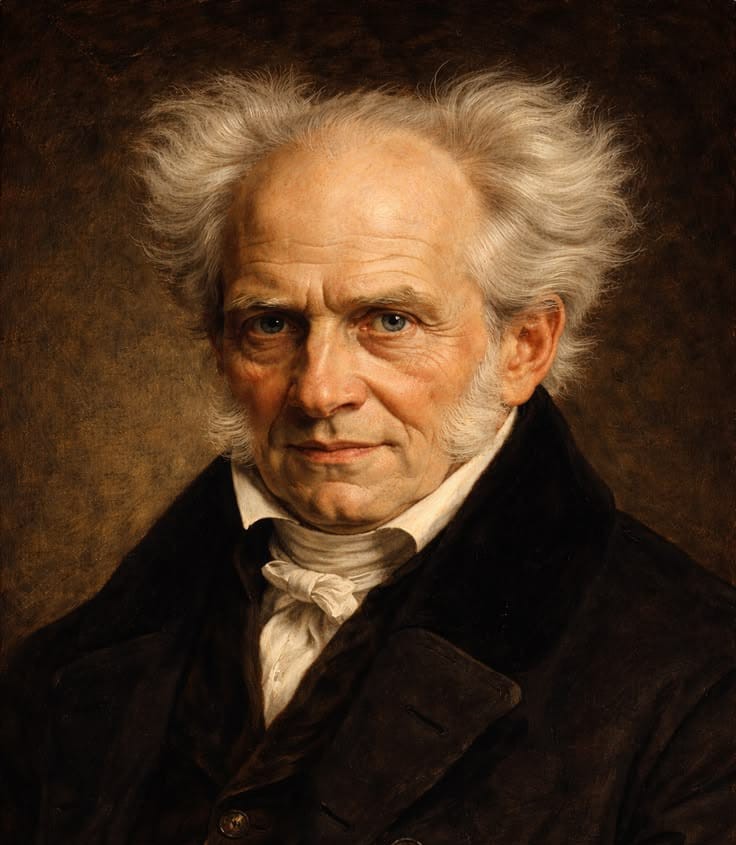
Arthur Schopenhauer was born on February 22, 1788, in Danzig (present-day Gdańsk, Poland), into a prosperous family involved in international trade. His father, Heinrich Floris Schopenhauer, was a successful merchant who hoped that Arthur would eventually enter the commercial world. The family moved to Hamburg in 1793 after Danzig was annexed by Prussia, and Schopenhauer's childhood was shaped by a cosmopolitan environment rather than by the life of a single city or university.
Extensive travel formed an important part of his early education. Schopenhauer spent time in France and England and travelled through several parts of Europe with his family. These experiences exposed him to different languages, cultures, and social conditions, while his father's plans initially directed him toward a career in commerce. After his father's death in 1805, however, Schopenhauer gradually abandoned commercial training and turned increasingly toward scholarly and intellectual pursuits.
In 1809, Schopenhauer entered the University of Göttingen, where he initially studied medicine and the natural sciences before turning to philosophy. The philosopher Gottlob Ernst Schulze introduced him more seriously to the work of Plato and Immanuel Kant, two thinkers who would remain fundamental to his philosophical development. Schopenhauer later studied in Berlin, where he attended lectures by figures including Johann Gottlieb Fichte and Friedrich Schleiermacher, although he became deeply critical of much of the dominant philosophical culture around him.
His intellectual development took place during the powerful rise of German Idealism. Philosophers such as Fichte, Schelling, and Hegel were major figures in German academic philosophy, but Schopenhauer rejected what he regarded as excessive abstraction and speculative system-building in their work. Instead, he attempted to build his philosophy upon Kant's distinction between appearance and reality while developing a radically different account of what lies at the foundation of existence: not reason, but an irrational and striving Will.
Arthur Schopenhauer and Immanuel Kant
Immanuel Kant was one of the most important influences on Arthur Schopenhauer, and Schopenhauer regarded Kant's philosophy as a decisive turning point in the history of modern thought. In particular, he admired Kant's distinction between the world as it appears within human experience and the reality that exists independently of the particular forms through which human beings experience it. Schopenhauer believed that this distinction had broken with earlier forms of dogmatic metaphysics and opened a new way of understanding the limits and conditions of human knowledge.
Kant had argued that human beings do not encounter the world in a completely unstructured or immediate way. Experience is possible only through fundamental forms and concepts involved in human cognition. Space and time, for Kant, are forms through which objects are given to us, while the understanding organizes experience according to fundamental concepts. Schopenhauer adopted the general insight that the world of ordinary experience is inseparable from the conditions under which a knowing subject experiences it.
Schopenhauer simplified and modified Kant's account in important ways. He argued that the world of ordinary experience is representation: a world that always exists as an object in relation to a knowing subject. Objects appear within space and time and stand in relations governed by causality and other forms of explanation. For Schopenhauer, therefore, the world known through ordinary experience is not reality considered independently of every possible knower, but reality as it appears under the conditions of human cognition.
However, Schopenhauer also attempted to go beyond Kant. Kant had maintained that the thing-in-itself cannot be known through the ordinary forms of experience that structure the phenomenal world. Schopenhauer argued that human beings occupy a distinctive position because each person experiences the body both externally, as an object among other objects, and internally through acts of willing, striving, desire, and effort. This double awareness, he believed, offered a special clue to the inner nature of reality.
From this starting point, Schopenhauer developed his famous claim that the inner reality of the world is Will. He did not simply reproduce Kant's philosophy, and his identification of the thing-in-itself with Will remains one of his most original and controversial philosophical moves. His system therefore begins from Kantian questions about the conditions and limits of knowledge but develops into a distinctive metaphysics in which the world is understood from two interconnected perspectives: as representation and as Will.
What Is The World as Will and Representation?
The World as Will and Representation is Arthur Schopenhauer's central philosophical work and the fullest systematic expression of his mature thought. First published at the end of 1818 with the date 1819 on the title page, the work initially attracted little attention, although Schopenhauer later became one of the most influential philosophers of the nineteenth century. The book presents an ambitious philosophical system dealing with knowledge, reality, nature, the human body, desire, suffering, art, ethics, freedom, and the possibility of liberation from the endless demands of striving.
The title expresses the basic structure of Schopenhauer's philosophy. The world can be understood from two interconnected perspectives: as representation, meaning the world as it appears within experience to a knowing subject, and as Will, meaning the inner metaphysical reality that Schopenhauer believed is expressed throughout nature and life. These are not intended simply as two separate physical worlds, one visible and the other hidden somewhere behind it. Rather, they represent two fundamentally different ways of understanding the same reality.
Representation refers to the world of objects, space, time, causality, and individual distinctions. Human beings do not simply encounter reality without any cognitive structure; they experience a world organized through the conditions of perception and understanding. Everything encountered as an object belongs to a relation between subject and object. Schopenhauer summarized this aspect of his philosophy with the famous opening thought that the world is his representation: whatever is known as an object is known in relation to a subject capable of knowing it.
The Will, by contrast, is not another physical object concealed behind the universe. For Schopenhauer, it is the fundamental striving expressed through natural forces, organic life, instinct, desire, and human action. The Will in itself is not guided by a rational plan designed to produce universal happiness or moral progress. Its manifestations are characterized by continual striving, conflict, and the pursuit of further existence.
The distinction between Will and representation became the foundation of Schopenhauer's entire philosophical system. His first book examines the world as representation and the conditions of knowledge; his later discussions turn toward the Will, its objectification in nature, the aesthetic contemplation of universal forms, ethical compassion, and finally the possibility of turning away from the endless striving associated with the will to live. The work therefore attempts to connect epistemology, metaphysics, aesthetics, and ethics within one comprehensive philosophical vision.
What Did Schopenhauer Mean by Representation?
In Schopenhauer's philosophy, the word representation refers to the world as it is experienced by a knowing subject. Everything that appears as an object of knowledge belongs to this world of representation. Objects appear within space and time, stand in causal relationships, and become part of an organized world in which human beings can perceive, investigate, compare, and explain things.
This means that the world we ordinarily know is always a world connected with consciousness and cognition. Schopenhauer emphasized the inseparable relation between subject and object: there is no object of experience without a subject for whom it is an object, just as there is no ordinary act of perception without something perceived. The knowing subject is therefore not simply another object inside the world in the same way as a tree, a stone, or a human body considered from the outside.
Schopenhauer inherited this general approach from Kant but developed his own account of the structures through which representation is organized. Space, time, and causality are central to the world of ordinary experience because they make possible the perception of separate objects and events. We experience things as existing beside one another in space, following one another in time, and standing in relations of cause and effect.
The world as representation is therefore not simply an illusion in the ordinary sense of a false appearance that can be corrected by looking more carefully. It is the real world of experience as it necessarily appears to a knowing subject. Schopenhauer's philosophical question was whether this world of appearances also reveals the inner nature of reality itself. His answer led him toward the concept of Will and the claim that the world known objectively has an inner dimension that cannot be understood merely by describing objects and their causal relationships.
What Is the Will in Schopenhauer's Philosophy?
The Will is the central concept of Arthur Schopenhauer's philosophy. It should not be understood simply as a conscious decision, a personal preference, or the rational ability to choose between alternatives. In ordinary language, a person may say that they will to perform a particular action, but Schopenhauer used the term in a far deeper metaphysical sense. The Will is the fundamental striving that he believed underlies the natural world and the existence of living beings.
Schopenhauer describes the Will as fundamentally blind, restless, and non-rational. By calling it blind, he did not mean that it literally possesses eyes or lacks them. He meant that the fundamental striving of existence is not necessarily directed by conscious knowledge toward a final rational purpose. Nature continues to act, organisms struggle to survive, and desires arise without the universe appearing to possess a single ultimate plan designed to bring the whole process to complete satisfaction.
Human beings often imagine themselves as primarily rational creatures who consciously govern their desires. Schopenhauer challenged this picture. He believed that the intellect frequently serves deeper drives and practical needs rather than completely controlling them. Thought, calculation, and reflection are important, but they often operate in response to desires and motives that were not themselves freely created by pure reason.
The Will is expressed in different forms throughout nature. Natural forces, biological growth, the struggle for self-preservation, animal instinct, sexual desire, and human ambition can all be interpreted, within Schopenhauer's system, as manifestations of a deeper striving. The forms of this striving differ enormously, and Schopenhauer did not claim that every natural process is consciously pursuing the same goal. Rather, he interpreted the apparent energy and activity of nature as expressions of one fundamental metaphysical reality.
Schopenhauer's concept of Will was revolutionary because it challenged philosophical systems that treated reason, rational order, or progressive development as the ultimate foundation of reality. Instead, he placed striving, desire, impulse, and instinct at the center of his interpretation of existence. This emphasis later made his philosophy important to thinkers interested in unconscious motivation, irrationality, instinct, psychology, and the limits of conscious rational control.
Schopenhauer's Will to Live
One of Schopenhauer's most important expressions of the universal Will is the will to live. Living beings constantly strive to preserve themselves, satisfy their needs, avoid danger, reproduce, and continue existing. Hunger, thirst, sexual desire, fear, ambition, and the instinct for self-preservation all reveal, in different ways, the persistent tendency of life to continue and assert itself. Schopenhauer interpreted this continual striving as a manifestation of the deeper metaphysical Will.
The will to live is not identical with a conscious wish that every individual explicitly formulates. A person may consciously reject a particular goal while still participating in the broader processes of desire, self-preservation, and striving characteristic of living existence. Schopenhauer therefore regarded the body itself as an important expression of the will to live, particularly because bodily needs and instincts often reveal desires before reflective thought has completely analyzed them.
Human desire, according to Schopenhauer, is never permanently satisfied. When one desire is fulfilled, another soon appears. A person may spend years pursuing wealth, love, recognition, power, or achievement, only to discover that the satisfaction produced by success does not remain unchanged. New needs, ambitions, fears, and desires emerge, and the process of striving begins again.
This endless movement from desire to temporary satisfaction and then to new desire is central to Schopenhauer's explanation of suffering. The Will continually pushes living beings toward new goals without providing a final state of complete and lasting fulfillment. Failure to satisfy a desire produces pain or frustration, while successful satisfaction usually provides only temporary relief before another source of dissatisfaction arises.
The will to live therefore explains both the energy and the tragedy of existence in Schopenhauer's philosophy. The same force that produces growth, activity, creativity, and the continuation of life also produces conflict, competition, dissatisfaction, and suffering. His philosophical problem was consequently not simply how human beings can satisfy more desires, but whether genuine peace requires changing one's relationship to the endless process of desiring itself.
Schopenhauer's Philosophy of Art and Aesthetics

Art and aesthetics provide one of the most important responses to suffering in Schopenhauer's philosophy. During ordinary life, human consciousness is constantly connected with personal desires, needs, fears, ambitions, and practical concerns. We usually perceive objects in relation to what they can do for us, whether they can satisfy a need, present a danger, increase our advantage, or help us achieve a particular goal.
Aesthetic experience can temporarily interrupt this ordinary cycle of striving. When a person becomes deeply absorbed in a work of art or in the contemplation of natural beauty, the object is no longer viewed simply in terms of personal usefulness or individual desire. Attention becomes less concerned with possession, practical advantage, or immediate satisfaction and more completely directed toward contemplation itself.
For Schopenhauer, the individual may then become what he called a pure subject of knowing. Personal interests and immediate striving temporarily recede, allowing consciousness to contemplate the object without continually asking what benefit or harm it might bring. In this state, the individual is no longer absorbed to the same extent in the endless movement of personal desire.
Schopenhauer connected this form of contemplation with the perception of what he called the Ideas, drawing in part upon the Platonic tradition. The work of art can reveal enduring and universal forms that are not grasped merely as particular objects serving practical purposes. The artist, and the spectator capable of aesthetic contemplation, can therefore experience reality from a perspective that temporarily rises above ordinary individual concerns.
Schopenhauer regarded aesthetic experience as a temporary liberation from the domination of the Will. Art cannot permanently eliminate human suffering or abolish the conditions of embodied existence, but it can create moments in which the endless pressure of desire becomes less powerful. For this reason, aesthetics occupies an essential place between his pessimistic analysis of life and his more radical philosophical exploration of compassion and ascetic detachment.
Why Did Schopenhauer Consider Music So Important?
Music occupies a unique and exceptionally important position in Schopenhauer's aesthetics. He believed that music differs fundamentally from painting, sculpture, literature, and other artistic forms because of its unusually direct relationship with the deeper structure of reality. While other arts represent particular aspects or forms of the world, music possesses a distinctive status within his metaphysical interpretation of art.
Schopenhauer associated the visual arts and other forms of artistic representation with what he called Platonic Ideas: universal forms or grades through which the Will becomes objectified in the world. Music, however, was not simply another representation of these Ideas. He argued that music stands in a more immediate relation to the Will itself and can therefore express the fundamental movements of striving without depending upon the representation of particular visible objects.
This explains why Schopenhauer considered music one of the most profound artistic experiences available to human beings. Music can communicate movement, tension, release, conflict, longing, and emotional intensity without requiring the listener to translate every aspect of the experience into ordinary concepts or descriptions. Its meaning, within Schopenhauer's philosophy, is not limited to the depiction of particular events or objects.
Schopenhauer developed elaborate analogies between musical structures and the different levels through which the Will is expressed in nature. Such analogies were part of his broader attempt to explain why musical experience can appear to possess a universal significance that transcends the representation of a particular physical scene. Music does not merely copy the visible world; it gives expression, in a different medium, to the dynamic striving that Schopenhauer believed lies at the metaphysical foundation of existence.
His philosophy of music later became particularly influential among artists and composers. Richard Wagner, among others, engaged deeply with Schopenhauer's philosophical ideas and became an important figure in the later cultural reception of his thought. Although Wagner developed his own artistic and theoretical positions, Schopenhauer's elevation of music to a unique metaphysical status helped make his aesthetics especially influential in nineteenth-century debates about art, emotion, genius, and the power of music.
Schopenhauer's Idea of Genius
Schopenhauer connected genius with the ability to perceive the world in a way that is less dominated by immediate practical interests. Ordinary consciousness is usually occupied with survival, desire, work, personal advantage, and everyday concerns. The human intellect normally serves the needs of the individual will, helping a person navigate the world and pursue the objects of desire.
The genius, in Schopenhauer's account, possesses an unusual capacity for sustained and disinterested contemplation. This allows the artist or thinker to focus upon aspects of reality that may remain unnoticed when consciousness is constantly directed toward personal needs. Genius is therefore not defined merely by intelligence, technical skill, education, or the ability to solve practical problems.
Schopenhauer believed that the genius could become temporarily absorbed in the contemplation of universal forms rather than seeing everything only as an instrument for personal advantage. This capacity is closely connected with his theory of aesthetic experience. The artist sees something in reality with an unusual degree of clarity and then gives that vision an objective form through painting, poetry, sculpture, literature, music, or another artistic medium.
Genius therefore has an important relationship with aesthetic experience because the artist can produce works that enable others to experience a temporary distance from their ordinary individual desires and practical concerns. A great work of art can direct the spectator's attention away from immediate self-interest and toward a more contemplative awareness of the world.
Schopenhauer's account of genius also reflects his broader criticism of purely utilitarian ways of understanding knowledge. Not all forms of understanding exist simply to produce practical advantages. Aesthetic and philosophical contemplation can possess value precisely because they allow consciousness to move, at least temporarily, beyond the constant demands of individual striving.
What Was Schopenhauer's Philosophy of Ethics?
Schopenhauer's ethical philosophy differs sharply from moral theories based primarily on abstract rules, religious commands, calculations of personal advantage, or purely rational duties. Although he engaged critically with other ethical traditions, he believed that genuine morality has its deepest foundation in compassion. The moral significance of an action depends fundamentally on whether an individual is capable of responding to the suffering of another rather than acting solely from narrow self-interest.
When an individual feels compassion for another person's suffering, the rigid boundary between self and other becomes less absolute in moral experience. The suffering of another person is no longer viewed merely as an external fact that has no importance for oneself. Compassion allows the individual to recognize another being's pain as something that makes a direct claim upon moral concern.
Schopenhauer distinguished compassion from actions motivated primarily by fear of punishment, the desire for praise, obedience to social expectations, or calculations of future personal benefit. Such motives may produce outwardly useful behavior, but he argued that they do not necessarily explain the deepest moral value of an action. A genuinely moral act occurs when another being's suffering becomes the immediate motive for helping rather than merely a means of gaining some personal advantage.
This ethical position follows from Schopenhauer's broader metaphysics. If all living beings are manifestations of the same fundamental Will, then the apparent separation between individuals may not represent the deepest level of reality. The ordinary world presents individuals as separate beings with separate interests, but compassion can provide an experiential awareness that the suffering of another cannot always be treated as morally irrelevant simply because it occurs outside one's own individual body.
Schopenhauer therefore placed compassion at the center of moral life. Ethical action is not simply obedience to a universal rule but can arise from a profound recognition of suffering shared by other living beings. His ethics gives his philosophy an important dimension often overlooked when he is described only as a pessimist: the recognition that suffering is fundamental to existence can also become a reason for deeper moral concern and efforts to reduce unnecessary suffering.
Schopenhauer on Compassion and Morality
Compassion is one of the most important concepts in Schopenhauer's ethics. He argued that genuinely moral actions cannot be explained completely by selfishness, fear of punishment, obedience to authority, or the desire for social approval. These motives may influence behavior and may sometimes produce beneficial consequences, but Schopenhauer believed that they do not reveal the distinctive source of genuinely moral concern.
A compassionate person responds to the suffering of another because that suffering becomes morally significant in itself. The individual does not help merely because doing so will produce a reward or protect a personal interest. Compassion therefore represents a movement beyond narrow self-interest and provides, for Schopenhauer, the psychological foundation from which genuine justice and benevolence can arise.
Schopenhauer's theory of compassion is closely connected with his metaphysical interpretation of individuality. In ordinary experience, human beings appear as separate individuals whose interests often conflict. Yet his philosophy argues that the fundamental Will lies beneath this apparent multiplicity. Compassion can therefore weaken the absolute sense of separation that normally encourages a person to regard another being's suffering as completely unrelated to oneself.
Schopenhauer also extended serious moral concern beyond human beings. He strongly criticized traditions that treated non-human animals as morally insignificant or regarded cruelty toward them as unimportant. Because animals are capable of suffering, he believed that their pain must be taken seriously within ethical reflection. This aspect of his thought has made him an important figure in the historical development of modern philosophical discussions concerning animal welfare and moral responsibility toward non-human life.
His emphasis on compassion gave his pessimistic philosophy an essential ethical dimension. Although suffering cannot simply be removed from existence, human beings can refuse to increase it unnecessarily and can respond to the suffering of others with justice, kindness, and moral concern. The recognition that life contains unavoidable suffering therefore does not lead, in Schopenhauer's philosophy, to indifference; it can instead become the foundation for a deeper awareness of why compassion matters.
Schopenhauer, Asceticism, and the Denial of the Will
Schopenhauer's most radical philosophical response to suffering involves asceticism and what he described as the denial of the will to live. If endless desire produces continual dissatisfaction, conflict, and suffering, then one possible response is not simply to satisfy more desires but to weaken the power of desire itself. This idea represents the furthest development of his attempt to find liberation from the restless striving that characterizes ordinary existence.
Asceticism involves forms of detachment from excessive desire, material attachment, sensual craving, and the constant pursuit of personal satisfaction. Schopenhauer was interested in religious and philosophical traditions that had recognized the possibility of reducing suffering by transforming one's relationship with desire. The ascetic does not merely exchange one ordinary desire for another but attempts to reduce the fundamental attachment to continual individual striving.
Within Schopenhauer's philosophical system, this process is more radical than ordinary self-discipline. A person may control a particular desire while remaining deeply committed to countless other forms of striving. The denial of the will to live represents an attempt to challenge the underlying tendency toward continual self-assertion and satisfaction rather than merely regulating the outward behavior produced by that tendency.
Schopenhauer associated this transformation with experiences such as compassion and the recognition of the universality of suffering. Compassion weakens the narrow dominance of individual self-interest, while aesthetic contemplation temporarily suspends ordinary desire. Asceticism, however, represents the possibility of a more lasting and fundamental turning away from the will to live.
This does not simply mean refusing every pleasure or becoming indifferent to every aspect of life. Schopenhauer's concept is part of a complex metaphysical and ethical system rather than a simple recommendation for misery or self-punishment. Art offers temporary liberation from the Will, and compassion transforms the individual's relationship with others. Ascetic detachment represents a more radical possibility: the attempt to fundamentally reduce the domination of desire and individual striving over consciousness.
Schopenhauer and Buddhism
Arthur Schopenhauer is often associated with an important early European philosophical engagement with Buddhism. He recognized significant similarities between aspects of his own analysis of desire and suffering and ideas found in Asian religious and philosophical traditions. His interest developed at a time when European knowledge of Buddhist thought was still limited and depended heavily upon translations, reports, and interpretations that did not always provide the accuracy or historical context available to modern scholarship.
Buddhism places great importance on the role of craving and attachment in human suffering. Schopenhauer's philosophy likewise argues that endless desire prevents lasting satisfaction and keeps living beings within a continuous cycle of striving. This similarity made Buddhist thought especially significant to him because he believed that major philosophical traditions separated by geography and history had independently recognized the profound connection between desire and dissatisfaction.
Schopenhauer was also interested in the possibility that liberation requires a transformation of one's relationship with desire, individuality, and attachment. His own concept of the denial of the will to live appears, at a broad philosophical level, to share certain concerns with traditions that seek liberation from craving and the cycle of suffering. However, similarities should not be mistaken for complete identity between Schopenhauer's system and Buddhist philosophy.
Schopenhauer's philosophy developed within a distinct European intellectual framework shaped strongly by Kant, Plato, and debates within modern Western philosophy. His concept of the Will and his identification of metaphysical reality cannot simply be translated into Buddhist concepts. Likewise, Buddhism includes a wide range of philosophical traditions, doctrines, and historical developments that cannot be reduced to a general philosophy of pessimism or the rejection of desire.
Nevertheless, Schopenhauer's engagement with Buddhist ideas contributed to his distinctive position in nineteenth-century philosophy. He helped make Asian philosophical traditions increasingly important within European intellectual discussions, even though his interpretations reflected the limitations of the sources available to him. His work remains significant in the history of cross-cultural philosophy because it illustrates both an early serious encounter between European and Asian thought and the difficulties involved when philosophical ideas are interpreted across major differences of language, history, and intellectual tradition.
Schopenhauer and Indian Philosophy
Indian philosophy was one of Schopenhauer's most important intellectual interests outside the European philosophical tradition. He encountered European translations and interpretations of Indian texts, particularly material associated with the Upanishads. These writings made a profound impression on him and became part of the broader intellectual background against which he developed his own reflections on individuality, the nature of reality, suffering, and liberation.
Schopenhauer believed that some Indian philosophical traditions had explored questions similar to those found in his own work. These included the nature of individuality, the relationship between ordinary experience and a deeper reality, the suffering connected with desire and attachment, and the possibility of liberation from the ordinary condition of striving. He was particularly impressed by philosophical attempts to question the assumption that the individual self, as it appears in everyday experience, represents the ultimate reality of existence.
His engagement with the Upanishads was historically mediated through the translations available to him. One of the most important sources through which he encountered Upanishadic thought was the Oupnek'hat, a Latin version based on a Persian translation rather than a direct translation from Sanskrit. This fact is important because it demonstrates that Schopenhauer's understanding of Indian philosophy was shaped by a complex chain of linguistic and cultural transmission.
Schopenhauer therefore sometimes drew comparisons between his own concepts and Indian philosophical ideas in ways that modern scholars would treat with greater caution. Similarities between the Will and concepts found in Indian traditions do not mean that the ideas are identical. Indian philosophy contains numerous distinct schools with different metaphysical, epistemological, and ethical commitments, and these traditions cannot be reduced to Schopenhauer's interpretation of them.
Even with these limitations, Schopenhauer remains an important figure in the history of cross-cultural philosophy. Unlike many European thinkers of his period who treated non-European intellectual traditions as merely historical curiosities, he regarded Indian thought as a serious source of philosophical insight. His engagement was shaped by the limitations of nineteenth-century scholarship, but it nevertheless contributed to the later history of European interest in the Upanishads, Buddhism, and the wider philosophical traditions of Asia.
Schopenhauer and Hindu Philosophy
Discussions of Schopenhauer and Indian thought frequently focus on his engagement with ideas associated with Hindu philosophy, particularly the philosophical traditions connected with the Upanishads.
Schopenhauer was interested in philosophical ideas concerning the relationship between individual experience and a deeper reality. These interests resonated with his own attempt to move beyond the ordinary world of separate objects and individuals.
His interpretation of Indian philosophy was not identical with the traditions themselves. He approached them through the conceptual vocabulary of his own philosophical system and through the sources available to him in nineteenth-century Europe.
The connection remains historically important because Schopenhauer was among the major Western philosophers who openly acknowledged the philosophical significance of Asian intellectual traditions.
Why Did Schopenhauer Believe Life Involves Suffering?
Suffering occupies a central place in Schopenhauer's philosophy because he believed that life is fundamentally characterized by striving. Human beings are creatures of desire: they want things they do not possess, seek conditions that do not yet exist, and attempt to avoid circumstances they find painful or threatening. To desire something, in this sense, is already to experience a form of lack, and this lack creates a condition of dissatisfaction.
When a desire remains unfulfilled, human beings experience pain, frustration, anxiety, disappointment, or some other form of suffering. A person may desire health, security, love, recognition, wealth, or success and suffer because these things remain uncertain or beyond immediate reach. For Schopenhauer, this is not merely an accidental feature of a badly organized society; it arises from the more general structure of a life driven by continual wanting.
Yet fulfillment does not solve the problem permanently. Once a goal is achieved, the satisfaction it produces may gradually fade, and the individual begins to desire something else. A long-awaited success can become ordinary once it is obtained, while new ambitions immediately take its place. The Will therefore continually produces new objects of striving, making permanent satisfaction difficult to achieve through the simple accumulation of fulfilled desires.
Schopenhauer also argued that the absence of urgent desire does not necessarily create lasting happiness. When people are no longer occupied by strong needs, ambitions, or immediate problems, they may experience boredom. Boredom reveals another kind of dissatisfaction: consciousness seeks stimulation or new objects of interest because the temporary absence of pressing desire can itself become difficult to endure.
Human life therefore moves between pain and boredom, according to one of Schopenhauer's most famous analyses. This pessimistic view did not mean that every moment of life is equally miserable or that pleasure is completely unreal. Rather, Schopenhauer challenged the belief that permanent happiness can be achieved simply through endless desire and satisfaction. His philosophy asks whether a more lasting form of peace might require temporary or radical freedom from the domination of striving itself.
Why Was Arthur Schopenhauer Called a Pessimist?
Arthur Schopenhauer is one of the philosophers most strongly associated with philosophical pessimism. He rejected optimistic theories that viewed the universe as naturally moving toward inevitable progress, harmony, rational perfection, or universal happiness. In contrast to philosophies that interpreted history as the gradual realization of reason, Schopenhauer emphasized the persistence of suffering, conflict, frustration, and death throughout both human and non-human existence.
For Schopenhauer, nature contains constant struggle. Living beings compete for resources, organisms survive through processes that often involve the suffering or destruction of other organisms, and individuals pursue desires that frequently conflict with the desires of others. Human life is likewise marked by illness, loss, disappointment, insecurity, aging, and mortality. He saw these facts not as minor exceptions to an otherwise harmonious universe but as evidence of the restless and conflict-ridden character of existence.
His pessimism was closely connected with his metaphysics of Will. If reality is fundamentally characterized by endless striving, then complete and permanent satisfaction becomes difficult or impossible to achieve within ordinary life. Every fulfilled desire may produce another desire, while every individual remains vulnerable to forces beyond personal control. Schopenhauer therefore doubted that history, technological progress, or material improvement could eliminate the deeper conditions that generate human dissatisfaction.
Schopenhauer also criticized forms of optimism that, in his view, attempted to justify suffering by claiming that the world must ultimately be arranged for the greatest possible good. His philosophy begins instead from a serious confrontation with suffering as a basic feature of existence. This does not mean that he denied the existence of pleasure, beauty, friendship, or moral goodness; rather, he refused to treat such experiences as proof that life as a whole is ordered toward permanent happiness.
However, describing Schopenhauer simply as a philosopher who believed that life is hopeless is incomplete. His philosophy also investigates possible ways of reducing the power of desire through aesthetic experience, compassion, philosophical understanding, and ascetic forms of detachment. His pessimism therefore functions not only as a negative judgment about life but also as the starting point for a philosophical search for forms of freedom from unnecessary suffering and from the endless domination of the will to live.
Schopenhauer on Desire, Pleasure, and Boredom
Schopenhauer's philosophy of desire begins with the idea that desire is connected with lack. When we desire something, we become aware that something is missing or that our present condition is insufficient. Hunger reveals the absence of food, loneliness can reveal the desire for companionship, and ambition expresses dissatisfaction with one's present position. Desire therefore creates a state of tension between what exists and what the individual wants to bring about.
Pleasure is often experienced when this tension temporarily disappears. However, Schopenhauer believed that pleasure is usually negative in character, meaning that it often consists primarily in the removal of an existing discomfort rather than the creation of a permanent and independent positive state. The pleasure of eating, for example, follows the discomfort of hunger; once the need has been satisfied, the intense pleasure gradually disappears because the original lack is no longer present.
This interpretation does not mean that Schopenhauer considered all pleasant experiences meaningless or imaginary. His point was that pleasure often depends upon a prior state of need or dissatisfaction. Because human needs continually return and new desires constantly emerge, the relief provided by fulfillment is generally temporary. The individual remains within a larger process in which new forms of striving repeatedly replace those that have temporarily disappeared.
Once a desire is satisfied, another problem may emerge. Without a new goal or pressing need, individuals can become bored. Human beings therefore continue searching for stimulation, achievement, entertainment, possessions, relationships, and new forms of desire. Boredom demonstrates, for Schopenhauer, that merely removing immediate pain does not automatically produce lasting contentment.
This analysis explains why material success alone cannot guarantee happiness in Schopenhauer's philosophy. Wealth may remove certain forms of hardship, and achievement may satisfy particular ambitions, but neither necessarily ends the fundamental tendency of consciousness to generate new desires. The endless multiplication of wants may therefore create new forms of striving rather than bringing the individual closer to lasting peace. This insight forms an important foundation for Schopenhauer's later discussions of art, detachment, compassion, and asceticism.
Schopenhauer and the Principle of Sufficient Reason
Before publishing his major philosophical work, Schopenhauer wrote On the Fourfold Root of the Principle of Sufficient Reason, originally published as his doctoral dissertation in 1813. This work examines the broad philosophical principle that nothing can be understood as existing or occurring without some ground, reason, or explanation appropriate to the kind of thing being considered. Schopenhauer regarded the principle as fundamental to understanding the structure of the world as it appears to a knowing subject.
Schopenhauer argued that the principle of sufficient reason operates in different ways rather than referring to only one type of explanation. Events in the physical world are understood through causes; logical judgments depend upon grounds of knowing; mathematical and spatial-temporal relations involve forms of being; and human actions can be explained in relation to motives. These distinctions form what Schopenhauer called the fourfold root of the principle of sufficient reason.
This theory became closely connected with his later account of representation. The world as experienced contains distinct objects and events connected through relations that can be investigated and explained. Causality, logical inference, spatial and temporal relations, and motivation make the experienced world intelligible as an ordered field rather than a collection of entirely disconnected impressions.
Schopenhauer nevertheless believed that the principle of sufficient reason governs the world as representation rather than revealing the ultimate nature of reality independently of every form of experience. The explanatory relations through which we understand objects belong to a world structured by distinctions between things, events, causes, and effects. The metaphysical question of what reality is in itself therefore could not, in his view, be answered simply by discovering another cause behind every object.
The Will itself could not simply be reduced to another object within this explanatory system. Schopenhauer's metaphysics attempted to move from the structured world of representation toward the deeper reality that he believed is disclosed through the experience of willing. The principle of sufficient reason thus remains essential to his philosophy: it explains the ordered world of phenomena while also marking the limits of an approach that seeks to understand everything solely through causal and rational explanation.
Arthur Schopenhauer's Metaphysics
Metaphysics is one of the central dimensions of Schopenhauer's philosophy. He was concerned with the question of what reality is beyond the ordinary world of individual objects, events, and appearances. Scientific knowledge can explain how events are connected through causes and describe the regularities of nature, but Schopenhauer believed that philosophical inquiry could still ask a deeper question: what is the inner nature of the reality that appears through these observable processes?
His answer was the concept of Will. The world that human beings experience contains countless separate things and living beings, yet Schopenhauer argued that beneath this apparent multiplicity lies a more fundamental metaphysical unity. The Will is expressed in different degrees and forms throughout nature, from basic natural processes to the complex desires and conscious actions of human beings.
This metaphysical view gave Schopenhauer's philosophy a distinctive structure. The world of separate individuals belongs to representation, where things appear as distinct objects located in space and time and connected through causality. The Will, by contrast, represents the deeper inner dimension of reality as Schopenhauer interpreted it. The apparent separation between individuals therefore does not necessarily reveal the deepest level of existence within his philosophical system.
Schopenhauer's metaphysics also rejects the idea that the fundamental reality of the universe must be rational, conscious, or directed toward moral progress. The Will is not a divine intellect that deliberately creates the world according to a perfect plan. It is fundamentally striving without the kind of final rational purpose that human beings often seek in nature and history. This claim provides the metaphysical foundation for Schopenhauer's pessimistic interpretation of suffering and conflict.
His metaphysics influenced later discussions of instinct, unconscious motivation, desire, irrationality, and the limits of reason. Although later thinkers did not necessarily accept his identification of the thing-in-itself with Will, his emphasis on forces beneath conscious thought made his philosophy particularly important for the intellectual history of psychology, literature, aesthetics, and theories of the unconscious. His work helped challenge the image of human beings as creatures whose deepest nature can be explained entirely through conscious rational thought.
Schopenhauer's Philosophy of the Body
The human body plays a unique role in Schopenhauer's philosophy because it provides a connection between his account of representation and his account of Will. We experience our bodies in two different ways. From the outside, the body appears as a physical object among other objects: it occupies space, changes through time, and can be studied according to causal relationships. At the same time, each person experiences their own living body directly through movement, sensation, pain, hunger, desire, effort, and action.
This double experience provided Schopenhauer with an important route toward his metaphysics. When a person intentionally moves a hand, for example, the movement can be observed externally as an event involving a physical body. Yet the individual also experiences the act from within as willing. Schopenhauer did not regard willing and bodily movement as two entirely separate events that happen to occur beside one another; instead, he interpreted them as two aspects of the same reality known in different ways.
The body therefore occupies a special philosophical position. It is both an object of representation and the immediate expression of willing. Through the body, the individual gains an awareness of striving that differs from the purely external observation of other objects. Schopenhauer then extended this insight beyond the individual human body, arguing that the striving encountered within oneself offers a clue to the inner character of the natural world more generally.
This argument is one of the most distinctive features of Schopenhauer's attempt to move beyond the limits established by Kant. Rather than claiming that human beings can observe the thing-in-itself as they observe an ordinary physical object, Schopenhauer argued that self-awareness of willing provides a unique form of access to the inner side of existence. The experience of one's own body therefore becomes a crucial bridge between epistemology and metaphysics.
Schopenhauer's philosophy of the body also challenged purely intellectual accounts of human nature. Thought and reason remain important, but human existence is embodied and deeply connected with needs, instincts, desires, and forms of striving that do not originate simply from abstract rational reflection. The body consequently reveals why his philosophy places the Will, rather than pure reason, at the center of its interpretation of life.
Did Schopenhauer Believe in Free Will?
Schopenhauer's philosophy presents a complex and highly influential view of free will. He rejected the idea that human beings are completely free to choose any desire, motive, or character they wish at any moment. In his view, people certainly experience themselves as making decisions and acting according to their intentions, but this ordinary experience does not prove that the underlying act of willing itself is completely free from necessity.
Human actions occur in response to motives, circumstances, and the underlying character of the individual. Given a particular character and a particular motive, Schopenhauer argued that an action follows with necessity. Human behavior therefore belongs to the world of representation, where events occur within intelligible relationships rather than appearing as completely uncaused interruptions of nature. This view gives a central role to motivation rather than reducing human action to simple mechanical causation.
Schopenhauer famously expressed the distinction by arguing, in substance, that a person may do what they will but cannot simply will what they will. A person may act according to a desire or intention, but the deeper philosophical question concerns the origin of that desire itself. Why does one person want one thing while another person wants something different? For Schopenhauer, the individual cannot simply step outside their own character and freely manufacture an entirely different act of willing at the moment of choice.
This position led Schopenhauer to distinguish the empirical individual from the deeper metaphysical dimension of the Will. In ordinary experience, individual actions are connected with motives and character and can therefore be understood within the principle of sufficient reason. The metaphysical Will, however, is not treated as merely another event within the ordinary causal order. This distinction makes his theory more complicated than a simple statement that human beings are either completely free or completely determined.
Schopenhauer's view therefore challenged simple accounts of personal autonomy based solely on conscious rational choice. He believed that much of human behavior arises from deeper forces that cannot be fully explained as the product of deliberate reasoning. His philosophy anticipated later questions about unconscious motivation and the extent to which conscious thought controls human action, even though his own metaphysical theory of Will remains distinct from later psychological theories of the unconscious.
What Did Schopenhauer Say About Happiness?
Schopenhauer was skeptical of the idea that human beings can achieve permanent happiness through wealth, success, pleasure, or the continual satisfaction of personal desires.
Because every fulfilled desire can produce another desire, the pursuit of happiness may become an endless process. External achievements can provide genuine satisfaction, but Schopenhauer doubted that they can permanently overcome the restless structure of human wanting.
His philosophy therefore places greater importance on reducing unnecessary suffering than on pursuing an imagined state of continuous pleasure. Wisdom may involve understanding the limits of desire and developing a more detached relationship with external circumstances.
Art, intellectual contemplation, friendship, compassion, and reduced attachment can all contribute to a more peaceful life. Schopenhauer's philosophy of happiness is therefore closely connected with his broader attempt to understand suffering and the human condition.
Major Works of Arthur Schopenhauer
Arthur Schopenhauer produced philosophical works covering metaphysics, epistemology, ethics, aesthetics, freedom, nature, and the problems of human existence. His writings became much more widely recognized during the later part of his life and especially after his death.
- The World as Will and Representation — Schopenhauer's major philosophical work presenting his system of Will, representation, suffering, aesthetics, ethics, and asceticism.
- On the Fourfold Root of the Principle of Sufficient Reason — His early philosophical work examining different forms of reason, explanation, causality, and knowledge.
- On the Will in Nature — A work connecting Schopenhauer's metaphysics of Will with observations from the natural sciences.
- On the Freedom of the Will — A philosophical examination of human freedom, character, motives, and determinism.
- On the Basis of Morality — A major work presenting Schopenhauer's ethical theory centered on compassion.
- Parerga and Paralipomena — A collection of philosophical essays and reflections that played an important role in bringing Schopenhauer wider recognition.
Arthur Schopenhauer and Friedrich Nietzsche
Friedrich Nietzsche was strongly influenced by Schopenhauer during his early intellectual development. Nietzsche initially regarded Schopenhauer as an important philosophical model and wrote extensively about him.
Both philosophers challenged traditional optimism and questioned the idea that reason alone provides a complete explanation of human existence. Both also emphasized the importance of forces beneath ordinary rational consciousness.
However, Nietzsche eventually developed a philosophy very different from Schopenhauer's. Schopenhauer saw liberation partly in reducing the power of desire, while Nietzsche increasingly emphasized the affirmation and transformation of life.
The relationship between Schopenhauer and Nietzsche is therefore both one of influence and disagreement. Understanding Schopenhauer helps explain many of the philosophical questions from which Nietzsche later developed his own distinctive ideas.
Arthur Schopenhauer's Influence on Philosophy and Psychology
Schopenhauer's influence extended far beyond academic philosophy. His emphasis on unconscious forces, instinct, desire, and irrational motivation became important for later discussions about human psychology and behavior.
His philosophy influenced major writers, artists, musicians, and philosophers. Friedrich Nietzsche was one of his most famous philosophical readers, while Richard Wagner was deeply affected by Schopenhauer's ideas about music and art.
Schopenhauer's emphasis on forces beneath conscious reason is also frequently compared with later developments in psychology and psychoanalysis. Although later thinkers developed very different theories, Schopenhauer helped make unconscious motivation a major philosophical subject.
His influence continues because his questions remain powerful: Why do human beings desire endlessly? Can happiness be permanent? Does reason control our deepest motivations? Can art provide liberation from suffering? These questions continue to connect Schopenhauer with modern discussions of the human condition.
Arthur Schopenhauer's Main Philosophical Ideas
1. The World as Will and Representation
Reality can be understood from two perspectives: the world as it appears within human experience and the deeper Will that Schopenhauer believed is expressed throughout nature and life.
2. The Will Is Endless Striving
The Will is a blind and restless force that drives organisms toward existence, survival, desire, reproduction, and continual activity without guaranteeing permanent satisfaction.
3. Desire Creates Suffering
Desire begins with a sense of lack. When desires remain unfulfilled, people suffer, while fulfilled desires often create new desires and continue the cycle of striving.
4. Art Can Temporarily Liberate Us
Aesthetic experience can temporarily free consciousness from ordinary personal desires by allowing the individual to contemplate an object without focusing immediately on personal advantage.
5. Compassion Is the Basis of Morality
Genuine moral concern arises when individuals recognize and respond to the suffering of others rather than acting solely from selfish interest.
6. Detachment Can Reduce Suffering
Schopenhauer's most radical philosophical response to endless desire involves asceticism and the weakening of attachment to the continual demands of the will to live.
Arthur Schopenhauer's Philosophy Explained Simply
Arthur Schopenhauer believed that human beings often misunderstand what controls their lives. We like to think that reason directs our decisions, but beneath our conscious thoughts are powerful desires, instincts, needs, and forms of striving.
- What is reality? The world we experience is representation, but Schopenhauer believed that its deeper inner reality is Will.
- Why do people suffer? People constantly desire things, and desire creates dissatisfaction when it remains unfulfilled.
- Does satisfying desire make us permanently happy? No. According to Schopenhauer, fulfilled desires often create new desires, continuing the cycle of striving.
- Can art help us? Yes. Art can temporarily free the mind from personal desire and practical concerns.
- What is the basis of morality? Schopenhauer believed that genuine morality is rooted in compassion for the suffering of others.
- What is the deepest solution to endless desire? His most radical answer involved reducing attachment to desire through forms of detachment and asceticism.
Why Is Arthur Schopenhauer Important in Philosophy?
Arthur Schopenhauer is important because he developed one of the most distinctive philosophical systems of the nineteenth century. At a time when many philosophers emphasized reason, progress, and rational development, Schopenhauer placed irrational striving and suffering at the center of his interpretation of reality.
His philosophy also connected several major areas of thought. Metaphysics, epistemology, aesthetics, ethics, psychology, and the philosophy of life all appear within his larger system.
Schopenhauer was also historically important for his serious interest in philosophical traditions outside Europe. His engagement with Indian thought and Buddhism contributed to the development of later cross-cultural philosophical discussions.
Most importantly, Schopenhauer continues to matter because his philosophy addresses experiences that remain central to human life: desire, disappointment, boredom, suffering, art, compassion, and the search for a more peaceful existence.
Frequently Asked Questions About Arthur Schopenhauer
Who was Arthur Schopenhauer?
Arthur Schopenhauer was a German philosopher who lived from 1788 to 1860. He is famous for his philosophy of Will, representation, suffering, pessimism, art, compassion, and the possibility of liberation from endless desire.
What is Arthur Schopenhauer famous for?
Schopenhauer is most famous for The World as Will and Representation and his idea that the fundamental reality underlying existence is a blind and restless Will expressed through nature and living beings.
What was Schopenhauer's philosophy?
Schopenhauer's philosophy argues that the world experienced by human beings is representation, while its deeper inner nature is Will. He connected this metaphysical theory with an account of desire, suffering, art, compassion, and ascetic detachment.
What did Schopenhauer mean by the Will?
The Will is not simply conscious human choice. For Schopenhauer, it is a fundamental, blind, and restless force expressed through nature, instinct, desire, survival, reproduction, and human striving.
Why was Schopenhauer a pessimist?
Schopenhauer believed that human life is characterized by endless desire and striving. Unfulfilled desires produce suffering, while fulfilled desires are often followed by new desires or boredom, making permanent satisfaction difficult to achieve.
What did Schopenhauer say about suffering?
Schopenhauer believed suffering is deeply connected with desire. Because living beings constantly want, need, and strive for things, they remain vulnerable to frustration, loss, disappointment, and dissatisfaction.
What is the will to live?
The will to live refers to the persistent striving of living beings toward existence, survival, reproduction, and the satisfaction of needs. Schopenhauer regarded this as an important expression of the deeper Will.
What did Schopenhauer believe about happiness?
Schopenhauer doubted that permanent happiness could be achieved through endless material success or desire satisfaction. He believed that reducing unnecessary desires and developing detachment could provide a more peaceful form of life.
What did Schopenhauer say about art?
Schopenhauer believed that art can temporarily free human beings from the domination of personal desire. During aesthetic contemplation, individuals can become less focused on practical needs and immediate self-interest.
Why did Schopenhauer consider music important?
Schopenhauer regarded music as the most metaphysical of the arts. He believed that music had an especially direct relationship with the deeper movements and patterns associated with the Will.
What was Schopenhauer's ethics?
Schopenhauer's ethical philosophy places compassion at the center of morality. He believed that genuinely moral action arises when people recognize and respond to the suffering of others.
Did Schopenhauer believe in free will?
Schopenhauer rejected simple ideas of completely unrestricted free will. He argued that human actions are connected with motives and character, raising the question of whether people can freely choose the desires that motivate them.
Was Schopenhauer influenced by Buddhism?
Yes. Schopenhauer was deeply interested in Buddhist ideas concerning suffering, desire, attachment, and liberation, although his own philosophical system remained distinct from Buddhist philosophy.
Was Schopenhauer influenced by Indian philosophy?
Yes. Schopenhauer studied European translations and interpretations of Indian philosophical texts, particularly material associated with the Upanishads, and considered Indian thought an important philosophical resource.
How did Schopenhauer influence Nietzsche?
Nietzsche was strongly influenced by Schopenhauer during his early intellectual development. Although Nietzsche later rejected important aspects of Schopenhauer's pessimism and asceticism, Schopenhauer remained a major figure in Nietzsche's philosophical formation.
What is Schopenhauer's most famous book?
Schopenhauer's most famous work is The World as Will and Representation, his major philosophical book on metaphysics, knowledge, suffering, aesthetics, ethics, and the possibility of liberation from desire.
Related Modern and Enlightenment Philosophers
Explore other major philosophers connected with German philosophy, metaphysics, pessimism, existential thought, ethics, and the development of modern philosophy.
Related Areas of Philosophy
Schopenhauer's philosophy connects metaphysics and epistemology with aesthetics, ethics, philosophy of mind, philosophy of life, the problem of suffering, and cross-cultural philosophical traditions.
Why Arthur Schopenhauer Still Matters
Arthur Schopenhauer remains one of the most compelling philosophers for readers interested in the difficult questions of human existence. His philosophy challenges easy optimism and asks whether endless desire, competition, and striving can ever produce permanent happiness.
His answer begins with the idea of the Will: a fundamental force of striving expressed throughout nature and human life. From this idea, Schopenhauer developed a philosophical system explaining suffering, desire, art, music, morality, compassion, and ascetic detachment.
Yet Schopenhauer's philosophy is more than pessimism. He also searched for ways human beings could experience temporary freedom from desire through art and develop deeper moral awareness through compassion. His engagement with Buddhism and Indian philosophy also gave his work an important place in the history of cross-cultural thought.
Understanding Schopenhauer helps explain the development of later philosophy, psychology, literature, and modern ideas about desire, irrationality, suffering, and the limits of reason. His questions remain relevant because they concern experiences that continue to shape human life.
Explore Great Philosophers