Who Was Anselm of Canterbury?
Anselm of Canterbury was an Italian-born Benedictine monk, philosopher, and theologian who lived from 1033 to 1109, eventually serving as Archbishop of Canterbury in England. He is remembered above all as the originator of the ontological argument, one of the most famous and philosophically enduring arguments for the existence of God, and as a foundational figure often credited as the "father of scholasticism."
Anselm is especially associated with his guiding philosophical motto, "faith seeking understanding," a method that begins from sincerely held Christian belief and then applies careful, rigorous rational argument to deepen and clarify that belief, treating philosophical reasoning not as a challenge to faith but as a natural and welcome extension of it.
Trained first as a Benedictine monk at the abbey of Bec in Normandy under the influential teacher Lanfranc, Anselm rose through a distinguished monastic and ecclesiastical career before eventually becoming Archbishop of Canterbury, a position that entangled him directly in significant political conflict with the English crown over the proper boundaries of religious and royal authority.
Because Anselm's most famous argument continues to generate active philosophical debate more than nine centuries after its original composition, scholars of philosophy of religion continue to study and reformulate his reasoning using modern logical tools. His importance nonetheless remains considerable, since his method of combining rigorous logical argument with sincere religious conviction established an influential model for the subsequent development of medieval scholastic philosophy.
Anselm of Canterbury: Quick Facts
- Name — Anselm of Canterbury (Doctor Magnificus)
- Period — 1033–1109
- Born in — Aosta, Kingdom of Burgundy (present-day Italy)
- Died in — Canterbury, England
- Associated with — Scholasticism and the ontological argument
- Known for — The ontological argument and "faith seeking understanding"
- Major works — Proslogion, Monologion, and Cur Deus Homo
- Religious role — Archbishop of Canterbury from 1093 until his death
- Key teacher — Lanfranc, at the abbey of Bec
- Historical importance — Often called the father of scholasticism
Anselm and the Dawn of Scholasticism
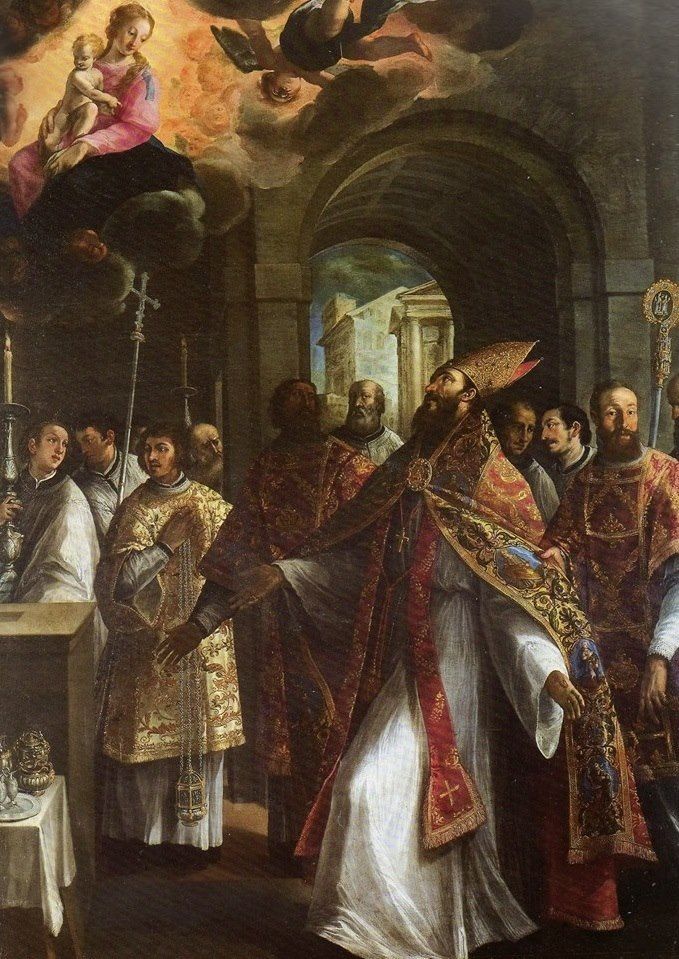
Anselm's philosophical career unfolded during the early formative period of what would later become the medieval scholastic tradition, a time preceding the full rediscovery of Aristotle's complete philosophical corpus in Western Europe, when Christian philosophy drew more heavily on the Neoplatonic and Augustinian intellectual inheritance than the later Aristotelian synthesis associated with Thomas Aquinas.
This period also saw the growing use of formal dialectical reasoning, careful logical argument and structured debate, as a legitimate tool for exploring theological questions within monastic and emerging university educational contexts, a methodological development that Anselm's own rigorously logical approach to theology significantly advanced and exemplified.
Anselm's later career also unfolded against the backdrop of the broader investiture controversy, a significant political and ecclesiastical dispute across medieval Europe concerning whether secular rulers or church authorities held the proper right to appoint bishops and other church officials, a conflict that would directly and repeatedly affect Anselm's own tenure as Archbishop of Canterbury.
Anselm's Early Life in Italy
Anselm was born in Aosta, in a region of the Kingdom of Burgundy within present-day northern Italy, into a family of some local standing, and traditional accounts describe him as having experienced significant tension with his father during his youth, eventually leading him to leave his family home to pursue a religious and scholarly vocation elsewhere.
Following an extended period of travel through France, Anselm eventually arrived at the Benedictine abbey of Bec in Normandy, drawn there specifically by the reputation of its prior, the influential scholar and teacher Lanfranc, whose growing fame as a teacher of dialectic and theology had already established Bec as an important center of intellectual life within Western monasticism.
This early journey from Italy to Normandy established the essential geographic and intellectual foundation for Anselm's subsequent career, bringing him into direct contact with the rigorous logical and theological training that would decisively shape his own later philosophical method and his eventual rise to significant ecclesiastical leadership.
Anselm at Bec Abbey Under Lanfranc
Anselm entered the Benedictine monastery at Bec in 1060, studying directly under Lanfranc, whose rigorous training in logic and theology provided Anselm with essential intellectual formation, and Anselm eventually succeeded Lanfranc as prior of the monastery when Lanfranc himself departed to take up further ecclesiastical responsibilities elsewhere.
During his years at Bec, Anselm composed several of his most important philosophical works, including the Monologion and the Proslogion, developing the rigorous logical method of argument that would become his most enduring philosophical legacy, while also serving as a respected teacher and spiritual guide to the monastic community under his leadership.
Anselm's time at Bec established his reputation as one of the most philosophically and theologically capable minds of his generation, and this growing reputation, combined with his successful leadership of the monastic community, eventually positioned him for the significant ecclesiastical responsibility he would later assume as Archbishop of Canterbury in England.
Anselm as Archbishop of Canterbury
Anselm succeeded his former teacher Lanfranc as Archbishop of Canterbury in 1093, a position of considerable political as well as religious significance within medieval England, requiring Anselm to navigate a complex and often contentious relationship with the English crown regarding the proper boundaries of religious and royal authority.
Anselm's tenure as archbishop was repeatedly disrupted by significant conflict with successive English kings, including William Rufus and later Henry I, particularly over the investiture controversy, the broader dispute concerning whether secular rulers possessed legitimate authority to formally install bishops in their ecclesiastical office, a conflict that twice forced Anselm into extended periods of exile from England.
Despite these considerable political difficulties, Anselm continued his philosophical and theological writing throughout his tenure as archbishop, including significant portions of his later major work, Cur Deus Homo, composed partly during his periods of continental exile, illustrating his remarkable capacity to sustain serious intellectual work even amid considerable political and institutional turmoil.
What Did Anselm Believe?
Anselm's philosophy rests on the foundational conviction, expressed through his guiding motto "faith seeking understanding," that Christian belief, already firmly held on the basis of revelation and religious authority, could and should be further explored and clarified through careful, rigorous rational argument, rather than treating faith and reason as fundamentally opposed or mutually exclusive sources of knowledge.
Central to this approach is Anselm's conviction that certain core Christian theological truths, including the existence of God, could in principle be established through purely rational argument alone, independent of appeal to scriptural authority or religious revelation, a conviction most famously demonstrated through his celebrated ontological argument developed in the Proslogion.
Anselm's broader philosophical method consistently emphasizes careful logical precision and rigorous argumentative structure, reflecting his early training in dialectical reasoning at Bec under Lanfranc, and this methodological rigor extends across his treatment of diverse theological topics, including the nature of truth, human free will, and the reasons behind Christ's incarnation and atonement.
Scholars of philosophy of religion continue to study and debate the precise logical structure and philosophical validity of Anselm's most famous arguments, particularly the ontological argument, but his overall philosophical method is consistently recognized as a foundational and historically significant contribution to the development of rigorous philosophical theology within the Western tradition.
Faith Seeking Understanding: Anselm's Method
Faith seeking understanding, rendered in Latin as fides quaerens intellectum, names Anselm's distinctive philosophical method and guiding intellectual motto, describing an approach that begins from sincerely held religious belief, accepted on the basis of faith, and then applies careful rational inquiry to deepen and clarify understanding of what is already believed.
This method deliberately reverses what might seem the more obvious philosophical order of first establishing rational proof before accepting belief, instead treating faith as the proper starting point from which reason then proceeds to explore and illuminate, rather than treating unaided reason as a neutral starting point from which religious belief must first be independently justified before any further theological exploration can proceed.
Anselm's approach reflects a broader tradition within Christian philosophy, tracing back significantly to Augustine, that treats faith and reason as fundamentally complementary rather than competing sources of genuine understanding, and this methodological framework shaped virtually all of Anselm's subsequent philosophical and theological writing throughout his career.
The Ontological Argument Explained
Anselm's ontological argument, developed in his work the Proslogion, begins by defining God as "that than which nothing greater can be conceived," and argues that even a person who denies God's existence, such as the biblical "fool" Anselm explicitly addresses, must still possess this concept of a greatest conceivable being within their own understanding.
Anselm then argues that if this greatest conceivable being existed only within the mind and not in actual external reality, one could conceive of an even greater being, namely one possessing all the same qualities but also actually existing in reality, producing a direct logical contradiction, since the being defined as the greatest conceivable being would then fail to be the greatest conceivable being after all.
Anselm concludes from this reasoning that the greatest conceivable being must therefore exist not merely as an idea within the mind but in actual external reality, since existing in reality is, in Anselm's analysis, greater than existing merely as a mental concept, an argument notable for attempting to establish God's existence through pure logical reasoning alone, without appeal to empirical evidence from the natural world.
Responses to the Ontological Argument: Gaunilo's Objection
The medieval monk Gaunilo of Marmoutiers offered one of the earliest and most influential objections to Anselm's ontological argument, constructing a parallel argument for the existence of a perfect island, reasoning that if Anselm's logical structure were valid, one could similarly prove the existence of the greatest conceivable island simply by defining it as necessarily existing.
Gaunilo argued that since this parallel argument for a perfect island's existence seems obviously absurd, since no one seriously believes that merely conceiving of a perfect island guarantees its actual existence, Anselm's original argument concerning God must contain some similar underlying logical flaw, even if that flaw is not immediately obvious from the argument's surface structure.
Anselm responded directly to Gaunilo's objection, arguing that his argument applies specifically and uniquely to a being defined as the greatest conceivable being in an absolute, unrestricted sense, a definition that Anselm maintained does not apply coherently to any finite, limited kind of thing such as an island, since islands, unlike God, are defined by inherently limited and comparative qualities admitting no coherent notion of an absolute maximum.
Kant's Critique of the Ontological Argument
The philosopher Immanuel Kant, writing several centuries after Anselm, offered one of the most influential and widely cited philosophical objections to the ontological argument, contending that Anselm's reasoning mistakenly treats "existence" as a genuine predicate or property that could meaningfully add to or increase the greatness of a concept, in the same way that properties such as wisdom or power might.
Kant argued instead that existence functions logically quite differently from ordinary descriptive predicates, since saying that something exists does not add any new descriptive content to the concept of that thing but rather asserts that the concept, whatever its content, actually applies to something in reality, a distinction Kant believed undermined the entire logical structure of Anselm's original argument.
Kant's critique proved enormously influential within subsequent philosophy of religion, and while later philosophers have continued to debate its precise force and applicability to every possible version of the ontological argument, it remains one of the most widely cited and philosophically significant objections to Anselm's original reasoning within the history of philosophical theology.
The Monologion: Anselm's Earlier Argument for God
The Monologion, composed before the more famous Proslogion, presents Anselm's earlier and more extended philosophical argument for God's existence, proceeding through careful consideration of the varying degrees of goodness observed among different things in the world to argue for the existence of a single supreme good through which all other lesser goods derive their own more limited goodness.
This earlier argument follows a considerably more traditional philosophical structure than the later Proslogion, reasoning from observed features of the created world, including varying degrees of goodness and greatness among different things, toward the necessary existence of a single supreme source possessing these qualities in their most complete and perfect form.
Anselm himself later expressed some dissatisfaction with the Monologion's reliance on this extended chain of separate arguments, motivating his subsequent development of the more elegant and famous single argument presented in the Proslogion, which Anselm hoped could establish God's existence through a single unified line of reasoning rather than the Monologion's more extended argumentative structure.
Cur Deus Homo: Anselm's Satisfaction Theory of Atonement
Cur Deus Homo, meaning "Why God Became Man," presents Anselm's influential theological explanation for why the Christian doctrine of God's incarnation in human form was necessary, developing what has come to be called the satisfaction theory of the atonement, a significant departure from earlier theological explanations of Christ's redemptive death.
Anselm argued that human sin represents an offense against God's honor so infinite in magnitude that only an infinite being could offer adequate satisfaction to restore that honor, while the satisfaction properly needed to be offered specifically by a human being, since it was humanity that had committed the original offense, a dual requirement that Anselm argued could only be met by a being who was both fully divine and fully human simultaneously.
This satisfaction theory proved enormously influential within the subsequent history of Christian theology, offering a systematic and philosophically rigorous explanation for Christ's incarnation and death that would significantly shape later medieval and even Reformation-era theological reflection on the doctrine of atonement.
Anselm on the Nature of Truth
Anselm developed an influential philosophical treatment of the nature of truth in his dialogue titled precisely On Truth, arguing that truth fundamentally consists in a kind of rightness or correctness, applicable not only to statements and beliefs but more broadly to actions, wills, and even the natural existence of created things insofar as they properly correspond to their intended purpose within the divine order.
This broader conception of truth as a form of rightness allowed Anselm to unify what might otherwise seem quite distinct applications of the concept, including the truth of a proposition, the moral rightness of a human action, and even the proper functioning of a natural object, treating all of these as expressions of a single underlying philosophical concept of conformity to proper purpose or standard.
Anselm's treatment of truth connects directly to his broader theological framework, since he ultimately grounds this conception of rightness in God's own nature as the ultimate standard of truth, illustrating how his philosophical analysis consistently sought to connect careful conceptual reasoning back to his underlying theological convictions.
Anselm on Free Will and Divine Justice
Anselm developed a careful philosophical account of human free will, defining it not simply as the ability to choose between different options but more precisely as the capacity to preserve rightness of will for its own sake, a definition designed to explain how even God and unfallen angels, who cannot actually sin, nonetheless possess genuine free will in the fullest sense.
This distinctive definition allowed Anselm to address a significant philosophical puzzle concerning the relationship between free will and the capacity for sin, arguing that the essential core of free will consists in the positive capacity to maintain moral rightness rather than in the merely negative capacity to choose evil, since the latter, in Anselm's analysis, represents a defect rather than a perfection of the will.
Anselm's careful philosophical treatment of free will also connected to his broader concern with reconciling divine justice with human moral responsibility, contributing to ongoing medieval theological discussions concerning how human freedom and moral accountability could be coherently maintained within a broader framework of divine providence and foreknowledge.
Anselm's Investiture Controversy and Exile
Anselm's tenure as Archbishop of Canterbury was significantly shaped by his direct involvement in the broader investiture controversy, a major political and ecclesiastical dispute across medieval Europe concerning whether secular political rulers possessed legitimate authority to formally appoint and install bishops within their ecclesiastical office, a practice the reforming papacy increasingly sought to restrict to church authority alone.
Anselm's principled resistance to royal claims over ecclesiastical appointment, particularly during conflicts with King William Rufus and later King Henry I of England, resulted in Anselm being forced into extended periods of exile from England on two separate occasions, requiring him to conduct significant portions of his continued philosophical and administrative work while living away from his own archdiocese.
These political conflicts illustrate the considerable practical and institutional pressures Anselm faced throughout much of his later career, demonstrating how his philosophical and theological convictions translated directly into concrete political resistance against royal claims he regarded as illegitimately encroaching upon proper ecclesiastical authority.
Anselm and the Rise of Scholastic Method
Anselm's rigorous and systematically structured approach to philosophical and theological argument, emphasizing careful logical precision and the sustained application of dialectical reasoning to theological questions, established an important early model for what would develop into the mature scholastic method characteristic of later medieval university philosophy.
This methodological contribution, predating the full rediscovery of Aristotle's logical works in Western Europe that would later shape the more elaborate scholastic method associated with figures such as Thomas Aquinas, demonstrates Anselm's role as an important early pioneer of applying rigorous, systematic logical analysis directly to Christian theological content.
Anselm's methodological innovation earned him the frequently used historical designation as the "father of scholasticism," a title recognizing his foundational contribution to establishing rigorous rational argument as a legitimate and valuable tool within Christian theological inquiry, well before this methodological approach reached its later, more fully developed form.
Anselm Compared with Augustine
Anselm's philosophy developed in close and significant intellectual continuity with the earlier work of Saint Augustine, sharing Augustine's fundamental conviction that faith and reason work in harmony rather than conflict, and adopting significant elements of Augustine's broader Neoplatonic philosophical framework in his own treatment of goodness, truth, and the nature of God.
Where Augustine's writing often proceeds through extended personal reflection and theological meditation, as in the Confessions, Anselm's philosophical method demonstrates a considerably more tightly structured and systematically rigorous approach to logical argument, particularly evident in the concise, carefully constructed reasoning of the ontological argument itself.
This relationship between Anselm and Augustine illustrates the continuity of the broader Augustinian philosophical tradition within early medieval Christian thought, with Anselm building directly on Augustine's foundational insights while contributing his own distinctive and historically significant innovations in logical rigor and argumentative method.
Anselm Compared with Aquinas
Anselm's ontological argument for God's existence stands in notable contrast to the later approach of Thomas Aquinas, who explicitly rejected Anselm's specific argumentative strategy, arguing in his own Summa Theologica that human beings cannot know God's essence directly and therefore cannot validly move from a mere concept or definition of God to a conclusion about God's actual existence.
Aquinas instead developed his own alternative Five Ways, arguing for God's existence through observed features of the natural world, including motion, causation, and apparent purposeful order, an approach that begins from empirical observation of the created world rather than from Anselm's purely conceptual analysis of the definition of God.
This significant methodological disagreement between Anselm and Aquinas illustrates an important and enduringly significant division within the philosophy of religion concerning whether arguments for God's existence should proceed from pure reason and definition alone, as Anselm attempted, or from observed empirical features of the created world, as Aquinas's own alternative approach preferred.
Anselm and Modern Philosophy of Religion
Anselm's ontological argument has continued to generate significant philosophical interest well into the modern era, with philosophers including Norman Malcolm and Alvin Plantinga developing reformulated modal versions of the argument using the technical resources of modern modal logic, distinguishing between necessary and possible existence in ways that address several traditional objections to Anselm's original formulation.
Plantinga's influential modal version of the argument reasons about possible worlds, arguing that if a maximally great being exists in any possible world, then such a being must exist in every possible world, including the actual world, a sophisticated reformulation that continues to generate active philosophical debate regarding its own validity and underlying assumptions.
This continued philosophical engagement with Anselm's original insight, conducted using considerably more technically sophisticated logical tools than were available in Anselm's own medieval context, illustrates the remarkable enduring philosophical significance of his original argument, which continues to be seriously studied and debated within contemporary academic philosophy of religion.
Common Misconceptions About the Ontological Argument
One persistent misconception treats the ontological argument as a simple or naive piece of philosophical reasoning easily dismissed, overlooking the considerable technical sophistication of Anselm's original formulation and the extensive subsequent philosophical literature it has generated across more than nine centuries of continuing critical engagement.
Another common misconception assumes that Kant's famous objection, that existence is not a real predicate, definitively and completely refutes every possible version of the ontological argument, overlooking the considerable subsequent philosophical work, including Plantinga's modal reformulation, that attempts to address or circumvent this specific objection through different logical structures.
A further misconception treats Anselm's argument as intended primarily to convert religious skeptics through pure logical demonstration, when Anselm himself, consistent with his broader method of faith seeking understanding, likely intended the argument primarily as a tool for deepening and clarifying the understanding of those who already held Christian belief rather than as a straightforward missionary or apologetic device.
Anselm's Legacy in Philosophy and Theology
Anselm's philosophical legacy extends across an unusually wide range of subsequent intellectual history, with his ontological argument remaining one of the most continuously studied and debated arguments in the entire history of philosophy of religion, and his broader method of faith seeking understanding establishing an influential model for subsequent Christian philosophical theology.
His satisfaction theory of atonement, developed in Cur Deus Homo, similarly exercised lasting influence over subsequent Christian theological reflection on the meaning and necessity of Christ's death, while his methodological emphasis on rigorous logical argument helped establish important groundwork for the later, more fully developed scholastic method associated with the medieval university tradition.
Today, Anselm is widely recognized as one of the most significant and continuously influential figures in the history of philosophy of religion, whose ontological argument continues to be studied intensively within contemporary academic philosophy, securing his lasting position as a foundational figure in the development of Western philosophical theology.
Anselm of Canterbury: Main Philosophical Ideas
Because Anselm's philosophical output, though smaller in volume than some later scholastic philosophers, addresses several distinct and historically significant questions, his central ideas are often summarized under a small number of key themes drawn from across his major works.
Faith Seeking Understanding
Anselm's guiding method begins from sincerely held Christian belief and applies rigorous reason to deepen and clarify that belief.
The Ontological Argument
God, defined as the greatest conceivable being, must exist in reality rather than merely as an idea within the mind.
The Satisfaction Theory of Atonement
Christ's incarnation and death were necessary to offer adequate satisfaction for the infinite offense of human sin against God's honor.
Truth as Rightness
Anselm defined truth broadly as a form of rightness or correctness applicable to statements, actions, and the natural order alike.
Free Will as Preserving Rightness
Genuine free will consists in the positive capacity to maintain moral rightness for its own sake, not merely the ability to choose between options.
What Do We Actually Know About Anselm's Philosophy?
Because Anselm's surviving works, letters, and near- contemporary biographical accounts, particularly by his student Eadmer, provide considerable documentary detail, his intellectual biography is relatively well established for a medieval figure, though certain specific interpretive questions about his arguments remain subjects of continuing scholarly debate.
Relatively Well-Attested
- Anselm was born in Aosta around 1033 and died in Canterbury in 1109.
- He studied under Lanfranc at the abbey of Bec before eventually succeeding him there.
- He authored the Proslogion, the Monologion, and Cur Deus Homo, among other works.
- He served as Archbishop of Canterbury from 1093 and was twice exiled during conflicts over investiture.
- He is widely credited as a founding figure of medieval scholasticism.
Areas of Ongoing Scholarly Debate
- The precise logical structure and validity of the ontological argument.
- Whether Anselm intended the argument primarily for believers or as an apologetic tool for skeptics.
- How later modal reformulations of the argument relate to Anselm's own original medieval reasoning.
Why Is Anselm of Canterbury Important in Philosophy?
Anselm is important because he developed one of the most enduringly influential and continuously debated arguments in the entire history of philosophy of religion, and because his method of faith seeking understanding established an important model for the rigorous philosophical exploration of religious belief.
His philosophical legacy raises a fundamental question that remains central to metaphysics and philosophy of religion: Can the mere concept or definition of a being determine whether that being actually exists in reality, or does existence always require independent evidence beyond conceptual analysis alone?
Anselm's importance therefore does not depend on resolving every scholarly debate about the ultimate validity of his argument. His significance comes from his role in establishing rigorous logical argument as a serious tool for philosophical theology, a legacy that continues to shape philosophy of religion and metaphysics today.
Anselm of Canterbury Explained Simply
Anselm of Canterbury was a medieval Italian monk and Archbishop of Canterbury who developed the ontological argument, reasoning that God, defined as the greatest conceivable being, must exist in reality rather than merely as an idea in the mind.
Instead of treating faith and reason as opposed, Anselm's philosophy insists that careful rational argument can deepen and clarify religious belief already held through faith, a method he called faith seeking understanding, applied across his writing on God's existence, truth, and the atonement.
- Philosopher: Anselm of Canterbury
- Period: 1033–1109
- Tradition: Medieval scholastic philosophy
- Major work: The Proslogion
- Central concern: Proving God's existence through pure reason
- Key method: Faith seeking understanding
A Principle Central to Anselm's Philosophy
“I believe in order to understand.”
Frequently Asked Questions About Anselm of Canterbury
Who was Anselm of Canterbury?
Anselm of Canterbury was a medieval Italian Benedictine monk and Archbishop of Canterbury, best known for the ontological argument for God's existence and his method of faith seeking understanding, often called the father of scholasticism.
What is the ontological argument?
The ontological argument, developed by Anselm in the Proslogion, argues that God, defined as the greatest conceivable being, must exist in reality and not only in the mind, since a being that exists in reality is greater than one that exists only as an idea.
What does "faith seeking understanding" mean?
Faith seeking understanding, Anselm's guiding motto, describes his method of beginning from firmly held Christian belief and then using careful rational argument to deepen and clarify understanding of what is already believed through faith.
What was Gaunilo's objection to Anselm's argument?
Gaunilo argued that Anselm's logical structure could be used to "prove" the existence of a perfect island, suggesting a similar flaw might undermine Anselm's argument for God's existence.
What is Kant's criticism of the ontological argument?
Kant argued that existence is not a real predicate that can add to the greatness of a concept, undermining the logical structure of Anselm's original argument.
What is Cur Deus Homo about?
Cur Deus Homo presents Anselm's satisfaction theory of the atonement, arguing that Christ's incarnation was necessary to offer adequate satisfaction for humanity's infinite offense against God's honor.
How is Anselm's argument different from Aquinas's Five Ways?
Anselm's ontological argument reasons from the pure concept of God alone, while Aquinas's Five Ways reason from observed features of the natural world, such as motion and causation.
Has anyone updated the ontological argument for modern philosophy?
Yes, philosophers including Norman Malcolm and Alvin Plantinga have developed modal versions of the argument using modern logic, reasoning about necessary existence across possible worlds.
Why was Anselm exiled from England?
Anselm was twice exiled during conflicts with English kings over the investiture controversy, a dispute over whether secular rulers could appoint bishops.
Why is Anselm important today?
Anselm remains important because the ontological argument continues to be studied and reformulated in contemporary philosophy of religion, and his method of faith seeking understanding continues to shape philosophical theology.
Related Thinkers
Anselm of Canterbury belongs to the wider tradition of medieval scholastic philosophy. Explore thinkers who shaped and responded to many of the same questions about God, faith, and reason.
Philosophy Branches Connected to Anselm
Anselm's philosophical legacy is particularly important for metaphysics, where his ontological argument remains widely studied, and for epistemology, which examines the relationship between faith and rational knowledge.
Why Anselm of Canterbury Still Matters
Anselm did not simply inherit the Augustinian tradition he received; he sharpened it into a rigorously logical form, producing an argument for God's existence so philosophically compelling and controversial that it continues to be debated more than nine centuries after he first composed it.
Yet the questions associated with Anselm remain fundamental to philosophy: Can pure reason establish God's existence? What is the proper relationship between faith and rational inquiry? Does the mere concept of a perfect being guarantee that such a being actually exists?
The philosophy of faith seeking understanding he developed across a career combining monastic scholarship with significant political struggle transformed these questions into one of the most enduringly debated arguments in the history of Western philosophy. His emphasis on the ontological argument and the harmony of faith and reason made Anselm of Canterbury one of the most significant philosophers of the medieval period.
Explore Great Philosophers