Who Was Kūkai?
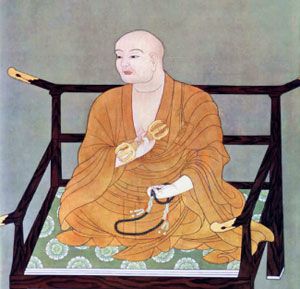
Kūkai (774–835), also known by the posthumous title Kōbō Daishi, was a Japanese Buddhist monk, scholar, writer, and religious thinker who lived during the early Heian period. He is best known as the founder of the Japanese Shingon tradition, a major form of esoteric Buddhism whose teachings emphasize ritual, meditation, sacred language, and the symbolic expression of Buddhist awakening.
Seeking advanced Buddhist instruction, Kūkai traveled to China in 804, where he studied esoteric Buddhist teachings under the master Huiguo. His encounter with the traditions transmitted at the Qinglong Monastery profoundly shaped his intellectual and religious development. After returning to Japan, Kūkai worked to establish and transmit the teachings that became known in Japan as Shingon Buddhism.
Kūkai's thought addressed major questions concerning Buddhahood, the nature of reality, language, knowledge, and religious practice. He taught that the body, speech, and mind could all participate in the realization of awakening through properly transmitted Buddhist practices. His philosophy therefore brought together doctrinal study, meditation, ritual action, mantras, visual symbolism, and a distinctive understanding of the relationship between language and reality.
Kūkai also played an important role in the religious and intellectual history of Japan. He established Mount Kōya as a major center for Shingon Buddhist practice and helped create lasting institutions for the transmission of esoteric Buddhism. Through his writings, religious communities, and cultural influence, Kūkai became one of the most important figures in the development of Japanese Buddhism and the broader history of Japanese thought.
Kūkai: Life, Philosophy, and Key Facts
- Name — Kūkai (空海)
- Also known as — Kōbō Daishi
- Born — 774
- Died — 835
- Country — Japan
- Period — Early Heian period
- Tradition — Esoteric Buddhism
- School associated with him — Shingon Buddhism
- Major center — Mount Kōya
- Known for — Buddhist philosophy, esoteric practice, meditation, language, calligraphy, and religious education
- Major philosophical concern — The realization of Buddhahood and the nature of reality
Kūkai and Buddhism in Heian Japan
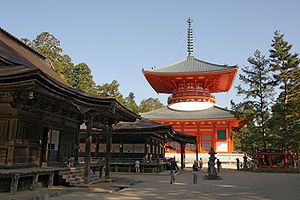
Kūkai lived during the early Heian period, when Buddhism was becoming increasingly important to Japanese religious, political, and intellectual life. Japan had already received Buddhist teachings, texts, and institutions through its long cultural contact with the Asian continent, particularly China and the Korean peninsula. Kūkai emerged during this period of intellectual exchange and became one of the most important figures in the development of Japanese esoteric Buddhism.
As a young man, Kūkai received an education in the classical learning expected of members of the educated elite, including the Chinese literary and intellectual traditions that strongly influenced Japan. His surviving writings and later biographical traditions indicate, however, that he became increasingly dissatisfied with limiting his search for truth to conventional scholarly education. He turned more deeply toward Buddhist study and religious practice in search of a more comprehensive understanding of human existence and awakening.
His intellectual development eventually led him toward esoteric Buddhism, a form of Buddhism involving specialized scriptures, ritual practices, mantras, meditation, and symbolic forms of representation. The decisive stage in his development came through his journey to Tang China, where he studied under the esoteric Buddhist master Huiguo and received instruction and transmission within important esoteric traditions.
After returning to Japan, Kūkai worked to establish and explain this tradition in a new cultural setting. His achievement was not simply the introduction of foreign Buddhist rituals, but the development of a systematic intellectual account of esoteric Buddhism. His writings explored the nature of reality, Buddhahood, embodiment, language, and religious practice, making him one of the most philosophically significant thinkers in the history of Japanese Buddhism.
What Is Shingon Buddhism According to Kūkai?
Shingon Buddhism is the Japanese tradition of esoteric Buddhism most closely associated with Kūkai. The word Shingon is a Japanese rendering of a term commonly translated as "true word" or "word of truth," and it is closely connected with the Sanskrit tradition of mantra. For Kūkai, however, esoteric Buddhism involved far more than the repetition of sacred formulas or the performance of ritual ceremonies.
Kūkai understood esoteric Buddhism as a path in which religious truth must be realized through the whole person. Intellectual understanding alone was not sufficient because awakening involved the transformation and integration of body, speech, and mind. Buddhist doctrine, meditation, ritual action, sacred sound, visualization, and symbolic representation could therefore work together as different dimensions of a single path toward the realization of Buddhahood.
Shingon practice includes such elements as meditation, ritual, mantras, visualization, mandalas, and symbolic hand gestures known as mudrās. These practices are not treated merely as external religious performances. Within Kūkai's philosophical framework, they provide concrete means through which the practitioner can participate in and realize the enlightened reality represented by the Buddha and the Buddhist cosmos.
A central feature of Kūkai's interpretation was therefore the close connection between doctrine and practice. He argued that the deepest Buddhist truths could not always be adequately communicated through ordinary conceptual explanation alone. Esoteric practice provided a disciplined method for embodying and directly realizing those truths, making Shingon both a philosophical system and a practical path toward awakening.
Kūkai and the Three Mysteries of Shingon Buddhism
One of the central features of Shingon practice is the doctrine of the Three Mysteries, traditionally associated with the body, speech, and mind of the Buddha. Kūkai understood these three dimensions as fundamental to the relationship between Buddhist practice and enlightenment. Human beings also possess body, speech, and mind, and esoteric practice seeks to bring these dimensions into correspondence with the awakened activity represented by the Buddha.
Body
The body participates in Buddhist practice through disciplined ritual action, particularly through symbolic gestures known as mudrās. These gestures are not simply decorative signs but form part of an embodied system of religious practice. Through the body, the practitioner actively participates in forms understood to correspond with enlightened activity rather than treating awakening as a purely intellectual experience.
Speech
Speech is expressed through the recitation of mantras, sacred sounds and formulas used within esoteric Buddhist practice. The term Shingon itself points toward the importance of sacred language and sound in Kūkai's tradition. His philosophical writings also developed a broader theory in which sound, signs, and meaning were connected with the expression of Buddhist truth rather than being regarded as merely conventional labels.
Mind
The mind is trained through meditation, concentration, and visualization. The practitioner directs awareness toward Buddhist forms and symbols, including the mandalic representation of awakened reality. The Three Mysteries are therefore practiced together rather than as completely separate activities: body, speech, and mind are integrated so that the practitioner's entire embodied existence becomes involved in the path toward realization.
Kūkai and Buddhahood in This Very Body
One of the most important ideas associated with Kūkai is sokushin jōbutsu, commonly translated as "attaining Buddhahood in this very body" or "becoming a Buddha in this very embodied existence." Kūkai gave this idea a particularly systematic explanation in his philosophical writings, where it became one of the defining features of his understanding of esoteric Buddhist practice.
The teaching emphasizes that Buddhahood is not necessarily something that must remain indefinitely distant from ordinary human existence. Kūkai argued that awakening could be realized within one's present embodied existence through esoteric Buddhist practice. This did not mean that enlightenment required no discipline or transformation; rather, it meant that the present body-and-mind could itself become the field in which awakening was realized.
This idea reflects the distinctive importance Kūkai gave to embodiment. Rather than treating the physical body simply as an obstacle that must be abandoned before enlightenment can occur, Shingon practice incorporates the activities of body, speech, and mind into the path. Ritual gesture, mantra, meditation, and visualization become practical means for realizing the relationship between the human practitioner and awakened reality.
Sokushin jōbutsu therefore connects Kūkai's metaphysical ideas with his theory of religious practice. The possibility of Buddhahood in this very existence depends upon his broader understanding of the relationship between the individual and the Buddhist cosmos. His philosophy seeks to explain not only what enlightenment is, but also why embodied human practice can provide a direct means of realizing it.
Kūkai, Mahāvairocana Buddha, and the Nature of Reality
Kūkai's Shingon philosophy gives a central role to Mahāvairocana Buddha, known in Japanese as Dainichi Nyorai. Mahāvairocana represents the cosmic or universal dimension of Buddhahood within esoteric Buddhist thought and occupies a central position in the scriptures and symbolic systems that shaped Kūkai's philosophy. For Kūkai, Buddhahood was therefore not merely the condition of an isolated historical individual.
His philosophy presents reality as profoundly connected with the expression of Buddhist truth. Kūkai developed the idea that the cosmic Buddha, understood as the embodiment of ultimate truth, is not completely separate from the world of phenomena. The natural world, human experience, sound, form, and other phenomena could be understood within a larger Buddhist cosmos in which reality itself expresses the Dharma.
This understanding helped provide the philosophical basis for Shingon practices involving mandalas, mantras, and visualization. A mandala, for example, does not simply function as an artistic image of a supernatural world located elsewhere. Within esoteric practice, it can represent the structure and interrelationship of awakened reality and provide a symbolic field through which the practitioner contemplates and realizes that reality.
Kūkai's interpretation of Mahāvairocana is therefore closely connected with his effort to explain how ordinary embodied existence can become a field for enlightenment. If the human practitioner and the cosmos are understood within a deeply interconnected Buddhist reality, then awakening involves realizing that relationship rather than escaping from the world into a completely separate realm of existence.
Kūkai's Philosophy of Language and Reality
Language occupies an unusually important place in Kūkai's philosophical thought. He explored the relationship between sounds, written signs, words, and reality in works such as Shōji Jissōgi. His interest was not limited to the ordinary linguistic question of how human beings use words to describe objects. Instead, he examined language within a broader Buddhist understanding of how truth is manifested and communicated.
For Kūkai, sacred language was not merely a collection of arbitrary labels attached to things. Mantras and other symbolic forms could participate in the expression of Buddhist truth. He developed the closely connected concepts of sound, sign, and reality to explain how audible sounds, written forms, and the meaning or reality they express could be understood as different but interconnected dimensions.
This idea is connected with Kūkai's broader concept that the cosmos itself expresses the Dharma. From this perspective, Buddhist truth is not communicated only through ordinary human speech or written philosophical arguments. The phenomena of the world can themselves be understood as participating in a larger process of expression, which the trained practitioner learns to interpret through esoteric insight.
Speech consequently plays an important role within the Three Mysteries. The recitation of mantra becomes part of a larger practice involving body, mind, ritual, and realization. Kūkai's philosophy of language therefore challenges a simple separation between words and reality, presenting language, sound, and symbolic form as deeply connected with his Buddhist account of the cosmos and enlightenment.
Kūkai and Mount Kōya: Why Is Kōyasan Important?
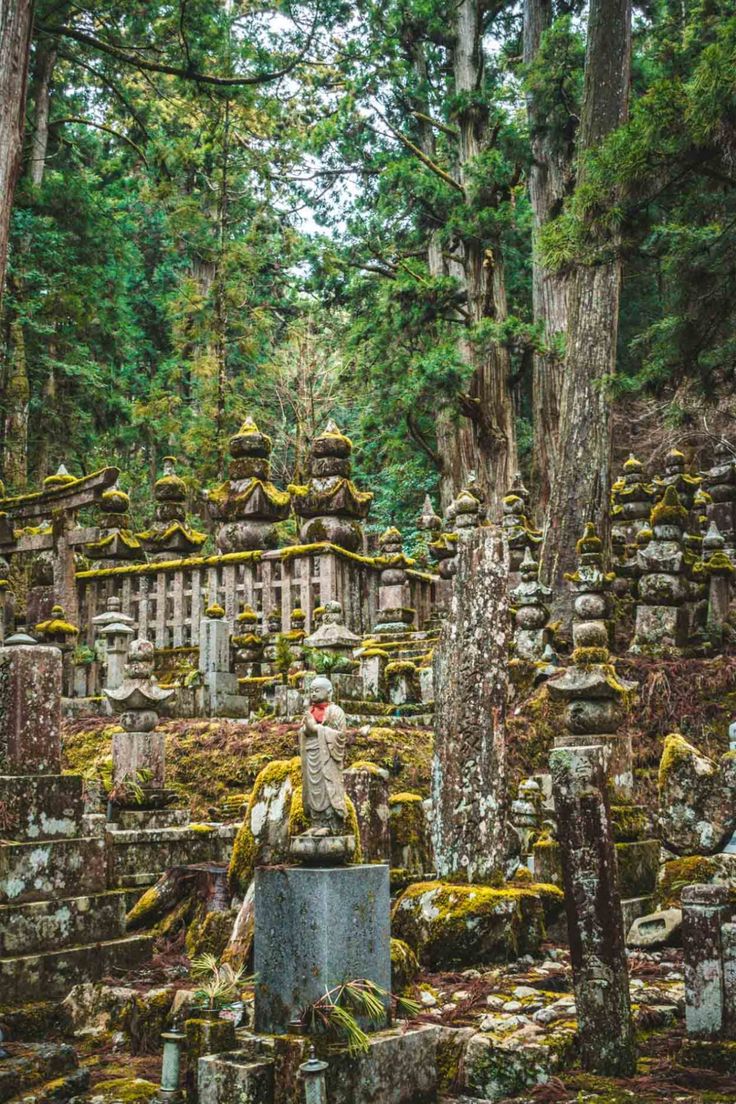
Mount Kōya, or Kōyasan, became one of the central locations associated with Kūkai's Buddhist tradition. In the early ninth century, Kūkai began establishing a monastic center on the mountain, creating a place intended for religious practice, study, and the development of esoteric Buddhism. The site eventually became one of the most important institutional and spiritual centers of the Shingon tradition.
The mountain's geographical setting supported the development of a monastic environment devoted to Buddhist discipline and religious training. Kūkai's connection with Mount Kōya also gave his tradition a lasting institutional center beyond the political capital. Over time, temples, monastic communities, and religious practices developed there, helping to preserve and transmit Shingon teachings through later periods of Japanese history.
Kōyasan became important not only as a physical location but also as a symbol of Kūkai's continuing religious legacy. The mountain remains strongly associated with Kōbō Daishi and with the transmission of Shingon Buddhism. Its religious institutions have continued to make the site a major destination for Buddhist practitioners, pilgrims, scholars, and visitors interested in Japanese religious history.
Kūkai is also closely associated with Okunoin, where his mausoleum became a major focus of religious devotion. Later tradition developed the belief that Kūkai remains in a state of continuing meditation rather than having simply disappeared from the religious world. Whether considered historically or through the lens of religious tradition, Mount Kōya remains inseparable from the cultural and spiritual legacy of Kūkai.
Kūkai's Main Philosophical Ideas
Kūkai's philosophy brings together Buddhist metaphysics, religious practice, language, embodiment, meditation, and theories of enlightenment. His ideas should not be understood as isolated doctrines because they form an interconnected account of reality and the path toward awakening. Several themes are especially important for understanding why Kūkai occupies such a significant position in the history of Japanese philosophical and Buddhist thought.
Esoteric Knowledge
Kūkai distinguished esoteric Buddhist teachings from forms of teaching that communicate Buddhist truth primarily through ordinary conceptual explanation. He argued that esoteric Buddhism provided access to dimensions of truth that required specialized practices and symbolic forms of realization. This distinction did not mean that intellectual understanding was useless, but that awakening required a deeper integration of knowledge, practice, ritual, and direct realization.
Buddhahood in This Very Body
Kūkai emphasized the possibility of attaining Buddhahood within one's present embodied existence. Through the coordinated practice of body, speech, and mind, the practitioner could realize a non-dual relationship with awakened reality. This teaching gave philosophical importance to the body and made concrete religious practice central to Kūkai's explanation of how enlightenment could actually be realized.
Body, Speech, Mind, Language, and Reality
Kūkai treated the transformation of body, speech, and mind as central to Buddhist practice, while also giving special importance to mantras, sounds, symbols, and mandalas. Reality itself was understood as deeply connected with Buddhahood rather than as a completely separate realm that had to be abandoned. These ideas together form a distinctive philosophical system in which embodiment, language, practice, and the nature of the cosmos are inseparably connected.
Kūkai's Ten Stages of Mind
Kūkai developed a systematic account of religious and philosophical development in his major work Jūjūshinron, commonly known in English as The Ten Stages of the Development of Mind or The Ten States of Mind. Completed late in his life, the work presents an ambitious attempt to classify and compare different forms of thought, religious understanding, and spiritual practice within a broad philosophical framework.
The work examines a range of perspectives, including non-Buddhist and Buddhist traditions known to Kūkai, and arranges them according to his understanding of their insight into reality and enlightenment. Esoteric Buddhism occupies the highest position within this system. The structure therefore expresses Kūkai's conviction that Shingon provides the most comprehensive account of Buddhist truth and the most direct means of realizing it.
The Ten Stages should not be understood simply as a ranking of individual people from morally inferior to morally superior. Kūkai was constructing a philosophical and religious classification of different ways in which the mind understands itself, the world, ethics, and ultimate reality. Each stage represents a particular orientation or level of understanding rather than a simple description of a person's permanent identity.
The importance of the work lies in its extraordinary scope. Kūkai attempted to organize the intellectual and religious traditions available to him into a single comprehensive vision of spiritual development. The Jūjūshinron therefore demonstrates both his confidence in the superiority of esoteric Buddhism and his ability to engage systematically with competing philosophical and religious systems.
What Did Kūkai Write?
Unlike many ancient philosophers whose ideas survive only through fragments or the reports of later writers, a substantial body of Kūkai's writings has been preserved. His works address Buddhist doctrine, esoteric practice, language, enlightenment, education, and the classification of religious teachings. This surviving body of literature makes it possible to study Kūkai not only as a religious founder but also as a systematic and original thinker.
Major Works Associated with Kūkai
- Jūjūshinron — commonly translated as The Ten Stages of the Development of Mind, Kūkai's major systematic classification of religious and philosophical development.
- Hizō Hōyaku — an abbreviated presentation of the system developed in the larger work on the stages of mind and an important explanation of esoteric Buddhist teachings.
- Sokushin Jōbutsugi — a major work explaining the possibility of attaining Buddhahood in one's present embodied existence.
- Shōji Jissōgi — a philosophical work concerning sound, signs or letters, language, and the nature of reality.
These works are particularly important because they show how Kūkai developed an intellectual framework for Shingon Buddhism rather than merely transmitting a collection of rituals. His writings explain the relationship between theory and practice, the nature of the Buddhist cosmos, and the possibility of enlightenment. Together they form the foundation for understanding Kūkai as one of the most systematic philosophical thinkers in the history of Japanese Buddhism.
Kūkai, Education, and Japanese Culture
Kūkai's influence was not limited to Buddhist doctrine and religious practice. He was also an important figure in the intellectual and cultural history of Japan, with interests extending across scholarship, literature, language, artistic expression, and education. His broad range of activities reflects the close relationship between religion, learning, and cultural life in the early Heian period.
He became associated with scholarship, poetry, calligraphy, and the transmission of continental learning. Kūkai's intellectual life was therefore not confined to writing theological explanations for Buddhist specialists. His engagement with language and literature also complemented his philosophical interest in sound, signs, symbols, and the ways through which meaning and truth can be communicated.
Kūkai is traditionally associated with the establishment of Shugei Shuchi-in, an educational institution in Heian Japan. The school is significant because it reflected an effort to make learning available beyond the narrow hereditary aristocratic structures that dominated some forms of official education. Although the institution did not survive indefinitely, its establishment became an important part of Kūkai's broader cultural legacy.
His importance for Japanese culture therefore extends beyond the boundaries of a single Buddhist school. Kūkai became a symbol of the ideal of the learned religious figure whose activities could include philosophical writing, artistic expression, education, and practical social concerns. Later traditions further expanded this image, making Kōbō Daishi one of the most culturally influential figures in Japanese religious memory.
Kūkai and Japanese Calligraphy
Kūkai is traditionally remembered as one of the major figures in the early history of Japanese calligraphy. His cultural importance therefore extends beyond Buddhist philosophy into the development of writing and artistic expression in Japan. His journey to Tang China also exposed him to highly developed continental traditions of writing and calligraphy that influenced Japanese intellectual and artistic culture.
Later Japanese tradition associated Kūkai with the celebrated group known as the Sanpitsu, or "Three Brushes," three important early Heian masters of calligraphy. His reputation became closely connected with the cultural image of Kōbō Daishi as an extraordinarily versatile scholar and religious figure. As with many famous historical figures, later tradition also added stories and associations that must be distinguished from securely documented facts.
Kūkai's interest in writing and calligraphy also fits naturally with his broader philosophical concern with language. His reflections on sounds, letters, signs, and reality gave symbolic expression an unusual philosophical importance. Written characters were therefore not merely practical instruments for recording information but could be considered within a larger inquiry into meaning and the manifestation of Buddhist truth.
The connection between calligraphy and Kūkai's philosophy should not, however, be exaggerated into the claim that every calligraphic work expressed a complete metaphysical doctrine. His historical importance lies instead in the combination of genuine cultural accomplishment and philosophical reflection on language. Together these helped establish his lasting reputation as a figure whose influence crossed the boundaries between religion, philosophy, literature, and art.
Kūkai's Journey to China and the Development of Shingon Buddhism
Kūkai traveled to Tang China as part of a Japanese diplomatic mission, entering a cultural world in which Buddhist scholarship and religious institutions had developed through centuries of interaction among Indian, Central Asian, and Chinese traditions. His journey was crucial because many of the forms of esoteric Buddhism that would later shape Shingon were then being transmitted and developed within the broader Buddhist world of China.
One of the most important figures in Kūkai's intellectual and religious development was the Chinese Buddhist master Huiguo. Under Huiguo, Kūkai received instruction and transmission in important esoteric Buddhist teachings and practices. Their relationship became central to later accounts of the transmission of esoteric Buddhism from the continental Buddhist tradition to the Japanese Shingon school.
Kūkai returned to Japan with Buddhist texts, ritual knowledge, artistic and symbolic materials, and a more fully developed understanding of esoteric Buddhist practice. His return did not mean that he simply reproduced Chinese Buddhism unchanged. He spent the remainder of his life interpreting, organizing, and institutionalizing these teachings within the religious and political circumstances of Japan.
The journey to China therefore represents a decisive turning point in Kūkai's life. It gave him access to an important international network of Buddhist learning while also providing the foundations for his later intellectual work. The development of Shingon Buddhism in Japan was the result of this continental inheritance combined with Kūkai's own systematic interpretation, writing, teaching, and institutional activity.
Was Kūkai a Philosopher?
Kūkai is primarily remembered as a Buddhist monk, teacher, and religious founder, but his writings contain substantial philosophical arguments concerning reality, knowledge, language, consciousness, embodiment, and spiritual development. Whether he is called a "philosopher" depends partly on how philosophy is defined, since the modern distinction between philosophy and religion does not map perfectly onto the intellectual traditions of ninth-century Japan.
Nevertheless, Kūkai clearly addressed questions that are philosophical in a broad and rigorous sense. He developed systematic accounts of the nature of reality, the relationship between signs and meaning, the structure of consciousness and spiritual development, and the possibility of knowledge that goes beyond ordinary conceptual thought. His works also compare and classify different intellectual and religious systems according to their understanding of ultimate truth.
His work therefore occupies an important position in the history of Japanese philosophy as well as the history of Japanese Buddhism. Kūkai demonstrates that philosophical reflection does not always occur independently from religious practice. In his thought, metaphysical claims about reality were closely connected with questions about meditation, ritual, language, and the transformation of human existence.
Rather than separating theory from practice, Kūkai treated intellectual understanding and religious realization as interconnected. A person could study Buddhist doctrines and philosophical arguments, but those truths also required practical realization through the disciplined activities of body, speech, and mind. This integration of speculative thought and embodied practice is one of the defining characteristics of Kūkai's distinctive philosophical contribution.
Kūkai's Influence on Japanese Philosophy and Buddhism
Kūkai became one of the most influential figures in the history of Japanese Buddhism. The Shingon tradition associated with his teaching continued long after his death and developed into one of the major forms of Japanese Buddhism. His intellectual influence was especially important because he provided Shingon with systematic philosophical explanations as well as institutions and practices through which the tradition could be transmitted.
His ideas influenced Japanese approaches to meditation, ritual, sacred language, artistic representation, and the relationship between human beings and Buddhist reality. The importance he gave to mantra, mandala, embodiment, and symbolic practice also contributed to a broader religious culture in which visual forms, sounds, gestures, and material objects could play significant roles in spiritual understanding and practice.
Kūkai's influence also extended into literature, education, calligraphy, and cultural memory. Later generations remembered him not simply as a historical monk but as Kōbō Daishi, a figure surrounded by an extensive body of religious tradition and popular devotion. This continuing process of remembrance helped make him one of the most recognizable and culturally significant Buddhist figures in Japan.
His legacy is particularly visible in the continuing importance of Kōyasan, which remains a major center associated with Shingon Buddhism. For the history of philosophy, Kūkai remains important because his work demonstrates the extraordinary intellectual complexity of Japanese Buddhist thought. His writings continue to attract attention for their discussions of language, embodiment, reality, and the possibility of enlightenment.
What Do We Know About Kūkai?
Kūkai is considerably better documented than many ancient philosophical figures because a substantial body of writings traditionally attributed to him survives, while historical records and biographical traditions concerning his life developed relatively early. Nevertheless, the distinction between securely established historical evidence and later religious tradition remains important when studying his life. Kūkai eventually became the subject of extensive veneration, and later stories sometimes expanded his historical image.
Well Established
- Kūkai lived from 774 to 835 during the early Heian period of Japanese history.
- He became one of the most important figures in the development of Japanese esoteric Buddhism and the Shingon tradition.
- He traveled to Tang China, where he studied important esoteric Buddhist teachings and received instruction from Huiguo.
- He became associated with the establishment and development of Mount Kōya as a major center of Shingon Buddhism.
- He wrote major Buddhist philosophical and religious works concerning enlightenment, language, esoteric teaching, and the development of the mind.
Important Traditional Associations
- His posthumous title Kōbō Daishi, bestowed after his death.
- His enduring reputation as one of the great figures of Japanese calligraphy and early Heian culture.
- His continuing association with Mount Kōya and his mausoleum at Okunoin.
- The extensive religious traditions, miracle stories, and forms of devotion that developed around his later veneration.
The historical Kūkai and the Kūkai remembered through later religious tradition should therefore be distinguished without assuming that the traditional material is historically worthless. His surviving writings and contemporary historical setting allow scholars to establish much about his intellectual career, while later traditions reveal how profoundly his memory continued to shape Japanese religious and cultural life.
Kūkai Explained Simply
Kūkai was a Japanese Buddhist monk, scholar, and thinker who became the most important figure associated with the development of Shingon Buddhism, a major Japanese tradition of esoteric Buddhism. He believed that Buddhist truth should not remain merely an abstract theory and that awakening required the active transformation and integration of the whole person.
His philosophy taught that the body, speech, and mind could all become part of the path toward enlightenment. Through practices involving meditation, mantra, ritual gesture, visualization, and other esoteric methods, the practitioner could work toward realizing Buddhahood in the present embodied existence. Kūkai therefore connected philosophy, religious practice, language, and the nature of reality into a single intellectual and spiritual system.
In very simple terms, Kūkai asked a question such as this: How can human beings directly realize the deepest truth of reality rather than merely talk about it? His answer emphasized disciplined practice. Understanding Buddhist teachings matters, but the body, speech, and mind must also participate in the process of awakening.
- Who was he? — A Japanese Buddhist monk, scholar, writer, and one of the most important thinkers of the early Heian period.
- What is he famous for? — Developing and systematically explaining the Japanese tradition of Shingon esoteric Buddhism.
- What did he teach? — A path toward awakening involving body, speech, mind, meditation, mantra, ritual, and esoteric Buddhist practice.
- What is his famous idea? — Sokushin jōbutsu, the possibility of attaining Buddhahood in this very embodied existence.
- Where is he strongly associated? — Mount Kōya, or Kōyasan, one of the major centers of the Shingon Buddhist tradition.
- Why is he important? — He profoundly influenced Japanese Buddhist philosophy, religious practice, language, education, art, and cultural history.
Frequently Asked Questions About Kūkai
Who was Kūkai?
Kūkai was an influential Japanese Buddhist monk, scholar, writer, and religious thinker of the early Heian period. He is best known for developing Shingon esoteric Buddhism in Japan.
What is Kūkai famous for?
Kūkai is famous for developing Japanese Shingon Buddhism, establishing Mount Kōya as a major Buddhist center, writing influential Buddhist philosophical works, and contributing to Japanese culture and calligraphy.
What did Kūkai believe?
Kūkai taught an esoteric Buddhist path centered on awakening and Buddhahood. His philosophy emphasized meditation, mantra, ritual, and the transformation of body, speech, and mind.
What is Shingon Buddhism?
Shingon Buddhism is a Japanese tradition of esoteric Buddhism associated with Kūkai. Its practices include mantra, meditation, mudrā, visualization, ritual, and other methods intended to realize Buddhist awakening.
What does Kūkai mean by Buddhahood in this very body?
Kūkai is associated with the teaching known as sokushin jōbutsu, or attaining Buddhahood in this very body. The teaching emphasizes the possibility of realizing Buddhahood through esoteric Buddhist practice within one's present embodied existence.
What are the Three Mysteries in Shingon Buddhism?
The Three Mysteries refer to the Buddha's activities of body, speech, and mind. Shingon practice uses mudrā, mantra, and meditation or visualization to engage these dimensions of Buddhist practice.
Why is Mount Kōya important to Kūkai?
Mount Kōya became a major center for the Shingon Buddhist tradition associated with Kūkai. Kōyasan remains strongly connected with his religious legacy.
Did Kūkai travel to China?
Yes. Kūkai traveled to Tang China and studied Buddhist teachings there, including esoteric Buddhism. His encounter with Chinese esoteric Buddhism played an important role in the development of Shingon Buddhism in Japan.
What books did Kūkai write?
Important works associated with Kūkai include Jūjūshinron, Hizō Hōyaku, Sokushin Jōbutsugi, and Shōji Jissōgi. These works address Buddhist philosophy, enlightenment, esoteric practice, language, and reality.
Was Kūkai a philosopher?
Kūkai was primarily a Buddhist monk and religious thinker, but his writings contain extensive philosophical discussions of reality, consciousness, language, knowledge, and spiritual development.
Who was Kōbō Daishi?
Kōbō Daishi is the posthumous title by which Kūkai became widely known in Japan. The name remains strongly associated with his religious legacy and the Shingon Buddhist tradition.
Why is Kūkai important in Japanese philosophy?
Kūkai is important because he developed a sophisticated Buddhist philosophical system that connected enlightenment, language, consciousness, ritual, meditation, and the nature of reality. His thought became an important part of the history of Japanese philosophy and Buddhism.
Related Asian Philosophers and Thinkers
Kūkai's thought developed within a broader history of Buddhist, Chinese, and Japanese philosophy. Explore other thinkers connected with Buddhism, Japanese philosophy, and Asian intellectual history.
Philosophy and Traditions Connected to Kūkai
Kūkai's philosophy connects with several major areas of philosophical and religious inquiry, especially metaphysics, philosophy of language, Buddhist philosophy, consciousness, and the study of reality.
Why Kūkai Still Matters
Kūkai remains one of the most important figures in the history of Japanese Buddhism and philosophy. His development of Shingon Buddhism created a tradition that connected Buddhist doctrine with meditation, ritual, language, art, and the transformation of human consciousness.
His philosophy also presents a distinctive understanding of enlightenment. Through the Three Mysteries and the teaching of Buddhahood in this very body, Kūkai emphasized that the path toward awakening involves the whole person rather than intellectual knowledge alone.
From his writings on language and reality to his establishment of Kōyasan as a center of Buddhist learning, Kūkai left a lasting intellectual and religious legacy. His work remains an important subject for anyone interested in Japanese philosophy, Buddhist philosophy, Shingon Buddhism, and the history of Asian thought.
Explore Great Philosophers