Who Was Watsuji Tetsurō?
Watsuji Tetsurō (1889–1960) was a Japanese philosopher, ethicist, cultural historian, and scholar of Japanese intellectual history. He is particularly known for developing an influential approach to ethics that places human beings within networks of relationships rather than treating the individual as an isolated and completely self-sufficient self. His philosophical work became one of the major contributions to modern Japanese ethical thought during the twentieth century.
Watsuji's philosophy connects ethics with culture, society, history, environment, and human relationships. His most distinctive ideas include aidagara, often translated as "betweenness," and fūdo, a concept concerning the environmental and cultural milieu in which human beings live. Through these concepts, Watsuji examined human existence as fundamentally relational and situated rather than as something that can be understood solely by studying an individual consciousness in isolation.
A central concern of Watsuji's ethics was the tension between individuality and social existence. Human beings are distinct individuals, yet they are also formed through families, communities, languages, institutions, traditions, and other forms of shared life. Watsuji attempted to explain ethics through this dynamic relationship, arguing that moral life cannot be understood adequately if either the individual or the social whole is treated as the only fundamental reality.
His work brought together Japanese intellectual traditions and engagement with Western philosophy. He studied thinkers including Nietzsche, Kierkegaard, and Heidegger while also investigating Buddhism, Japanese culture, ethics, and the history of Japanese thought. Watsuji did not simply reproduce either Western or Japanese philosophical traditions; he attempted to develop his own philosophical account of human existence, culture, and ethical responsibility.
Watsuji remains important for his contribution to relational ethics, environmental and cultural philosophy, and the study of modern Japanese thought. His ideas have influenced discussions about the relationship between the individual and society, the role of climate and environment in human existence, and the philosophical foundations of ethical life. At the same time, his intellectual legacy has also been examined critically in relation to nationalism and the political circumstances of twentieth-century Japan.
Watsuji Tetsurō: Quick Facts
- Full name — Watsuji Tetsurō
- Japanese name — 和辻哲郎
- Born — March 1, 1889
- Died — December 26, 1960
- Born in — Himeji, Hyōgo Prefecture, Japan
- Known for — Ethics, cultural history, Japanese philosophy, and philosophical anthropology
- Major concepts — Aidagara, ningen, fūdo, relationality, and betweenness
- Major work — Rinrigaku (Ethics)
- Another major work — Fūdo (Climate and Culture)
- Philosophical interests — Ethics, culture, religion, history, human existence, and Japanese thought
Watsuji Tetsurō's Early Life and Education
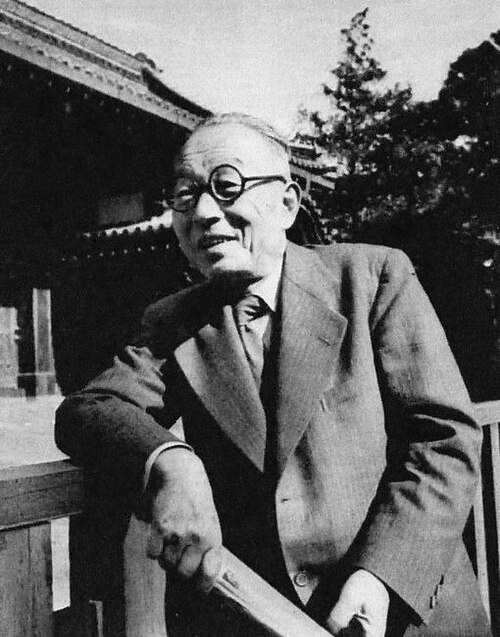
Watsuji was born in 1889 in what is now Himeji City in Hyōgo Prefecture, Japan, during a period of rapid intellectual and social transformation in modern Japan. His father was a physician, and Watsuji developed an early interest in literature as well as philosophy. These literary interests remained important throughout his career and contributed to the unusually broad cultural range of his later philosophical work.
He studied at the First Higher School in Tokyo before entering Tokyo Imperial University, where he specialized in philosophy. During his early intellectual career he wrote about Western philosophers including Friedrich Nietzsche and Søren Kierkegaard, engaging with questions about individuality, culture, religion, and modern European intellectual life.
His interests gradually expanded toward Japanese culture, Buddhist thought, ancient Japanese history, aesthetics, and the history of Japanese ethical ideas. He became especially interested in the ways philosophical ideas are expressed through historical traditions and cultural forms rather than existing only as abstract theories detached from particular societies.
This combination of Western philosophy and Japanese intellectual history became an important feature of his mature philosophy. Watsuji did not abandon Western philosophical inquiry when turning toward Japanese and Buddhist traditions; instead, he attempted to bring different intellectual resources into conversation while developing his own account of human existence and ethical life.
Why Is Watsuji Tetsurō Important in Japanese Philosophy?
Watsuji is regarded as one of the major philosophers of modern Japanese thought. His importance comes especially from his attempt to construct a systematic account of ethics in which human existence is fundamentally relational. Rather than treating moral life as something produced solely by independent individuals, he examined the social structures within which persons become individuals in the first place.
Rather than beginning with an isolated individual, Watsuji asks how people exist within families, communities, institutions, cultures, historical traditions, and environments. These relationships are not, in his view, merely external circumstances surrounding an otherwise complete individual; they belong to the concrete conditions of human existence.
His philosophy therefore connects questions usually treated separately: What is a human being? How should people live together? How does culture shape human existence? And how does the environment participate in the formation of human life? This broad approach links ethics with philosophical anthropology, cultural history, and the study of the human relationship with the natural world.
Watsuji is also important because his work demonstrates the distinctive development of modern Japanese philosophy during the twentieth century. His writings engaged deeply with European thinkers while drawing upon Buddhist and Japanese intellectual traditions, making his philosophy significant for comparative philosophy as well as for the history of Japanese ethical thought.
What Is Watsuji Tetsurō's Philosophy of Ethics?
Watsuji's ethics is one of the central achievements of his philosophy. He argued that ethics cannot be adequately understood by treating human beings as completely independent individuals who first exist alone and only later choose to form social relationships. Ethical existence begins from the fact that human life is already lived among and with other people.
Human beings are simultaneously individuals and members of communities. Our lives are shaped by relationships with other people, social institutions, historical traditions, and the environments in which we live. Watsuji therefore sought to explain morality through the dynamic tension between individual selfhood and forms of shared human existence.
For Watsuji, ethics therefore concerns the ways human beings relate to one another. Ethical life involves relationships, obligations, social practices, and the possibility of both separation and connection between people. Moral responsibility arises within concrete forms of human coexistence rather than in a purely abstract realm outside history and society.
This relational approach distinguishes Watsuji's ethics from ethical theories that begin primarily with an autonomous individual making independent moral choices. However, he did not simply deny individuality in favor of the community. His ethical philosophy attempts to understand how individual persons emerge from, return to, and continually negotiate the relationships that constitute social life.
What Is Aidagara in Watsuji's Philosophy?

Aidagara is one of the most important concepts in Watsuji's philosophy. It is commonly translated as "betweenness" and refers to the relational dimension of human existence. The concept directs attention away from the idea of a completely self-contained individual and toward the concrete space of relations in which persons encounter and respond to one another.
Watsuji argues that human beings do not first exist as completely isolated selves and only later enter relationships. Human existence is already structured through relationships with others, including relations of communication, cooperation, conflict, obligation, and mutual dependence. The individual and the social world therefore cannot be understood as entirely separate realities.
Family relationships, friendship, social membership, cultural traditions, and other forms of interaction all contribute to the relational world in which a person exists. Even language and ordinary patterns of communication reveal that human self-understanding is shaped through forms of life shared with others.
Aidagara therefore helps explain why Watsuji's ethics focuses on the "between" rather than only on the isolated individual. Ethics concerns how this relational existence is organized, maintained, disrupted, and renewed. The concept became fundamental to his attempt to describe human beings as simultaneously distinct persons and participants in larger forms of communal life.
What Does Ningen Mean in Watsuji's Philosophy?
The Japanese term ningen is central to Watsuji's philosophical anthropology. The term can refer to the human being or human existence, but Watsuji develops its meaning in connection with the relational character of human life. He uses it to challenge accounts of humanity that define the person exclusively through individual consciousness or biological existence.
For Watsuji, the human being should not be understood simply as an isolated biological or psychological individual. Human existence is simultaneously individual and social, involving both personal distinctness and participation in shared worlds. This dual character is not an accidental addition to humanity but belongs to the basic structure of human existence.
This dual character is essential to his ethics. A person has an individual dimension, but also exists as a member of families, communities, institutions, and broader social formations. Watsuji's analysis therefore asks how individuals become separated from communal forms while also remaining dependent upon and connected with them.
The concept of ningen thus provides a foundation for Watsuji's wider philosophical project. To understand ethical responsibility, he believed, one must first understand the kind of being capable of ethical relations. Human beings are neither merely private selves nor simply anonymous parts of a collective, but exist within an ongoing tension between individuality and shared existence.
Watsuji Tetsurō on Human Relationality
Human relationality is arguably the central theme connecting Watsuji's ethics, anthropology, and philosophy of culture. He sought to show that relationships are not merely secondary connections formed between already complete individuals, but an essential dimension of the way human beings actually exist.
A person is formed through relationships and does not exist outside every social and cultural context. Language, customs, institutions, family relationships, and historical traditions all influence the ways people understand themselves and others. At the same time, human beings can question, transform, and sometimes reject the relationships and traditions in which they find themselves.
Watsuji's approach therefore treats social connection not merely as something added to human existence but as part of what it means to be human. This does not mean that every existing social relationship is morally justified. Rather, relationality provides the field within which ethical questions about responsibility, conflict, obligation, and human freedom arise.
His account of relationality also explains why Watsuji connected philosophy with history and culture. Human relationships take different forms in different societies and historical periods, yet the fundamental fact of living with others remains central to human existence. Ethics must therefore consider both universal philosophical questions and the concrete conditions of historical life.
Watsuji on the Individual and Community
Watsuji's ethics attempts to avoid reducing human beings either to isolated individuals or to completely absorbed members of a collective. Both dimensions are essential to his understanding of human existence, and neither can adequately explain ethical life when treated as the only fundamental reality.
Human beings have an individual dimension and a social dimension. The ethical problem arises within the dynamic relationship between these dimensions. Individuals distinguish themselves from communal forms, make particular commitments, and develop personal identities, while also remaining dependent upon relationships that make social life possible.
This means that individuality and community should not simply be treated as absolute opposites. Human existence involves movement between separation and connection, independence and belonging. Watsuji analyzes this movement as a basic structure of ethical existence rather than as a problem that can be permanently solved by choosing either individual freedom or collective unity.
This aspect of his thought is particularly important because it has generated both appreciation and criticism. Watsuji's relational ethics offers a powerful challenge to radical individualism, but scholars have also questioned how his emphasis on communal existence can avoid giving excessive philosophical priority to social or political wholes.
What Is Fūdo? Watsuji's Philosophy of Climate and Culture

Fūdo is another major concept in Watsuji's philosophy. It is often translated as "climate," but the concept is broader than weather or atmospheric conditions alone. Fūdo refers more generally to the environmental milieu within which human beings live, including the interaction of geographical, climatic, social, and cultural conditions.
Watsuji uses fūdo to discuss the relationship between human beings and their environmental and cultural milieu. Geography, climate, landscape, patterns of settlement, food, clothing, architecture, customs, and ways of life can all be considered in relation to the human environment. His concern is with lived human existence rather than with nature understood as a completely separate object.
The concept therefore challenges a simple separation between human culture and the natural environment. Human beings live within environments and develop cultural forms in relation to them, while those environments are themselves experienced, interpreted, and transformed through human activity and collective life.
Fūdo should not simply be interpreted as a theory of strict environmental determinism. Watsuji was concerned with the mutual relationship between human beings and their milieu rather than the claim that climate mechanically produces a particular culture. This distinction is important for understanding both the originality and the limitations of his environmental philosophy.
Watsuji's Climate and Culture Theory
Watsuji's Fūdo, often translated as Climate and Culture, examines how environmental conditions and human cultural life are interconnected. The work asks how people experience climate and landscape as part of a shared human world rather than merely as external physical conditions measured by natural science.
His argument is not simply that climate mechanically determines culture. Rather, human beings exist within a particular milieu and develop ways of living, building, eating, dressing, working, and organizing society within that environment. Environmental conditions become meaningful through collective forms of human response and historical experience.
Watsuji's analysis therefore differs from a purely geographical or scientific study of climate. He is interested in the lived relation between people and their surroundings and in the ways environments are encountered through culture, social practices, and shared forms of existence.
This makes fūdo important not only for environmental philosophy but also for philosophical anthropology and the philosophy of culture. Later readers have found the concept useful for reconsidering the relationship between place, embodiment, society, and environment, while also critically examining some of Watsuji's broader cultural generalizations.
Watsuji Tetsurō and Martin Heidegger
Watsuji's philosophy developed partly through engagement with Martin Heidegger, especially Heidegger's Being and Time. Watsuji encountered Heidegger's philosophy during the period of his study in Germany and recognized the importance of Heidegger's attempt to analyze human existence without reducing it to a detached knowing subject.
Watsuji appreciated Heidegger's analysis of human existence but believed that Heidegger placed insufficient emphasis on spatiality in comparison with temporality. Watsuji argued that human existence is not only historical and temporal but also fundamentally situated within concrete environments and shared spaces.
Watsuji's response was to emphasize the environmental and relational dimensions of human existence. His concept of fūdo highlights the spatial and environmental conditions in which human life unfolds, while aidagara emphasizes that existence is always also existence among other human beings.
This dialogue with Heidegger became an important part of the development of Watsuji's distinctive philosophical anthropology. Watsuji did not merely reject Heidegger but extended and transformed questions raised by European existential and phenomenological philosophy through his own analysis of climate, place, culture, and human relationality.
Watsuji Tetsurō and Japanese Philosophy
Watsuji occupies an important position in modern Japanese philosophy. His work combined engagement with Western philosophy with detailed studies of Japanese culture, Buddhism, history, and ethical thought. This combination allowed him to approach philosophical questions through both systematic analysis and historical investigation.
He also studied Japanese intellectual figures and traditions, including Dōgen and Buddhist thought. His historical and cultural research became an important part of his philosophical project because he believed that ethical and philosophical ideas must be understood in relation to the concrete forms of life through which they are expressed.
Watsuji is sometimes discussed alongside the Kyoto School, particularly because of his engagement with Nishida Kitarō and shared interest in Buddhist and Western philosophical questions. However, he developed a distinctive philosophical system and should not simply be treated as identical to the Kyoto School.
His strongest distinctive contribution was his systematic account of ethics, relationality, human existence, and culture. Whereas Nishida's philosophy became especially associated with concepts such as pure experience, basho, and absolute nothingness, Watsuji concentrated much more directly on the interpersonal and ethical structures of human existence.
Watsuji Tetsurō and Buddhist Philosophy
Buddhist thought played an important role in Watsuji's intellectual development and philosophical investigations. His historical studies of Buddhism and his engagement with Japanese Buddhist traditions gave him important resources for thinking about the nature of the self, human relations, history, and forms of spiritual and ethical life.
His engagement with Buddhist ideas contributed to his interest in concepts such as emptiness, relational existence, and the rejection of a completely self-sufficient individual self. These themes resonated with his broader criticism of philosophical approaches that treat the individual subject as the sole starting point for understanding human reality.
Watsuji nevertheless developed his own philosophical vocabulary and used Buddhist thought alongside Western philosophy and Japanese cultural history in constructing his account of ethics. His philosophy should therefore not be understood simply as a restatement of Buddhist doctrine translated into modern terminology.
His work on Buddhist thinkers and traditions also reflects his broader interest in intellectual history. For Watsuji, philosophical ideas were not isolated from the historical worlds in which they emerged. The study of Buddhism consequently formed part of his larger attempt to understand the development of Japanese ethical and cultural life.
Watsuji's Ethics as Philosophical Anthropology
Watsuji's ethics can also be understood as a form of philosophical anthropology because it begins with a question about what human beings are and how they exist. Before asking only what moral rules people should follow, Watsuji investigates the fundamental structure of human existence itself.
His answer emphasizes that human beings are both individual and social. The human being exists within relationships and within a particular historical and environmental world. This means that the study of ethics cannot ignore embodiment, social institutions, culture, history, and the concrete conditions in which people live.
Ethics therefore cannot be separated completely from anthropology. To understand how people ought to live together, Watsuji believes we must first understand the relational structure of human existence. Moral obligations arise within forms of coexistence and cannot be fully explained by imagining an individual who exists outside all social relationships.
This approach gives Watsuji's philosophy an unusually broad scope. His ethics connects questions about moral responsibility with philosophical accounts of the self, society, culture, and environment. It is this attempt to unite anthropology and ethics that makes his work particularly distinctive within modern Japanese philosophy.
Important Books by Watsuji Tetsurō
Watsuji produced important works covering ethics, Japanese culture, religion, intellectual history, and the relationship between human beings and their environment. His writings range from systematic philosophical studies to historical and cultural investigations, reflecting the breadth of his intellectual interests throughout his career.
- Rinrigaku (Ethics) — Watsuji's major systematic work on ethics and human relational existence.
- Fūdo — A major philosophical study of climate, environment, culture, and human existence.
- Nihon Rinri Shisō-shi — A major study of the history of Japanese ethical thought.
- Koji Junrei — A literary and cultural work concerning ancient temples and Japanese cultural heritage.
- Nihon Seishin-shi Kenkyū — Research into the history of Japanese intellectual and spiritual culture.
Watsuji Tetsurō's Main Philosophical Ideas
Aidagara — Betweenness
Human existence is fundamentally relational. People exist within networks of relationships rather than as completely isolated selves, and ethical questions arise within the concrete "between" that joins and separates persons in shared forms of life.
Ningen — Human Being
The human being is simultaneously individual and social. Human existence cannot be adequately understood by considering only one of these dimensions because personal identity and communal life remain continuously interconnected.
Fūdo — Climate and Milieu
Human beings live within environmental and cultural milieus that participate in shaping their ways of life. Fūdo emphasizes the lived relationship between people, climate, landscape, historical practices, and the places in which human communities exist.
Relational Ethics
Ethics concerns the ways people exist and act in relation to one another. Moral responsibility is therefore connected with families, communities, institutions, and other forms of shared existence rather than arising only from isolated personal decision-making.
Individual and Community
Individuality and social belonging are interconnected dimensions of human existence rather than completely separate realities. Watsuji examines ethical life through the continuing movement between personal distinction and participation in communal forms.
Culture and Human Existence
Human beings understand and express themselves through historical and cultural forms that develop within particular social and environmental conditions. Culture is therefore important to philosophical inquiry because human existence is always concretely situated in a historical world.
Why Watsuji's Ethics Matters Today
Watsuji's emphasis on relationality raises questions that remain relevant to contemporary ethics. Modern moral philosophy frequently asks how individual rights, personal autonomy, social obligations, community, and environmental responsibility should be balanced. Watsuji offers a perspective that begins by questioning whether these issues can be understood through the isolated individual alone.
Watsuji's philosophy encourages us to examine the relationships and environments within which individual choices become possible. People make decisions within families, workplaces, institutions, cultures, and political communities, and these contexts influence both the opportunities available to them and the responsibilities they may possess toward others.
His philosophy can therefore contribute to discussions of social ethics, environmental philosophy, community, cultural identity, and the relationship between individuals and institutions. His emphasis on relational existence is especially relevant whenever moral problems cannot be resolved simply by considering one person's interests in isolation from wider networks of dependence.
At the same time, contemporary readers must approach Watsuji critically. His ideas about community and culture raise difficult questions about conformity, social authority, and nationalism. The continuing value of his philosophy lies partly in the way it invites renewed debate about how relational responsibility can be recognized without sacrificing individual freedom and critical independence.
Watsuji Tetsurō and Environmental Philosophy
Watsuji's concept of fūdo has attracted attention in discussions of environmental philosophy because it challenges a simple division between human society and the natural environment. His work emphasizes that human existence is always situated and that environments are experienced through collective practices, histories, and cultural forms.
Human beings are always situated somewhere. Their lives are affected by geography, climate, landscape, resources, built environments, and cultural practices. Watsuji's approach encourages philosophical reflection on place as a condition of human existence rather than treating the environment merely as an external background.
This makes Watsuji's philosophy useful for asking how human beings understand themselves as participants within environmental and social systems rather than as completely detached observers of nature. It also raises questions about the ways communities adapt to, interpret, and transform the environments in which they live.
However, Watsuji's environmental thought should be read with careful attention to its historical context. Some of his broad descriptions of climatic and cultural types have been criticized for excessive generalization. Contemporary interpretations of fūdo often preserve its insight into situated human existence while critically reassessing its more problematic cultural classifications.
Criticism of Watsuji Tetsurō's Philosophy
Watsuji's philosophy has also been subjected to serious criticism, particularly concerning his writings on Japanese culture, the state, and national morality. Scholars have examined the relationship between his philosophical emphasis on communal existence and the powerful forms of nationalism that shaped Japan during the first half of the twentieth century.
His attempts to describe Japanese ethical traditions and national identity have been examined in light of the political environment of prewar and wartime Japan. These discussions raise difficult questions about whether philosophical accounts of community can be used to strengthen critical ethical reflection or, alternatively, to justify excessive loyalty to political and cultural institutions.
This historical context is important when studying Watsuji because his philosophical writings cannot always be separated from the political and cultural debates in which they were produced. His intellectual legacy must therefore be approached with attention both to his philosophical arguments and to the historical circumstances in which those arguments developed.
Recognizing these criticisms does not erase his philosophical contribution. Instead, it allows his work to be studied more accurately and critically. Watsuji remains significant precisely because his philosophy raises enduring questions about the relation between individual freedom, ethical responsibility, cultural identity, community, and political power.
Was Watsuji Tetsurō Part of the Kyoto School?
Watsuji is often discussed in connection with the Kyoto School of Japanese philosophy, particularly because of his intellectual relationship with Nishida Kitarō and his engagement with Buddhist and Western philosophical ideas. These connections place him within the wider intellectual transformation of Japanese philosophy during the twentieth century.
However, it is more accurate to describe Watsuji as a distinctive modern Japanese philosopher who was closely connected with important philosophical currents of his time rather than simply treating his philosophy as identical to that of the Kyoto School. The boundaries of the Kyoto School itself have also been interpreted differently by historians and philosophers.
His strongest distinctive contribution was his systematic account of ethics, relationality, human existence, and culture. These concerns gave his work a philosophical direction different from the central development of Nishida's philosophy, even where both thinkers shared interests in Buddhism, Western thought, and the problem of human existence.
Watsuji should therefore be studied both in relation to his philosophical contemporaries and on his own terms. Understanding his distinctive vocabulary of aidagara, ningen, and fūdo is more useful than attempting to classify his entire philosophical project under a single institutional label.
Watsuji Tetsurō's Philosophy Explained Simply
Watsuji's philosophy can be understood through a simple question: Can we understand a human being without understanding the relationships and environment in which that person lives? His philosophy argues that an isolated picture of the individual is incomplete because human life is always lived among others and within particular historical and environmental conditions.
Watsuji's answer is essentially no. Human beings are individuals, but they are also members of families, communities, cultures, and historical worlds. We become distinct persons while participating in relationships that provide language, social practices, obligations, and the shared conditions necessary for human life.
- Aidagara: The relational "between" in which human beings exist.
- Ningen: Human existence understood as both individual and social.
- Fūdo: The environmental and cultural milieu in which human life unfolds.
- Ethics: The study of how human beings exist and act in relation to one another.
- Culture: A historical form of human life that develops within particular social and environmental conditions.
Watsuji Tetsurō's Legacy in Japanese Philosophy
Watsuji remains an important figure in the study of modern Japanese ethics and philosophy. His work challenged approaches that begin with an isolated individual and instead emphasized the relational structure of human existence. This fundamental insight continues to distinguish his philosophy within both Japanese and comparative philosophical scholarship.
His concepts of aidagara, ningen, and fūdo have also provided philosophical vocabulary for discussing relationships, culture, environment, and human identity. Later scholars have interpreted, developed, and criticized these concepts in discussions extending beyond the original historical setting of Watsuji's work.
His legacy therefore extends beyond Japanese ethics. Watsuji's philosophy contributes to broader discussions about philosophical anthropology, environmental thought, social philosophy, and the relationship between human beings and their cultural worlds. His engagement with both Western and East Asian traditions has also made him an important figure in cross-cultural philosophy.
A balanced assessment of Watsuji must also acknowledge the difficult political questions surrounding parts of his intellectual legacy. Studying him critically does not require either dismissing his philosophy or accepting it uncritically. His continuing importance lies in the depth of the questions he raised about how individuals exist with others in societies, histories, cultures, and environments.
Frequently Asked Questions About Watsuji Tetsurō
Who was Watsuji Tetsurō?
Watsuji Tetsurō was a Japanese philosopher and ethicist who lived from 1889 to 1960. He is particularly known for his philosophy of ethics, human relationality, culture, and environment.
What is Watsuji Tetsurō famous for?
Watsuji is best known for his systematic ethics and concepts such as aidagara, ningen, and fūdo, as well as his studies of Japanese culture and intellectual history.
What is Watsuji's philosophy of ethics?
Watsuji's ethics understands human beings as relational beings. Ethical life takes place within relationships, communities, social structures, and historical contexts.
What does aidagara mean?
Aidagara is commonly translated as "betweenness." In Watsuji's philosophy it refers to the relational space or network of relationships in which human beings exist.
What does ningen mean in Watsuji's philosophy?
Ningen refers to the human being or human existence. Watsuji emphasizes that human existence has both an individual and a social dimension.
What is fūdo according to Watsuji?
Fūdo is often translated as "climate," but Watsuji uses it more broadly to describe the environmental and cultural milieu in which human life takes place.
What is Watsuji's Climate and Culture?
Fūdo, commonly translated as Climate and Culture, examines the relationship between human existence, environmental conditions, and cultural forms.
Was Watsuji influenced by Heidegger?
Yes. Watsuji engaged seriously with Heidegger's philosophy, particularly Being and Time. He criticized what he regarded as Heidegger's insufficient attention to spatiality and developed his own emphasis on environment and relational existence.
Was Watsuji part of the Kyoto School?
Watsuji was closely connected with the intellectual environment of the Kyoto School and Nishida Kitarō, but his philosophy developed in a distinctive direction and should not simply be equated with the Kyoto School.
Why is Watsuji important in Japanese philosophy?
Watsuji developed one of the most influential modern Japanese approaches to ethics, emphasizing that human beings are both individuals and members of relational, social, cultural, and environmental worlds.
Why is Watsuji's philosophy relevant today?
His emphasis on relationality, community, culture, and environment provides useful philosophical perspectives for contemporary discussions of social ethics and environmental philosophy.
Related Japanese and Asian Philosophers
Explore thinkers connected with Japanese philosophy, Buddhist thought, ethics, culture, and human relationality.
Related Areas of Philosophy
Watsuji's philosophy connects with ethics, social philosophy, philosophical anthropology, environmental philosophy, Japanese philosophy, Buddhist thought, and the philosophy of culture.
Why Watsuji Tetsurō Still Matters
Watsuji Tetsurō developed a distinctive philosophy in which ethics begins with the relational character of human existence. His concepts of aidagara, ningen, and fūdo challenge the idea that people can be understood adequately as isolated individuals.
His philosophy connects human relationships with culture, history, environment, and community, making his work an important contribution to modern Japanese ethics and philosophical anthropology.
Studying Watsuji also reveals an important feature of Japanese philosophy: the attempt to bring Western philosophical questions into dialogue with Japanese, Buddhist, and cultural traditions while developing concepts that do not simply reproduce Western categories.
Explore Great Philosophers